Railroad Transportation Company Turns to Propane

Joanna Schroeder

Trains may not run on alternative fuels just yet, but one of the companies that provides railroad crew transportation solutions does. Rezenberger recently unveiled ten 2012 ROUSH CleanTech propane autogas fueled Ford E-350 shuttle vans for its California fleet.

The unveiling took place during an event called “Less Traffic, Lower Emissions — Crew Transportation Company Rides Clean with Propane Autogas,” held at the BNSF San Bernardino Intermodal Facility. During the event key members of the Rezenberger and ROUSH CleanTech team showcased the benefits of propane. Attendees were able to experience the performance of propane by test-driving the vehicles.

“Choosing propane autogas to fuel our fleet vehicles has allowed Renzenberger to reduce the carbon footprint of our company and lower fuel costs, while providing a safe, sustainable and reliable transportation solution to transport California employees,” said Karen Seitter, president of Renzenberger. “This area is known for congestion, and we are reducing both traffic and emissions.”

When considering the switch, Renzenberger estimated they will save nearly $14,500 per vehicle in fuel costs each year. This is important because the company logs more than 60 million miles each year transporting railroad, oil and gas and its employees to and from work sites across the country. The company has a private on-site station at its San Bernardino, California location and also takes advantage of public propane autogras stations across Southern California.

Todd Mouw, vice president of sales and marketing for ROUSH added, “We are excited to help Renzenberger achieve their safety and sustainability goals with this clean-burning alternative to gasoline. Renzenberger plays an important role in safely transporting railway crew from job site to job site. They’re now able to do this cleaner, safer and less expensively using propane autogas.”

Propane

Ethanol Industry Seeks Obama’s Support

Joanna Schroeder

The newly formed Biofuels Producers Coordinating Council sent a letter this week to President Obama in an effort to stress the importance of the Renewable Fuel Standard (RFS). Many organizations have been calling for a waiver of the RFS due to severe drought conditions this summer but the ethanol industry says that the RFS was developed to allow flexibility for various situations including severe weather conditions. The letter also explains several counterintuitive consequences of waiving the RFS.

One of the Biofuels Producers Coordinating Council members, Growth Energy, said about the letter, “While the Environmental Protection Agency has the fiduciary duty to review the petitions filed by state governors, I felt it was critical that the industry communicated the importance of the RFS and how a waiver will not accomplish the goal of bringing down grain prices,” said Tom Buis CEO of Growth Energy.

The Council says that blaming ethanol industry is disingenuous and misplaced and in the letter addresses much of the misinformation. For instance, the letter says, ethanol production does not use 40 percent of the corn, only 16 percent of the total net corn acreage. The starch is removed and the fiber is used for animal feed. In addition, the Council says the market is already working in the response to high commodity prices.

One other fact the Council points out is that obligated parties will continue to use ethanol blends in gasoline because it remins the cheapest way to increase octane. Should ethanol be removed from the fuel supply, gas prices would go up, not down, and negatively affect consumers.

In conclusion, the letter says that one isolated event should not dictate policy decisions. Click here to read the letter in full.

corn, Ethanol, Growth Energy

Organic Produce Company Harnesses Solar

Joanna Schroeder

Food producers and manufacturers continue to harness the sun. Watsonville Coast Produce, based in Watsonville, California, has just gone online with a 739.2 kW solar power system to generate all the electricity needed to power its agricultural distribution facility. The 44,000 square foot warehouse has nearly 450,000 cubic feet of refrigerated space to house its organic produce before being shipped out to consumers.

The Solar Company assisted in the design and installation of the solar power system that is comprised of 2,400 SunPower panels. Estimated annual production is 1,094,576 kWh, powering a projected one year savings of $134,314 and 10 year savings of $1,770,367.

“We anticipate saving nearly $120,000 within the first year of production,” said Gary Manfre.

Agribusiness, Electricity, Energy, Solar

Car Talker Responds to SEMA Ethanol Slam

Joanna Schroeder

Specialty Equipment Market Association (SEMA), has slammed ethanol saying it opposes the use of E15 based on scientific evidence that it causes corrosion with incompatible parts. They are one of many organizations that have brought a lawsuit against the use of E15 that also included manufacturers of cars, boats and power equipment. The organization says ethanol increases water formation that can create formic acid and corrode metals plastics and rubber.

The court has ruled in favor of E15 and now SEMA is spearheading a campaign targeted at U.S. Congress calling for them to enact legislation to ban the sale of E15.

In response, Bobby Likis, who is best known for his national radio program Car Clinic, has come out in support of ethanol (scroll down to see his response) the most researched fuel in the history of America. Likis writes that it is as if “…SEMA is more interested in sustaining old-think…outdated technologies” and “continued dependence on foreign oil.”

He continues to say that old car parts can be updated and people are smart enough to know that E15 is only approved for cars manufactured after 2001. He also put out a call to action asking consumers to let their representative know they support choice at the pump and to defeat federal legislation (HR 3199) that would ban the sale of E15.

automotive, biofuels, blends, Ethanol, Opinion

Export Exchange 2012 Heads to Minneapolis

Joanna Schroeder

Minneapolis, Minnesota is the home of the Export Exchange 2012 on October 22-24, 2012. Co-sponsored by the U.S. Grain Council and the Renewable Fuels Association (RFA), past events have attracted nearly 400 people from more than 30 countries ranging from domestic industry leaders to international buyers.

There will be many topics of discussion including a big picture overview of key factors that will drive global food and agriculture over the next decade. Other topics will include a review of U.S. and global supply and demand outlook for coarse grains in the coming year. The presentation by Chief Economist of the U.S. Department of Agriculture (USDA) Dr. Joe Glauber will touch on the 2012 harvest and its potential impact on world and domestic consumption and trade patterns.

Along with Dr. Glauber, Carl Casale, CEO of CHS will be the keynote speaker giving a global market outlook, RFA Present and CEO Bob Dinneen will discuss U.S. agriculture and energy policy, and Dr Michael Boland, Director of the Food Industry Center at the University of Minnesota will discuss the economic characteristics of the agrifood supply chain.

Registration is currently open. You can learn more about the conference and register online by visiting the Export Exchange 2012 website.

Agribusiness, biofuels, conferences, corn, Ethanol, Exports, RFA

“Ethanol Rocks” Farm Progress Show

Joanna Schroeder

The annual Farm Progress Show is heading back to Iowa this week and Boone, Iowa will be swarming with thousands of attendees checking out the latest and greatest in agricultural and energy technologies and products. One group who will be showcasing its work is the Iowa Corn Growers Association (ICGA), a state affiliate of the National Corn Growers Association (NCGA). Organizational employees will be educating members about what they are doing to help Iowa corn growers just inside the gate at booth 26N.

ICGA will also be promoting the “Ethanol Rocks” video contest open to high school and college students. Those students who attend the Farm Progress Show along with their coordinators can enter to win a Sony Handycam and NCGA backpack filled with just the right loot to get them started on their film career.

“With school starting, NCGA is taking this opportunity to reach out to high school and college students, along with FFA and Ag Club coordinators to sign up for our “Ethanol Rocks” video contest,” said NCGA First Vice President Pam Johnson. “In addition to finding out more about this program, show attendees can stop by the Iowa Corn Growers Association booth, visit with corn growers and learn what NCGA and Iowa Corn are doing to promote our industry at the national and state levels.”

The short videos should be two minutes or less and should highlight the benefits of ethanol fuel blends to the U.S. environment and economy. The first place winner will pocket $1,500 and the second place winner to take home $500. There will be winner for two categories: high school and college students. Videos must be received by 5:00 pm CDT, Monday, October 15, 2012.

In addition to getting the low-down on 411 for the Ethanol Rocks video contest, Farm Progress attendees can also stop by the ICGA booth to sign a petition to keep the Renewable Fuel Standard (RFS) in place. There is also an opportunity to win free registration to the 2013 Commodity Classic and visitors can walk away with educational materials on programs, topics and policies affecting the corn industry.

Each day during the show, at 2:00 pm, ICGA will host membership VIP educational sessions where speakers from the Iowa Corn Collegiate Advisory Team, CommonGround along with industry spokespersons will discuss how to involve the next generation in agriculture, discuss the economics of corn stover and learn about feed feasibility trials using corn stover.

The ZimmComm team will be posting live this week from the Farm Progress Show so don’t miss out on the one-of-a-kind coverage only Chuck and Cindy can bring.

Agribusiness, biofuels, Cellulosic, corn, Ethanol, Farm Progress Show, NCGA

Nebraska Corn Growers Funding Blender Pumps

Cindy Zimmerman

Nebraska corn growers are on a mission to get more blender pumps installed in their state, especially in the larger cities.

Kim Clark, director of biofuels development for the Nebraska Corn Board, gave an update at the American Coalition for Ethanol conference on what they are doing to help get more blender pumps out in the state. “The corn board feels blender pumps are really important, especially for the state of Nebraska, since we are the number two producer of ethanol,” she said, noting that they set aside $750,000 this year to help promote installation of pumps. There are nearly 20 in the state now and about 30 new pumps are expected to be installed within the next year.

One of their challenges is getting into the larger cities of Nebraska, like Omaha, where there are currently no blender pumps available. “With the new grant program of $40,000 max per location, that has gotten a lot more retailers interested,” said Clark.

Find out more about the program on the Nebraska Corn Board website.

Listen to an interview with Clark from ACE here: NE Corn Board's Kim Clark

ACE, Audio, blends, corn, Ethanol, Ethanol News

GPRE Shenandoah Ethanol Plant Marks 5 Years

Joanna Schroeder

Green Plains Renewable Energy‘s (GRPE) ethanol plant in Shenandoah, Iowa is celebrating its 5th Anniversary. August 23 marks the first date of Shenandoah’s first grind. GPRE is excited about the achievement because this was their first of nine plants that they own and operate. In addition, this is the location of their partnership with BioProcess Algae, currently the only algae biorefinery using carbon dioxide directly from an industrial plant.

Since Shenandoah’s 1st grind on August 23, 2007:

  • Processed 108,665,339 bushels of corn
  • Produced 308,806,276 gallons of ethanol
  • Produced 625,000 tons of dried distillers grains
  • Produced 519,745 tons of modified distillers grains
  • Produced 6,900 tons of corn oil
  • Created 43 jobs in Shenandoah

GPRE held a celebration event for the local community that included a social hour, lunch and several presentations. Speakers included; Jim Stark, Vice President of Investor & Media Relations, Green Plains; Shenandoah Mayor Richard “Dick” Hunt; Gregg Connell, Executive Director, Shenandoah Chamber & Industry; Jeff Briggs, Chief Operating Officer, Green Plains; and Cory Scamman, General Manager – Green Plains Shenandoah.

Bioprocess Algae is in the final stage of construction of its Phase III Commercial Farm and it is expected to be completed in the next few weeks.

algae, biofuels, Ethanol

Republican Nat’l Convention Fueled with Natural Gas

Joanna Schroeder

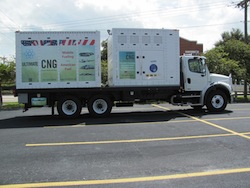
The upcoming 2012 Republican National Convention being hosted by Tampa, Florida, shuttle buses will be fueled with compressed natural gas (CNG). The buses, coined GOP EZ Shuttles, will be transporting participants to hotels and local attractions. America’s Natural Gas Alliance (ANGA) is coordinating with local TECO Peoples Gas and Ultimate CNG to provide the CNG fuel for the shuttles. ANGA says CNG provides significant cost savings over diesel-fueled buses. When compared to diesel, CNG costs about $1.69 less per gallon equivalent.

“We are proud to have this opportunity to provide transportation to convention participants in Tampa and to give them a first-hand experience with natural gas vehicles,” said ANGA President and Chief Executive Office Regina Hopper. “Companies and local leaders across the country are embracing natural gas as a fuel choice and calling for more vehicle options and filling stations to help drive this change. Our message in Tampa and beyond is that this is an extraordinary opportunity for our nation, and it’s time to get on board with this American fuel choice.”

The city and surrounding areas such as St. Petersburg are not strangers to CNG. Some companies operating as part of the Hillsborough Area Regional Transit use the fuel for airport transit vehicles. Florida is the second largest natural gas user in the U.S., and the country is the larget producer of natural gas, which can be used for transportation, electricity generation or industrial purposes.

“As mayor, I have seen firsthand the benefits that natural gas vehicles can bring in terms of lower fuel costs and clean air. I am pleased to welcome natural gas buses to the convention. These buses will not only provide a cleaner, cheaper method of transport but will also connect the thousands of guests here for various convention events to our local attractions,” said City of Tampa Mayor Bob Buckhorn.

William Harris, CEO of the 2012 Republican National Convention Committee on Arrangements added, “We’re delighted that these 12 natural gas vehicles – what we call ‘the Clean Dozen’ – will be part of our convention. Energy independence is critical to Mitt Romney’s vision of a better future for all Americans, which is what this convention is all about.”

ANGA also will be providing buses for the Democratic National Convention in Charlotte, NC.

Compressed Natural Gas (CNG), Electricity, Energy, Natural Gas, politics

California Releases 2012 Bioenergy Action Plan

Joanna Schroeder

California has released its 2012 Bioenergy Action Plan with the goal of improving the timeline to market of energy development, job creation and protection of public health and safety. The state defines bioenergy as energy produced from organic waste such as forest, urban and agricultural that would otherwise go into a landfill or be burned. The state is looking at Bioenergy to help create new jobs, protect the public from issues such as wildfires, landfill pollution, dairies, wastewater treatment facilities and other waste.

“Swift action on bioenergy will create jobs, increase local clean energy supplies, and help businesses grow in California,” said California Natural Resources Secretary John Laird. “Increasing bioenergy opportunities will also help California meet its climate change goals and protect public health and safety.”

The 2012 Bioenergy Action Plan was developed by a combination of state agencies and outside experts as directed by California Governor Brown. The plan contains more than 50 recommended actions to increase the use of organic waste, expand research and development, reduce permitting and regulatory challenges and address economic barriers to bioenergy development.

“Bioenergy is an exciting new frontier for agriculture,” said Karen Ross, Secretary of the California Department of Food and Agriculture, one of the agencies that collaborated on the report. “It creates jobs, reduces energy costs and reduces pollution. Early adopters are already realizing these benefits and are blazing the path towards self-sufficiency for agriculture.”

Expanding bioenergy development benefits California agriculture by providing an onsite or local source of clean energy, either electricity or liquid fuels for farm and other vehicles. The state currently produces about 600 megawatts of electricity and 50 to 100 million gallon equivalents from organic waste each year. The state hopes to double these numbers through the execution of the plan recommendations.

advanced biofuels, Agribusiness, bioenergy, Electricity, Energy, Waste-to-Energy