

 While it might have been something that farmers have tried to keep out of their fields, stinkweed could prove to be a successful product for those growing feedstocks for biodiesel.
This article in the Atlanta Journal Constitution says stinkweed… also known as field pennycress… might just be the ticket for those trying to find a non-food stock for the green fuel:
Past promises of cheap fuel grown on American soil have sometimes become, um, stuck in the weeds as prices for commodities such as corn and soybean oil rose. But a number of researchers believe that this winter weed with oily little seeds has an advantage in that it is not a food crop.
“Our intention is to create a crop that has a niche and does not displace anything else that is already growing,” said Steve Vaughn, a plant physiologist with the National Center for Agricultural Utilization Research in Peoria, Ill.
Soybeans, like corn, are a commodity in demand for food and fuel. Prices for soybean oil have more than doubled since 2005, giving the industry added incentive to experiment with other potential sources of fuel.
“The rise in commodity prices has really driven us to focus on other alternatives,” said John Fox, Innovation’s chief executive officer. Innovation relies primarily on animal fat to make biodiesel at its Newark, N.J. refinery.
The article goes on to point out that in addition to the non-food sources, researchers are also looking at increasing the yields of a more traditional feedstocks, such as soybeans.
 On the heels of its successful launch on
  With more than 100 million users logging on at least once each day, Facebook is the fourth-most trafficked Web site in the United States. Increasingly more people are turning to the Internet for information than any other media source – including television and newspapers.
 In recent weeks, the city of Sacramento has added 25 E85 fueling locations. The city is now boasting as being the nation’s ethanol epicenter, at least west of the Mississippi.
  The clean burning alternative is selling for $.66 less per gallon than regular unleaded at the Valero. Sasha Faught of Natomas, who owns a flex-fuel Chevy Tahoe, has been using E85. “I want to be green,” she said. “Let’s face it, we’re using up our resources. It’s smart to get on with it.”
 The
The In addition to the launch of the ethanol refinery, the government has developed an aggressive plan to expand the country’s sugar production from 800,000 tons per year to over 10 million tons per year. The increased sugar production could support both increased sugar exports and approximately 18 new ethanol plants.
 Cows often get a bad rap for emitting methane – a global warming gas. Maybe we shouldn’t be so hard on
  San Jose wants to become energy independent but they’re not going about it in a traditional fashion. Instead, they hope to be the first city in the U.S. to generate its electricity through an organics-to-energy biogas facility. Should this plant come to fruition, it would be sited on a 40-acre site near the San Jose/Santa Clara Water Pollution Control Plant and convert 150,000 tons of organic waste into energy. The plant will be constructed and operated by Zanker Road Biogas.
 The
The  At this week’s Fuel Ethanol Workshop we had a very large panel discussion titled, “Research, Technology and the Future of Ethanol Production.” This was a pretty serious group of industry leaders and thinkers that was introduced by Tom Bryan, BBI International. Included were:
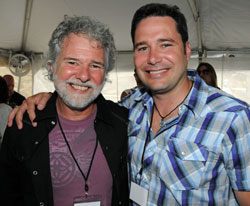 Two biofuels promoters took part in the 4th annual New Holland/Michael Peterson Celebrity Tractor Race held Sunday at the CMA Music Festival in Nashville. Chuck Leavell (left) is probably best known as the versatile keyboardist for the Rolling Stones and Joe Jobe is CEO of the