

Plans were announced this week for a cellulosic ethanol demonstration and research plant to be built in Florida that will produce both fuel and other products from the refining process.
 The University of Florida’s Institute of Food and Agricultural Sciences, Buckeye Technologies and Myriant Technologies (formed by BioEnergy International) are partners in the project that will explore ways to harness byproducts from some of the most promising cellulosic ethanol techniques to make environmentally friendly versions of petroleum products.
 The plant will be located at Buckeye’s facility in Perry, a small town near the armpit of the Florida peninsula, roughly halfway between Tallahassee and Gainesville. It will be built using a $20 million grant allocated by the Florida Legislature and groundbreaking is planned for this fall.
 “We’re trying to break our dependence on petroleum. Fuel is a big part of that, but it’s not the only part,” said Lonnie Ingram, the UF distinguished professor of microbiology and cell science who led development of the technology. “Learning how to develop these valuable byproducts not only helps to make cellulosic ethanol more economically feasible, but it takes the environmental impact of cellulosic ethanol and extends it to new areas-like plastic water bottles that won’t take up space in a landfill for thousands of years.”
Feedstocks for the facility will include wood, sugarcane bagasse, and rice hulls. The plan is to use the genetically-modified bacteria developed by Dr. Ingram to convert the biomass into sugars, the first and most commercially challenging step in the production of cellulosic ethanol. The cellulosic by-products can then be used as feedstock for sustainable production of high-value chemicals.
 Thomas Payne, Vice Chancellor and Dean at the University of Missouri School of Agriculture, sees biodiesel as playing “a key role in our nation’s future energy and environmental security.” He added, “I am proud to add my voice to the growing chorus of scientists who are singing the praises of biodiesel and advocating for an increased commitment that will ensure that biodiesel reaches its full potential as a vital U.S. energy source.”
 Dean of the College of Agriculture and Life Sciences and director of the Experiment Station at Iowa State University, Wendy Wintersteen, stressed the importance of a strong voice from the scientific community. “Scientists believe that research and innovation will continue to enhance the sustainability and efficiency of biodiesel,” she said. “With over 100 signatories, this declaration demonstrates the strength and breadth of support for biodiesel within the scientific community.”
 Artists and activists Graham Evans and Emily Nelson are getting ready to tour the Northeast and Midwest, teaching people how to grow and cook their own food in a sustainable way… in a sustainable set of wheels. The pair and their Nourish(meant) project will be refurbishing a 14-passenger school bus that will run on waste vegetable oil, have a kitchen inside, and a garden on top.
 As they meet, feed, and build relationships, they will begin a series of conversations about how to grow your own food, the importance of local and regional food systems, and general sustainability practices. In addition to this, they will teach those who are interested about biofuels, seed banking, and the many other topics they expect to learn about on the voyage. Nourish(meant) will function as a traveling art and education center geared toward addressing hunger and food insecurity in this country at the personal, community, and regional scales.
 Sunoco is now the owner of a 100 million gallon per year ethanol plant in Volney, NY. Northeast Biofuels, LP was purchased $8.5 million. This ethanol production faciltiy is the largest in the Northeastern United States, where much of Sunoco’s retail gasoline network is located.
  “Where has all the water gone?” Asks author
  Non-hydro sources of electricity continues to gain market share according to the latest statistics published by the
  I’ll be leaving the Fuel Ethanol Workshop soon but have several interviews to post over the next several days. Today’s a travel day back home after a week on the road that included working with biodiesel in Nashville and ethanol in Denver!
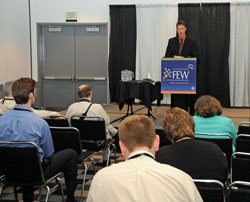 POET CEO, Jeff Broin, announced a new division for the company this morning at the Fuel Ethanol Workshop.
  According to the Clean Fuels Development Coalition, two timely publications addressing the environment were recently released at the Fuel Ethanol Workshop by the Ethanol Across America (EAA) education campaign.
 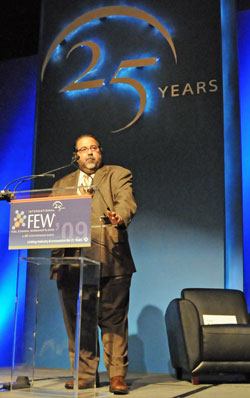 He preached a powerful sermon this morning. He’s the Reverend of Renewable Fuels. He’s Bob Dinneen, CEO, RFA. Bob was on our program at the opening general session of the Fuel Ethanol Workshop. This is the 25th FEW and Bob has attended 21 of them now!