ACE Conference 2026

E85 Sales Hit New Record in Iowa

Joanna Schroeder

Second quarter E85 (85 percent ethanol, 15 percent gasoline) sales in Iowa have hit an all-time record increasing 40 percent during the second quarter. According to the Iowa Department of Revenue, sales of E85 by Iowa retailers reached 3,697,199 gallons from April to June of this year, setting a new record.

“Iowans continue to have more E85 fueling options – and they are taking advantage of them in record fashion,” said Iowa Renewable Fuel Association Executive Director Monte Shaw. “E85 remains a good bargain – for our pocketbook, our economy, our national security, and our environment.”

There are currently 144 retail stations selling E85. A list can be found here. Retailers wishing to offer E85 may be eligible for a state grant to offset some of the equipment and installation costs. The Renewable Fuels Infrastructure Board is taking applications now. For an application, contact Harold Hommes, Iowa Department of Agriculture, at 515-242-6237 or harold.hommes@iowaagriculture.gov.

Source: Iowa RFA

E85, Ethanol

UOP Breaks Ground on Hawaii Cellulose Plant

Joanna Schroeder

UOP, a honeywell company, has broken ground on a biofuels demonstration plant in Hawaii that will convert forest waste, algae and other cellulosic biomass to fuel. The project is being helped along by a $25 million U.S. Department of Energy grant. The project will help meet federal biofuel mandates as well as help Hawaii reach its clean energy goals of producing 70 percent of its energy from “clean” sources by 2030.

The Integrated Biorefinery will be located at the Tesora Corp. refinery in Kapolei. The goal of the plant is to prove out the viability of the technology, test the fuels produced and evaluate the environmental footprint of the fuel. The first phase of production is expected to be begin in 2012 with the plant fully operational by 2014.

“Biomass is abundantly available today, and it is an important opportunity to consider as we seek alternatives that will reduce our dependence on fossil fuels and improve our environmental footprint,” said Jim Rekoske, vice president and general manager of Renewable Energy and Chemicals for Honeywell’s UOP.

“Our Integrated Biorefinery will illustrate these benefits as well the potential that biorefineries have to enhance the local economy and provide new green jobs. Our island home is far too dependent on imported fossil fuels, and I am very pleased that this alternative energy initiative has the support of the federal government,” he added.

According to Rekoske, once the technology is proven out, it could produce up to 50 million gallons of drop-in fuels. The Integrated Biorefinery is testing the RTP, rapid thermal processing technology to convert the biomass to biofuels.

Hawaii Senator Daniel K. Inouye said of the project, “Hawaii will play a critical role in helping the domestic biofuel industry thrive and this project will create much needed jobs in Kapolei. I am also pleased that Honeywell’s UOP is partnering with a number of local stakeholders including Hawaii BioEnergy, Group 70, Kai Hawaii, University of Hawaii and Leeward Community College. I will do all I can to ensure that Hawaii continues to serve as the laboratory for renewable energy initiatives in the Pacific.”

advanced biofuels, algae, biofuels, biomass

Energy Helps Fuel GROWMARK Business

Cindy Zimmerman

growmark annual meeting 2011At their annual meeting last week in Chicago, the GROWMARK system reported record sales of $8.5 billion for 2010-2011, with the 2nd highest net income ever at $182 million..

Chairman of the board Dan Kelley, an Illinois grain farmer, says it has been a very good year for GROWMARK and agriculture in general. “Agriculture has been one of the stellar industries in this economic downturn over the last 2-3 years,” he said. “We have now recorded our best seven years in the history of the GROWMARK system, which is 84 years.”

Kelley says they have a long term commitment to homegrown fuels, like ethanol. “We were one of the pioneers in ethanol, probably over 30 years now since we pumped the first gallons of ethanol,” said Kelley, noting that they market rather than produce the fuel.

Listen to my interview with Dan Kelley here. GROWMARK President Dan Kelley

growmark annual meeting 2011Renewable Fuels Association board member Ray Defenbaugh of Big River Resources West Burlington was at the annual meeting last week, as a director on the Riverland FS board in Illinois.

Defenbaugh says GROWMARK really demonstrates how well the cooperative system works. “A lot of our ethanol plants are cooperatives, GROWMARK’s a cooperative and we work well together. They recognize the importance of (ethanol) to agriculture,” he said, adding that ethanol helps support grain prices allowing farmers to afford the rising costs of fertilizer, equipment and other inputs.

Listen to or download the my interview with Ray here. Ray Defenbaugh, Big River Resources

2011 GROWMARK Annual Meeting Photos

Audio, Ethanol, Ethanol News, GROWMARK, RFA

Sporting Event Sponsorships Okay

Chuck Zimmerman

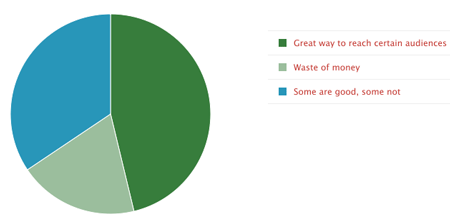
Last week we asked the question, “What is your opinion on ag-related sponsorships of sporting events?” 46% of you said Great way to reach certain audiences. 34% said Some are good, some not. 19% said Waste of money. Feel free to add your thoughts in the comments below. There are ag related sponsorships in just about every kind of sporting event that sells them. Which do you think are best? Which are the worst?

Our new ZimmPoll is now live. We’re asking the question, “How many years before cellulosic ethanol matches corn ethanol production?” Your input and thoughts would be greatly appreciated. Thanks.

ZimmPoll is sponsored by Rhea+Kaiser, a full-service advertising/public relations agency.

ZimmPoll

Biofuels Production Continues to Climb

Joanna Schroeder

According to the Worldwatch Institute, despite a struggling global economy, biofuel use continues to climb. In 2010, global biofuel production increased 17 percent and reached an all-time high of 105 billion liters, up from 90 billion litres in 2009. The increase in biofuel production has been driven by several factors including high oil prices, a global economic rebound and new laws and mandates in several countries including Canada, China, the U.S., Brazil, and Argentina.

The research was conducted by Worldwatch’s Climate and Energy Program for the website Vital Signs Online. It also found that U.S. and Brazil remain the two largest producers of biofuels with the U.S. producing 49 billion litres or 57 percent of global output and Brazil producing 28 billion litres or 33 percent of the total. For both the U.S, and Brazil, high oil prices were a major factor for production.

“In the United States, the record production of biofuels is attributed in part to high oil prices, which encouraged several large fuel companies, including Sunoco, Valero, Flint Hills, and Murphy Oil, to enter the ethanol industry,” said Alexander Ochs, Director of Worldwatch’s Climate and Energy Program.

Ochs continued, “Although the U.S. and Brazil are the world leaders in ethanol, the largest producer of biodiesel is the European Union, which generated 53 percent of all biodiesel in 2010. However, we may see some European countries switch from biodiesel to ethanol because a recent report from the European Commission states that ethanol crops have a higher energy content than biodiesel crops, making them more efficient sources of fuel.”

Vital Signs authors Sam Shrank, a Worldwatch MAP Sustainable Energy Fellow, and Farhad Farahmand, a Climate and Energy research intern, also explored how new mandates in Argentina, Brazil, Canada, and China have altered the biofuel industries in these countries. “In Argentina, the biodiesel industry grew not only because of favorable conditions for growing soybeans, but also in response to a new B7 blending mandate, which requires the fuel to be 7 percent biodiesel and 93 percent diesel.”

You can click here to learn more about the study.

Biodiesel, biofuels, Ethanol, International

Growth Energy Offers Retailers Flex Fuel Kits

Joanna Schroeder

As more retailers are considering adding the addition of E85, a blend of 85 percent ethanol and 15 percent gasoline, they can look to the ethanol industry for support. Growth Energy is now offering retailers a complimentary flex fuel promotion kit that includes:

· Pump topper
· Nozzle talkers
· Decals to educate motorists on mid-level ethanol blends
· New E15 label recently approved by the EPA
· E85 labels for Flex Fuel vehicles

Retailers who are interested in receiving the free kit can visit Growth Energy’s online store and click on the “FREE Amer. Ethanol Station Kit” tab. In addition to the above materials, the kit also contains a brochure holder for retailers to provide consumers additional facts about the benefits of ethanol.

“American Ethanol’s partnership with NASCAR provides unique visibility for ethanol blends. We are pleased to offer these station kits to retailers to provide consumers with the same fuel that their favorite NASCAR drivers use on the track,” said Growth Energy CEO Tom Buis.

E85, Ethanol, Growth Energy

6th Process Optimization Seminar Nears Sell Out

Joanna Schroeder

Back by popular demand, the 6th Process Optimization Seminar will take place on September 28-29, 2011 in Milwaukee, Wisconsin. To date, more than 120 ethanol plants have participated and 300 plus people have been trained. I was able to speak with Tom Slunecka, the VP of Marketing for Phibro Ethanol Performance Group this morning, one of the founders of the training seminars, to learn more about the upcoming event. The other supporting companies are Fermentis, Fremont Industries and Novozymes.

Slunecka told me that the training seminars came about by the request of the ethanol industry itself. This seminar was designed a little differently – it is set up so that after two days, an attendee can go back to his or her plant and immediately put the information learned to work. Also unique to the seminar is that class size is small and this fosters good interactions with the instructors and other attendees.

“One thing we’ve also held as a core of the Process Optimization Seminars is that the class sizes are small. So the one-to-one relationship between the trainer and those who’ve come to learn new technologies, is a very personal one,” explained Slunecka. “You’re right there, you’re with the instructor, you’re class is small with folks that are doing the same thing you are. So the flow of information back and forth is really refreshing.”

Listen to my interview with Tom Slunecka here: The 411 on the POS Seminars

He also stressed that the instructors make sure they are giving information that is usable, immediately, as soon as the operators get home to the plant. And this is important, he said, because training is paramount to how well a plant is going to run and how profitable that plant is running.

Success stories have come out of each of the five seminars to date and Slunecka said many plants have told him their ethanol yield per bushel has gone up. “Maybe only a point or two but that can mean hundreds of thousands of dollars for that plant.”

All indications are that this will be yet again another sold out show. Slunecka said they have been so overwhelmed with the response of the industry that every single one of these training seminars has been sold out. So hurry and register – there are only few slots left and the early bird registration date is nearing. To learn more and to register, visit www.processoptimizationseminar.com.

Audio, biofuels, Education, energy efficiency, Ethanol

RFA: Ethanol Lowers GHG Emissions

Joanna Schroeder

In the third installation of RFA Vice President of Research, Geoff Cooper’s series on ethanol plant improvements, he highlights how improvements in farming practices and ethanol efficiency have allowed greater productivity and cost efficiencies. He explained that in 2008-2010, the ethanol industry was producing nearly 440 gallons of ethanol per acre, a 50 percent improvement over the average from just 15 years earlier. He continued by noting that future projections, which include the use of cellulosic ethanol such as producing fuel from corn stover and corn cobs, plus corn could approach 800 gallons of ethanol per acre.

So how else have these efficiencies improved the ethanol industry? They have directly contributed to ethanol ability’s to lower greenhouse gas emissions (GHG) from gasoline on a well-to-wheels basis (or better known as lifecycle analysis), explained Cooper. He said that six recent reports show that corn ethanol reduced GHG’s by 28-53 percent using current technologies. He continues by highlighting that GHG reductions will continue to improve as technology improves.

Simultaneously, GHG emissions are getting worse for the oil industry. This is due to the fact that oil is getting harder to extract and oil shale and tar sand technologies create more emissions than predecessor technologies.

Cooper concluded by saying that both American farmers and ethanol producers are investing in technology that will continue to lower their carbon footprint while at the same time producing more food, feed and fiber than ever before with less resources.

Cellulosic, corn, energy efficiency, Environment, Ethanol

New E85 Station Opens in Stuart, Florida

Joanna Schroeder

Just in time for Labor Day travel (I will be one of those millions of travelers but I will be using ethanol) a new E85 station has opened in Planet Ozone at 1601 S.E. Federal Hwy. in Stuart, Florida. The new pump was opened in partnership with Protec Fuel. E85, a blend of 85 percent ethanol and 15 percent gasoline, can only be used in flex-fuel vehicles.

The benefits of E85 are many including the reduction of emissions, lowering dependence on foreign oil, spurring economic growth and is domestically produced.

Planet Ozone’s name implies more than just a greener fuel. The company also built one of the first “green” buildings in the area. The $3 million structure houses a Sunoco, an international grocery store, a Mediterranean and Middle-Eastern food cafe, and juice bar. The building also recycles rainwater and many of the building materials were recycled.

E85, Ethanol

Clean Green Minnesota Bean Appears at State Fair

Joanna Schroeder

The American Lung Association in Minnesota presented “The Clean, Green Minnesota Bean” over the weekend during the Minnesota State Fair. Randy Hilliard with the Agricultural Utilization Research Institute (AURI) gave a presentation to the fairgoers from the Sustainability Stage of the Eco Experience Building. The topic? Soybeans.

Hilliard discussed the market for plastics, fabrics, cleaners and other bio-based materials, all made from soybeans, which can be used in place of materials made from petroleum. Supporters of “The Clean, Green Minnesota Bean included the United Soybean Board, Minnesota Soybean Research and Promotion Council, Twin Cities Clean Cities Coalition and the American Lung Association in Minnesota.

Using crops such as soybeans and corn to create products rather than using petroleum is not new. Henry Ford, the founder of the Ford Motor Company, used soy plastics back in 1935 and every vehicle that rolled off the assembly line contained nearly 60 lbs, or one bushel of beans in the form of gearshift knobs, horn buttons, window frames, accelerator pedals, and more.

It may have taken multiple decades, but Detroit is once again looking to soy plastics. The AURI and Minnesota Soybean Growers Association recently held a conference in Mankota, Minnesota to discuss the potential of bio-based plastics to grow jobs in the state.

biochemicals, Biodiesel, biofuels, biomaterials, Education