ACE Conference 2026

Corn for Ethanol Predicted to Stall

Joanna Schroeder

According to an article in Agrimoney, growth in U.S. corn ethanol production is expected to stall due to reduced predictions on this year’s corn harvest along with the fact the industry has basically reached the blend wall. Also a factor has been record high corn prices which have already caused a few plants to stop production.

Goldman Sachs has estimated that corn use by the ethanol industry will increase 50m-100m bushels in 2011-2012 while Rabobank believes the number could be up to 130 million bushels. On the flip side, the International Grains Council (ICG) predicts corn usage by the industry will stay steady with demand from foreign biofuels producers also slowing.

“After rising sharply in recent years, corn used for the manufacture of fuel ethanol is forecast to show very little growth [worldwide],” the said IGC.

Today, the ethanol industry has surprised the livestock industry as the largest consumer of corn.

Despite lower corn harvest forecasts for this year, what is predicted will still be one of the highest harvests on record. However, the IGC still anticipates weakening production prospects for corn and cut its world corn output forecast by 10m tonnes to 849m tonnes. The corn crop is expected to reach around 12.9 billion bushels.

biofuels, corn, Ethanol

IRFA Calls for Texas Gov. To Oppose E15 Ban

Joanna Schroeder

Last week during the Ethanol Conference in Des Moines, Iowa, the Iowa Renewable Fuels Association (IRFA) was given an award for its work on promoting ethanol. Their work continues this week as the association sent a letter to Texas Governor and presidential candidate Rick Perry, to oppose Congressional efforts to ban E15, a blend of 15 percent ethanol and 85 percent gasoline. Perry is traveling to Iowa to campaign.

In the letter, authored by IRFA President Walt Wendland, “IRFA members want to welcome your campaign for president to Iowa. We look forward to a thoughtful dialog on our Nation’s energy future. One pressing issue is an attack on consumer freedom and enhancing America’s energy security.

Recently Members of Congress from Texas and Oklahoma have introduced amendments to the FY2012 Interior, Environment, and Related Agencies Appropriations Bill that would essentially ban E15, a legal competitor to petroleum based gasoline. IRFA calls upon you to publicly oppose amendment #6 by Rep. John Sullivan (R-OK) and amendments #9 and #10 by Rep. Michael Burgess (R-OK).”

IRFA has noted that several other candidates have expressed support for E15 including Former Gov. Matt Romney, Rep. Michelle Bachmann, Rep. Ron Paul, businessman Herman Cain, former Speaker of the House, Newt Gingrich, and former Senator Rick Santorum.

EPA is currently in the process of finalizing regulations that will implement its E15 approval. To date, no other fuel blend has been tested more than E15.

ACE, biofuels, Ethanol

US Navy Completes Successful T-45 Biofuel Flight

Joanna Schroeder

The U.S. Navy has successfully flown a T-45 training aircraft using biofuels at the Naval Air Station (NAS) in Patuxent River, Maryland. The flight was completed by the “Salty Dogs” of Air Test and Evaluation Squadron (VX) 23 flying on biofuel mixture of petroleum-based JP-5 jet fuel and plant-based camelina. The T-45 “Goshawk” is a tandem-seat aircraft used by the Navy and Marine Corps to train pilots on carrier and tactical mission operations.

“This successful test flight brings us a step closer to meeting the Navy’s energy security goals,” said Vice Adm. David Architzel, commander, Naval Air Systems Command. “My congratulations to the Navy fuels team here at NAVAIR for playing an instrumental role in proving the viability of biofuels to power naval aircraft.”

The T-45 is the fifth Navy aircraft to successfully test the biofuel blend. Previous Previous aircraft tested include the F/18 E/F, MH-60S, F/A-18 D, and most recently, the MV-22. The move to biofuels is being driven by Navy Secretary Ray Mabus’ goal is to cut the Navy’s oil usage in half by 2025.

“This test of the T-45 with a 50/50 blend of biofuel represents another significant milestone in the long list of detailed flight test and demonstrations of the F-18 Super Hornet, the MH-60S, and the V-22,” said Rear Adm. Phil Cullom, Director of the Chief of Naval Operations Energy and Environmental Readiness Division. “Our commitment to the aggressive test schedule for drop-in replacement fuels for JP-5 and F-76 keep us on pace for the 2012 demonstration and 2016 deployment of the Great Green Fleet.”

Additional biofuel test flights are scheduled for later this year.

biofuels, biojet fuel, feedstocks

NextGen Biofuels Fund Accepting Applications

Joanna Schroeder

If you are an advanced biofuels company based in Canada that needs funds, then you might not have to look any further than the NextGen Biofuels Fund. The fund was created by the Government of Canada to support development of advanced biofuels. Currently, Sustainable Development Technology Canada (SDTC) is issuing a Call for Applications.

“By helping to create biorefineries, the NextGen Biofuels Fund also aims to add value to renewable fuel production while diversifying the economy in rural and agricultural areas and supporting market and technology transitions in the forestry sector,” said SDTC President and CEO Vicky Sharpe. “This will be crucial in helping Canada to transition to a bio-based, sustainable economy.”

The NextGen Biofuels Fund is able to support up to 40 percent of eligible project costs and the funds are repayable based on free cash flow over a period of 10 years after the project is completed.

To be eligible, a project must:

  • • Be a First-of-Kind facility that primarily produces a next-generation renewable fuel at large demonstration-scale.
  • • Be located in Canada.
  • • Use feedstocks that are or could be representative of Canadian biomass.
  • • Have demonstrated its technology at pre-commercial scale.

For more information on how to apply, visit www.sdtc.ca.

advanced biofuels, biofuels, International

Crusin On A Biodiesel Bike

Joanna Schroeder

“When, in the course of human events, it becomes necessary for one people to dissolve the bands which have connected them through an ineffective national energy policy, a decent respect to the opinions of mankind requires that they should declare the causes which impel them to the separation. We hold these truths to be self-evident that all men are created equal, but all sources of access to energy are not,” reads the Declaration of American Energy Independence.

The Declaration was signed last week during several Energy Patriots events held in Fort McHenry in Baltimore, MD; York, PA; and Philadelphia, PA. The event was sponsored by AmeriGeen, a Manheim-based biofuel supplier.

Several Energy Patriots were on hand including Don Lingle, an instructor with the Lancaster County Career and Technology Center who rode his biobike to the event in York. Not only has he built his own custom motorcycle to use biodiesel, but last year he helped his students build a biobike using a four-cylinder Volkswagen turbo engine that ran on 100 percent biodiesel produced from the cafeteria’s used cooking oil.

Lingle said in an interview with the York Daily Record, “It smells like the fair – the York Fair. When people drive behind you, they want to know where that smell is coming from.”

Also participating in the event was Tom Washburn, the president of Aero Energy, who three years ago began selling only energy products produced in America. These products include BioHeat, a home heating product that is blended with biodiesel and gaining traction in the Northeastern region of the country.

Washburn noted that it won’t be long until more cars and motorcycles begin to use biodiesel and he believes torque and power will be even better. “People are just afraid right now. They don’t want it to mess up their motorcycle,” he concluded.

Biodiesel, biofuels

REG Distributing Biodiesel at Minnesota Refinery

Cindy Zimmerman

Biodiesel is now available via truck and rail from the Renewable Energy Group’s (REG) newly acquired Minnesota production facility, REG Albert Lea, LLC. The first truckload of biodiesel was picked up August 25 for the Trail’s Travel Center truck stop in Albert Lea along I-35.
REG VP Gary Haer says customers have the option to pick up either B99 or B100 at the 30 million gallon per year facility. “We are offering REG-9000/1 biodiesel ideal for harvest tank fills and meeting demand created by Minnesota’s B5 requirement and the Renewable Fuels Standard (RFS2),” said Haer.

REG bought the former SoyMor Biodiesel plant in July, after the plant had been idled since 2008. REG was the general contractor and manager for the refined vegetable oil feedstock biodiesel plant which originally began production in April 2005. Officials hope to upgrade the facility to process a wide variety of lower cost natural fats and oils including used cooking oil, inedible corn oil from ethanol production, and high free fatty acid materials.

REG is the largest biodiesel producer in the United States and the REG Albert Lea facility brings their total owned/operated capacity to more than 210 million gallons.

In the photo, supplied by REG, Trails Travel is the first fill for REG Albert Lea – left to right, Steve Klingman, General Manager, Trail’s Travel Center, Albert Lea, Minn; Myron Danzer, General Manager, REG Albert Lea, REG; Rocky Trail, owner, Trail’s Travel Center; Tom Schroeder, Biodiesel Sales Manager, REG; Debbie Morgan, Trail’s Travel Center; Bob Knutson, Knutson Oil, Glenville, Minn (biodiesel hauler)

Biodiesel, REG

Missouri Leads in Ethanol Blender Pump Plans

Cindy Zimmerman

Missouri has been recognized by the U.S. Department of Agriculture as the leader in ethanol blender pumps.

During the Missouri State Fair, an official from USDA’s Rural Development agency paid a visit to recognize Missouri as the national leader in renewable energy. Through a partnership with the Missouri Corn Merchandising Council (MCMC), the Association of Missouri Electric Cooperatives and the Missouri Department of Agriculture, Missouri fuel retailers have been approved to install 26 biofuel pumps – more than any other state in the nation.

“It’s the Show-Me State and they’re showing us alright,” USDA Rural Development Business Program Administrator Judy Canales said during a speech at the Missouri Corn booth. “It behooves Missouri because in the long run this is going to be a locally grown product that is creating and keeping jobs in rural communities. That’s why we’re so pleased to have this partnership with Missouri Corn.”

“Missouri Corn is leading the charge in growing Missouri’s use of renewable fuels and giving consumers choices at the pump,” noted Missouri Corn Director of Ethanol Policy Bradley Schad. “By providing these ethanol options, consumers can now choose a lower cost fuel alternative for their vehicle while supporting Missouri’s rural economy, keeping dollars here at home and reducing our dependence on foreign oil. We commend the USDA for their efforts to expand the availability of biofuels for consumers.”

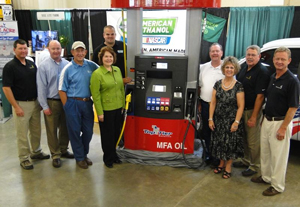
In this photo from Missouri Corn, Canales and Schad pose with other members of the partnership at the Missouri State Fair. Left to right: Missouri Corn board member Rob Korff of Norborne, Mo.; Matt Moore, Missouri USDA Rural Development business program director; Barry Hart, executive vice president of the Association of Missouri Electric Cooperatives; Judy Canales, USDA Rural Development business program administrator; Bradley Schad, Missouri Corn director of ethanol policy; Gary Marshall, Missouri Corn CEO; Janie Dunning, Missouri state director USDA Rural Development; Kenny McNamar, Missouri Corn Growers Association president from Gorin, Mo.; and Billy Thiel, Missouri Corn Merchandising Council chairman from Marshall, Mo.

Read more from Missouri Corn here.

blends, corn, Ethanol, Ethanol News

Solar Alliance Questions NJ’s Solar Commitment

Joanna Schroeder

New Jersey has been heavily promoting its addition of solar energy across the state but today the Solar Alliance criticized New Jersey Governor Chris Christie for his administration’s conclusions about the merits of the state’s Solar Renewable Energy Credit (SREC) program as part of the Energy Master Plan (EMP).

“While the Draft EMP successfully lays out New Jersey’s energy needs, it excludes solar as an energy source and investment opportunity. Further it contains factual inaccuracies. The type of rigorous analysis encouraged by the EMP must be based on the best and most current information available and not on lingering stereotypes,” said Carrie Cullen Hitt, President of the Solar Alliance.

The SREC’s have been a big factor in the investment in and installment of dozens of solar projects in the state. The loss of the program could dramatically slow the growth of solar energy in the state. The Solar Alliance says they agree with EMP’s focus on rigorous “net economic benefit” analysis but claims that the plan does not apply the benefit equally. They continued by saying many of the costs cited are outdated or misconstrued while the benefits of solar have been overlooked or de-emphasized.

The national solar association cited a few specific examples: the BPU should quantify all value streams associated with solar when applying a ‘net economic benefit test’; the EMP should use updated, universally recognized cost estimates of solar technology; and the EMP should reassess its interpretation of the rate impact of the SREC Program, which is less than 1/2 percent.

Hitt added, “We may debate the methodology for measuring benefits of solar, but their existence is undeniable and their omission from the Draft EMP extremely disappointing. This unfortunately leads to an incomplete picture of the role that solar can play in creating jobs, new investment and clean, reliable electricity for New Jersey.”

“As currently drafted, the EMP will restrict New Jersey solar businesses from creating jobs and deploying clean, reliable solar electricity,” he concluded.

Electricity, Energy, politics, Solar

U.S. Government Commissions EV Charging Stations

Joanna Schroeder

The U.S. government has commissioned the installation of several electric vehicle (EV) charging stations and has selected Envision Solar International to design, develop and install the system. The company has already begun installation of 15 EV charging enabled Solar Tree structures utilizing the company’s patent pending tracking systems. The project is expected to be complete by the end of 2011.

“Our ability to deliver high quality products to equally high quality customers with whom we have huge scaling potential is key to our growth strategy,” said Envision Solar’s President and CEO, Desmond Wheatley. “This deployment of 15 of our CleanCharge enabled EnvisionTrak Solar Tree structures for the world’s largest customer is another significant indication of our ability to repeatedly execute on that strategy. We are proud and delighted to have been selected for this very high visibility project and look forward to many more.”

Robert Noble, the company’s chairman and founder added, “We are excited about seeing 15 of our iconic, archetypal “Smart Trees” deployed at this highly visible location right here in our home town, San Diego. For many years to come, visitors to this Solar Grove will be able to charge their EVs, see clean energy generation in action, up close, and experience the sheer pleasure of a shady park of beautiful Solar Trees. It is truly an honor for us to be working on such a forward-looking project which we know will be a powerful demonstration of the government’s growing real commitment to a sustainable future.”

Electric Vehicles

Ethanol & FFV’s Promoted During State Fair

Joanna Schroeder

Today marks the first day of the 142nd Nebraska State Fair and the Nebraska Corn Board along with the Nebraska Ethanol Board (NEB) are on site to promote ethanol and flex fuel vehicles. The two associations have booths set up in the Exhibition Building to focus on ethanol education.

The groups are splitting duties: NEB will focus on FFV awareness and the economic benefits ethanol provides to both local and state communities and the national economy. “Ethanol is a cleaner, more inexpensive, renewable alternative to gasoline. Drivers want fuel choice, and high ethanol blend fuels like E85 allows them to save money, support Nebraska’s economy, and reduce pollution,” said Todd Sneller, Administrator of NEB.

Next door, the Nebraska Corn Board will have a blender pump on display with jars of corn representing corn production from 1930, 2011 and the future, complimented with a video showing the faces of Nebraska farmers.“There are approximately 100,000 FFVs in Nebraska and nearly 90 percent of consumers don’t know they drive a flex fuel vehicle,” said Kim Clark, Ag Program Manager from the Nebraska Corn Board. “The Nebraska State Fair is a great opportunity to educate consumers from all parts of the state about flex fuel vehicles and ethanol.”

On Saturday, September 3, from 3:00 – 4:00 pm, there will be a “Do You Flex Fuel?” presentation. On hand to answer questions will be an auto mechanic, fuel retailer, ethanol expert and automobile salesperson. Finally, to showcase ethanol in action, the groups will host an ethanol blended fuel promotion beginning Saturday, September 3rd through September 5th. FFV drivers will see discounts on mid-level ethanol blends include a 20 cent discount on E20, 30 cents on E30 and 85 cents on E85. Click here for details on the FFV fuel promotions.

biofuels, Education, Ethanol