NEC 2027

Will Global Biofuel Investments Continue?

Joanna Schroeder

Historically, 2009 was a hard year for biofuels. Biofuel spending was down to $5.6 billion from $15.4 billion in 2008. Investments in the industry focused on cellulosic technologies and sugarcane. This according to NRG Expert’s World Biofuels Report.

The report cites sugarcane-based biofuels as being the most competitive with oil and also have the lowest greenhouse gas emissions. The worst – biofuels produced from palm oil and soybeans. Fuel produced from either of these feedstocks do not meet EU sustainability criteria. The highest investments were for technologies focused on developing biofuels from feedstocks such as jatropha and algae. Yet investments in jatropha are tapering off, according to the report, because research has shown it to perform poorly in field trials and consumes more water than expected.

To court investments on the cellulosic side, the report says the technology must incorporate other core areas of business, such as developing biochemicals or high value products along with the production of the biofuel.

Moving in to 2012 and beyond, many biorefineries are operating below capacity due to the U.S. drought. Many mergers and acquisitions have taken place with many oil companies buying advanced biofuel technology. U.S. companies are having difficulty raising capital unless they are focused on the emerging Latin America or South East Asia markets.

While the report focuses on what has happened since 2009, it also looks at several strategies biofuel producers could employ to be more competitive in the tight investment market. For example, palm oil producers can retrofit by adding methane capture equipment to their plant as an effort to meet EU biofuel criteria and generate revenue selling electricity produced from methane.

The report predicts that raising oil prices will help biofuels be more competitive and new blending mandates could create a bigger market. In addition, more countries are expected to enter the sector on a commercial scale including Columbia, the Philippines and Thailand.

advanced biofuels, Biodiesel, Ethanol, Research

Federal Court to Hear Arguments Against Cali LCFS

Joanna Schroeder

Last December, U.S. District Judge Lawrence O’Neill ruled California’s Low Carbon Fuels Standard (LCFS) unconstitutional. However, a stay was issued allowing implementation of the law until a federal appeals court hears arguments in the case. This is set to take place this week.

The Consumer Energy Alliance (CEA) is lobbying for the end of the LCFS. Executive Vice President Michael Whatley said, “We are optimistic that through these proceedings, it will become clear the LCFS is an unconstitutional and destructive program that will hurt California’s consumers and kill jobs. Even those supporting California’s LCFS have acknowledged its legal risk. CARB’s claims of LCFS benefits have been debunked by study after study. At the end of the day, the LCFS will double gas prices and cost our economy billions of dollars – all while failing to reduce greenhouse gas emissions.”

CEA cites several studies showing that LCFS is harmful to consumers. In June 2010 Charles River Associates released a study that says it would cost the loss of between 2.3 and 4.5 million jobs; increase the price of gasoline and diesel up to 170 percent over the next 10 years; and will decrease the Gross Domestic Product (GDP) 2-3 percent.

The organization also cites a study from the Boston Consulting Group that adds that a LCFS will result in the loss of 25-35 percent of California’s refining capacity and the closure of 5-7 of the state’s refineries. And yet another study they cite is from Barr Engineering that poses a significant carbon emission increase could occur under a LCFS program.

While I’m not here to pick sides, it is interesting to note that both sides use the argument that “study after study” has debunked the view of the other side. I’ll let you decide what to believe.

advanced biofuels, Biodiesel, Ethanol, Legislation, Opinion

Mixed Bag of Things Needed to Feed the World

Melissa Sandfort

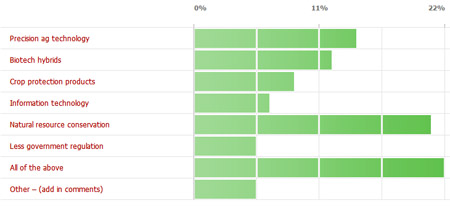
Our latest ZimmPoll asked the question, “What is most important for feeding growing world population? ”

Our poll results: Fifteen percent said Precision ag technology; thirteen percent said Biotech hybrids; nine percent said Crop protection products; seven percent said Information technology; twenty-two percent said Natural resource conservation; six percent said Less government regulation; twenty-three percent said All of the above; and six percent said Other.

There is not a simple answer to this question. We put a number of options up there but through comments others were suggested too. One thing we can all agree on though is that farmers will do all they can to produce the safest, affordable food to feed our growing population that they can!

Our new ZimmPoll is now live and asks the question, “Have our efforts to educate consumers about agriculture been successful?” Agri-marketers continue to try to help educate the growing population of non-ag consumers. Another great example is USFRA, the largest agricultural communications effort of its kind and the goal is to speak with “one voice”. So how are we doing? Let us know here.

ZimmPoll is sponsored by Rhea+Kaiser, a full-service advertising/public relations agency.

ZimmPoll

SLICE Award Winners for Clean Energy Announced

Joanna Schroeder

Seven winners received the 2012 State Leadership in Clean Energy (SLICE) Awards given by the Clean Energy States Alliance (CESA). The award recognize state programs that are most effectively accelerating the adoption of clean energy technologies.

This year’s winners are New York’s Clean Energy Business Incubator Program and On-Site Wind Market Development Program, both administered by the New York State Energy Research and Development Authority (NYSERDA); Connecticut’s Clean Energy Finance and Investment Authority’s (CEFIA) CT Solar Lease Program; the Massachusetts Clean Energy Center’s Commonwealth Solar Hot Water Pilot Program; the New Hampshire Public Utilities Commission’s Residential Wood-Pellet Boiler Rebate Program; and two projects by the California Energy Commission: the University of California, San Diego Microgrid, and the Synchrophasor Research and Development Program.

“Despite challenging economic conditions and uncertainty over continuing federal support, the SLICE Award-winning state programs have demonstrated innovation, supported emerging technologies, and advanced clean energy markets,” said Mark Sinclair, Executive Director of CESA. “After a decade of experience working with clean energy funds across the country, CESA feels confident that these programs represent the best of what’s out there today.”

Winners were chosen by a panel of six judges that included representatives from the U.S. Department of Energy, the National Renewable Energy Lab along with experts from several other energy organizations.

Energy, Solar, Wind

Tuscon Clean Cities Wins Oil Displacement Honor

Joanna Schroeder

During the 2012 Clean Cities Peer Exchange and Vehicle Technology Deployment Workshop, Tuscon Clean Cities Coalition was awarded the Top Award for Greatest Displacement of Petroleum Using E85. The award came from the U.S. Department of Energy (DOE) who thanked the coalition for the work they are doing to reduce petroleum consumption.

There are around 100 Clean Cities coalitions across the United States. These groups bring together stakeholders in the public and private sectors to deploy alternative and renewable fuels, idle-reduction measures, fuel economy improvements, and emerging transportation technologies. DOE cities Clean Cities coalitions as also advancing the nation’s economic, environmental, and energy security by supporting local actions to reduce petroleum consumption in the transportation sector.

Robert White, Director of Market Development for the Renewable Fuels Association (RFA), thanked Tuscon Clean Cities Coordinator Colleen Crowninshield for her dedication and hard work. White, who has had the opportunity to work with Colleen and her coalition, also congratulated her on her success. It is interesting to note that the winning coalition, was not from the Midwest – rather the Southwest.

“The DOE’s Clean Cities Program has been instrumental in expanding the use of alternative fuels and decreasing our dependency on foreign oil. The efforts of Coordinators like Colleen Crowninshield highlight the impact to the ethanol industry, but also to consumers and fleets across the country. It also stresses the importance of infrastructure development nationwide, as the most successful Coalition with E85 is not from the Midwest, it is from Tucson, AZ,” said White.

Biodiesel, biofuels, energy efficiency, Ethanol, RFA

Enogen Trait Technology for Ethanol

Joanna Schroeder

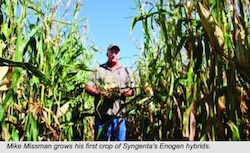
Syngenta has signed a commercial agreement with Plymouth Energy of Merrill, Iowa to use grain featuring Enogen trait technology in 2013. According to the company, Enogen trait technology eliminates the need to utilize liquid alpha amylase enzyme in dry grind ethanol production. Once incorporated into an ethanol production process, the plant will see improvements in ethanol production and also reduce energy, gas and water usage.

“As profit margins in the industry continue to shrink, we’re always looking for ways to be more efficient,” said Eamonn Byrne, CEO of Plymouth Energy. “We believe Enogen grain can help us do that and ultimately boost our bottom line.”

Plymouth will begin using Enogen grain for the first time in the fall of 2013. Currently, Syngenta is working with growers who provide corn to the ethanol plant to contract them to grow Enogen corn for 2013. Growers who sign on will deliver the specialty grain next fall. Enogen grain production contracts require growers follow specific, yet simple stewardship protocols. In return, growers are paid a premium price for each bushel of Enogen grain delivered to the ethanol plant per the contract terms.

David Witherspoon, head of renewable fuels for Syngenta, added, “Enogen corn adds tremendous value for both ethanol plants and their local communities. With Enogen corn, ethanol plants not only create greater profit potential for their business, but they help put money back in the growers’ pocket as well.”

corn, Ethanol

2013 Clean Energy Challenge Kicks Off

Joanna Schroeder

The 2013 Clean Energy Challenge, funded by the Clean Energy Trust, has kicked off with more than $300,000 in cash prizes waiting to be won. Researchers, students and entrepreneurs with transformative clean tech business ideas based in the Midwest, are encouraged to submit their businesses and concepts through the Clean Energy Exchange.

The Clean Energy Challenge is a two-track competition for projects in different stages of development. The Early Stage Challenge is for clean tech projects with fully-developed business plans and established start-up companies. The Student Challenge is for students in eight-state Midwest region who have a great idea, and need assistance in developing a clean energy business.

“The very best clean technology innovations are being developed in the Midwest and the Challenge ensures that those ideas are presented to the venture capitalists, businesses and investors who can bring them to market,” said Amy Francetic, executive director of the Clean Energy Trust. “The cash prizes and commercialization support kick start Clean Energy Challenge Finalists, which have all gone on to receive significant venture and federal funding.”

Applications are encouraged from Midwest entrepreneurs working in: Energy Storage; Hydrogen & Fuel Cells; Geothermal; BioEnergy; Solar Technologies; Wind Energy; Water-Energy Nexus; Recycling and Remediation; Energy Efficiency; Building Materials; Energy Management; Smart-Grid; Next Generation Transportation; and Manufacturing Efficiency.

Finalists will receive mentoring from the Clean Energy Trust in preparation for the Challenge finals taking place in Chicago on April 4, 2013. The judging panel is comprised of nationally renowned investors and clean technology business leaders. The application deadline is December 3, 2012. Complete rules and eligibility for the Challenge are available at www.cleanenergytrust.org.

bioenergy, Energy, energy efficiency, Geothermal, Hydrogen, Solar, Wind

USDA Announces 6th Regional Biofuels System

Cindy Zimmerman

The U.S. Department of Agriculture today announced a research grant to develop next generation biofuels in the Northeast.

Agriculture Secretary Tom Vilsack today awarded Pennsylvania State University a five-year research grant valued at roughly $10 million to develop biomass supply chains for the production of liquid transportation and aviation biofuels in the Northeast. This is the sixth such award made through USDA’s Agriculture and Food Research Initiative (AFRI), aimed at developing regional, renewable energy markets, generating rural jobs, and decreasing America’s dependence on foreign oil. In September 2011, the Secretary announced five major AFRI grants for the formation of five regional systems in the Pacific Northwest, the Northwest, Northern states, Southern states, and the Southeast. Today’s announcement underscores USDA’s support for public and private research in building the framework for a competitively-priced, American-made biofuels industry in every major American region.

During a press conference this morning, Vilsack said the goal is to develop alternatives to corn-based ethanol, with each different part of the country focused on different feedstocks and production methods. “This particular project is going to look at miscanthus and switchgrass and willow,” said Vilsack. “It’s possible that we can grow these biomass products on strip mines to restore the land or on marginal flood plane lands.”

Vilsack noted that the project will include support from a number of different educational institutions and companies, including Ernst Conservation Seeds, Case New Holland, Praxair, Inc., Idaho National Lab, Mascoma Biofuels, Primus Green Energy, and Double A Willow. “All of these companies are identifying feedstocks or processing by which these feedstocks can be grown and harvested, so it’s a coordinated effort,” said Vilsack.

Listen to Vilsack’s press conference here: USDA Pennsylvania Biofuels Announcement

advanced biofuels, Audio, biofuels, Ethanol, Ethanol News, USDA

Ethanol Report From CARS

Cindy Zimmerman

Ethanol helped to power events held as part of Automotive Service and Repair Week (ASRW) in New Orleans, October 11-13 at the Morial Convention Center.

The Renewable Fuels Association (RFA) teamed up with Bobby Likis Car Clinic Network and Ricardo on the trade show floor of the Congress of Automotive Repair and Service (CARS) and during a Myth Busters panel at the National Automotive Service Task Force meeting. The Ricardo EBDI (Extreme Boost Direct Injection) engine was on display in a GMC Sierra and Car Clinic Network television and radio programs were broadcast live from the event.

Ethanol Report PodcastThis edition of “The Ethanol Report” features comments from Automotive Service Association president Ron Pyle, RFA Director of Regulatory Affairs Kelly Davis, Ricardo Chief Engineer Powertrain Controls Dr. Matti Vint, and automotive talk show host Bobby Likis.

Listen to or download the Ethanol Report here: Ethanol Report from CARS

Subscribe to “The Ethanol Report” with this link.


CARS Event Photo Album

Audio, automotive, Ethanol, Ethanol News, Ethanol Report, RFA

Ricardo Engine Optimizes Ethanol

Cindy Zimmerman

It’s called the EBDI – Extreme Boost Direct Injection – and it may be the “little engine that could” revolutionize the automotive world to produce cars that get drastically improved fuel mileage while optimizing the higher octane properties of ethanol.

The engine was developed by Ricardo, Inc., and it was on display for automotive mechanics and technicians at the 2012 Congress of Automotive Service and Repair last week in New Orleans. Attendees were able to see the engine in model form and in a GMC Sierra testbed. Ricardo representatives, including Chris Talware (left) and Dr. Matti Vint, were on hand to talk with those at the event and participate in live broadcasts of the Bobby Likis Car Clinic Network from the trade show floor.

Vint says they designed the engine to run efficiently on straight gasoline up to 85% ethanol. “We got good savings with both E-0 as well as E-85, so we designed engines to be flex fuel capable,” said Vint, explaining how they used a systems approach that adjusted a number of variables to increase the “sweet spot” area of the engine.

“The net result is we’ve gotten equivalent performance of a 6.7 liter diesel engine that is in the Sierra truck with a 3.2 liter gasoline engine,” said Talware. That enables what they call “extreme downsizing” that allows it to be scalable to perform in a variety of applications. “The same technology could be applied to a tourist size vehicle, with a 1.4 liter engine,” said Vint. It’s also scalable in terms of market, whether it’s agricultural, light duty trucks or passenger vehicles.

Listen to an interview with Talware and Vint here: Ricardo's Chris Talware and Matti Vint

Watch Dr. Vint explain more about the engine and how it optimizes ethanol below.


CARS Event Photo Album

Audio, automotive, Car Makers, Ethanol, Ethanol News, RFA, Video