Ag Secy Vilsack to Address NBB Conference

Joanna Schroeder

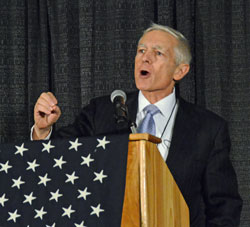
USDA Secretary Tom Vilsack, who just accepted a second four-year term as part of the Obama Administration’s second term, will give a keynote address at the National Biodiesel Conference & Expo in Las Vegas February 4-7, 2013. Vilsack is widely recognized for his leadership in support of the biofuels industry. His address will close out the conference on Thursday, Feb. 7.

Tom Vilsack and biofuels Photo USDA,jpg“Sec. Vilsack is one of the strongest advocates for renewable fuels in the nation, and we are thrilled to have him speak to our industry at the conference,” said Joe Jobe, CEO of the National Biodiesel Board. “Federal biodiesel policies reduce dependence on foreign oil, build green jobs at home, and are stimulating a rural renaissance. Sec. Vilsack has played a huge role in the continued support for these policies, and we’re looking forward to thanking him for his unwavering support.”

Vilsack has called the biodiesel industry a shining example of the promise of a new rural economy, creating opportunities for energy security, farmers, and revitalized job growth in small towns.

In March 2011, President Obama laid out is goal of reducing oil imports by half by 2020 in his Blueprint for a Secure Energy Future. As part of the plan, the Environmental Protection Agency (EPA) has increased the federal targets for biodiesel under the Renewable Fuel Standard to 1.28 billion gallons. Another win for energy security came on Jan. 1, 2013 when Congress passed the American Tax Relief Act, which included a $1 dollar per gallon biodiesel tax incentive.

Jobe added, “As we celebrate the 20th anniversary of the National Biodiesel Board, one of our goals for this conference is to examine where we see America’s Advanced Biofuel in the next 20 years. The Secretary has a vision for American agriculture’s contribution to energy security and the economy, and we are eager to hear his insight on our long-term role.”

advanced biofuels, Biodiesel, National Biodiesel Conference, NBB

Sungevity Secures $125 Million

Joanna Schroeder

Sungevity has completed a series of venture capital and project financings securing up to $125 million. The funding includes $40 million in equity financings raised in 2012 led by Oakland-based impact investment fund, Brightpath Capital Partners, and home improvement retailer, Lowe’s. New equity investors Vision Ridge Partners, Craton Equity Partners and Eastern Sun Capital Partners, LLC, also participated. The funding also includes a combined $85 million in new project financing commitments from two parties including Energy Capital Partners (ECP) and an undisclosed commercial bank.

Sungevity Solar Installation Photo Credit Hardy WilsonAccording to the company, the funds will be used to support the development of solar projects across nine U.S. states. The company also has a presence in Europe through Netherlands-based, Zonline, and in Australia through a joint venture called Sungevity Australia.

“Our ability to attract substantial investment from a list of respected backers is a powerful vote of confidence in our highly scalable growth model and customer-centric approach to doing business,” said Andrew Birch, Sungevity’s Chief Executive Officer. “We believe this new funding will take us into the next phase of growth and allow us to deliver on our mission of building the world’s most energized network of customers who power their lives with sunshine.”

In 2012, the company optimized its Solar Social Strategy, which helped the company overcome the sector’s common hurdle of high-cost customer acquisition. Key components of the strategy include partnerships along with software that allows Sungevity customers to make referrals. The company also leverages Internet and satellite technology to circumvent the high overhead costs related to providing potential customers with pricing quotes, and it partners with a network of preferred local installers to offset staff-related installation costs. As a result, the company has reduced installation costs by 30 percent in 2012.

Nazar Massouh, who leads ECP’s energy-focused mezzanine investment activities, added, “Energy Capital is excited to partner with Sungevity to provide an innovative and flexible capital solution to efficiently finance its on-going solar installations. Sungevity’s unique customer acquisition approach, scalable business model and stable cash flow generated by its established customer base, is a natural fit for our diversified energy portfolio.”

Alternative energy, Clean Energy, Electricity, Energy, Solar

POET Producing Corn Oil at 25 Biorefineries

Joanna Schroeder

viola-logoNearly all of POET’s ethanol plants have now producing corn oil: 25 of their 27 plants have installed corn oil technology bringing its total capacity to approximately 250,000 tons per year, enough feedstock to produce 68 million gallons of biodiesel annually. Branded Voilà, POET has been selling the corn oil since January 2011 with its ethanol plant in Hudson, South Dakota the first.

“Having a more diverse portfolio of products has been a benefit for POET, particularly when ethanol margins are challenging,” said POET CEO Jeff Lautt. “Expanding our product line is an important part of our strategy for growth.”

According to Lautt, one of POET’s four four Ingreenuity goals is to increase production of bio-based products, and corn oil is playing an important role in reaching that goal.

“There’s a bio-based solution to so much of what petroleum supplies today. It’s exciting for me to see POET playing a large part in providing those solutions,” added Lautt.

Biodiesel, Ethanol, feedstocks, POET

BIO, Fuels America Talk 2013 RFS

John Davis

As the ethanol industry awaits what the U.S. Environmental Protection Agency (EPA) will release for targets for this year’s Renewable Fuels Standard, members of the Biotechnology Industry Organization (BIO) and Fuels America expressed their support for the green fuel.

ericksonBIO‘s Executive Vice President, Brent Erickson, said today in a news conference that they are expecting EPA’s release of the 2013 renewable volume obligations, very soon, calling them “vitally important to companies commercializing advanced biofuels,” and this is expected to be a pivotal year for cellulosic and advanced biofuels.

“Stability in the RFS is crucial to investment [in the advanced biofuels sector],” Erickson explained, adding that “competing industries” would like to preserve their long-standing choke-hold on the fuel market in this country. “While other industry groups are spending large amounts of money to undermine or destabilize the RFS, it’s time for Congress to reaffirm its commitments to this successful policy.”

Standlee2Christopher G. Standlee, Executive Vice President, Abengoa Bioenergy, said that the road to commercialization of any new technology is not short or inexpensive, but the RFS “provides a roadmap to increased energy independence and national security, with a long-term vision for the U.S. fuel industry through 2022.” He also highlighted Abengoa’s efforts in the Midwest to be on the leading edge of the new technology, citing its 25 million gallon cellulosic ethanol plant in Kansas under construction and expected to be running by the end of the year.

robeyOthers on the news conference called the RFS a bold, aggressive vision, with Wade Robey, a board member of POET-DSM Advanced Biofuels, saying Congress took the leap of faith without having the commercialization of cellulosic ethanol in place when it was passed. “It is clear [the EPA’s] volume targets have been optimistic; however, it is that optimism that has spurred many projects to be under construction and coming online soon across the United States. It has sped the development of this clean, domestic energy source,” prompting even foreign investors to jump into U.S. production, Robey said.

koninckxJan Koninckx, Global Business Director for Biorefineries, DuPont Industrial Biosciences, said America is now leading the world in renewable fuels because of the RFS. And he warns that abandoning this successful policy is not the way to go. “When we listen to those who want to repeal the RFS, what we hear is essentially an industry organization that wants the United States to turn its back on new technology … and keep the [U.S.] dependent on a 20th century technology. Turning our backs on innovation is certainly not in the tradition of the U.S. or the company that I am with.”

Listen to all of their opening remarks here: BIO/Fuels America News Conference

BIO, Cellulosic, Ethanol, Ethanol News, Government, RFS

U.S. Advanced Energy to Grow 19% Year-Over-Year

John Davis

aeereportcoverA new report shows that advanced energy became a $1.1 trillion market globally in 2011, outpacing even pharmaceutical manufacturing worldwide, and the U.S. sector is expected to have grown by 19 percent last year, with American revenues rising to $157 billion. The report from Advanced Energy Economy highlights how in 2011 alone, this advanced energy sector, including hydropower, solar, wind, geothermal, waste and biomass, generated more than $20 billion in federal, state and local taxes:

“Advanced energy is what happens when energy meets 21st Century technologies,” said Graham Richard, CEO of Advanced Energy Economy, a national business organization. “This report defines precisely, for the first time, the size, breadth, and scope of the advanced energy industry. With a $1 trillion global market and a U.S. industry that is already bigger by revenue than trucking, advanced energy is a significant contributor to the economy today and has greater potential for tomorrow.”

AEE defines advanced energy as the best available commercial technologies for meeting energy needs today and tomorrow. With global energy consumption projected to rise nearly 40 percent by 2030, future prosperity depends on meeting this growing demand with energy that is secure, clean and affordable.

Officials compare the potential of the advanced energy sector to transform society and the economy to how the Internet has created so many new opportunities. AEE admits that its estimates might be a bit conservative, understating the size and extent of advanced energy economic activity in the U.S. and around the world.

advanced biofuels, Alternative energy, biomass, Geothermal, Waste-to-Energy, Wind

GRFA: Biofuels Support Rural Communities

Cindy Zimmerman

grfa_logo2As the world’s Agriculture Minister’s gather in Berlin at the Global Forum for Food and Agriculture (GFFA), the Global Renewable Fuels Alliance (GRFA) is calling on ministers to include biofuels for agricultural investment and to improve food security in the world’s most impoverished areas.

“It has been shown that developing a biofuels industry can attract significant agricultural investment to the countries that need it most.” said Bliss Baker, spokesperson for the Global Renewable Fuels Alliance. “Unlike crude oil nations who are prosperous because of their geographic location, a biofuels industry can be developed anywhere because of the wide array of feedstocks. This means any state, especially developing countries, can advance their economy by becoming a biofuel capital.”

The GFFA is an international political event that includes high level discussions focused on the central issues regarding the future of the global agri-food industry. This year’s topic for the International GFFA Panel Discussion is “Responsible investment in the food and agriculture sectors – A key factor for food security and rural development.”

biofuels, Ethanol, Ethanol News, International

Vilsack to Keynote Ethanol Conference Again

Cindy Zimmerman

rfa-vilsackThe ethanol industry will help Agriculture Secretary Tom Vilsack kick off his second term in the Obama administration when he visits the 18th Annual National Ethanol Conference of the Renewable Fuels Association (RFA) next month in Las Vegas. Vilsack was also the keynote speaker at the 2012 ethanol conference.

“We congratulate Secretary Vilsack as he begins his second term. He is a well-spoken, highly credible voice for the Obama Administration and for American renewable fuels. As only a former Governor and current Secretary could do, he speaks eloquently about the importance of energy independence from foreign oil, investment in the next generation of biofuels, and the powerful role the ethanol industry plays in rural economic development. We are honored to host him at the National Ethanol Conference,” said Bob Dinneen, RFA President and CEO.

The National Ethanol Conference will be held February 5-7 in Las Vegas and a $100 discount on early registration is still available until January 19.

Ethanol, Ethanol News, RFA, USDA

Evance Wind Turbines Receive Certification

Joanna Schroeder

Evance_R9000_wind_turbineEvance Wind Turbines, a manufacturer of small wind turbines, has received full certification from the Small Wind Certification Council (SWCC) for its 5kW R9000 turbine. The SWCC is a U.S.-based independent body that certifies small turbines for performance and safety. The Evance R9000 successfully passed rigorous safety, function, performance and durability testing, in accordance with the American Wind Energy Association Standard (AWEA), to become one of only four turbines to achieve full certification from the SWCC.

Kevin Parslow, CEO of Evance Wind Turbines said, “It is great news that we have received full SWCC certification for our R9000 turbine. There are R9000 small wind turbines installed across some 17 states, and we’re looking to expand this significantly during 2013. Customers already know our turbine is highly efficient and durable; however, it’s good to receive independent confirmation from the SWCC – not only promoting consumer confidence and industry credibility, but also helping to establish pathways to qualify for incentives.”

Mike Langert, who lives in Montana, installed a R9000 to generate wind energy to power his home. “Our home has been built to be energy efficient – with well-planned windows, lighting, insulation, and a GSHP heating/cooling system – but we still use 12,000 to 15,000kWh of electricity a year. With the Evance turbine now generating up to 75 percent of our requirements, we are saving a substantial amount on energy costs and reducing our use of power generated from fossil fuels,” explained Langert.

The Evance R9000 is a UK-designed and manufactured 3-blade, upwind, horizontal axis wind turbine with a swept area of 23.8 m2. The AWEA Rated Annual Energy is 9,160kWh, for one year based on an average wind speed of 5 m/s (11.2 mph), and the AWEA Rated Power is 4.7kW at 11 m/s.

Alternative energy, Electricity, Energy, Wind

Bioenergy Bytes

Joanna Schroeder

BioEnergyBytesDFIntroducing Bioenergy Bytes, a new weekly feature that will provide quick industry updates. Have news you would like to consider for inclusion? Send us an email.

People on the Move
> The Renewable Energy Group (REG) has named Eric Bowen to the newly created position of Vice President, Corporate Business Development and Legal Affairs.
> Lonnie Ingram, a distinguished professor in the University of Florida’s microbiology and cell science department, has been named the 2013 Medalist by the Florida Academy of Sciences.

Upcoming Events
> The FREE 2013 Iowa Renewable Fuels Summit and Expo is January 30, 2013 in Altoona, Iowa and the registration deadline in January 23.
> Registration is still open for the 2013 National Biodiesel Board Conference & Expo being held February 4-7 in Las Vegas, Nevada.
> The National Renewable Energy Policy Forum is February 5-6, 2013 in Washington, D.C.
> Early Bird registration ends on January 19, 2013 for the National Ethanol Conference being held in Las Vegas, Nevada on February 5-7, 2013.
> Nominations close February 1, 2013 for the 5th annual Sustainable Biofuels Awards. Winners will be announced during the World Biofuels Markets Congress & Exhibition on March 13, 2013 being held in Rotterdam, Netherlands.
> The Municipal Solid Waste to Biofuels and Bio-Products Summit, is taking place in Orlando, Florida on February 20-21, 2013.
> Registration is now open for the 2013 ASES National Solar Conference, Solar 2013, being held April 16-20, 2013 in Baltimore, Maryland.

Industry Updates
> Support the biodiesel industry by supporting the National Biodiesel Foundation.
> New Energy Farms is offering a complete source guide for biomass feedstocks.

Biofuel Production
> The EPA reports that 69 million gallons of biodiesel were produced in November 2012, reporting year-to-date production of more than 994 million gallons through the end of November.
> According to EIA data, ethanol production averaged 32.93 million gallons daily for the week ending January 11, 2013. The four week average for ethanol production stood at 813,000 b/d for an annualized rate of 12.46 billion gallons. Stocks of ethanol stood at 20.4 million barrels and imports of ethanol showed 27,000 barrels per day.

Bioenergy Bytes

Renewable Energy Installed Capacity Grows by Leaps and Bounds

Joanna Schroeder

The Federal Energy Regulatory Commission’s Office of Energy Projects has released its latest “Energy Infrastructure Update,” and finds that renewable energy sources including biomass, geothermal, solar, water, and wind, accounted by 49.10 percent of all new domestic electrical generating capacity installed during 2012. The total was 12,956 MW and more than a quarter of that new capacity, or 3,276 MW, came online during December 2012 alone.

geothermal-energyWind power led the way in 2012 with 164 new “units” totaling 10,689 MW installed. Solar power followed with 240 units totaling 1,476 MW installed. Biomass added 100 new units totaling 543 MW while geothermal steam and water each had 13 new units with installed capacities of 149 MW and 99 MW respectively. By comparison, during 2012, new natural gas generation in service totaled 8,746 MW (33.15%) followed by coal (4,510 MW -17.09%), nuclear (125 MW – 0.47%), and oil (49 MW – 0.19%).

New capacity from renewable energy sources in 2012 increased by 51.16 percent compared to 2011 when those sources added 8,571 MW. In 2011, renewables accounted for 39.33 percent of all new in-service generation capacity. Renewable sources now account for 15.40 percent of total installed U.S. operating generating capacity: water – 8.47 percent, wind – 4.97 percent, biomass – 1.30 percent, solar – 0.34 percent, and geothermal – 0.32 percent. This is more than nuclear (9.24%) and oil (3.57%) combined.

“If there were still any lingering doubts about the ability of renewable energy technologies to come on-line quickly and in amounts sufficient to displace fossil fuels and nuclear power, the 2012 numbers have put those doubts to rest,” said Ken Bossong, Executive Director of the SUN DAY Campaign. “Not only has renewable energy become a major player in the U.S. electrical generation market, but it has also emerged in 2012 as THE reigning champion.”

Alternative energy, biofuels, biomass, Geothermal, Hydro, Solar, Wind