DOE Awards Novozymes $2.5M

Joanna Schroeder

Corn Stover Photo Credit Joanna SchroederThe U.S. Department of Energy (DOE) has awarded Novozymes an award of up to $2.5 million to find new and more efficient enzymes for turning corn stover into fuel for cars and trucks. The specific project that was awarded funds by the DOE is called ‘SynTec,’ and is a two-year collaborative project between Novozymes and MBI. The companies will screen natural enzyme diversity for the best performing enzymes. Each enzyme combination will then be tested on pretreated agricultural waste that can first be converted into sugars and then into bio-based products and advanced biofuels.

According to Novozymes, many chemical-based industrial processes have inherent drawbacks from a commercial and environmental point of view. These drawbacks can be nearly eliminated with enzymes:

  • Enzymes can be used in mild conditions such as moderate temperatures and pH levels.
  • Only small amounts of enzymes are needed in order to carry out chemical reactions on an industrial scale.
  • Enzymes reduce the impact of manufacturing on the environment by reducing the use of chemicals, water and energy, and the subsequent generation of waste.

Novozymes’ work will support DOE’s focus on research, development and demonstration efforts to achieve affordable, scalable and sustainable advanced biofuels. According to the company, it has already reduced the cost of enzyme production for biofuels by 90 percent. Once the new screening process is proven, it can be used to rapidly develop tailored cost-effective enzyme solutions for specific industrial biorefineries. This is the third time Novozymes has partnered with the D.O.E. for bioenergy enzyme development.

advanced biofuels, Cellulosic, Company Announcement, Renewable Energy

AAA Holds Fast to E15 Position

Joanna Schroeder

The American Automobile Association (AAA) has taken a position against the use of E15 for all motorists despite the fact that E15 is the most tested fuel in American history. The Environmental Protection Agency (EPA) approved the use of E15 for cars and light duty trucks manufactured in 2001 or later. In addition, the EPA has put safeguards in place for retailers before they are legally allowed to sell the ethanol blend to ensure motorists use the fuel correctly.

ace logoToday, Senior Vice President of the American Coalition for Ethanol (ACE) Ron Lamberty charged AAA with “unnecessarily alarming motorists” and having a double standard between ethanol and oil based fuels, in a letter sent to AAA President Robert Darbelnet. In the letter, Lamberty questions AAA’s stand on E15 and points out its silence on non-approved low-octane fuel being sold in states like Colorado and South Dakota.

Lamberty points out in the letter that, “The hypocrisy of turning a blind eye and most likely allowing people to shorten the lives of their vehicles by using unapproved and untested oil-company produced sub-octane gasoline for decades, while loudly attacking thoroughly tested and approved E15 when only a few stations are offering it for sale, is quite unbecoming for an organization that claims it puts the best interests of the American motorist first.”

“Furthermore,” wrote Lambery, “making “recommendations” about E15 based on oil-industry funded and directed “studies,” while ignoring millions of miles of federal government laboratory testing showing E15 is safe for cars and light trucks manufactured in 2001 and later (some of which now have owners’ manuals that list E15 as an approved fuel) is indefensible.”

You can Lamberty’s letter to AAA by clicking here.

ACE, biofuels, E15, Ethanol, Renewable Energy

First Solar Extends Agreement with Intermolecular

Joanna Schroeder

First Solar LogoFirst Solar has entered into a two-year collaboration and licensing agreement with Intermolecular (IMI) focused on further increases to the conversion efficiency of First Solar’s cadmium telluride (CdTe) solar cell technology. Within the new collaborative program, the two companies will work together to develop disruptive new approaches to increasing the performance of CdTe solar cell technology using Intermolecular’s proprietary High Productivity Combinatorial (HPC(TM))platform. According to First Solar, the program targets substantial gains in its module conversion efficiency beyond its previously announced roadmap.

“We are excited to extend and deepen our collaboration with IMI. The combinatorial approach to material and process screening has shown promise to augment First Solar’s already world-leading research and development capabilities in CdTe solar technology, enabling better performance and faster time-to-market,” said Raffi Garabedian, First Solar’s Chief Technology Officer.

Intermolecular LogoGarabedian added the company is confident that this effort will bear fruit in the coming years and believes that this project, in combination with other R&D advances, will extend the company’s leadership in photovoltaic technology and further enhance value for our power plant customers.

Sandeep Nijhawan, Vice President and General Manager of Intermolecular’s Clean Energy Group, added, “We are excited to partner with First Solar, a global leader in thin-film photovoltaic technology and systems. Extending and expanding the collaboration with First Solar after working closely with them last year represents tremendous validation of our value proposition. We look forward to be closely working with First Solar to further increase CdTe solar cell conversion-efficiency by leveraging our HPC platform and capabilities.”

Alternative energy, Electricity, Energy, Solar

Abengoa US Formed

Joanna Schroeder

International company Abengoa has announced the creation of a new American subsidiary, Abengoa, US, which will be responsible for all its business in the country. The formation of the new subsidiary supports the company’s strong commitment to the U.S. market.

abengoa logoAccording to the company, Abengoa US has assets in excess of $5.8 billion, more than $1.7 billion in shareholders’ equity, and its revenues account for approximately 20 percent of the company’s total sales.  Today, U.S. projects are coordinated from three offices located in Washington D.C., St. Louis and Denver with R&D+i centers in Denver and St. Louis. In addition, the company has projects completed or underway in 12 sates.

Currently,, Abengoa US is engaged in various landmark projects in the country, including Solana, the world’s largest solar plant using parabolic-trough solar-thermal technology based in the Arizona desert, which has up to six hours of electricity storage, and one of the first commercial second-generation bioethanol plants located in Hugoton, Kansas, which will come into operation at the end of this year.

advanced biofuels, Alternative energy, bioenergy, Company Announcement, Solar

Sweetwater and Ace to Produce Cellulosic Ethanol

Cindy Zimmerman

A cellulosic sugar producer in New York has signed a deal with an ethanol plant in Wisconsin to begin commercial production of cellulosic ethanol.

Sweetwater Energy signed a long-term commercial agreement with Ace Ethanol to generate cellulosic ethanol at the ACE corn ethanol facility for up to 16 years.

sweetwaterAccording to Sweetwater officials, the company’s “patented, decentralized process will convert locally available cellulosic, non-food biomass, such as crop residues, energy crops, and woody biomass into highly fermentable sugar, which Ace will ferment into ethanol. The entire contract has a total potential value in excess of $100 million, and requires a minimal capital outlay by Ace Ethanol while stabilizing Ace’s feedstock cost over the life of the agreement.”

“Ace Ethanol has been bench testing Sweetwater’s cellulosic material for some time and we’re confident that this project will be commercially profitable,” says Neal Kemmet, President of Ace Ethanol. “With Sweetwater, we’ll move from 100% corn to a combination of corn starch and 7% cellulosic sugar as our feedstocks.”

“This is a very exciting time for the industry, and we couldn’t be more pleased to have aligned Sweetwater with Ace,” says Jack Baron, President and COO of Sweetwater. “Our patented, decentralized sugar-production model is designed to let us work in tandem with a refiner’s existing infrastructure, which fosters strong collaboration on both sides. Furthermore, our refined sugars can be used for biochemical or bioplastics production, giving Ace diversification options in the future. Ace is a progressive industry leader located near affordable biomass; they are financially successful and constantly incorporating proven new technologies to maintain their leadership position.”

Sweetwater also announced today that they have been issued a patent for the “manufacture and deployment of distributed pretreatment units designed for the extraction of sugars from any cellulosic feedstock for the production of ethanol.” Officials say the process allows Sweetwater to deploy its cellulosic sugar conversion facilities in a “hub and spoke” fashion, providing broad scale diversity for cellulosic ethanol production that takes full advantage of economic and capacity constraints surrounding cellulosic biomass. “This patent is a major breakthrough for the future of cellulosic ethanol,” says Arunas Chesonis, Chairman and CEO of Sweetwater. “The patent protects the first technology to support a viable economic model for scaling the conversion of cellulosic biomass into highly fermentable sugar and subsequently, ethanol. It will mean a great deal to the US corn ethanol industry, and the profitable future of biofuel production worldwide.”

advanced biofuels, Cellulosic, Ethanol, Ethanol News

Farm Bill Extension Without Energy Funding is Job Killer

Joanna Schroeder

With the 112th Congress unable to come to terms and pass a new Farm Bill, the current bill was extended for nine months while the 113th Congress works to pass a 2013 Farm Bill. Although the bill is extended as part of the American Taxpayer Relief of 2012, it was extended without energy title funding that includes programs such as the Rural Energy for American Farm Photo: John Helmstetter FarmAmerica Program (REAP), Biomass Crop Assistance Program (BCAP) Biorefinery Assistance Program (BAP) and the Biobased Markets Program (Biopreffered). The news was not greeted with enthusiasm by the agricultural and renewable energy industries.

“We are deeply disappointed that Congress ignored the bipartisan bill drafted by House and Senate Ag Committee leaders,” said Lloyd Ritter, Ag Energy Coalition co-director. “By eliminating mandatory funding for energy title programs, the agreement cuts short vitally important job creation and economic growth in rural America.”

According to Ritter, these programs have helped to revitalize rural America, develop new agricultural markets, and reduce the need for direct payments to farmers. In addition, says Ritter, these programs have unlocked private capital for construction of the nation’s first cellulosic and advanced biofuel biorefineries. As part of this movement, more than 150,000 acres of underutilized, such as marginal land, in more than 150 countries.

Last year, the U.S. Senate passed a version of a five-year Farm Bill that set mandatory levels each year for renewable energy and energy efficiency programs. A slightly different version of a five-year Farm Bill was passed by the House Agriculture Committee that provided discretionary funding for these programs. Draft legislation for a one-year extension of the current Farm Bill agreed to by the House and Senate Ag Committee leaders and released at the end of December 2012 set mandatory funding levels for 2013. However, the extension did not pass with these funding levels included and will ultimately cause harm to the momentum of agriculture’s role in renewable energy.

advanced biofuels, Agribusiness, bioenergy, biofuels, farm bill, Renewable Energy

Sen. Byron Dorgan to Keynote NBB’s Momentum

Joanna Schroeder

Retired Senator and biodiesel champion Byron Dorgan will be the keynote speaker on Wednesday, February 6, 2013 at the National Biodiesel Conference & Expo in Las Vegas. While serving as a senator, Dorgan consistently sponsored legislation that became the Renewable Fuel Standard (RFS), and advocated for the DorganLRbiodiesel tax incentive and energy program in the Farm Bill. A recognized leader and expert in energy and agriculture issues, Dorgan remains well-positioned to help shape future energy policy.

First elected to Congress in 1980, Dorgan represented his home state of North Dakota for 12 years in the U.S. House followed by 18 years in the U.S. Senate where he was a senior senator on the Appropriations, Energy, and Commerce Committees in the Senate. After retiring, he became a senior fellow at the Bipartisan Policy Center, where he recently joined former Senate Majority Leader Trent Lott to launch and chair the center’s Strategic Energy Policy Initiative. He also serves as co-chairman of the government relations practice Arent Fox.

“During his career in public office, Senator Dorgan consistently championed renewable energy and energy independence, promoted the economic needs of rural America, and fought for sound economic policies,” said Joe Jobe, CEO of the National Biodiesel Board. “Senator Dorgan continues to be a thought leader in Washington D.C. and is highly engaged in energy policy development. We’re thrilled that he will join us to share his insights as we lay a course for America’s Advanced Biofuel for the next 20 years.”

Dorgan is on the short list to become Energy Secretary during President Obama’s second term should current Secretary Steven Chu resign.

Click here for more conference information and to register.

advanced biofuels, Biodiesel, National Biodiesel Conference, NBB

Iowa Gov. Terry Branstad to Speak at IRFA Summit

Joanna Schroeder

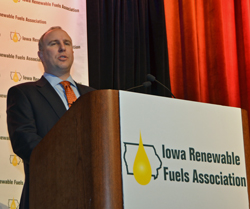
Iowa Gov. Terry BranstadIowa Governor Terry Branstad will address the 7th Annual Iowa Renewable Fuels Summit and Trade Show on January 30, 2013 being held at The Meadows Conference Center in Altoona, Iowa.

“Governor Branstad’s continued leadership has helped Iowa remain the nation’s leader in renewable fuels production,” said IRFA President Rick Schwarck. “Under Branstad, the state is at the forefront of proactive public policy for E15 and biodiesel. The renewable fuels community looks forward to hearing from the Governor on maintaining Iowa’s renewable fuels leadership.”

The Summit is free and open to the public. Pre-registration is required. Click here for the agenda and to register.

biofuels, Ethanol, Iowa RFA

Start the New Year with Some Solar Education

Joanna Schroeder

Start off the new year with some solar education. According to The Solar Foundation, and the third annual National Solar Jobs Census report, the U.S. solar industry currently employs 119,016 people. Over the past month alone, the industry has seen a 13.2 percent growth rate. The Bureau of Labor Statistics estimated that 1 in 230 jobs created nationally during 2012 were created in the solar industry.

In anticipation for training the much needed workforce, Solar Energy International (SEI) offers a professional certificate program out of the Solar Photovoltaic lab facility in Paonia, Colorado and also online. While on-site, hands-on learning is still a core part of the program, students can take their prerequisites online and then finish off the program in the PV lab during the summer.

“We have hundreds of students travel to our world-class Solar Photovoltaic (PV) lab facility in Paonia, Colorado every year. The interest continues to increase every year and we needed to find a way to offer flexible educational opportunities that would allow our students to get their prerequisite course work completed so they could come to the week long hands-on labs in the summer,” said Kathy Swartz, Interim Executive Director for SEI.

“The SEI Online Campus has made this training a reality for thousands of people from all over the world while maintaining SEI’s rigorous quality standards of teaching and learning,” she added.

The 2013 Online Solar Training Schedule is now available and the new session kicks off January 14.

Alternative energy, Education, Electricity, Energy, Solar, Video

2013 & 2014 Outlook for Ethanol RINS

Joanna Schroeder

According to a policy brief authored by Bruce Babcock with the Center for Agricultural and Rural Development (CARD), the U.S. ethanol industry will face lower profit margins in 2013 due to increased corn prices caused by the drought. With a saturated ethanol market, ethanol mandates that will be implemented in 2013 and 2014 can possibly be met only if ethanol prices are heavily discounted. As a result, Babcock writes that profit margins will continue to be low even if production costs fall after the harvest this fall. The brief also cites that ethanol buyers can draw on blending credits, or Renewable Identification Numbers (RINs), that have been accumulated over the last few years in lieu of ethanol to meet requirements set forth in the Renewable Fuel Standard (RFS).

Iowa corn affected by 2012 drought Photo Joanna SchroederThe “Outlook for Ethanol and Conventional Biofuel RINs in 2013 and 2014,” policy brief looks at how the next two years could unfold in the ethanol market by looking at scenarios of whether obligated parties use banked RINS in 2013 to help offset current high production costs or in 2014 to offset low ethanol prices. The guiding thought is that ethanol buyers will use their RINS when they have the greatest value.

The analysis finds that due to the E10 blend wall along with high ethanol production costs, many buyers will use their banked RINS in 2013 to meet their RFS obligations. “If, as seems likely,” the brief states, “imported sugarcane ethanol is used to meet the portion of the advanced biofuels mandate that is not met by biodiesel meeting its own mandate, then almost all the banked RINs should be used in 2013.”

Regardless of the scenario, the analysis indicates that that RIN prices will be low in both 2013 and 2014 and low future prices are why conventional biofuel RIN prices are low today. The assumption for this scenario is that heavily discounted ethanol will incentivize significant amounts of additional ethanol consumption from owners of flex fuel vehicles or by an unexpectedly large and rapid movement to use of E15. Should this not occur, Babcock concludes that the EPA will have no choice but to waive conventional ethanol mandates in 2014 because the mandate will exceed the ability of consumers to use ethanol.

biofuels, Ethanol, Renewable Energy