ACE Conference 2026

EPA: 109 Million Gallons of Biodiesel Produced in March

John Davis

epa-logoNew figures out from the EPA today shows that 109 million gallons of biodiesel were produced in March… up considerably from February’s numbers of about 78 million gallons.

The National Biodiesel Board (NBB) points out that while the EPA’s numbers for Biomass-based Diesel for March shows 127 million gallons produced, that figure also includes renewable diesel. The year-to-date total for biodiesel production is at just about 259 million. If that pace continues, biodiesel production this year will top 1 billion gallons. NBB went on to point out that biodiesel, an EPA-designated Advanced Biofuel, has exceeded targets under the Renewable Fuel Standard (RFS) for two consecutive years.

NBB also pointed out that biodiesel is being made from an increasingly diverse mix of resources such as recycled cooking oil, soybean oil and animal fats, and it’s being produced in nearly every state in the country and is used in existing diesel engines without modification. The industry supports more than 60,000 jobs across the country.

Biodiesel, NBB

Research Turns Swine Manure into Biocrude Products

John Davis

schideman1Researchers at the University of Illinois have come up with a way to turn swine manure into a biocrude oil, as well as growing algae biomass, capturing carbon, purifying wastewater and recycling nutrients. This news release from the school says Yuanhui Zhang and Lance Schideman, both professors in the Department of Agricultural and Biological Engineering, have combined their years of research for the innovative development.

“We first convert swine manure into crude oil in a hydrothermal liquefaction reactor,” Schideman said. “There is a very strong wastewater that comes off that process. It contains nutrients that can be used to grow algae that simultaneously clean the water. Lately, we’ve added low-cost, bioregenerable adsorbents into the system that allow us to grow additional bacterial biomass and further improve effluent water quality.

“Our recent research, a combination of experimental work and some computer modeling, has shown that we can reuse the nutrients multiple times and thus amplify biofuel production from waste feedstocks,” he explained. “If we start with a particular waste stream that has one ton of volatile solids in it, we might be able to produce three, five or even ten tons of algal and bacterial biomass. This new biomass is then recycled back into the biofuel production process,” he continued. “It can also clean the water with the goal of making it suitable for environmental discharge or reuse in some other application. So we get more bioenergy and more clean water resources – both good things in the long run.”

The biocrude oil has higher oxygen and higher nitrogen content than traditional petroleum, but lower sulfur content. The researchers see the process helping bridge the gap between the smaller refineries and petroleum’s requirements of having refineries that process hundreds of thousands of barrels of material each day.

The biocrude oil is being tested as an asphaltic binder in a piece of pavement leading to Six Flags St. Louis.

algae, biomaterials, Research

Spring Planting Delay

Talia Goes

Our latest ZimmPoll asked the question, “Have you started spring planting”

Our poll results: Sixty-two percent said No, I’ve Been Delayed More Than One Week, twenty-three percent said Yes, I’m In the Field Right Now, and fifteen percent said No, I’ve Been Delayed by One Week. The late winter storms and heavy rain showers seem to have put a damper on the majority of farmer’s spring planting plans.

Untitled

Our new ZimmPoll is now live and asks the question, “What is the #1 thing you look for on a food label?” Reading food labels has become more popular with media attention about health risks. What are some of the things you look for in the grocery store? Let us know.

ZimmPoll is sponsored by New Holland Agriculture.

New Holland, ZimmPoll

LS9 Expands Demonstration Facility

Joanna Schroeder

LS9 has announced plans to expand its operations at their Okeechobee, Florida demonstration facility with a successful customer trial. The Florida facility was initially designed, and has been used, to scale-up LS9’s fermentation technology and generate large commercial samples for testing and product qualification by key partners and prospective customers. Since the company’s initial run at 135,000 liter scale in the third quarter of last year, LS9 has made several additional fatty alcohol runs of this size as well as smaller production runs of fatty acid methyl esters (biodiesel).

LS9In addition, LS9 has successfully completed a pilot production run at its Florida plant for another advanced bioproducts company, Cobalt Technologies. According to LS9, fermentation scale-up is an expensive proposition and requires the proper facilities and expertise to make an effective run. The need to run trials is also intermittent so it is not cost-effective for many companies in the industry to make the investment in a larger plant.

LS9 says its Florida demonstration plant was designed to manage a multitude of processes, and with this successful customer run, they have proven they can leverage their state-of-the-art facility and the expertise of its operations staff to work with partners to commercialize renewable products. Given the success of the initial production run, says LS9, Cobalt is considering future work at LS9’s Florida facility.

“The capability to transition from the lab to 135,000 liter scale is a key milestone on our road to commercial success, and we know we are not alone in this requirement,” said Tjerk de Ruiter, President and Chief Executive Officer of LS9. “Our ability to support other companies’ technology scale-up activities is not only an example of the flexibility and the capabilities of our team, it is also an excellent example of how, as an industry, we can work together to make a renewable future a reality. This new revenue source, together with a recent $6 million investment from our current investors, positions LS9 to enter into new partnerships with our technology and advance our own products.”

advanced biofuels, biochemicals, Biodiesel, biomaterials

Biofuels Conference Told to be Biomass Agnostic

John Davis

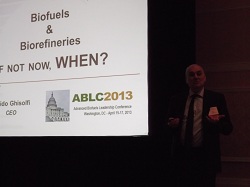
ghisoli1If you’ve never been to Italy, you might be inclined to believe the whole country is very much the same. But you’d be wrong. From the simmering sea shores of the southern coasts to the towering Alpine peaks of the north, where people are more likely to speak German than Italian, the whole country is a rich tapestry of diverse people, customs and foods. In that tradition, Guido Ghisolfi of the Italian company Beta Renewables told attendees of the Advanced Biofuels Leadership Conference (ABLC) that they, too, needed to be diverse in their thinking of biomass for biofuels.

“It’s quite important that the [refineries] be biomass agnostic – they can take several different types of biomass without changing the hardware,” he says, adding that no matter where you are in the world, biomass is seasonal by definition, and those who want to convert the various types into fuels need to be able to change to stay in business year-round. But he admits that currently there is not one system that converts the divergent forms of biomass, whether it’s corn stover or wheat straw or even what’s left over when you press olives, into biofuels. And the technical solution might be simpler than people think.

“So far, people have not focused on the advantage of having a multi-feedstock plant. I’m pretty sure the new technologies coming up in the next few years will be able to handle many more types of biomass,” especially when the costs drive that need.

Guido says you want to bring technology to the territory so you can use all the various biomass feedstocks that an area might have. He adds that biofuels producers need to be flexible as well … and spend less time complaining.

“Instead of complaining and wailing about the RFS, we have to deliver competitive fuel that people will but because it is cheaper and not because it is green.”

You can hear my conversation with Guido here: Guido Ghisolfi, CEO, Beta Renewables

advanced biofuels, Audio, biofuels, biomass

IU Bloomingdale Achieves GHG Emission Reductions

Joanna Schroeder

Indiana University Bloomington has reduced its greenhouse gas emissions (GHG) by 43 percent last year from the previous year and has now cut its direct emissions by more than half in the past two years, according to campus officials. The major reduction in GHG emissions over the past two years reflects a concerted shift from coal to natural gas usage at the campus’s Central Heating Plant according to Mike Jenson, director of IU’s Office of Environmental Health and Safety Management. The campus has already exceeded a goal set forth in IU Bloomington’s 2010 Campus Master Plan, which called for a 30 percent reduction in greenhouse gas emissions by 2020.

IU Bloomindale Central Heating Plant“This is a very positive step — perhaps the most significant step the campus has taken so far — toward carbon neutrality,” said Mike Jenson, director of IU’s Office of Environmental, Health and Safety Management.

The Campus Master Plan, spanning several years, established a goal to build “fuel flexibility” into the boiler system, ensuring the campus could take advantage of falling natural gas prices to dramatically cut its carbon footprint. “In recent years, there has been a strong dedication among our utilities group toward reducing our emissions and increasing our energy efficiency as much as possible, so when there were changes in the marketplace, we were in a position to shift more and more resources to natural gas,” said Jenson.

“Still, we were surprised by the magnitude of our reduction,” he added. “Because we were burning so much more natural gas than ever before, we knew it was going to drop, but we didn’t expect it to drop that much.” The campus power plant now uses 95 percent natural gas and only 5 percent coal. Among the next steps for the campus is increasing its focus on energy efficiency in its buildings and facilities.

In December, IU trustees approved a new Integrated Energy Master Plan for the IU Bloomington campus that provides detailed guidelines for reducing campus energy use and cutting carbon emissions while maintaining sound economic rationales for conservation-related improvements. The plan benchmarks energy consumption by campus buildings and addresses the current and future effectiveness of the Central Heating Plant, Central Cooling Plant and utility distribution systems for electricity, chilled water, and steam and condensate.

Electricity, Energy, energy efficiency, Environment, Natural Gas

Shell & TravelCenters to Build LNG Nationwide Network

Joanna Schroeder

Shell and TravelCenters of America LLC have finalized an agreement to develop a U.S. nationwide network of liquefied natural gas (#LNG) fueling centers for heavy-duty road transport customers. The plan is to construct at least two LNG fueling lanes and a storage facility at up to 100 existing TA and Petro Stopping Centers SHELL OIL COMPANY TRAVELCENTERS OF AMERICA LNGbranded full service travel centers along the U.S. interstate highway system, in a phased approach.

The two companies anticipate the first of LNG stations to open by the end of this year, with a priority to develop main trucking corridors to provide the potential for the first-ever coast-to-coast LNG-fueled commercial transport network.

“Shell is investing now in the infrastructure that will bring this innovative, cost-competitive and environmentally beneficial fuel to our customers,” said Elen Phillips, Vice President, Shell Fuels Sales & Marketing Americas. “We are leveraging our strength as an integrated company to produce, liquefy, distribute and commercialize natural gas in transport – and TravelCenters of America is the ideal partner to help us bring this vision to life.”

Demand for innovative fuels, like LNG, from commercial customers is growing due to the wide range of benefits for trucking fleet operators says Shell. These benefits can include lower fuel costs, the potential to reduce emissions as well as reduce noise levels in certain engines.

“We see great potential for LNG as a fuel option among our range of quality fuels, due to the sheer abundance and affordability of domestic natural gas in North America,” added Phillips.

Liquefied natural gas (LNG)

Bioenergy Bytes

Joanna Schroeder

  • BioEnergyBytesDF#EcoEngineer’s RIN QAP WEBINAR recording is now available. The free webinar covered QAP and A and B programs as well as the NPRM. Answers to questions asked during and after the webinar will be posted on their website.
  • @SunPower Corp. has begun construction on two solar power projects for Yolo County in Calif. The projects are expected to generate 5.8 megawatts of emission-free solar power for county facilities, worth an estimated $1.5 million in electricity costs the first year of operation.
  • #Versalis and #Genomatica announced the signing of a definitive joint development and licensing agreement establishing a technology joint venture for bio-based butadiene. The two companies will work together to develop a complete ‘end-to-end’ process for the on-purpose production of butadiene from non-food biomass.
  • Solectria Renewables @SolectriaRen is offering a webinar, “Single-Phase Inverters for your PV System,” on Thursday, May 23, 2013 at 2:00 pm EST. The webinar will walk through the company’s single-phase PVI 1800 through PVI 7500 inverters including: installation details, string sizing, AC/DC connections, wiring needs, data monitoring, available options and how to use the inverters in parallel for PV installations ranging from 1.8kW through 15kW.
  • SEI – Solar Energy International @solarenergyintl has announced April 22nd Earth Day Solar PV training events. For Earth Day 2013, SEI will be offering some of their most popular training sessions both online and in-person in support of their non-profit mission of renewable energy education for a more sustainable future.
Bioenergy Bytes

Is Winter in Trouble?

Joanna Schroeder

Earth Day is around the corner and 75 Olympic medalists, including White House “Champion of Change” awardee and pro snowborder Jeremy Jones, along with other winter sport athletes are urging President Obama to take action on climate change and clean energy and delivering the message that “winter is in trouble.” The athletes signed a letter to Obama and delivered it in tandem with the “Champion of Change” ceremony honoring ordinary Americans doing extraordinary things in their communities to out-innovate, out-educate, and out-build the rest of the world.”

Jeremy-Jones-ChampsChangePanelDiscuss“Without a doubt, winter is in trouble,” the letter states. “… at risk are the economies of tourist-dependent states where winter tourism generates $12.2 billion in revenue annually, supports 212,000 jobs and $7 billion in salaries. Those are the jobs and businesses owned by our friends and families, generators of billions in federal and state income.”

Jones was recognized for his contribution to raising awareness about the impact of climate change on the winter sports industry by creating “Protect Our Winters,” a foundation established in 2007 to unite and mobilize the global winter sports community against climate change.

“This nomination is an absolute honor for me and the work we’re doing at POW. But it’s now my responsibility to take this recognition and help secure a place in the climate discussions in Washington,” said Jones. “The letter that’s been enthusiastically signed by so many amazing athletes is a strong showing of solidarity from the leaders in snow sports on climate action, so together, we have to keep that momentum going.”

The letter to the president references a December 2012 report published by #ProtectOurWinters and the @NRCS (Natural Resources Defense Council) highlighting the economic impact of inconsistent winters on the U.S. snow sports community and tourism-dependent states. It calls for Obama to follow through on the promise he made in the State of the Union address to fight climate change. The athletes say he can do so by using executive authority currently available to reduce carbon pollution emitted by America’s power plants, the largest source of carbon pollution worsening climate change, and by rejecting the Keystone XL pipeline, which would add millions of tons of new carbon pollution to the atmosphere.

“Mr. President, it’s time to force our transition to clean energy, and we need your leadership,” the letter states. “…on behalf of 23 million of us who love winter and depend on it for our economic livelihoods, please take the action on climate change you have promised.”


Clean Energy, Climate Change, Environment

The Truth Behind High Gas Prices

Joanna Schroeder

Fuels America has released a new video highlighting the truth behind high gas prices and how renewable fuels can help. Many studies, including a report from the American Security Project, have shown that the country can’t drill its way out of high gas prices and vulnerability to global oil markets. In addition, recent International Energy Agency (IEA) data shows drilling will still leave us with oil that costs upwards of $215 per barrel.

Other studies have shown that renewable fuel lowers gas prices by an average of $1.09 per gallon in 2011, reducing the average American’s gas bill by more than $1,200 per year.

biofuels, Fuels America, Video