Biodiesel Advertising Campaign Launched

Cindy Zimmerman

An advertising campaign to spotlight biodiesel as America’s advanced biofuel has been launched by the U.S. biodiesel industry.

The multi-million dollar project will include national television advertising, coupled with regional print and radio advertising as well as an online presence. The centerpiece of the education effort is a 30-second spot that will air across the nation on Sunday-morning network talk shows, beginning this Sunday, June 19th. The ads feature the tagline, “Biodiesel. America’s Advanced Biofuel” and focus on biodiesel’s viability here and now. The television spot highlights biodiesel use in the Dallas area to demonstrate the fuel’s practical, common-sense appeal in communities across the country.

“The public generally doesn’t know that there is an advanced biofuel here now,” said Joe Jobe, CEO of the National Biodiesel Board. “This is not some pipedream. Biodiesel today is fueling long-haul trucks from Florida to California, municipal buses in Texas, Ford pickups in Detroit, and Volkswagens in New York City.”

The campaign has a new website – AmericasAdvancedBiofuel.com – where the ads are posted. The TV ad can be viewed below.

advanced biofuels, Biodiesel, biofuels

WindMade Label Proposed on Global Wind Day

Cindy Zimmerman

A new international label for companies and products using wind energy is being proposed by a new organization.

Wind energy industry leaders gathered in New York today on Global Wind Day to unveil the proposed WindMade™ standard for public comment and to promote it worldwide. This event was co-sponsored by the new WindMade™ organization, headquartered in Brussels, Belgium, and the Wind Energy Foundation, of Washington, D.C.

“I believe that WindMade has the potential to develop into a truly global movement, with consumers around the world demanding transparency on the companies and products they choose,” said WindMade CEO Henrik Kuffner. “WindMade can make a real difference in driving consumer demand for sustainable products, and I am excited to be given the opportunity to spearhead this groundbreaking initiative.”

The proposed standard requires participating companies to source a minimum of 25 per cent of their electricity demand from wind power and it was developed by a committee made up of representatives from founding organizations, including the World Wildlife Fund (WWF), American Wind Energy Association (AWEA), LEGO, Climate Friendly, Gold Standard, and Vestas Wind Systems. “We believe that the label will build a bridge between consumers and companies committed to clean energy,” said Steve Sawyer, Chairman of the WindMade™ Board and Secretary General of GWEC.

Organizers say that WindMade™ will be “dedicated to increasing corporate investments in wind power by informing consumers about companies’ use of wind energy, and increasing demand for products that embrace this clean and renewable energy source.”

Wind

Beef Is Top Choice

Chuck Zimmerman

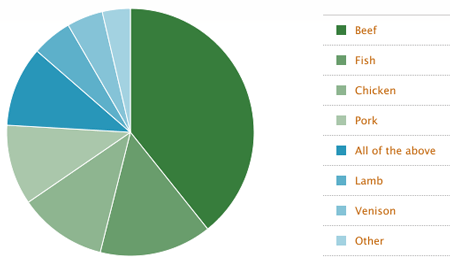
We’ve got some beef eaters in this community! In answer to our question, “What’s your favorite meat?” an overwhelming majority said Beef at 39%. Here’s how the other choices fared in order. Fish, 15%; Chicken, 12%; Pork, 10%; All of the above, 10%; Lamb, 5%; Venison, 5% and Other, 4%. I’ve spoken with some AgWired community members who voted that told me they voted for beef but definitely eat other meat choices. We just thought we’d ask the question this way to see if you had a favorite and it sure looks like you do. Thanks to everyone who participated.

Our new ZimmPoll is now live. We’re asking the question, “Will ethanol be an issue in the presidential race?” Let us know what you think. And if you have any questions you want to suggest for future ZimmPolls please let us know.

ZimmPoll is sponsored by Rhea+Kaiser, a full-service advertising/public relations agency.

ZimmPoll

More Ethanol Dialogue Needed

Joanna Schroeder

The ethanol industry is anxious to continue talks about the future of the Volumetric Ethanol Excise Tax Credit (VEETC) and how best to balance the budget while still ensuring the ethanol industry can move forward. Yet while many believe the Senate’s defeat of Sen. Coburn’s ethanol amendment opens the door for dialogue, others believe today’s action does little to move the debate forward.

“Today’s debate did little to move the ball forward in encouraging the development of an advanced and cellulosic biofuels industry,” said Michael McAdams, president of the Advanced Biofuels Association. “Our nation needs a comprehensive approach that focuses on the future of all biofuels, including advanced drop-in, algae, and cellulosic fuels to deliver as many gallons to back out foreign oil as quickly as possible. In order to best achieve this goal, Congress must consider policies that are technology, feedstock, and product neutral, and provide long term certainty for the markets. We remain committed to working with Congressional leaders and stakeholder groups to find a common sense approach the benefits all biofuels.”

While all groups remain committed to working with federal policymakers on a compromise, Bart Schott, a grower from Kulm, North Dakota and the current president of the National Corn Growers Association noted that should Coburn’s policy have been passed, the ethanol industry could have seen production reduced by 38 percent. “This would have significantly impacted an industry that provides and supports more than 400,000 U.S. jobs, many in rural America, during a time of economic uncertainty. The loss in ethanol production could have resulted in the shedding of approximately 112,000 of these jobs, in all sectors of the economy,” said Schott.

Schott pointed out that while the ethanol industry remains open to change the oil and gas industry has refused to proactively engage in debates about subsidy reform. He continued by reiterating his organization’s support of the Ethanol Reform and Deficit Reduction Act that was introduced yesterday by Sens. John Thune and Amy Klobuchar.

Jeff Broin, chairman and CEO, of POET, the country’s largest ethanol producer added that the country must transition away for the tax credit and make a short-term investment that will reap long-term rewards. This should be done through the expansion of flex fuel pumps and flex fuel vehicles.

“Over the years as the tax credit has declined, we have been able to improve our efficiency and stay competitive with gasoline. Now it is time for the ethanol industry to take the next step in competing with oil. That can only happen if ethanol is allowed greater access to the fuel market,” concluded Broin.


biofuels, Cellulosic, Ethanol, Government, Legislation

Ethanol Future Could be Headed to Senate Showdown

Cindy Zimmerman

After the defeat Tuesday in the Senate of an amendment by Sen. Tom Coburn (R-OK) to immediately eliminate the Volumetric Ethanol Excise Tax Credit (VEETC), the ethanol industry is supporting another approach and the two concepts could be heading for a showdown in the Senate before the end of the month.

“That indeed has been teed up with a commitment by the majority leader for a vote on Coburn again in a couple of weeks and a vote on an alternative,” says Renewable Fuels Association CEO and President Bob Dinneen.

The alternative is the Ethanol Reform and Deficit Reduction Act introduced this week by Senators John Thune (R-SD) and Amy Klobuchar (D-MN) that would end the tax incentive this year while still helping the industry move forward. The legislation would provide tax incentives for infrastructure such as blender pumps, and for cellulosic biofuels development, as well as a variable safety-net determined by the price of oil. “It’s very fiscally responsible and makes sense as an insurance that the investment that the taxpayer has already made in this industry will be protected,” Dinneen said.

The ethanol industry and agriculture groups are supportive of the alternate approach, which would save about $1 billion toward deficit reduction and Dinneen hopes it will go head-to-head against the Coburn amendment. “I welcome that side-by-side comparison,” he says. “I think there would be a great deal of support for our vision.”

Ethanol Report PodcastIn this edition of “The Ethanol Report,” Dinneen talks about why ending the ethanol tax credit without a plan to move forward would be disastrous and how the ethanol industry is taking the initiative to work with Congress and develop a plan that cuts spending while continuing to move the country toward energy independence.

Listen to or download the interview with Dinneen here: Ethanol Report on Senate Legislation

Ethanol, Ethanol News, Ethanol Report, Government, RFA

Coburn Amendment Quashed

Joanna Schroeder

In a vote of 40-59, Sen. Tom Coburn’s (R-OK) Amendment No. 436 to immediately eliminate the Volumetric Ethanol Excise Tax Credit (VEETC) and the tariff on imported ethanol was quashed. Coburn’s proposal needed 60 votes to move forward but fell short by 20 votes. Shortly after the news hit, the ethanol industry began calling for “real reform.”

“The fight is not over until we achieve real reform for the ethanol industry, but this vote sends a signal that there is a right way and a wrong way to go about it,” said Growth Energy CEO Tom Buis. “For more than a year, Growth Energy has advocated for our Fueling Freedom plan, which would phase out the VEETC in a fiscally responsible way, while redirecting the funds toward ethanol infrastructure build out. Opening the fuels market to ethanol, through Flex Fuel pumps and Flex Fuel vehicles, would give consumers a choice at the pump and allow us to ultimately eliminate all government assistance.”

The industry applauded the Senators who voted to stop the amendment from moving forward. Renewable Fuels Association President and CEO Bob Dinneen said, “This vote demonstrates the lack of appetite for this kind of destructive policy and political gamesmanship. The Senate and the country need to focus on a comprehensive energy strategy that seeks to expand America’s ability to renewably meet its fuel needs.”

Yesterday the ethanol industry joined together in support of another proposal introduced by Senators Thune and Klobuchar. This proposal also eliminates VEETC in its current form but replaces it with a variable tax incentive tied to the price of oil, which hit more than $120 a barrel today, a five week high. This proposal would also allocate funds to improve ethanol infrastructure and supports tax policies for emerging ethanol technologies.

“This vote is a major victory for the biofuels industry and American consumers and a setback for those clinging to our status-quo dependence on oil,” added Brian Jennings, executive vice president of the American Coalition for Ethanol. “It proves political stunts aimed at ethanol won’t be tolerated in the U.S. Senate. Now we can focus on continuing our work with the White House and both chambers of Congress to support meaningful and responsible legislation to reform ethanol policy.”

ACE, biofuels, Ethanol, Ethanol News, Government, Growth Energy, Legislation, RFA

NBB Study Shows Biodiesel’s Benefits

Joanna Schroeder

According to a new study released today by the National Biodiesel Board (NBB), the U.S. biodiesel industry will grow to support more than 74,000 jobs throughout the economy by 2015. These jobs will create nearly $4 billion in household income and generate almost $1.6 billion in local, state and federal tax revenues. The study was conducted by Cardno ENTRIX and released in timing with NBB’s annual membership meeting being held in Washington, D.C.

“This shows without question that a healthy and thriving biodiesel industry is good for America,” said Joe Jobe, CEO of NBB. “Biodiesel isn’t just improving our environment and shoring up our energy security, it’s creating good-paying jobs in virtually every state in the country.”

The study also looked at how the industry responded after losing its key tax incentive in 2010, which was retroactively brought back at the end of the year. It discovered the expiration of the tax credit and the resulting 42 percent drop in production caused the loss of nearly 8,900 jobs. Household income also decreased by $485 million and a reduction in real GDP or $879 million.

Fortunately for the industry, this year marks a major turnaround as the Renewable Fuels Standard ramps up with biodiesel considered an advanced biofuel. In January alone, production jumped 69 percent and is continuing to climb.

“Since the EPA designated us as an advanced biofuel last year and Congress reinstated our tax incentive in December, the market has responded with incredible quickness, ” said Jobe. “Plants across the country are reopening and ramping up production. This means new jobs in all sorts of sectors – manufacturing, transportation, agriculture, sales. It means plants are hiring, buying supplies and machinery, and circulating money throughout the economy.”

Jobe continued, “The numbers also show what happens when those incentives weren’t there in 2010. They demonstrate what we’ve been saying, that biodiesel is still a young industry. We’re trying to gain a foothold in a business that is and always has been dominated by fossil fuels, and breaking into that business is extraordinarily difficult.”

Biodiesel, biofuels, NBB, Research

Proterra Secures $30M in Financing

Joanna Schroeder

Proterra Inc has secured $30 million in financing led by Silicon Valley venture firm Kleiner Perkins Caufield & Byers. Also participating were GM Ventures, Mitsui & Co. Ltd., Vision Ridge Partners, and 88 Green Ventures. Golden, Colorado-based Proterra will use the money to accelerate the commercialization of its fast-charge battery electric transit buses and automated bus charging system.

“Our goal at Proterra is to fundamentally transform urban transit,” said Jeff Granato, President of Proterra. “The tremendous resources of Kleiner Perkins, leveraged with GM’s automotive expertise and the financial and technical strength of Mitsui, Vision Ridge and 88 Green Ventures gives us an enviable platform to compete and win in the electric transit bus market.”

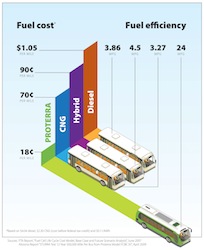
Proterra’s main product is its 35 foot EcoRide BE35 bus. A bus is currently being tested by Foothill Transit in Pomona, California since last September. The company plans to deliver EcoRide buses to VIA Transit in San Antonio and Tallahassee Star Metro later this year. The bus is emission free, quiet and charges in less than 10 minutes with the company’s FastFill charging station. When compared to the diesel buses EcoRide is designed to replace, the bus is averaging nearly 24 miles per gallon, a 600 percent improvement over a typical diesel bus that averages only 4 miles or less per gallon.

Former Vice President Al Gore, a partner with Kleiner Perkins Caufield & Byers noted, “Electrification of public transportation has tremendous benefits to governments, municipalities and citizens by reducing the operating cost of transit, while also eliminating local air pollution and reducing C02 per passenger mile in the industry.

The funds will be used to complete federal validation testing, launch additional pilot fleets, as well as enable the company to reduce costs and increase volume of production at its production facility in Greenville, South Carolina.

Electric Vehicles

Alcatel-Lucent Flips the Switch On Solar System

Joanna Schroeder

Solar energy has come full circle for Bell Labs. Recently, Bell Labs Global Headquarters in Murray Hill, NJ “flipped the switch” on its 1.2 megawatt solar power system. This is the same site where in 1954, Bell Labs researchers invented the first device to convert sunlight into electricity in meaningful amounts.

A formal ceremony was held at the site on Jun 7 and participants included Robert Mennella, COO, ConEdison Development; New Providence Council President Michael Gennaro; John Conley, Project Development Director, SunPower Corporation; and Stephen Reynolds, General Counsel, Alcatel-Lucent. The solar system is comprised of 3,728 solar panels and was designed and constructed by SunPower Corp. The new solar power system will provide an estimated 10 percent of the campus’ electricity when operating at peak capacity. The system is owned and operated by ConEdison Development.

Electricity, Energy, Solar

Diverse Groups Oppose Coburn Ethanol Amendment

Cindy Zimmerman

In advance of a vote in the Senate on an amendment to eliminate the Volumetric Ethanol Excise Tax Credit (VEETC) immediately, ethanol interests remain “cautiously optimistic” that the measure will fail.

Seven agriculture and ethanol organizations sent a letter to the Senate leadership urging a no vote on the amendment proposed last week by Sen. Tom Coburn (R-OK). In it the groups note that, “As evidenced by the ethanol tax reform legislation recently introduced by a bipartisan group of senators and supported by our nation’s ethanol producers, the ethanol industry understands the need for reforming the tax incentive to significantly reduce costs to a more responsible approach that protects the evolution of the industry.” Groups signing the letter include the American Coalition for Ethanol, Advanced Ethanol Council, American Farm Bureau Federation, Growth Energy, National Corn Growers Association, National Farmers Union, and the Renewable Fuels Association.

Other groups that have voiced opposition to the amendment include the Petroleum Marketers Association of America (PMAA), and the Society of Independent Gasoline Marketers of America (SIGMA) which sent a letter to Sen. Coburn in opposition stating, “…an abrupt termination of VEETC before that date will injure many marketers who have contracts to purchase ethanol at prices that were premised upon the existence of VEETC through the year 2011. SIGMA assumes that such a consequence is not your intent and therefore urges you to forego any legislation which would end VEETC before the end of this year.”

A vote on the amendment is expected this afternoon.

ACE, AEC, corn, Ethanol, Ethanol News, Growth Energy, RFA