RFA E-15 Ad

Using ‘Old’ Tools For Better Biodiesel

Joanna Schroeder

Findings from studies conducted by the U.S. Department of Agriculture scientists, and published in the Journal of Near Infrared Spectroscopy, have shown that “old” stand by techniques could help optimize oilseed yield for biodiesel production. For more than 30 years, near infrared (NIR) reflectance spectroscopy has been used to measure protein, moisture and oil levels in whole grains.

Dan Long, Agricultural Research Service (ARS) research leader, is heading up the study to learn how remote sensing tools could assess oil quality and quantity before and after harvest.  ARS is USDA’s main scientific research agency and supports the USA in finding new ways to develop bioenergy.

Long used a special NIR sensor to assess seed oil content in 226 canola samples from Montana, Washington and Oregon. Seed oil concentration is used to estimate extraction efficiency, which is the percentage of oil recovered in relation to the amount of oil in seed.

Using this technique, oil concentration in the samples ranged from 32 percent to 46 percent with an average error of .73 percent. Long believes that NIR sensors could be installed in seed crushing facilities to rapidly and continuously measure the oil content of clean seeds flowing into the expeller, where they are crushed to obtain the oil. Long believes that using NIR to monitor extraction efficiency could enable workers to adjust the choke setting on the expeller to compensate for oil loss in meal.

Improving the oil ratio would boost profits associated with seed processing and lower the costs of oil feedstock that is used to produce biofuel. NIR measurements might also help reduce the number of acres needed for oilseed feedstock production by maximizing seed oil extraction rates in the seed crushing facilities.


advanced biofuels, Biodiesel, Research

Vilsack Frustrated by No Farm Bill

Cindy Zimmerman

Congress left town last week without even considering a new farm bill in the House, leaving the current bill to expire at the end of this month. House Speaker John Boehner (R-OH) said they would deal with a farm bill after the election because he did not believe there were 218 votes to pass either an extension or new legislation.

“It just didn’t have to be,” said a frustrated Secretary of Agriculture Tom Vilsack on Friday. “They would have had 218 votes if they had worked it. It’s really unfortunate.”

Vilsack believes this is a set back to a thriving rural economy. “Rural America has great momentum that’s been built with record exports, record conservation acres, record expansion in biofuels and biobased products,” he said. “We want to add to that momentum and what we’re doing now is creating this uncertainty which creates a real problem for momentum to continue.”

Vilsack fears that Congress will not pass a new farm bill during the lame duck session, meaning the measure would have to wait until the new Congress, which means the already passed Senate bill would be dead and they would have to start from scratch.

biofuels, Ethanol, Ethanol News, farm bill, Government, USDA

Solar Cell Reading Light for Children

Joanna Schroeder

As you spend the weekend sprawled on the couch watching football and reading the newspaper, don’t take for granted the light that helps you watch TV and read. In many emerging countries, light is created by burning a kerosene lamp which is equivalent to smoking two packs of cigarettes a day. Yet without light, people in third world countries without electricity are left in the dark.

Osei Darwka, president of Ghana Telecom University and a fierce advocate of education, wants every household in his country to replace kerosene –– the fuel commonly used in home lighting –– with a healthier, safer, more environmentally friendly alternative that will allow schoolchildren to read and study in the evening.

The solution? A LED reading light that is eight times more efficient than in incandescent light bulb. The reading light was developed by John Bowers and his team at the University of California Santa Barbara and the Institute for Energy Efficiency. The LED light contains a solar cell that is efficient enough that a small area will provide a sufficient charge for the LED. Just two hours of light each day provides one hour of illumination. And operating with a single rechargable battery means the cost is kept low- much lower than the cost of kerosene.

So far, over 20,000 lights have been sent to 43 countries.

This is just one example of how students, professors and alums of the University of California are recreating “The California Dream” and helping to improve the world. This story is the first in University of California’s “Onward California” series. The episodes feature John Bowers and the value he and his team are bringing to society.

energy efficiency, International, Solar

Energy Mix Must Reflect Future

Joanna Schroeder

A new report released by the European Wind Energy Association (EWEA) argues that European Union (EU) electricity market rules must reflect the energy production mix of the future. This will help ensure a flexible power system with a large-scale uptake of wind power and other renewable energy sources.

The report comes as the Single European Act – creating a single market in goods, capital, people and services – turns 25. However, there is still no single market in electricity. EU Heads of State have agreed that Europe should have an internal energy market by 2014, but the EU is not on track to meet that target.

To this end, the report recommends creating a level playing field for renewable energy sources by tackling structural market deficits such as:

  • Removing regulated prices and excessive market concentration to enable small-  and medium-sized power generators to enter the market.
  • Removing coal, gas and nuclear subsidies before they are removed from mature renewable technologies like onshore wind.
  • Creating functioning markets covering larger geographical regions within Europe so as to reduce the need to balance variable renewables like wind and solar.
  • Developing intraday and balancing markets at national and cross-border levels.
  • Creating new markets for ‘grid support services,’ supporting the functioning of the grid to ensure a secure supply of electricity, instead of introducing market-distorting capacity payments.

“The European wind industry strongly supports the creation of a single market in electricity,” said Paul Wilczek, Senior Regulatory Affairs Advisor, Grids and Internal Electricity Market, at EWEA. “If Europe is serious about decarbonising the power sector in a cost-effective manner, it has to create a market that facilitates this transformation. EWEA’s new report sets out how a single market in electricity could simultaneously create benefits for all producers and consumers and integrate renewable energy sources.”

This October the European Commission is set to publish a communication on the internal energy market which is expected to contain an action plan to take Europe closer to a single energy market.

Electricity, Energy, International, Wind

PTC Stalls, Wind Energy Workers Laid Off

Joanna Schroeder

As the Production Tax Credit (PTC) remains stalled in Congress, worker layoffs in the wind energy industry are rising. The Iowa Wind Energy Association has been forewarning legislators that if the PTC is not extended, thousands of Americans could lose their jobs.  Proof: Siemen’s has laid off more than 400 workers in its Fort Madison wind turbine blade plant. Other companies that have let employees go include Clipper and Vestas among others.

Layoffs will accelerate as many wind farms currently under construction will be completed by December 31, 2012. Without the security of the Production Tax Credit, investors are not moving forward with the monies needed to build or expand wind farms. This in turn dries up demand for the entire wind turbine supply chain.

Iowa leads the nation in the number of people employed with component manufacturers and wind related companies. The industry totaled nearly 7,000 across the state until the layoffs began. Following the Siemen’s announcement, 10 percent of Iowa’s wind energy workforce has disappeared.

On the national level, the failure to extend the PTC could cost as many as 37,000 jobs according to estimates by Navigant Consulting. A delay could reduce the expansion of the wind energy industry between 75 percent to 90 percent compared to previous years.

The lowa Congressional Delegation is leading the effort to expand the PTC in both the Senate and House. Yet the Iowa Wind Energy Association notes that legislators need more help from Senators and Representatives from other states to grow a bipartisan coalition to move the extension forward. This can be done through grassroots efforts including contacting your local legislator to let them know how important the wind energy industry is to America.

Energy, Legislation, Wind

Algae Aviation Facility Lands in Europe

Joanna Schroeder

Lufthansa and Algae.Tec have created a partnership to construct a large scale algae to aviation biofuels production facility. The facility will be located adjacent to an industrial CO2 source. Lufthansa will arrange 100 percent funding for the project and has committed to a long-term offtake agreement of at least 50 percent of the crude oil produced at an agreed upon price. Algae.Tec , who will manage the facility, will receive licence fees and profits from the project.

Recently, the Advisory Council for Aviation Research and Innovation in Europe released a road map outlining the government and industry-funded research required to make Europe’s Flightpath 2050 vision of reducing CO2 emissions 75% relative to 2000 by the middle of the century, a reality.

The agreement cements cooperation between Algae.Tec and Lufthansa for the industrial production of crude algae suitable for conversion into aviation kerosene and conventional diesel fuels. The algae oil produced in the facility will meet the European Union Renewable Energy Directive and shall be certified according to ISCC – Standard.

advanced biofuels, algae, aviation biofuels

Nissan Leaf Gets Top Rating

Joanna Schroeder

The 100 percent electric vehicle (EV) Nissan LEAF has scored a top rating on TotalCarScore.com as the number one car for commuting. The website scores vehicles based on evaluations from sources such as Consumer Guide, Edmunds.com, MSN Autos, The Car Connection and more. The “10 Best Cars for Commuting” was determined by the vehicle’s total car score combined with its fuel efficiency rating in city-driving conditions.

“What we like about this list is that it truly measures the LEAF in the way it was intended—as a zero-emissions car with no-compromise performance,” said Brendan Jones, director, Electric Vehicle Marketing and Sales Strategy. “Our data shows that Nissan LEAF owners drive an average of 31 miles per day, which makes it a perfect choice to meet the daily driving needs of most Americans.”

The Nissan LEAF uses no gas yet still offers a number of great features including heated front and rear seats, heated outside mirrors, heated steering wheel, Automatic on-off LED Headlights, Navigation system, CARWINGS telematics service, Bluetooth® Hands-free Phone System and XM® Satellite Radio. Not enough? Drivers can add additional features including a Level 3 480V quick charge port, fog lights, photovoltaic solar panel rear spoiler (shown in photo) and RearView Camera Monitor.

Electric Vehicles

Promoting Ethanol at Kansas Events

Joanna Schroeder

The Kansas Association of Ethanol Processors (KAEP) had a great showing during the Kansas State Fair last week. Positive ethanol messages were heard by thousands of attendees through educational materials, displays and videos. The state fair opened with a KAEP sponsorship, allowing the association to greet attendees and drive traffic directly to the KAEP booth. Once there, attendees had a chance to win a Kwik Shop fuel gift card.

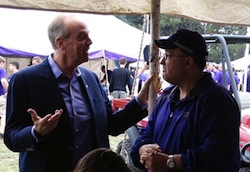
In other Kansas news, the Kansas State University football sponsorship is in full swing. Last weekend, several KAEP members, staff and ag partners attended a tailgating event in Manhattan, Kansas prior to kickoff.  Ethanol advocates, including Greg Krissek, with Wichita-based ICM, was on hand to network with fuel retailers (did you know Kansas is the leading state on E15 sales with seven retail stations now selling the ethanol blend?) as well as lawmakers such as U.S. Senator Jerry Moran, about the benefits of ethanol.

The tailgating event is just one part of a season-long Bill Snyder radio campaign promoting ethanol. Radio commercials are airing on KSU’s 33-station network during all home football games as well as during the Bill Snyder radio call-in shows.

biogas, blends, Ethanol

Global Corn Crop to Break Records

Joanna Schroeder

According to a recent World Agricultural Supply and Demand Estimates (WASDE) report, global farmers will harvest the second largest corn crop on record in 2012. In response to the news, the Global Renewable Fuels Alliance (GRFA) criticized Organisation of Economic Co-operation and Development (OECD) Senior Counsellor, Carmel Cahill for making unsubstantiated comments blaming biofuel mandates for increasing the cost of food.

The WASDE report also concluded that despite wide spread drought, the U.S. will harvest its eighth largest crop in history. Output in several countries has increased including Argentinean production more than 30 percent over last year, Mexican production increased 19 percent, South Africa 17 percent, Canada 9 percent, and China 4 percent. Global grain supply is also expected to be the second-largest in history, totaling 2.71 billion metric tons in 2012/2013 with the European Union grain crop to be about average.

“It is irresponsible of policy-makers like Ms. Cahill to make these sweeping, unsubstantiated statements,” said Bliss Baker, spokesperson for GRFA.  “A wealth of evidence clearly shows that in recent years farmers are producing record crops and that these types of comments are simply not backed up by any evidence whatsoever.”

GRFA cites several significant factors causing a rise in food prices including volatile oil prices, food waste, climate change, financial speculation in commodities markets, trade protection measures such as export bans, fluctuating currency exchange rates, and changing diets in Asia that has led to an increase in global meat demand and ultimately higher demand for animal feed.

Baker continued, “Instead of making ill-informed policy statements about biofuels we should applaud our farmers and their determination to continually produce record corn harvests. Evidence shows that biofuels production is actually beneficial to food production by producing valuable food co-products and providing much needed investment in the agricultural system.”

In other news, the International Energy Agency, that just happens to be an OECD agency, recently released their Technology Roadmap – Biofuels for Transport, that shows biofuels could make up 27 percent of the world’s transport fuels by 2050, eliminate 2.1 gigatonnes of CO2 emissions and not jeopardize food security. The same report also revealed that current global biofuels production utilizes only 2 percent of global arable land, not significant enough to have any impact on food prices.

biofuels, corn, Food prices, International

New Grain Council Launched

Joanna Schroeder

A new Grain Council has been launched  by AgGateway, a non-profit association comprised of agribusiness organizations with the goal expanding electronic business within the ag industry. The Grain Council will identify, develop and implement standards and guidelines to bring eBusiness efficiencies to grain, oilseed and renewable-fuel companies.

“This marks an important expansion in the agriculture industry’s eBusiness efforts,” said AgGateway President and CEO Rod Conner. “These companies are dedicated to finding ways to streamline business transactions, enhance cost-savings, reduce waste and work for more sustainable agriculture practices.”

There are more than 150 members of AgGateway representing nine major industries: Ag Retail, Crop Nutrition, Crop Protection, Feed, Grain, Ornamental Horticulture, Precision Ag, Seed, and Allied Providers that includes systems and software developers and providers. The segments each operate a council within AgGateway and determine their own eBusiness priorities and projects. In addition, each council elects its own leaders who serve on AgGateway’s Board of Directors.

The goal of the Grain Council is to identify and define industry business processes, electronic business messages, and information standards that support these processes. Once these decisions are decided, participating parties then follow through and integrate standards-based messaging into their business processes.

Charter members of the new Grain Council include Central Valley AG Coop, CHS Inc., Cultura Technologies, DTN, EFC Systems Inc., EMarkets Inc., Growmark Inc., Key Cooperative, MFA Inc., SSI, Telvent DTN Inc., and Triple Crown Nutrition Inc., among others. More information on the Grain Council and AgGateway’s other councils will be presented during AgGateway’s Annual Conference in Albuquerque, November 6-8, 2012.

Agribusiness, biofuels