SG Biofuels Breakthrough

Joanna Schroeder

SG Biofuels has expanded it global network of hybrid trial and agronomic research sites with the addition of eight new JMAX Knowledge Centers located in Brazil, Guatemala and India. The company is also expanding it production facility in Guatemala. Current trials are underway in San Diego, California. The company focuses on the the production of Jatropha for use in biofuels, biochemicals and biomaterials.
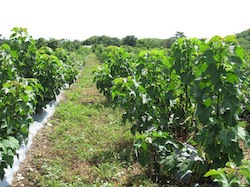
According to a company statement SG Biofuels’ hybrids are performing better compared to commercial varieties across multiple geographies in terms of plant vigor, health, flowering consistency, stress tolerance and yield. The success validates the ability to produce crude Jatropha oil for less than $99 per barrel in a range of growing conditions.

“The performance of our hybrids in multiple geographies not only validates the strength of our genetics, but our ability to deploy profitable energy crop projects around the world,” said Kirk Haney, president and chief executive officer. “Through our network of JMax Knowledge Centers, we are developing the highest performing hybrids of Jatropha while establishing best agronomic and production practices for deploying those hybrids at commercial scale.”

According to the company, JMax Knowledge Centers are professionally managed trials using experimental design and statistical analysis to evaluate hundreds of hybrids in a range of environmental and agronomic conditions. The centers serve as outdoor classrooms where SGB agronomists and technical teams conduct training and field tours with customers and growers, develop localized agronomic studies and recommendations and develop high performing Jatropha hybrids for commercial deployment. SGB’s hybrids have been developed following five years of research, drawing from a diverse germplasm library including more than 12,000 unique genotypes.
advanced biofuels, Agribusiness, Alternative energy, biochemicals, biomaterials, feedstocks, Renewable Energy

Iowa Biodiesel Production Remains Strong

Joanna Schroeder

Biodiesel production in Iowa remained strong during the 3rd quarter according to the Iowa Renewable Fuels Association (IRFA). Figures released by the Iowa Department of Revenue show that 10 Iowa biodiesel plants claimed tax credits on more than 44.2 million gallons of biodiesel produced from July 2012 through September 2012. Several of the biodiesel plants have reached the tax credit program cap and as a result, the total production numbers were higher than what was submitted for credits.

In 2011, the Iowa Legislature enacted a short-term, modest biodiesel production tax credit to help Iowa’s biodiesel community compete against states that provide large biodiesel incentives. The Iowa program went into effect on January 1, 2012.

As the 4th quarter is in full swing, the federal biodiesel mandate has almost been met causing a slow-down in the industry. Through the end of September, biodiesel sales in the U.S. totaled 843 million gallons, just 157 million gallons shy of the federal mandate for 2012 that set total use at around 1.1 billion gallons. This number was increased for the 2013 mandate to 1.28 billion gallons per year.

“While 4th quarter demand appears to be down somewhat, Iowa produced more than 150 million gallons of biodiesel during the first three quarters of 2012 and is on target to break the biodiesel production record of 169 million gallons set in 2011,” said IRFA Executive Director Monte Shaw. “That is great news for Iowa jobs and farm income. It is also good news for Iowa livestock producers because biodiesel production increases the value of their animals while reducing their feed costs.”

advanced biofuels, Alternative energy, Biodiesel, Iowa RFA

Economist Bruce Johnson To Address NEB Meeting

Joanna Schroeder

Professor of Agricultural Economics at the University of Nebraska/Lincoln, Dr. Bruce Johnson, will be addressing the attendees of the Nebraska Ethanol Board (NEB) meeting tomorrow, October 30, 2012 at 10:00 am CDT at the University of Nebraska East Campus Union in Lincoln. He will be discussing the recently released “2010 Economic Impact of the Nebraska Agricultural Production Complex.” The report focuses on the state’s industries involved in growing, processing and transporting agricultural products, which account for nearly one quarter of Nebraska’s total economy. In addition, Dr. Johnson will address the role of the state’s ethanol industry and prospects for future agricultural growth.

According to statements from NEB, the production and use of ethanol strengthens the state’s economy while lowering fuel costs. Ethanol blended fuels are projected to save Nebraska consumers more than $70 million during 2012. Francisco Blanch, a commodities expert for Merrill Lynch, said that biofuels, like ethanol, lower gas prices by at least 15 percent on a nationwide basis.

“Those energy savings are retained in the domestic economy,” said Steve Hanson, Nebraska Ethanol Board chairman. “The high price of oil and gas is driving up the cost of nearly all consumer products but the ethanol industry is helping to keep the Nebraska economy strong amidst nationwide inflation.”

Phil Lampert, former director of the National Ethanol Vehicle Coalition, will also speak at the Nebraska Ethanol Board meeting. Lampert is nationally recognized for his work to expand the use of E85 and other higher percentage ethanol blends. Lampert will provide an overview of ethanol flex fuel infrastructure development.

Agribusiness, Alternative energy, biofuels, blends, Ethanol

Internationalists Share Views On US Competitiveness

Jamie Johansen

During the recent 2012 Export Exchange a few key leaders in the international market took the stage in a panel to share their perception on United States competitiveness in grain production.

Adel Yusupov, Southeast Asia Regional Director for US Grains Council, served as the moderator for the panel.

Panelists consisted of:
Willis Wu-Yeh Cheng, Chairman, Charoen Pokphand (Taiwan)
Mousa Wakila, General Manager, National Poultry Al Ahlieh (Jordan)
Jamie Rueda, General Manager, Escala (Colombia)
Dennis Inman, Vice President & Commercial Lead, Cargill, Inc.

The panelists were asked to share their candid thoughts on how the United States ranks in grain production and what attributes are most important to them when buying grain. Prices were at the top of all their lists, but they also want reliable market research and stressed that logistics were always a concern. Other items on the list included: consistency, a strong relationship and predictability.

Listen to the International Panel’s presentation here: International Panel at Export Exchange

You can find photos from this years Export Exchange here: 2012 Export Exchange

Agribusiness, Audio, Export Exchange, Exports, International, Production, USGC

Outlook For The Supply & Demand Of DDGS

Jamie Johansen

Distiller grain production was a hot topic discussed throughout the 2012 Export Exchange. Dr. Bob Wisner, Agriculture Extension Economics at Iowa State University, shared his research on the future of DDGS and what we can expect in the coming years. He also spoke on how this years drought affected DDGS production and it’s long-term affect on our US supply.

“The biofuel industry has expanded extremely rapidly in the last six years. It has become a major feed ingredient domestically and in the international market. Here in the United States it’s marketed in several different forms. We have dried distiller grains, that are dried to 10% moisture. We have a modified distiller grain that is partially dried. We have a wet distiller grain that is especially useful in the beef feeding industry. It gives a higher feed conversion efficiency versus corn than dry distiller grains. We have quite the combination of alternative uses here in the United States that for those of you outside the US are not generally available.”

“This is the first year in the last 17 years that we have seen a significant decline in distiller grain production. That of course is being driven by the severe drought here in the United States.”

In conclusion, Dr. Wisner shared these major things that will determine the supply and demand of DDGS.

  • DDGS production follows ethanol production level and corn cost.
  • Prices as % of corn/sbm price higher than in the past: 105%-108% of corn this winter.
  • Prices for all feeds including DDGS will be extremely sensitive to South American weather in the next 4 months.
  • After the current marketing year, with a return to more normal US crop yields, DDGS supplies will likely resume a longer-term uptrend, but at a slower rate than in the last six years.
  • Risk of US domestic DDGS market saturation is low.
  • DDGS exports likely will be growing competitor with the domestic feed industry.
  • Longer-term future production and use depends heavily on policy issues and fuel prices.
  • Important emerging issue: Will oil removal from DGS impact the value by species?

Listen to Dr. Bob Wisner’s complete presentation here: Dr. Wisner at Export Exchange

You can find photos from this years Export Exchange here: 2012 Export Exchange

Audio, corn, Distillers Grains, Export Exchange, Exports, livestock feed

Obama Campaign “Energy Tour” at Juhl Wind Today

Cindy Zimmerman

The Obama Campaign “Energy Tour” will be blowing into Woodstock, Minnesota today for a press conference at the headquarters of Juhl Wind, Inc.

Former Minnesota state representative Matthew Entenza will join company representatives to discuss the importance of the extension of the Renewable Energy Federal Production Tax Credit (PTC) and President Obama’s support of the clean energy sector.

“In my over 25 years in the energy business, I have never seen a more balanced approach to our nation’s energy strategy than the Obama administration’s,” said John Mitola, President of Juhl Wind. “We are very pleased to welcome Mr. Entenza to the Juhl Wind headquarters to further underscore the need for continued support of Renewable Energy, a critical component of our domestic renewable energy policy and a creator of new domestic job opportunities. We are proud of President Obama’s strong ongoing support of the Renewable Energy industry and the need to continue to invest in our clean energy future. For anyone to solely attack the Renewable Energy PTC as a subsidy, they are simply ignoring the hundreds of billions of dollars in subsidies that have been provided to the nuclear, coal, gas and oil industries for decades and continue to this today – and, seemingly are never questioned.”

Mitola referenced the most recent American Wind Energy Association report that says 2012 has been a record year for the development of wind power within the United States, surpassing 50,000 megawatts of electrical power generation capacity, with a total of 4,728 megawatts added this year alone and another 8,430 megawatts in active development throughout 29 states and Puerto Rico.

politics, Wind

Green Plains Renewable Energy to Sell Grain Elevators

Cindy Zimmerman

Green Plains Renewable Energy has entered into an asset purchase agreement to sell 12 grain elevators located in northwestern Iowa and western Tennessee to The Andersons

The sale involves approximately 32.6 million bushels, or 83%, of the Company’s reported agribusiness grain storage capacity and all of its agronomy and retail petroleum operations.

The estimated sales price for the facilities and certain related working capital is $133.1 million, including the assumption at closing of term debt of approximately $28.3 million. In addition, the Company expects to realize net proceeds from the liquidation of retained working capital of approximately $86.7 million before the repayment of approximately $85.2 million under a revolving credit facility and inventory financing arrangements. Working capital and amounts outstanding under debt and inventory financing arrangements are based on September 30, 2012 balances and will be adjusted to final amounts at closing. Net cash proceeds, including working capital liquidation, are expected to be approximately $103.8 million.

“We continually evaluate options to maximize shareholder value and this transaction is about opportunistically realizing that value,” stated Todd Becker, President and CEO of Green Plains. “While we have referred to this as a strategic part of our business, we are by no means exiting U.S. agriculture. We will continue to participate with our remaining grain handling assets and through future grain storage expansions at or near our ethanol plants. Once closed, this transaction will add more than $100 million in cash to our balance sheet and reduce outstanding debt by more than $113 million. Our continued focus is to ensure that Green Plains is positioned to take advantage of growth opportunities throughout our platform.”

Green Plains Renewable Energy is North America’s fourth largest ethanol producer.

Read more from GPRE.

Agribusiness, Ethanol, Ethanol News

Winterize Farm Equipment With Slip Plate

Melissa Sandfort

With the fall harvest ending in the near future it’s time to look at winterizing all that equipment. That means you need a good lubricant and that means you might want to check out Slip Plate. You can find out all they ways you can use this product from Superior Graphite on their website. Go ahead. Visit now. Here are a few places where you can use Slip Plate:

SLIP Plate dry film graphite coatings (SLIP Plate No. 1, SLIP Plate No. 3, SLIP Plate No. 4, and SLIP Plate Aerosol) significantly reduce sliding friction on corn picker heads, combine cutter bars, hay elevators, planter plates, hay bailers, gravity wagons, and many more applications around the farm.

Slip Plate is a dry lubricant that is very environmentally friendly unlike petroleum based products. More reasons to use Slip Plate!

I visited with Barry Lee, Superior Graphite, once again to talk about Slip Plate products for the agricultural market. This is part of a periodic series of interviews I’m doing to help the ag industry come to know this company and their products. In our interview Barry not only talks about products for specific farm applications but also one I think you hunters out there should know about and that is Black Ice.

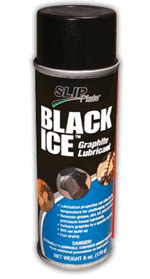
A unique formulation combining a unique solvent cleaner with a friction reducing mineral that first cleans the surface, and then deposits a layer of pure, lubricous graphite powder.

This makes it perfect for gun cleaning!

Our discussion also focused on “What’s inside a can of graphite?” You might think all cans of graphite are the same but they are not. Barry did some research on this subject that finds two things that govern the performance of the graphite product you are using: amount of graphite and the type of graphite. You can find details of his research findings on the Slip Plate website.

Listen to my interview with Barry here: Interview with Barry Lee

Agribusiness, Audio, Company Announcement

World Grain Buyers Get US Producer Perspectives

Jamie Johansen

Grain buyers from around the world in attendance at the 2012 Export Exchange had the opportunity to embrace the US producers perspective on the 2012 crop through a producer panel during the opening general session. Key panelists were Ron Gray, Illinois farmer and Secretary/Treasurer of the US Grains Council, and John Mages, Minnesota farmer and Chairman of the Minnesota Corn Research & Promotion Council.

They shared their personal experiences overcoming the 2012 drought and assured buyers of their fight and passion to raise a consistent and quality product.

Listen to the entire Producers Panel here: Producer Panel at Export Exchange

Following the opening session I took the time to talk with Ron Gray, where he summed up the 2012 corn crop and how farming for him is more than a job, its a personal endeavor.

“For us the 2012 crop started out with all the hope of an extraordinary crop. We planted early, the crop went in very well, emergence was good. Then it didn’t rain. Beginning the second week of May through the first week of August we only had about three inches of total rainfall and because of that our corn crop was severely reduced in production. Our farm probably averaged 50 bushels an acre, which is approximately 1/3 of our normal production. The rainfall did come later and the soybean crop is a fairly good crop, but the corn crop was devastated.”

Listen to my interview with Ron here: Ron Gray Interview

Beyond simply listening to producers, international grain buyers had the opportunity to visit farms across the United States. The goal was to gain information, assess the current US corn crop, explore the availability of other grains such as sorghum and barley, and build relationships leading to future sales.

Many participants expressed a preference for buying US grains due to the consistency and quality of the grain. They also appreciate the transparency and reliability of the US marketing and delivery systems. Clearly price and availability hindered US exports this year, but buyers are looking forward to a better crop next year.

You can find photos from this years Export Exchange here: 2012 Export Exchange

Agribusiness, Audio, conferences, corn, Distillers Grains, Education, Export Exchange, Exports, Farming, sorghum, Soybeans, USGC

Book Review – Clean Energy Nation

Joanna Schroeder

This week I read Clean Energy Nation by Congressman Jerry McNerny and Martin Cheek. I can’t quite put my finger on it, but I found myself likening the book to the classic Brave New World by Aldous Huxley. Subconsciously I think it was because one of the recurring themes in Brave New World, first published in 1932, is the Fordship’s desire, after Our Ford ‘s first T-Model,” for its citizens to “consume manufactured articles as well as transport.” Ironically, a portion of Huxley’s predictions came true – globally, people have been conditioned to consume both manufactured items and transportation. It is expected that by 2020 or so, there will be two billion cars on the road.

Clean Energy Nation is like most other energy books and begins with a history lesson about energy with special attention paid to the use and development of fossil fuels. In the words of the New World controller, “…you all remember, I suppose, that beautiful and inspired saying of Our Ford’s: History is bunk. History,” he repeated slowly, ‘is bunk’.” While history is not bunk, as a global population we seem to think that it is, and it bears saying that recurrent energy history lessons are much needed.

The next section of the book delves into America’s energy issues and covers all the usual suspects including national security, environment, economy, agriculture, public health, education, and good government. (Or in the case of the U.S., bad government. Since 1973, the U.S. Department of Energy has missed 34 deadlines to set mandatory energy standards.). Finally, the book gets into a discussion about America’s energy future.

The discussion about the “crossroads” of America was very motivational. Read More

Alternative energy, book reviews, Clean Energy, Opinion