Outlook For The Supply & Demand Of DDGS

Jamie Johansen

Distiller grain production was a hot topic discussed throughout the 2012 Export Exchange. Dr. Bob Wisner, Agriculture Extension Economics at Iowa State University, shared his research on the future of DDGS and what we can expect in the coming years. He also spoke on how this years drought affected DDGS production and it’s long-term affect on our US supply.

“The biofuel industry has expanded extremely rapidly in the last six years. It has become a major feed ingredient domestically and in the international market. Here in the United States it’s marketed in several different forms. We have dried distiller grains, that are dried to 10% moisture. We have a modified distiller grain that is partially dried. We have a wet distiller grain that is especially useful in the beef feeding industry. It gives a higher feed conversion efficiency versus corn than dry distiller grains. We have quite the combination of alternative uses here in the United States that for those of you outside the US are not generally available.”

“This is the first year in the last 17 years that we have seen a significant decline in distiller grain production. That of course is being driven by the severe drought here in the United States.”

In conclusion, Dr. Wisner shared these major things that will determine the supply and demand of DDGS.

  • DDGS production follows ethanol production level and corn cost.
  • Prices as % of corn/sbm price higher than in the past: 105%-108% of corn this winter.
  • Prices for all feeds including DDGS will be extremely sensitive to South American weather in the next 4 months.
  • After the current marketing year, with a return to more normal US crop yields, DDGS supplies will likely resume a longer-term uptrend, but at a slower rate than in the last six years.
  • Risk of US domestic DDGS market saturation is low.
  • DDGS exports likely will be growing competitor with the domestic feed industry.
  • Longer-term future production and use depends heavily on policy issues and fuel prices.
  • Important emerging issue: Will oil removal from DGS impact the value by species?

Listen to Dr. Bob Wisner’s complete presentation here: Dr. Wisner at Export Exchange

You can find photos from this years Export Exchange here: 2012 Export Exchange

Audio, corn, Distillers Grains, Export Exchange, Exports, livestock feed

Obama Campaign “Energy Tour” at Juhl Wind Today

Cindy Zimmerman

The Obama Campaign “Energy Tour” will be blowing into Woodstock, Minnesota today for a press conference at the headquarters of Juhl Wind, Inc.

Former Minnesota state representative Matthew Entenza will join company representatives to discuss the importance of the extension of the Renewable Energy Federal Production Tax Credit (PTC) and President Obama’s support of the clean energy sector.

“In my over 25 years in the energy business, I have never seen a more balanced approach to our nation’s energy strategy than the Obama administration’s,” said John Mitola, President of Juhl Wind. “We are very pleased to welcome Mr. Entenza to the Juhl Wind headquarters to further underscore the need for continued support of Renewable Energy, a critical component of our domestic renewable energy policy and a creator of new domestic job opportunities. We are proud of President Obama’s strong ongoing support of the Renewable Energy industry and the need to continue to invest in our clean energy future. For anyone to solely attack the Renewable Energy PTC as a subsidy, they are simply ignoring the hundreds of billions of dollars in subsidies that have been provided to the nuclear, coal, gas and oil industries for decades and continue to this today – and, seemingly are never questioned.”

Mitola referenced the most recent American Wind Energy Association report that says 2012 has been a record year for the development of wind power within the United States, surpassing 50,000 megawatts of electrical power generation capacity, with a total of 4,728 megawatts added this year alone and another 8,430 megawatts in active development throughout 29 states and Puerto Rico.

politics, Wind

Green Plains Renewable Energy to Sell Grain Elevators

Cindy Zimmerman

Green Plains Renewable Energy has entered into an asset purchase agreement to sell 12 grain elevators located in northwestern Iowa and western Tennessee to The Andersons

The sale involves approximately 32.6 million bushels, or 83%, of the Company’s reported agribusiness grain storage capacity and all of its agronomy and retail petroleum operations.

The estimated sales price for the facilities and certain related working capital is $133.1 million, including the assumption at closing of term debt of approximately $28.3 million. In addition, the Company expects to realize net proceeds from the liquidation of retained working capital of approximately $86.7 million before the repayment of approximately $85.2 million under a revolving credit facility and inventory financing arrangements. Working capital and amounts outstanding under debt and inventory financing arrangements are based on September 30, 2012 balances and will be adjusted to final amounts at closing. Net cash proceeds, including working capital liquidation, are expected to be approximately $103.8 million.

“We continually evaluate options to maximize shareholder value and this transaction is about opportunistically realizing that value,” stated Todd Becker, President and CEO of Green Plains. “While we have referred to this as a strategic part of our business, we are by no means exiting U.S. agriculture. We will continue to participate with our remaining grain handling assets and through future grain storage expansions at or near our ethanol plants. Once closed, this transaction will add more than $100 million in cash to our balance sheet and reduce outstanding debt by more than $113 million. Our continued focus is to ensure that Green Plains is positioned to take advantage of growth opportunities throughout our platform.”

Green Plains Renewable Energy is North America’s fourth largest ethanol producer.

Read more from GPRE.

Agribusiness, Ethanol, Ethanol News

Winterize Farm Equipment With Slip Plate

Melissa Sandfort

With the fall harvest ending in the near future it’s time to look at winterizing all that equipment. That means you need a good lubricant and that means you might want to check out Slip Plate. You can find out all they ways you can use this product from Superior Graphite on their website. Go ahead. Visit now. Here are a few places where you can use Slip Plate:

SLIP Plate dry film graphite coatings (SLIP Plate No. 1, SLIP Plate No. 3, SLIP Plate No. 4, and SLIP Plate Aerosol) significantly reduce sliding friction on corn picker heads, combine cutter bars, hay elevators, planter plates, hay bailers, gravity wagons, and many more applications around the farm.

Slip Plate is a dry lubricant that is very environmentally friendly unlike petroleum based products. More reasons to use Slip Plate!

I visited with Barry Lee, Superior Graphite, once again to talk about Slip Plate products for the agricultural market. This is part of a periodic series of interviews I’m doing to help the ag industry come to know this company and their products. In our interview Barry not only talks about products for specific farm applications but also one I think you hunters out there should know about and that is Black Ice.

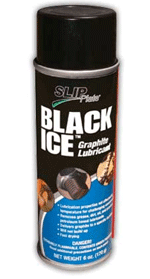
A unique formulation combining a unique solvent cleaner with a friction reducing mineral that first cleans the surface, and then deposits a layer of pure, lubricous graphite powder.

This makes it perfect for gun cleaning!

Our discussion also focused on “What’s inside a can of graphite?” You might think all cans of graphite are the same but they are not. Barry did some research on this subject that finds two things that govern the performance of the graphite product you are using: amount of graphite and the type of graphite. You can find details of his research findings on the Slip Plate website.

Listen to my interview with Barry here: Interview with Barry Lee

Agribusiness, Audio, Company Announcement

World Grain Buyers Get US Producer Perspectives

Jamie Johansen

Grain buyers from around the world in attendance at the 2012 Export Exchange had the opportunity to embrace the US producers perspective on the 2012 crop through a producer panel during the opening general session. Key panelists were Ron Gray, Illinois farmer and Secretary/Treasurer of the US Grains Council, and John Mages, Minnesota farmer and Chairman of the Minnesota Corn Research & Promotion Council.

They shared their personal experiences overcoming the 2012 drought and assured buyers of their fight and passion to raise a consistent and quality product.

Listen to the entire Producers Panel here: Producer Panel at Export Exchange

Following the opening session I took the time to talk with Ron Gray, where he summed up the 2012 corn crop and how farming for him is more than a job, its a personal endeavor.

“For us the 2012 crop started out with all the hope of an extraordinary crop. We planted early, the crop went in very well, emergence was good. Then it didn’t rain. Beginning the second week of May through the first week of August we only had about three inches of total rainfall and because of that our corn crop was severely reduced in production. Our farm probably averaged 50 bushels an acre, which is approximately 1/3 of our normal production. The rainfall did come later and the soybean crop is a fairly good crop, but the corn crop was devastated.”

Listen to my interview with Ron here: Ron Gray Interview

Beyond simply listening to producers, international grain buyers had the opportunity to visit farms across the United States. The goal was to gain information, assess the current US corn crop, explore the availability of other grains such as sorghum and barley, and build relationships leading to future sales.

Many participants expressed a preference for buying US grains due to the consistency and quality of the grain. They also appreciate the transparency and reliability of the US marketing and delivery systems. Clearly price and availability hindered US exports this year, but buyers are looking forward to a better crop next year.

You can find photos from this years Export Exchange here: 2012 Export Exchange

Agribusiness, Audio, conferences, corn, Distillers Grains, Education, Export Exchange, Exports, Farming, sorghum, Soybeans, USGC

Book Review – Clean Energy Nation

Joanna Schroeder

This week I read Clean Energy Nation by Congressman Jerry McNerny and Martin Cheek. I can’t quite put my finger on it, but I found myself likening the book to the classic Brave New World by Aldous Huxley. Subconsciously I think it was because one of the recurring themes in Brave New World, first published in 1932, is the Fordship’s desire, after Our Ford ‘s first T-Model,” for its citizens to “consume manufactured articles as well as transport.” Ironically, a portion of Huxley’s predictions came true – globally, people have been conditioned to consume both manufactured items and transportation. It is expected that by 2020 or so, there will be two billion cars on the road.

Clean Energy Nation is like most other energy books and begins with a history lesson about energy with special attention paid to the use and development of fossil fuels. In the words of the New World controller, “…you all remember, I suppose, that beautiful and inspired saying of Our Ford’s: History is bunk. History,” he repeated slowly, ‘is bunk’.” While history is not bunk, as a global population we seem to think that it is, and it bears saying that recurrent energy history lessons are much needed.

The next section of the book delves into America’s energy issues and covers all the usual suspects including national security, environment, economy, agriculture, public health, education, and good government. (Or in the case of the U.S., bad government. Since 1973, the U.S. Department of Energy has missed 34 deadlines to set mandatory energy standards.). Finally, the book gets into a discussion about America’s energy future.

The discussion about the “crossroads” of America was very motivational. Read More

Alternative energy, book reviews, Clean Energy, Opinion

BP Continues Biofuels Backout

Joanna Schroeder

BP is continuing its biofuels backout with the announcement that it is abandoning its $300 million cellulosic project in Highlands County, Florida. This is the second major announcement of the company moving away from the production of renewable energy. Last December, the company exited the solar business. According to an interview with Matt Hartwig in the Washington Post, the company will continue to focus its U.S. efforts on research and development and licensing its technology.

“Ethanol is not something a lot of people are interested in investing money in,” said Mark Schultz, an analyst at Northstar Commodity Investment Co. in Minneapolis, to the Post. “Corn-based ethanol hasn’t been profitable for about a year. BP is seeing that this isn’t the right street to go down anymore.”

Many advanced biofuels players responded to the news today including Brooke Coleman, the executive director of the Advanced Ethanol Council. “BP has been reallocating its resources when it comes to biofuels for some time. BPs’ decision today signals a move by that company away from that particular project. This happens all the time in the oil, gas, and biofuel industries. As BP pulls back in Florida, the first movers in the space continue to move forward with commercial projects in more than 20 U.S. states. We are expecting first commercial gallons of cellulosic ethanol to come online by the end of the year, which is a tremendous accomplishment in this economic climate.”

Many of the 20 companies mentioned by Coleman are members of the Biotechnology Industry Organization (BIO) Read More

advanced biofuels, AEC, Alternative energy, BIO, Cellulosic, Ethanol, Renewable Energy

Investors Ask for Wind Tax Credit Extension

Joanna Schroeder

Dozens of investors totaling more than $800 billion in assets have called for an immediate extension of the Production Tax Credit (PTC) for renewable energy, specifically wind power. In a letter delivered to Congressional leaders, investors noted that this critical tax credit creates broad economic benefits, both for wind power producers and their suppliers across the nation. Several of these investors met with Congressional staff to discuss their support for the credit.

The PTC provides a tax credit of 2.2 cents for each kilowatt-hour of renewable power generated. Designed to spur investment, the credit has helped the wind energy industry develop a large domestic network of supplies. According to the American Wind Energy Association, the PTC has spurred $20 billion in private investment and the creation of 75,000 jobs. Investors wrote to encourage. The PTC expires at the end of 2012.

“The Production Tax Credit is vital to fostering a vibrant renewable power sector, which will improve our economic competitiveness while also reducing our reliance on fossil fuels,” said Oregon State Treasurer Ted Wheeler, who oversees the management of $72.5 billion of state funds. “Renewable energy generation opportunities beckon from border-to-border in Oregon, and they promise to produce not only clean and sustainable power but also crucial employment and investments in key infrastructure.”

Oregon wind farms now generate enough energy to power 700,000 homes, and the state is the home to the North American headquarters of wind power companies Vestas and Iberdrola Renewables.Read More

Alternative energy, Electricity, Renewable Energy, Wind

Cool Planet – 3 Years, 30 Biomass Plants

Joanna Schroeder

Cool Planet Energy Systems has announced a breakthrough in the commercialization and affordability of biofuels from biomass. Using a mechanical process and scaling approach, the company says it can produce high octane gasoline at the cost of $1.50 per gallon without the need for subsidies and also while removing carbon from the air during the course of production.

The company, backed by Google, BP, General Electric, NRG, and others, says it has already successfully tested the technology internally as well as at Google’s headquarters with its campus vehicle, GRide, that has driven 2,400 miles on the fuel. By running on a 5% Cool Planet carbon negative fuel blended with 95% regular gasoline, the test car blend met California’s 2020 Low Carbon Fuel Standard – eight years ahead of schedule according to a Cool Planet statement.

The statement also said the control car used 100 percent regular gasoline, and successfully passed five smog checks with no significant difference between cars. The total mileage of the test car was virtually the same as the control car, driving a total of 2,490 stop and go miles in the test car compared with 2,514 miles in the control car. Additionally, both the test car and the control car were virtually identical in emissions testing. Other field tests are planned.

“Innovations in alternative fuels will be key in addressing growing climate change concerns,” said Brendon Harrington, Transportation Operations Manager at Google, Inc. “We are thrilled to be a part of Cool Planet’s field testing and believe that this product has the potential to make a significant impact on our future energy needs.”

A byproduct of producing the biofuel from biomass is the activated carbon, or biochar that can be used as a soil enhancer increasing land fertility while isolating the carbon captured from the atmosphere.Read More

advanced biofuels, Alternative energy, biomass, Carbon, Renewable Energy

Meet the Who’s Who at NBB Conference

Joanna Schroeder

There are more than 10 reasons to attend the National Biodiesel Board’s Conference: Momentum, and here is reason number 5: Meet People. This conference marks the 20th Anniversary of the event and is still the place to meet and greet the real players in the biodiesel industry.

The event is being held in Las Vegas (how apropos they would offer a “wheel of savings” for early bird registrants – enter WHEEL100 when you register to receive your discount) beginning February 4, 2013 and ends on February 7, 2013. This gives you plenty of time to work out your elevator, or in this case, 10 second casino pitch.

Momentum offers four tracks: technical, regulatory, marketing, and petroleum so no matter what, your interests will be covered and your question answers.  And if you play your cards right, you may also walk away with a set of great contacts to develop future partnerships.

In anticipation for the event, NBB CEO Joe Jobe filmed some brief remarks.

Now that you’re duly inspired, why don’t you register already?

advanced biofuels, Biodiesel, National Biodiesel Conference