
- The American Coalition for Ethanol (ACE) has joined the ASTM (Formerly American Society for Testing and Materials) Technical Committee D02 on Petroleum Products and Lubricants, represented by ACE Senior Vice President Ron Lamberty.

- Solar garden developer Clean Energy Collective (CEC) is working to build the first community-owned solar garden in Putney, Vermont. Reservations are available for the Putney Community Solar Array, a 147 kW photovoltaic (PV) system. The 588-panel solar garden owners will receive all rebates and tax incentives.
- N.C. State University has been awarded a three-year $6,200,000 award for the Clean Fuel Advanced Technology (CFAT) project from the North Carolina Department of Transportation. The CFAT project focuses on improving air quality in 24 non-attainment counties throughout the state and includes a public education campaign and the launch of a green fleet.
- Sempra U.S. Gas & Power and Consolidated Edison Development are partnering on two of Sempra U.S. Gas & Power’s solar power facilities, the 150-megawatt (MW) Copper Mountain Solar 2 plant near Las Vegas and the 150-MW Mesquite Solar 1 power plant near Phoenix. Under the sales agreement, each company will own a 50-percent interest in the two solar facilities, which are among the largest photovoltaic plants in the U.S.
- CleanFUEL USA has partnered with the City of Springfield, Illinois to convert 24 police cars and pickup truck to propane autogas. Fuel savings for the first year is estimated to be more than $82,000.

EMCORE Wins NASA Solar Contract
EMCORE Corporation has been awarded a contract by ATK to design and manufacture solar panels for NASA’s Green Propellant Infusion Mission (GPIM) planned for launch in 2015. The solar panels include EMCORE’s most advanced XTJ triple-junction solar cells, and will power a satellite that will carry the GPIM payload. ATK will integrate the EMCORE’s solar panels into its heritage-designed solar arrays for final flight configuration for the GPIM satellite.
 One goal of the GPIM project is to demonstrate the practical capabilities of AF-M315E, a high-performance green alternative to hydrazine that has traditionally been used to fuel several spacecraft. This low-toxicity propellant is expected to improve overall vehicle performance – more fuel can be stored in current containers and it delivers greater thrust per given quantity of fuel.
“ATK is pleased to be providing the solar arrays for the GPIM project to Ball Aerospace, and we look forward to another successful collaboration with EMCORE in support of this innovative program,” said Dave Messner, General Manager of ATK Space Systems in Goleta, Calif.
GPIM is supported by co-investigators including NASA’s Glenn Research Center and the U.S. Air Force Research Laboratory at Wright-Patterson Air Force Base in Ohio; Aerojet Corporation, a GenCorp company in Washington; NASA’s Kennedy Space Center in Florida; and the U.S. Air Force Space & Missile Systems Center at Kirtland Air Force Base in New Mexico.
“EMCORE is extremely pleased and honored to receive this program award from ATK,” added Brad Clevenger, Ph.D., General Manager of EMCORE’s Photovoltaics Division. “EMCORE has partnered with ATK on many successful missions, and we greatly value our long-standing business relationship. We look forward to supporting ATK on the Green Propellant Infusion Mission.”
AFAI Completes Jatropha-to-Biodiesel Research
 A Florida-based biodiesel company says it has completed its research into using jatropha as a feedstock at its Central American operation. In a news release published in the Sacramento Bee, Alternative Fuels Americas, Inc. (AFAI) says it successfully completed research trials and is moving to establish above ground oil fields as a staged entry into a market forecasted to exceed $500 billion by 2019.
AFAI operates a 25 acre pilot plantation with 40,000 mature Jatropha trees in Tempate, Costa Rica. During the past years AFAI has conducted trials to establish best-practice protocols for maximum crop yield and production profitability. AFAI has successfully concluded its trials and plans to transition its activities to commercial scale.
“We have a strong degree of certainty that we can successfully farm and harvest Jatropha for the purpose of profitably producing biodiesel. We have dedicated much time and substantial resources to reaching this goal, which was a necessary rite of passage,” comments AFAI CEO Craig Frank. “Now that we have reached our breakthrough we can continue towards profitably producing and selling biodiesel and initiate our plans to enter additional markets worldwide.”
AFAI considers itself a “seed to pump” vertically integrated energy company.
REAP Deadline Extends, Creates More Biogas Opps
 The U.S. Department of Agriculture extends the deadline on a program that could see more farmers, especially those in the dairy industry, turning livestock waste into energy. The deadline to submit for funds under the Rural Energy for America Program (REAP) and Dairy Industry Memorandum of Understanding has been extended to to May 31, 2013. During a teleconference moderated by Jerry Bingold from the Innovation Center for U.S. Dairy, the USDA’s Energy Policy Advisor for Rural Development Todd Campbell said this is a top priority of his agency.
“Taking biomass feedtsock and creating renewable energy, helping to implement enhanced manure management techniques, it not only helps our dairy farmers across the country to continue to be the great stewards of the land, it makes also makes real dollars and cents in their farming operations,” Campbell said.
Kelley Oehler, USDA’s Branch Chief Energy Division said the budget battles that have resulted in continuing resolutions, instead of real federal budgets, actually helped more money go to REAP.
“We’re still working with budget to identify the specific amount, but what I can tell you is it is significantly more than the [$20.8 million original amount announced in the March 29, 2013 deadline],” Oehler said.
More money meant they needed more time to give out the grants for things such as grants for under $20,000 programs, feasibility study grants (up to $50,000), and grants and combination grants-loans for things like biodigesters (which could be up to $500,000 for those digesters) that dairy farmers can use to turn waste into energy. Guaranteed loan-only deadlines remain at July 15, 2013. (More information available here.) Another program, the 9005 Program (for advanced biofuels payments made from things, such as biodigesters) will have a notice go out shortly that will have an additional 30 days, usually sometime in October.
Meanwhile, Campbell and Oehler praised the recent renewal of the Memorandum of Understanding (MOU) signed to accelerate the adoption of innovative waste-to-energy projects and energy efficiency improvements on U.S. dairy farms, both of which help producers diversify revenues and reduce utility expenses on their operations. The original MOU was signed in Copenhagen, Denmark, in 2009.
“Through the renewed commitment, the USDA, working with the Innovation Center for U.S. Dairy, will continue the research, development and deployment of these technologies that are helping to make dairy farmers’ operations more sustainable,” Campbell said.
Listen to an edited version of the teleconference here: USDA Teleconference on REAP
Is Ag Marketing Itself Well or Not?
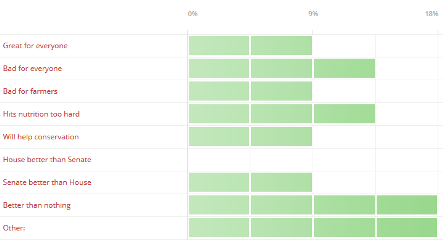
With all the farm bill activity in Congress this past week, our latest ZimmPoll asked “What’s your opinion of committee farm bill?” From the results, most think it’s better than nothing.
Our poll results: 18% said Better Than Nothing and Other, 14% said Hits Nutrition Too Hard and Bad For Everyone, nine percent said Senate Better Than House, Bad For Farmers, Will Help Conservation and Great For Everyone, and nobody said House Better Than Senate. Poll results are all over the charts this week with mixed reviews and disagreement with particular sections of the farm bill.
Our new ZimmPoll is now live and asks the question, “Is agriculture doing a bad job of marketing?” Marketing seems to be the key to a successful industry. The public often gets a bad taste for agriculture after “issues” hit the media. Do we cover our tracks and market the good along with the benefits to agriculture, not to mention the must haves of it? Let us know.
ZimmPoll is sponsored by  .
.
Absolute Energy Offers Drivers Relief at the Pump
As Memorial Day approaches marking the beginning of summer driving season, gas prices have spiked. Last week, gas prices went up .19 cents per gallon in  Iowa with ending average prices at $3.70 per gallon. Spikes were even higher in Minnesota/St. Paul with prices averaging $4.21 across the state while the national average is around $3.60 per gallon.
In response Absolute Energy, an ethanol plant located on the Iowa-Minnesota border, is offering Minnesota drivers some relief at the pump in the form of ethanol. Absolute Energy is offering E85, (85 percent ethanol / 15 percent gasoline), in bulk to gas marketers impacted by the recent shut-down of three oil refineries for mostly seasonal reasons. According to E85Prices.com this week, the published average statewide E85 price is averaging $3.08 and has been reported to be as low as $2.39 per gallon in Eagan, Minn.
Rick Schwarck, CEO of Absolute Energy, said, “With gas prices spiking and ethanol plentiful in the Midwest, this will be the summer of the flex-fuel vehicle. Drivers of FFVs should be able to take advantage of serious savings at the pump by using E85. Not only will they be saving money, they will be choosing a fuel alternative that creates jobs and opportunities throughout Minnesota, Iowa and other states. E85 will drive us toward a cleaner, brighter summer sky thanks to lower greenhouse gas emissions while also strengthening our national security and economy.”
Ag Processing Shuts Its Doors
 Ag Processing Inc a cooperative (AGP) announced it has permanently shut down operations of its corn processing plant at Hastings, Nebraska. The plant had been on an extended shutdown since February 1, 2013 amid challenging economic conditions. At that time, the company said it would continue to evaluate the future of the plant. This week the decision to permanently close the corn processing operations was made public.
The cooperative also operates a soybean processing plant, a vegetable oil refinery and an AminoPlus production facility at its industrial complex in Hastings. Company officials reiterated that those operations will not be impacted by the closing of the ethanol plant operations.
AGP is the largest farmer‐owned soybean processor in the world, is owned by 178 local and regional cooperatives representing over 250,000 farmers from 15 states throughout the United States. Corporate headquarters are located Omaha,Nebraska.
JinkoSolar Partners with GRID Alternatives
 JinkoSolar has entered in to a partnership with GRID Alternatives, a U.S. nonprofit solar installer, to donate 150kW of its solar modules towards the installation and training of volunteers of solar electric systems exclusively for low-income homeowners. The company says its donation will provide savings of over $2 million for low-income families over the systems’ lifetimes, and support more than 700 hours of hands-on installation training.
“JinkoSolar is delighted to have the opportunity to provide installation and training experience in clean solar energy to US low-income communities,” said Mr.Nigel Cockroft, General Manager of JinkoSolar USA. “Having participated in numerous other charitable projects across the globe, we applaud GRID Alternatives for their contribution to sustainable energy development.”
GRID Alternatives’ mission is to empower communities in need by providing renewable energy and energy efficiency services, equipment and training. Since 2004, GRID Alternatives has installed more than 8.5 MW of clean, renewable power for over 3000 families and has provided over 11,000 volunteers and job trainees with solar installation experience.
“The donation of equipment from our manufacturing partners provides benefits to families who save on energy; Workers who need jobs; and an industry that needs skilled labor,” added Ms. Erica Mackie, GRID Alternatives co-founder and Chief Executive Officer. “We’re thrilled to have JinkoSolar as a partner.”
Canada to Fund Algae-to-Biodiesel Project
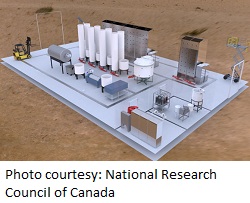 A joint project between the National Research Council of Canada (NRC) and industry partners could result in technology to grow algae to be made into several items, including biodiesel, in the heart of the Canadian petroleum industry: oil sands facilities.
The Algal Carbon Conversion Pilot Project, a partnership among the National Research Council of Canada (NRC), Canadian Natural Resources Limited (Canadian Natural) and Pond Biofuels, will result in the construction of a unique, $19 million facility in Alberta.
“This discovery has tremendous potential to benefit our environment and our economy, and further establish Canada as a leader in managing CO2 emissions,” said the Honourable Gary Goodyear, Minister of State (Science and Technology). “What the results of this project could mean for the future of the oil sands and Canadian businesses makes this a significant day for Canada.”
In the coming months, a demonstration-scale algal biorefinery will be established at Canadian Natural’s Primrose South oil sands site, near Bonnyville, Alberta. This facility will recycle industrial emissions from their oil sands facility by using carbon dioxide to grow algal biomass, which will undergo further processing into products, such as biofuels, livestock feed and fertilizer.
Officials say the project will lessen the oil industry’s carbon footprint, while marking this unique partnership between fossil fuels and renewable industries.
Investors Interested in Fossil Fuel-Free Portfolios
According to a recent survey conducted by SRI, 65 percent of retail investors and 53 percent of institutional investors are currently expressing interest in fossil fuel-free portfolios in reaction to climate change. More than 2,000 SRI industry professionals took the First Affirmative Financial Network’s Fossil Fuels Divestment Survey in anticipation of the 24th annual SRI Conference taking place October 28-30 in Colorado Springs, Colorado.
Other key survey findings include:
- 77 percent see growing risks for investors associated with fossil fuel company holdings in their investment portfolios.
- 30 percent of those surveyed either already do – or are getting ready to – offer fossil-fuel free portfolios to investors.
- 63 percent believe that investors will in the next 10 years start divesting in meaningful numbers from fossil-fuel companies due to climate change implications of such energy sources.
 “The survey findings strongly suggest that fossil fuel free investing is one of the SRI industry’s next big issues. Ours is an incredibly dynamic field, and as we develop the agenda for the 24th annual SRI Conference in October, we are working hard to present speakers and sessions focused on the most timely, important, and pressing topics,” said First Affirmative President Steve Schueth, producer of The SRI Conference. “Fossil fuel free investing is already becoming a nationwide movement, and it’s likely to gain momentum as the impacts of climate destabilization are felt far and wide.”
Sixty-seven percent of respondents believe that 2013 is the right time for investors to assess and perhaps alter their approach to investing in traditional energy companies, while 40 percent of those surveyed worry about increased diversification risk in fossil fuel free portfolios, in their role as a fiduciary to clients. In addition, 24 percent of those surveyed said they would be able to adequately replace the most carbon-intensive fossil fuel companies in portfolios they managed/advised with holdings that exhibit similar risk/return characteristics.