Grupo T-Solar Powers Up Plant in Cali

Joanna Schroeder

Spain-based Grupo T-Solar has successfully completed its first photovoltaic solar plant in El Centro, California. The solar plant, located in the municipality of Centro (Imperial Valley, California), occupies 140 acres of land and will produce 55 GWh per year, equal to an energy consumption of more than 12,000 inhabitants. The sale of energy is regulated by a 30-year Power Purchase Agreement (PPA) with the company IID (Imperial Irrigation District).

“USA is one of the target markets for the growth of Grupo T-Solar and a key part of our long term business strategy”, said Marta Martinez, CEO of Grupo T-Solar.

Grupo T-Solar Centro Cali project The project in El Centro has an investment of over U.S. $75 million (more than 55 million euros) and has been financed and supported by several international financial institutions including North American Development Bank, as senior lender; Santander Bank NA, a subsidiary of Banco Santander, as Tax Equity Investor; Astris Finance, a financial advisory firm specializing in energy and infrastructure structured finance in the Americas, acted as financial advisor; and CCA Group, a FINRA-registered broker-dealer specializing in renewable energy, acted as advisor for the tax equity component.

“We are very grateful and proud to cooperate with the City of El Centro in a joint effort to preserve and enhance environmental conditions and quality of life for people living in Imperial County”, said Marta Martínez.

The new solar plant is located in an area considered as priority by U.S. and Mexican Governments in its effort to preserve and improve the environmental conditions and the quality of life of the people who live on the border between the two countries.

According to the company strategy in the U.S. market, Grupo T-Solar has just been awarded a MATOC (Multiple Award Task Order Contracts) by the Department of Defense. The program has a budget of $7 Billion with the goal of installing 3,000 MW of renewable energy in the facilities of the U.S. Army until 2025.


Alternative energy, Solar

Year End Equipment Purchase Intentions

Talia Goes

zp-nhOur latest ZimmPoll asked the question, “Do you plan to make any year-end equipment purchases?”

Our poll results:

· No. Not this year: 35%
· Yes – Planting equipment: 18%
· Yes – Sprayers: 12%
· Yes – GPS/guidance: 12%
· Yes – Hay equipment: 6%
· Yes – Harvest equipment: 6%
· Yes – Tillage: 6%
· Yes – Other: 6%

Looks like most of the farmers out there are either up-to-date on equipment or satisfied with what they have. Are things like Farm Bill uncertainty holding you back?

Our new ZimmPoll is now live and asks the question, “Which winter farm shows/events are you planning to attend?” Are you planning to get out of the house to browse new products and services this fall and winter or wait and see what spring brings? Let us know!

ZimmPoll

USDA, DOD Announce Farm-to-Fleet Program

Joanna Schroeder

U.S. Agriculture (USDA) Secretary Tom Vilsack and Secretary of the Navy Ray Mabus have announced a joint “Farm-to-Fleet” venture to make biofuel blends part of regular, operational fuel purchases and use by the military. The announcement incorporates the acquisition of biofuel blends into regular Department of Defense (DOD) domestic solicitations for jet engine and marine diesel fuels. The Navy will seek to purchase JP-5 and F-76 advanced drop-in biofuels blended from 10 to 50 percent with conventional fuels. Funds from USDA’s Commodity Credit Corporation (CCC) will assist the effort.

military use of biofuels“The Navy’s intensifying efforts to use advanced, homegrown fuels to power our military benefits both America’s national security and our rural communities,” said Vilsack. “Not only will production of these fuels create jobs in rural America, they’re cost effective for our military, which is the biggest consumer of petroleum in the nation. America’s Navy shouldn’t have to depend on oil supplies from foreign nations to ensure our national defense, and rural America stands ready to provide clean, homegrown energy that increases our military’s energy independence and puts Americans to work.”

Farm-to-Fleet builds on the USDA/U.S. Navy partnership inaugurated in 2010, when President Barack Obama challenged his Secretaries of Agriculture, Energy and Navy to investigate how they could work together to speed the development of domestic, competitively-priced “drop-in” diesel and jet fuel substitutes.

“A secure, domestically-produced energy source is very important to our national security,” said Navy Secretary Mabus. “Energy is how our naval forces are able to provide presence around the world. Energy is what gets them there and keeps them there. The Farm-to-Fleet initiative we are announcing today is important to advancing a commercial market for advanced biofuel, which will give us an alternative fuel source and help lessen our dependence on foreign oil.”

The announcement marks the first time alternative fuels such as advanced drop-in biofuels will be available for purchase through regular procurement practices. It lowers barriers for alternative domestic fuel suppliers to do business with DOD. Preliminary indications from the Defense Production Act Title III Advanced Drop-in Biofuels Production Project are that drop-in biofuels will be available for less than $4 per gallon by 2016, making them competitive with traditional sources of fuel.

The program gets underway with a bulk fuels solicitation in 2014, with deliveries expected in mid-2015. USDA and Navy also are collaborating on an Industry Day, Jan. 30, 2014, where stakeholders can learn more about Farm-to-Fleet.

Listen to the press announcement with Ag Secretary Vilsack and Secretary of the Navy Ray Mabus here: USDA, DOD Announce Farm-to-Fleet Program

advanced biofuels, Agribusiness, Audio, military

Standard Ethanol Selects Greenbelt Technology

Joanna Schroeder

Greenbelt Resources Corporation has been selected by Australia-based Standard Ethanol Pty. Ltd to design and deliver an end-to-end commercial-scale advanced biofuel system for converting wheat feedstock to ethanol and organic fertilizer.

The module is designed to enable beverage producers and agri-businesses to locally recycle organic wastes into usable products. The customized modular system for Standard Ethanol will include proprietary distillation and dehydration modules and a plant-wide implementation of automated process controls. This commercially-viable system, designed to produce fertilizer and 0.5 million gallons per year (MMGY) fuel-grade ethanol, is scheduled for delivery in 2014.

“This system design will prove that converting waste to bioenergy is a profitable endeavor for our industry and the customers we serve,” said Darren Eng, CEO of Greenbelt Resources Corporation. “The management team leading the effort at Standard Ethanol has a strong track record for executing on visionary business innovations and their contract with us is an important validation of our technology and expertise.”

plant_image_smallerStandard Ethanol conducted a worldwide search over a four year period that included visits to the Greenbelt Paso Plant in Paso Robles, California, and to the Stan Mayfield Biofuel Center at the University of Florida, where a distillation module purchased by the university is currently in operation. Standard Ethanol said they selected Greenbelt Resources as the best technology partner based on verifiable experience, high-quality workmanship and a reputation for delivering performance outcomes which exceed expectations. The system will recycle wheat and the company plans to use the ethanol to fuel its own irrigation pumps and vehicles or sell it within the local community.

“After an international search, choosing Greenbelt Resources as the partner for developing our bioenergy facility came easily due to their impressive technology and versatile business model,” said Larry Walsh, Director, Standard Ethanol Pty Ltd. “By adding this system we will gain added value from lower grades of wheat while we also begin to achieve a measure of local energy independence.”

The directors of Standard Ethanol were recently involved in completing another large venture in Australia with the construction of a fully operational cotton gin. Projected cost to operate the system from Greenbelt Resources is estimated to be below one dollar per gallon of biofuel produced.

advanced biofuels, Agribusiness, Waste-to-Energy

Biodiesel, Solar Powered RV Ready to Hit the Road

John Davis

etrekWhile the weather outside might be frightful, it won’t be too much longer until thoughts will be turning to getting out in the great outdoors, and a company called Roadtrek has a way you can do it using biodiesel and solar power. This article from the Gas2 blog says Roadtrek has unveiled the new E-trek, a B+ class motorhome that also uses recycled materials in its construction.

Built on Mercedes’ Sprinter van platform, Roadtrek’s eco-friendly E-Trek is powered by a 3.0 liter Mercedes diesel engine that’s 100% bio-diesel capable. The diesel is used as the primary power plant to drive the RV, and is also capable of feeding the E-Trek’s electrical system and batteries. When parked, the diesel generates 3.5 KW of power that gets bumped up to 5.5 KW while it’s on the move. Still, that’s not the most visible “green” feature on the E-Trek- that award goes to the roof-mounted, 245 watt solar panel array that continuously charges a bank of 8 AGM batteries and a 5000 watt power inverter (you’ll need that to plug standard 110/220 appliances into the outlets).

Roadtrek calls the E-Trek “the most eco-friendly motor home in the universe”. It’s not just an empty claim, though- they back that up with the batteries, solar panels, biodiesel engine, and even the composite body of the RV, itself, which uses a recycled cotton and denim insulation to help regulate temperature and a recycled, paper-based material in the counters and cabinets. Roadtrek is helping cut back carbon emissions and push back against harmful fracking operations as well, by totally eliminating propane and natural gas (full-timer RV staples) from the E-Trek’s operations.

It doesn’t come cheap, with a price tag of around $130,000. But the company does have a link for rentals on its website, so maybe it would be worth a spin around the block this summer.

Biodiesel, Solar

Multi-Feedstock Biodiesel Plant in France Ready

John Davis

BDI-franceAn Austrian company is bringing a multi-feedstock biodiesel plant in France into operation. BDI – BioEnergy International AG announced the $22.5 million project uses animal fats and used cooking oil as its feedstock.

The commission covered the entire BioDiesel process, including installation of the plant. The project was completed on schedule and as budgeted within eleven months, when it was handed over to the satisfied customer. The biggest Multi-Feedstock BioDiesel plant in France does not process the predominant raw material in France (rapeseed oil); instead of this, it produces high-quality BioDiesel solely from waste materials and animal fats.

The French customer ESTENER can benefit from this plant in an additional way too, because BioDiesel manufactured from waste materials in France counts double towards the achievement of the national renewable energy targets.

“We are particularly proud that our technology was chosen for the construction of the first Multi-Feedstock BioDiesel plant in France and that we have succeeded in satisfying our customer by implementing the project successfully”, says Dr. Edgar Ahn (CSO).

BDI – BioEnergy International AG builds customized biodiesel plants using vegetable oils, used cooking oils and animal fats.

Biodiesel, International

Sapphire & Phillips 66 Embark on Algae Partnership

Joanna Schroeder

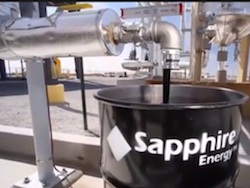
Sapphire Energy Algae Crude OilAlgae-based Sapphire Energy and Phillips 66 have announced a joint development agreement with the goal of taking production of algae crude oil to commercial scale production. The companies will work together to collect and analyze data from co-processing of algae and conventional crude oil into fuels. The goal is to complete fuel certifications to ready Sapphire Energy’s renewable crude oil, called Green Crude, for wide-scale oil refining.

Under the agreement the companies will expand Sapphire Energy’s current testing programs to further validate that Green Crude can be refined in traditional refineries and meet all of the Environmental Protection Agency’s (EPA) certification requirements under the Clean Air Act. This includes determining the optimal operating conditions for processing algae crude oil into American Society for Testing and Materials (ASTM)-certified diesel, gasoline and jet fuel. Once the study is finished, the companies will work together to complete the EPA certification process to register a new fuel product entering the market.

“In under a year, Sapphire Energy has entered into contracts with two major companies in the oil and gas industry, showing that there is increasing momentum for algae fuel as a viable crude oil alternative, and significant interest by refiners to have new and better options to meet the California Low Carbon Fuel Standard (LCFS) and the federal Renewable Fuel Standard (RFS),” said Cynthia ‘CJ’ Warner, CEO and chairman of Sapphire Energy. “We’re looking forward to building a strong relationship with Phillips 66, an established leader in research and development for next generation fuels, who understands the opportunity our Green Crude oil holds as a feasible and sustainable crude oil choice for refiners.”

Combining Phillips 66’s experience in algae research and technical expertise in hydroprocessing and fuels upgrading with Sapphire Energy’s algae cultivation knowledge could yield promising results. Phillips says this new relationship with Sapphire Energy complements their other renewable fuels collaborations in academia and other sectors to convert a wide array of sustainable feedstocks to transportation fuels. The company’s biofuels platform is one piece of a technology strategy that also includes research and development of fuel cells and solar cells.

“Phillips 66 is committed to providing energy and improving lives. We are continually on the lookout for promising technology advances in energy manufacturing and logistics,” said Merl Lindstrom, vice president of Technology for Phillips 66. “We believe this joint development project with Sapphire Energy could produce a refinery-ready, sustainable product for Phillips 66, creating yet another exciting opportunity in this rapidly changing energy landscape.”

Sapphire Energy is now producing crude oil daily from algae biomass cultivated and harvested at the company’s Green Crude Farm, located in Columbus, New Mexico. The company says the farm is the world’s first algae-to-energy facility that demonstrates the entire value chain of algae-based crude oil production, from cultivation, to harvest, to the conversion of biomass into ready-to-refine crude oil.

advanced biofuels, algae, Renewable Energy, RFS

DOE Invests $13M in Solar

Joanna Schroeder

The U.S. Department of Energy (DOE) has announced over $13 million for five projects that they say will strengthen domestic solar manufacturing and speed commercialization of photovoltaic and concentrating solar power (CSP) technologies. The awards were given under the SunShot Initiative, a program aimed at creating a competitive solar industry in the U.S.

Screen Shot 2013-12-11 at 11.25.56 AM“The strong, continued growth in the U.S. solar industry over the past few years is giving more and more Americans access to affordable clean energy,” said Energy Secretary Ernest Moniz. “We have a tremendous opportunity for American manufacturing to lead the global clean energy market and help pave the way to a cleaner, more sustainable energy future.”

According to a new U.S. solar industry report, the U.S. solar market continues to grow – reaching record-breaking levels. In Q3 2013, the United States installed 930 megawatts of photovoltaic, up 20 percent over Q2 2013 and representing the second largest quarter in solar installations in U.S. history. Cumulatively, solar capacity has already surpassed 10 gigawatts and by the end of the year more than 400,000 solar projects will be operating across the country.

Matched by over $14 million in private cost share, the DOE’s investment will help companies in California, Colorado, Georgia, Pennsylvania and Oregon develop cost-effective manufacturing processes for photovoltaic and CSP technologies. For example, Colorado-based Abengoa Solar will develop new methods to produce concentrating solar power trough systems, helping to lower overall production costs and support easy and quick on-site assembly. PPG Industries, headquartered in Pennsylvania, will lead a project to cut solar module manufacturing costs in half, while Georgia-based Suniva will develop a low-cost highly efficient silicon photovoltaic cell.

Broadly, the DOE investment announced today will help drive affordable, efficient solar power in the United States and help industry partners meet the SunShot Initiative’s goal to make solar energy fully cost-competitive with traditional energy sources by the end of the decade. These awards also support the Department’s broader Clean Energy Manufacturing Initiative to increase the efficiency of the U.S. manufacturing sector and ensure that clean energy technologies continue to be made in America.

Alternative energy, Solar

Murphy USA Opens First E15 Station

Joanna Schroeder

logo-murphy-usaMurphy USA has opened the first E15 (15 percent ethanol, 85 percent gasoline) station in Arkansas, located at 2720 N. West Avenue in El Dorado. The Arkansas station is also the second Murphy USA location to offer E85 (85 percent ethanol, 15 percent gasoline). E15 is approved for vehicles 2001 and newer, while both E15 and E85 can be used in flex fuel vehicles. Murphy USA operates 1,179 stores in 23 states throughout the country, with additional E15 and E85 locations being planned in the Midwest.

“It is very encouraging to see a major retailer like Murphy USA understand the value in offering ethanol-blended fuels like E15 and E85, and we are confident they will have a positive experience,” stated Robert White, director of market development for the Renewable Fuels Association (RFA). “Retailers across the country are always looking for new opportunities to increase volumes and margins, while also attracting new consumers, and E15 and E85 are the perfect fit.”

The very first E15 station opened over a year ago in Lawrence, Kan. With the addition of the Arkansas station, there are now more than 60 stations in 12 states registered to offer the higher level fuel blend. E15 is the most tested fuel additive in the history of the Environmental Protection Agency and has been on the market for more than 16 months and driven over 45 million miles with no known cases of engine damage. Additionally, E85 has been available since 1995. There are now approximately 3,216 stations that sell E85 and more than 15.5 million flex-fuel vehicles on the roads.

Listen to the interview with Robert White about Murphy Oil’s E15 rollout strategy: Murphy USA Embraces E15

Audio, biofuels, E15, E85, Ethanol, RFA

Gen Wesley Clark Testifies on RFS

Joanna Schroeder

General Wesley K. Clark (Ret.), co-chair of Growth Energy’s Board of Directors testified on the numerous benefits of the Renewable Fuel Standard (RFS) before the Senate Environment and Public Works Committee today. One of his messages is that a reduction in the renewable fuel volume requirements of the RFS will move the biofuel industry backwards.

Growth_Energy_logo-1“My message to the Committee is this: the Renewable Fuel Standard (RFS) is an overwhelming success. It has reduced our dependence on foreign oil and made our nation more energy independent, created American jobs, revitalized rural America, injected much-needed competition into a monopolized vehicle-fuels market, lowered the price at the pump, and improved the environment. That is a great record of accomplishment – one that I would call a brilliant success. It is wise policy, and a tribute to its bipartisan passage.”

During his remarks, General Clark noted that the RFS has provided, “real, tangible results that benefit every American today. But if some had their way, we’d throw all of this progress away so the incumbents can shut out competition and maintain their stranglehold on the wallets of American drivers so that Americans will never escape the burden of imported oil and imported, monopolistic fuel pricing.”

Clark is a retired four star general and an expert on issues of national security. He attempted to impress on the committee, “The U.S. continues to be extremely vulnerable to shocks in the oil supply and price disruptions –from both foreign supply and the domestic supply chain. During the last decade, the price of oil has nearly quadrupled, going from roughly $25 per barrel in 2001 to nearly $100 per barrel today; that price disruption has had a significant impact on American consumers and the American economy, with the price of gasoline rising from $1.09 per gallon in 2001 to roughly $3.25 per gallon today.” General Clark will also explain that the U.S continues to spend billions each year to protect oil supply routes in the Middle East, which could be dramatically reduced with the increased use of homegrown American fuel.

In response to the EPA’s proposed rule, General Clark pointed out that, “The EPA proposal sets us back on the path to fulfillment, will chill investment in biofuels, rewards deliberate and willful resistance to the law, and will encourage further and more intensive efforts to gut RFS in the years ahead. It would cause severe harm to farmers, the biofuels industry, and the nation’s economy. This proposal is already creating great uncertainty for farmers and other industry investors.”

He concluded, “The RFS is a policy that is working…The bottom line is that this is a policy that benefits all Americas…and we can no longer afford to be 90 percent dependent on fossil fuels.”

biofuels, EPA, Ethanol, Growth Energy, RFS