EPA, DOT Unveil Hip, New Fuel Economy Labels

Joanna Schroeder

Amidst high gas prices consumers, legislators and NGO’s (non government organization) have all called for stricter fuel economy standards. Yesterday the U.S. Environmental Protection Agency and the U.S. Department of Transportation unveiled new fuel economy labels designed to help consumers take advantage of increased efficiency standards enacted under the Obama Administration. The increased fuel economy standards are designed to help save consumers money at the pump.

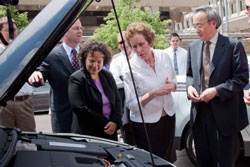
Changes to the new labels are the most dramatic in over 30 years, and provide more comprehensive fuel efficiency information, including estimated annual fuel costs, savings, as well as information on each vehicle’s environmental impact. The announcement was made today at electric car maker Tesla‘s headquarters in Palo Alto, California.

“Smart energy policy, advanced engineering, and technology are working together to move the auto industry forward,” said EPA Regional Administrator Jared Blumenfeld. “The Obama Administration delivered the first-ever tailpipe greenhouse gas emission and fuel efficiency standards. What we are doing today, with the new labels, is helping the American public make decisions that can reduce the burden on their pocketbooks, and the burden on our environment.”

The improvements to the fuel economy labels will give consumers better, more complete information to consider when purchasing new vehicles. Starting with model year 2013, the improved fuel economy labels will be required to be affixed to all new passenger cars and trucks – both conventional gasoline powered and “next generation” cars, such as plug-in hybrids and electric vehicles. The new rules, passed in 2010, should improve fuel economy of cars and trucks built between 2012-1016 to the tune of 1.8 billion barrels of oil over the life of the program and save consumers an average of $3,000 in fuel costs. Switching to an electric vehicles should reap even more savings at the pump.

“Looking at the true cost of gasoline – not just at the pump, but the cost in terms of our national security, our economy and the environment – electric vehicles simply make the most sense,” said Tesla VP of Corporate Development Diarmuid O’Connell. “Tesla is committed to putting as many affordable electric vehicles on the road as quickly as possible to end our reliance on foreign sources of oil and reduce the economic shocks that are driven by the volatility of oil prices.”

Click here to see versions of the new labels and click here to see side by side comparisons of the new labels versus the old labels.

Electric Vehicles, Environment, Flex Fuel Vehicles

What State Should Have Biofuel Bragging Rights?

Joanna Schroeder

Minnesota and Wisconsin are in a battle to claim bragging rights as the best biofuel retailer. Two fuel retailers – one in Minnesota and one across the border in Wisconsin – have renewed a friendly rivalry to determine which station can sell more E85 during a promotion on Thursday, June 2, 2011 from 4-6 pm. This will be the second time the two stations on opposite sides of the St. Croix River battle it out for biofuel bragging rights.

The participating stations include Freedom Valu station at 1535 Beam Avenue in Maplewood, Minn. and the Bob & Steve’s BP station at 101 Aspen Drive in Somerset, Wisc. Both will discount E85 by 85 cents per gallon during the two-hour “E85 Border Battle” promotion. Wisconsin won the first contest by a slim margin last year.

Last year even state mascots were involved with Goldy Gopher cheering on customers in Minnesota and “Alice in Dairyland” promoting E85 in Wisconsin. They are expected to renew the rivalry again this year.

There will be a 30 gallon limit per customer during the E85 Border Battle promotion and customers should know that E85 is only intended for use in flex-fuel vehicles. Not sure if you own an FFV? There will be ethanol enthusiasts on hand to answer this question and any others you may have.

The event is being organized by the American Lung Association chapters in Minnesota and Wisconsin, which recognizes cleaner-burning E85 as a “Clean Air Choice™” fuel. Other supporters include the Wisconsin Corn Growers Association, Minnesota Corn Growers Association, Bob & Steve’s BP Amoco Shops, Erickson Oil and the Minnesota and Wisconsin Clean Air Choice Teams. For more information, see www.CleanAirChoice.org.

E85, Education, Ethanol, Ethanol News

Lakeside Dairy Goes Solar

Joanna Schroeder

Agriculture gets greener everyday. Lakeside Dairy in Hanford, Cali. has gone solar. The dairy installed a new solar energy system to power its milking barn and other dairy operations. With the system in place, they expect to cut their conventional energy use by 75 percent. The family-owned dairy has 7,000 head of cattle and a custom farming business. I don’t know about you but I’m thinking a California cow is a happy cow!

The 891 kilowatt solar energy system was designed and installed by SPG Solar. It is comprised of 3,240 Suntech solar modules and two Solaron inverters. It is estimated that the system will generate more than 1.7 megawatt hours annually – enough to offset the dairy’s utility power usage by at least 75 percent.

“The recent volatility of milk prices has underscored the importance of hedging our input costs,” said Mike Monteiro, the dairy’s owner. “The solar energy system will help us fix our energy costs and hedge against long term increases in utility power rates.”

The solar system spans four-acres and is robust enough to power Lakeside’s entire dairy operation including an 11,000 square foot milking barn, heifer corral lighting and fans, manure separator equipment and well and irrigation equipment. This is just one effort engaged by the diary operation to become more sustainable. The farm’s manure-handling equipment removes nearly 50 tons of solid manure a day, thus preventing it from going into the lagoon or giving off gases from decomposition.

“Lakeside Dairy continues to show its commitment to solar that positively impacts their operations today, reducing future electricity costs and investing in the community through the creation of green jobs,” said CEO and President of SPG Solar, Chris Robine. “They are laying out a long-term strategy towards the sustainable production and quality of food produced.”

Rabobank provided the construction and term financing for the solar project and will work with Lakeside to help them manage their finances as they pay off the loan. Gianluca Signorelli, Vice President of Renewable Energy Finance for Rabobank added, “By combining the savings from lower utility power bills with federal and state incentives, Rabobank structured the term loan to potentially be cash flow positive throughout the lifetime of the loan. Once the loan is repaid, the solar system is likely to create even larger savings for Lakeside Dairy.”

Agribusiness, Electricity, Energy, Solar

Sabine Biofuels Formed to Produce Biodiesel

Joanna Schroeder

A new venture was announced today between Endicott Biofuels (EBF) and Holly Biofuels, a subsidiary of Dallas-based petroleum refiner Holly Corporation. The two companies formed Sabine Biofuels LLC to build and operate a 30 million-gallon-per-year biorefinergy to produce biodiesel from inedible fats. The facility is currently under construction in Port Arthur, Texas.

“This joint venture will assist Holly in meeting its biofuel obligations under the federal Renewable Fuel Standard,” said George Damiris, senior vice president for Supply and Marketing of Holly. “We are looking forward to our partnership with Endicott on this venture, and possibly others in the future.”

Sabine Biofuels will employ patent-protected Davy technology and licensed to EBF in North America.

David Robinson, CEO of EBF added, “We are extremely pleased to join forces with Holly on this opportunity. Both of our companies understand the value of finding renewable, economic sources of transportation fuel to supplement traditional petroleum sources. We believe the combination of Endicott’s unique, proven process with Holly’s industry-leading petroleum refining, distribution and marketing capability will make Sabine Biofuels the absolute leader in biorefining.”

Biodiesel, biofuels

GRFA- Diversification of Global Fuel Supply Needed

Joanna Schroeder

The G8 Summit and the OECD’s annual International Transport Forum has kicked off today in Leipzig, Germany to discuss the future of transportation on a global scale. During the event, the Global Renewable Fuels Alliance (GRFA) is calling on them to immediately adopt the International Energy Agency’s (IEA) Technology Roadmap: Biofuels for Transport. This roadmap suggests that biofuels could account for more than one quarter of the world’s transport fuels by 2050.

Bliss Baker, spokesperson for the GRFA, said, “Meetings like these are crucial opportunities to address energy security issues that must not be wasted. In April the IEA provided a comprehensive roadmap for reducing our crude oil reliance which included the widespread use of biofuels and we must take advantage of this opportunity.”

GRFA noted that record gas prices have occurred worldwide during the month of May. Baker stresses that a diversified fuel supply system will “alleviate our crippling reliance on crude oil.” This is the same strategy promoted by the IEA report. To support the organization’s position on biofuels, Baker highlighted two U.S. university economists who found that the presence of ethanol in the U.S. fuel supply kept gasoline prices 89 cents lower per gallon than if ethanol were not blended in the fuel. He also conveyed that even OPEC recognized in a recent forecast that “energy efficiency policies along with the use of biofuels will put downward pressure on oil consumption worldwide.”

Some of the findings of the report included:

• Biofuels providing 27% of global transport fuel by 2050
• Avoiding 2.1 gigatonnes of CO2 emissions by displacing gasoline
• Achieving these targets without compromising global food security

“The GRFA has long advocated that biofuels are the best way for the world to reduce its reliance on crude oil. In light of the IEA’s findings it is imperative that the G8 and OECD recognize the vital role biofuels can play in solving some of the world’s energy security problems,” Baker concluded.

biofuels, Ethanol, International

Waste Management Opens CNG Station in Chicago

Joanna Schroeder

Waste Management (WM) of Illinois has opened a new filling station for compressed natural gas (CNG) in Chicago. The refueling station is equipped with 40 filling bays to fuel WM’s CNG vehicles. Today, the company operates six CNG-powered vehicles in the northern suburbs of Chicago and this summer will add 10 additional CNG vehicles to its fleet. The natural gas is conveyed to the facility by pipe from a NICOR gas main nearby and is the same gas used in homes for heating and cooking.

“We congratulate Waste Management for taking another major step in demonstrating its commitment to the environment by implementing natural gas-powered refuse haulers and a natural gas refueling station at its Wheeling facility,” said Lisa Bonnett, Interim Director for the Illinois EPA who attended a kick-off event to open the station. “Clean-burning natural gas is a great way to significantly reduce emissions from heavy-duty trucks and help our state meet its air quality goals and further our energy independence.”

According to Steve Batchelor, WM’s area vice president for Illinois and Indiana, the company has embraced clean fuel technology across the country and has set a goal to lower the overall emissions by 15 percent while increasing fuel efficiency of its fleet by 15 percent each year through 2020. He also said the company is responding to requests from local government customers to use cleaner burning vehicles as they pursue sustainability initiatives.

“We have made the commitment to use more and more clean-burning CNG-powered collection trucks in the Chicago area. Our Wheeling facility will give us the direct capability to fuel our growing CNG fleet in the northern suburbs, lower our exhaust emissions, and help reduce our dependence on foreign oil. It’s a good step for our operations and a positive environmental contribution to the communities we serve,” concluded Batchelor.

Compressed Natural Gas (CNG)

Major Doubt Over USDA Corn Forecast

Chuck Zimmerman

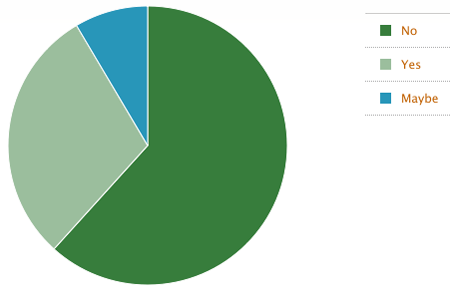
Well there is certainly a healthy dose of skepticism shown in our latest ZimmPoll in answer to the question, “Will USDA forecast for record 13.5 billion bushels of corn come true?” An overwhelming majority (61 percent) say NO. Only 30 percent say yes and 9 percent say maybe. In light of the weather we’ve had so far this year I don’t find this surprising at all. Do you?

Our new ZimmPoll is now live. We’re asking the question, “What is your opinion about the Farm Bill?” The political rhetoric is already heating up. Chime in with your thoughts.

And if you have any questions you want to suggest for future ZimmPolls please let us know.

ZimmPoll is sponsored by Rhea+Kaiser, a full-service advertising/public relations agency.

ZimmPoll

New Wind Measurement System Available

Joanna Schroeder

Vaisala has released the new WTS Wind Management System that has been specifically engineered for wind resource assessment, power curve measurement and monitoring of wind farms. The system was designed to help wind farm managers better understand and manage the impact of weather on operations. Vaisala wind sensors can be found at the National Weather Service’s Automated Surface Observing System (ASOS) sites and most airport Automated Weather Observing System (AWOS) sites.

“With alternate energy sources being the need of the hour, the Wind Energy industry is receiving billions of dollars worth of investments globally. For its success, it requires economical investment grade equipment that provides accurate and reliable measurements,” said Richard Pyle, segment director, Weather Critical Energy for Vaisala. “Combining several decades of experience in weather observation, and working closely with the wind energy industry, Vaisala has designed affordable world class systems that maximize certainty and minimize risk and long term costs for investors, developers, and operators.”

There are five different configurations within the wind measurement system. They include a cold climate option and an option that employs sensors designed to last more than 20 years and are largely maintenance free. In addition, each system includes a combination of sensors that provide accuracy and quality, a data logging system, power supply and tower. The wind measurement system is now available globally and customers can choose either a lease or purchase option.

Electricity, Energy, Wind

California Fuels Report Released

Joanna Schroeder

A new report, “Projected Outlook for Next Generation and Alternative Transportation Fuels in California 2010-2030,” has been released. The report concludes that with current investments and advances in alternative fuels over the past several years should lead to a significant displacement of petroleum-based fuels like diesel and gasoline. The report was released by Fueling California and Orange County Business Council and was authored by research experts at University of California, Irvine, the Automotive Club of Southern California and Tiax, LLC.

“Historically, California has been a trend-setter for the rest of the world in the transportation and fuel sectors,” said Mr. Sturtz. “California represents one of the largest fuel markets in the world and also houses some of the most technically innovative people, research institutions, and businesses to create an environment that incubates innovative and next-generation technologies. “These market factors coupled with a unique set of state government regulations that are creating a push for alternative fuels points to a large market that could potentially provide commercial benefits to all components of the fuel supply chain.”

While the report suggests a reduction of fossil-fuel based transportation fuels, because it takes between 10-15 years to change a fleet, by 2030 at least 75 percent of the fuels used will still remain petroleum-based. The report discusses three principal drivers for development of alternative fuels worldwide: reducing greenhouse gases, energy security, and urban air pollution. The report also discusses state policies, socio-economic factors, market forces, and business environment in California.Read More

Biodiesel, biofuels, biojet fuel, Electric Vehicles, Research

Federal Fleet to Use Alternative Fuels

Cindy Zimmerman

President Obama wants the federal fleet of more than 600,000 vehicles to use alternative fuels by 2015.

The goal of the Presidential Memorandum issued today implementing new Federal fleet management practices is “to cut oil imports by one-third by 2025 and to put one million advanced vehicles on the road by 2015.”

By December 31, 2015, all new light duty vehicles leased or purchased by agencies must be alternative fueled vehicles, such as hybrid or electric, compressed natural gas, or biofuel. Moreover, agency alternative fueled vehicles must, as soon as practicable, be located in proximity to fueling stations with available alternative fuels, and be operated on the alternative fuel for which the vehicle is designed. Where practicable, agencies should encourage development of commercial infrastructure for alternative fuel or provide flex fuel and alternative fuel pumps and charging stations at Federal fueling sites.

U.S. Department of Energy Secretary Steven Chu, U.S. General Services Administrator Martha Johnson and White House Council on Environmental Quality Chair Nancy Sutley came together to make the announcement on Tuesday and to look over alternative fuel options like the new Chevrolet VOLT electric vehicle.

The ethanol industry was pleased that the administration is interested in getting more flex-fuel vehicles. “By ordering the purchase of Flex Fuel vehicles capable of running on a range of ethanol blends, and encouraging installation of Flex Fuel pumps, this Executive Order will help us achieve the President’s energy security goal of reducing our dependence on foreign oil,” said Chris Thorne with the ethanol group Growth Energy.

National Biodiesel Board (NBB) chairman Gary Haer, vice president of Renewable Energy Group (REG), said the White House directive provides more opportunities for biodiesel growth in the federal fleet which uses more than 66 million gallons of diesel fuel and 6.5 million gallons of biodiesel each year. “Dozens of local governments, universities and other institutions already are using biodiesel to help green their fleets,” said Haer. “It’s something the federal government could do immediately, without leaving the taxpayer a big bill for new equipment.”

Biodiesel, biofuels, Electric Vehicles, Ethanol, Ethanol News, Flex Fuel Vehicles, Government