Site Prep Completed for BlueFire Cellulosic Plant

Joanna Schroeder

The site preparation has been completed for BlueFire Renewables’ cellulosic ethanol plant in Fulton, Mississippi. The work was conducted by Century Construction and the site is now ready for the construction of the plant to begin.

“With support from the County of Itawamba and the City of Fulton and excellent work done by Century Construction, the Fulton site is ready for facility construction,” said Arnold Klann, CEO of BlueFire Renewables, Inc. “We are happy to be working with the County and City to bring renewable fuel production into reality and, in the process, create local jobs.”

Klann said his company is working on various financing options including a pending loan guarantee application with the United State Department of Agriculture.

“Itawamba County is very pleased to join BlueFire Renewables in the effort to alleviate our dependence on foreign fuels, preserve our environment and spur our economy, said Greg Deakle, Itawamba County Executive Director. “BlueFire’s first phase of construction has already created 52 jobs in Fulton and, as BlueFire moves into its next phase of construction, will create numerous more.”

When the project is completed, BlueFire will produce 19 million gallons per year of cellulosic ethanol from green and wood wastes collected from the local region.

Cellulosic, Ethanol

Synder’s-Lance Snack Food Production Gets Sunny

Joanna Schroeder

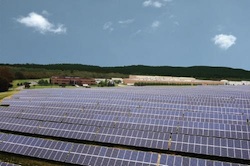
Synder’s-Lance, a snack food company, has completed its 3.5 MW Solar Farm located at its headquarters in Hanover, Pennsylvania. The project covers 26 acres and is comprised of 15,092 solar panels. The solar farm has the ability to generate up to 4,453,136-kilowatt hours (kWH) and save close to 30 percent of the facility’s energy costs. The project took nine months to complete beginning last September and was managed by RMK Solar.

“This is a very exciting time in the history of our company,” said Carl Lee, president and COO of Snyder’s-Lance. “The solar farm shows the commitment that Snyder’s-Lance has made to creating snack products in a more sustainable way. Our goal has always been to make ‘better for you’ snacks and now they are also better for the earth as well.”

It is estimated that the solar farm will reduce greenhouse gas emissions by more than 230 million pounds of carbon dioxide over a 25-year period. In comparison, the energy created from the solar field equals more than 111 million miles not driven by a medium-sized car, and more than 11 million trees would need to be planted to equal the same level of carbon dioxide reduction.

Electricity, Energy, Solar

“Propane Days” Rally Held in DC

Joanna Schroeder

The National Propane Gas Association held its “Propane Days” rally on Capital Hill last week and Autogas for America stakeholders were on hand for the event. The goal of the rally is to inform legislators about the benefits of propane. Alliance AutoGas President, Autogas for America founder and NPGA Governmental Affairs Committee Chairman, Stuart Weidie was a featured keynote speaker.

“Propane Days has been a valuable opportunity to reach lawmakers interested in addressing America’s energy challenges,” said Weidie. “Autogas for America doesn’t promote legislative favoritism for any particular fuel. However, we believe autogas should have equal opportunity to succeed in the marketplace alongside other alternative fuels already receiving attention in Washington D.C. The environmental and cost benefits of autogas will take it from there.”

Part of the efforts of the propane industry was to lobby for passage of the Propane Green Autogas Solutions Act of 2011 (Propane GAS Act). The industry hopes that autogas will achieve parity with other alternative fuels as part of the solution to energy independence. Other organizations participating in the event included the Propane Education and Research Council, Ferrellgas, AmeriGas, ROUSH CleanTech, Blossman Gas, and Blue Star Gas. In addition to meeting with lawmakers, the group also engaged in a social media campaign.

George Koloroutis, president of Ferrellgas North America, added, “Utilizing clean, American-made fuels like autogas for our nation’s vehicle fleets ultimately reduces our dependence on foreign oil. America has been lagging behind the rest of the world in using this environmentally friendly, economical fuel, and it’s time we started investing in U.S. energy security with autogas.”

Propane

Solena To Provide BioJet Fuel to ATA Members

Joanna Schroeder

Solena Fuels has received multiple letters of intent from members of Air Transport Association of America, Inc. (ATA) to supply biojet fuel made from biomass produced in Northern California. The biojet fuel will be produced at Solena’s “GreenSky California” biomass-to-liquids biorefinery in Santa Clara County and utilize post-recycled urban and agricultural wastes to produce nearly 16 million gallons each year by 2015. The biojet fuel will be used by airlines at the Oakland, San Francisco and San Jose airports.

“We applaud the airlines’ pledge to use our lower-emissions fuel to support their northern California operations, and we look forward to partnering with them to develop a facility that allows them to more sustainably operate their business,” said Dr. Robert Do, Chairman and Chief Executive of Solena Fuels.

This initiative is a result of ATA’s role in the Commercial Aviation Alternative Fuels Initiative (CAAFI), whose goal is to develop and deploy commercially viable, environmentally friendly alternative aviation fuels.

“Today’s announcement reinforces the ongoing steps that ATA member airlines are taking to stimulate competition in jet fuel production, contribute to the creation of green jobs, and promote energy security through economically viable alternatives that also demonstrate global and local environmental benefits,” said ATA President and CEO Nicholas E. Calio.

The agreement was led by American Airlines and United Holdings and the two airlines were joined by Alaska Airlines, FedEx, JetBlue Airways, Southwest Airlines, and US Airways. Also signing the letter of intent include Air Canada, Frontier Airlines, and Lufthansa German Airlines. This is not the first biojet fuel initiative for many of these airlines. Alaska Airlines is a also a member of Sustainable Aviation Fuels Northwest and FedEx has been experimenting with biofuels in many areas of their transportation network.

biofuels, biojet fuel

Is Ethanol An Issue For Political Race

Chuck Zimmerman

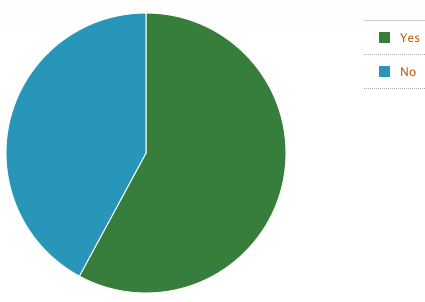
So, “Will ethanol be an issue in presidential race?” Maybe, maybe not. But I’m here to tell you, when I talk to anyone in agriculture this is a very hot topic. So it will be interesting to see how the candidates deal with it. In response to our survey, 58% say yes and 42% say no. What do you think? Should it be an issue?

Our new ZimmPoll is now live. We’re asking the question, “What can G20 ag ministers do to stabilize food prices?” Let us know what you think. I’ll bet you have an opinion on this one.

ZimmPoll is sponsored by Rhea+Kaiser, a full-service advertising/public relations agency.

ZimmPoll

EPA Proposes 2012 Renewable Fuel Standards

Cindy Zimmerman

Cellulosic ethanol targets were reduced while biodiesel was increased under the latest standards proposed by the federal government for the Renewable Fuel Standard program (RFS2).

The U.S. Environmental Protection Agency (EPA) today proposed the 2012 percentage standards for four fuel categories under the RFS2 based on the annual renewable fuel volume targets. EPA once again lowered the target for cellulosic ethanol, which was set at 500 million gallons in 2012, to somewhere between 3.45 and 12.9 million gallons. The agency “remains optimistic that the commercial availability of cellulosic biofuel will continue to grow in the years ahead” and so does the Advanced Ethanol Council, provided there is stable policy to allow the industry to invest in technology to make it possible.

“The most immediate term solution to this problem is to enact meaningful and long-term tax incentives to spur construction of the first-commercial advanced biofuel plants, in much the same way that Congress has stood behind oil and gas production for nearly 100 years,” said AEC Executive Director Brooke Coleman. “The cellulosic and advanced ethanol industry will hit the mark and achieve the goals of the RFS if Congress aligns our tax code with the RFS and sends a clear message to the marketplace that advanced biofuels will be a cornerstone of a broader strategy to create jobs and reduce oil dependence.”

EPA is also proposing to increase the volume requirement for biomass-based diesel from 800 million gallons this year to 1 billion gallons in 2012 and almost 1.3 billion gallons in 2013. The National Biodiesel Board (NBB) notes that since biodiesel qualifies as an advanced biofuel it is also eligible to exceed the biomass-based diesel targets and help meet general advanced biofuels requirements under the program. “As America’s first advanced biofuel being produced on a commercial scale nationwide, we have done extensive research to assess the various feedstocks that are used to make biodiesel, including agricultural oils, recycled cooking oil, animal fats, algae and camelina,” said NBB CEO Joe Jobe said. “We are confident we can meet these targets and we anticipate that we will likely exceed them.”

The EPA proposes to maintain the 2012 advanced biofuel requirements under the RFS at 2 billion gallons as federal law requires. The mandate for convention renewable biofuel also remained consistent with the statute at 13.2 billion gallons.

advanced biofuels, AEC, Ethanol, Ethanol News, Government, NBB, RFA

US Ag Secretary to Defend Biofuels at G20 Meeting

Cindy Zimmerman

Agriculture Secretary Tom Vilsack says he intends to defend biofuels at the G-20 Summit of Agricultural Ministers in Paris this week, stressing their importance to the economy and the environment.

“America is working on developing new feedstocks that don’t pit food versus fuel but that create new rural economic opportunities and allow us to continue to expand on our efforts to build a much more renewable energy source,” said Vilsack, who is attending the Paris Air Show prior to the G20 meeting to discuss biofuels for aircraft that can be made from dedicated energy crops.

The focus of the summit is on international efforts to ensure global food security and some groups are insisting that necessitates a change in biofuels policies. Oxfam is calling on Vilsack and the agriculture ministers of the other G20 countries to “urgently remove the types of biofuels subsidies and mandates that are leading to increased price volatility.”

Global RFAThe biofuels industry meanwhile is urging the ministers to examine the impact of crude oil price on food price volatility.

“It is imperative that the G20’s Agriculture Ministers use this first meeting to recognize that there is a direct and strong correlation between the price of crude oil and the price of food,” stated Bliss Baker, spokesperson for the Global Renewable Fuels Alliance (GRFA).

This will be the first meeting of all agricultural ministers in the Group of Twenty (G-20), which includes the United States, Argentina, Australia, Brazil, Canada, China, the European Union, France, Germany, India, Indonesia, Italy, Japan, Mexico, Russia, Saudia Arabia, South Africa, the Republic of Korea, Turkey and the United Kingdom.

biofuels, Ethanol, Ethanol News, Food prices, International, USDA

Popemobile Reportedly Going Green

Cindy Zimmerman

A greener Popemobile is reportedly in the works and could be on the road by next year.

A German newspaper reported over the weekend that Mercedes-Benz is designing a new hybrid four-wheel drive for Pope Benedict XVI. The Vatican has confirmed that such a vehicle is under development but will not be ready in time for the pope’s visit to his native Germany in September as speculated and may be the end of next year before it will be put on the road.

The report says that Mercedes is working to develop a hybrid variation on the Pope’s M Class SUV that can run about 16 miles emission-free on a rechargable lithium-ion battery, yet have the backup power and pick up to reach high speeds in case of emergencies. The Mercedes Popemobiles feature thick bulletproof glass and a heavily-armored build for security and are mostly used on papal visits to other counties.

Electric Vehicles, Energy

Millons Spent on Lobbying for VEETC Reform

Joanna Schroeder

Last week was a crazy week in DC as several amendments to alter or kill the Volumetric Ethanol Excise Tax Credit (VEETC) were voted on by the Senate. While the first vote was in favor of ethanol (it defeated the Coburn amendment), the industry took a hit when Sen. Dianne Feinstein’s (D-CA) bill was passed, essentially killing VEETC and the tariff without a phase-out plan (but the ethanol industry doesn’t think it will pass into law). So who spent the most money to get their way on VEETC? Lobbyists against VEETC outnumbered and outspent pro-ethanol groups, according to data from First Street-CQ Press’ new policy intelligence platform.

First street followed the money dedicated to lobbying for both Senate Bill S. 520 Volumetric Ethanol Excise Tax Credit Repeal Act and House Bill H.R. 1075 Volumetric Ethanol Excise Tax Credit Repeal Act. During first quarter of this year, there were 32 lobbying firms representing 36 clients to the tune of $8,895,893.00. There were 22 lobbying firms active on the House side representing 18 clients and spent $3,645,862.08. So first quarter alone, more than $12 million was spent on lobbying for VEETC reform.

Who were the players on the Hill? Most were the usual suspects. On the pro-ethanol side the biggest spenders were Growth Energy, Renewable Fuels Association, National Corn Growers Association, and POET, who spent $450,000 to just lobby against the VEETC legislation in the House. In the last three years, UNICA, the Brazilian Sugarcane Industry Association, spent more than $500,000 to lobby for the end of the tariffs as well as various other ethanol amendments.

On the anti-ethanol side you had the Grocery Manufacturers Association (GMA), National Retail Federation, League of Conservation Voters, Environmental Working Group, American Meat Institute, National Cattleman’s Beef Association, National Turkey Federation, and more. The biggest spender was GMA who spent $900,000 lobbying for the House bill alone. On the Senate bill side, your two biggest spenders were Pepsico with $1.44 million followed by Kraft who spent $720,000 to get the bill passed.

As the debate continues around subsidies and balancing the federal budget, ethanol and other biofuel tax incentives are at the center of the chopping block and have already become an important policy point for the Republic presidential candidates. And anti-ethanol groups are stepping up their game with new advertising campaigns aimed at both policymakers and consumers, as well as an all-out assault in the realm of social media (there are now social media-focused lobbyists). It will come as no surprise then, to see millions upon millions more spent throughout the year on VEETC and other biofuel subsidy reform.


biofuels, Ethanol, Opinion

Book Review – Life Without Oil

Joanna Schroeder

Woe is a country who can’t break its dependence on foreign oil. But how do you make such a bold move when our entire society is built upon its wares? And even more so, how do you break the chains when there are no other alternatives? This are some of the topics discussed in this week’s book, “Life Without Oil: Why We Must Shift To A New Energy Future,” by Steve Hallett with John Wright. Hallett is a professor in the department of Botany and Plant Pathology at Purdue and Wright is an energy and environmental journalist.

The premise of the book is that the world is running out of oil while at the same time depleting itself of its natural resources. These two issues can combine to cause destruction and complete collapse of a society. The book begins by highlighting some of the societies that have disappeared due to lack of resources whether it be water or trees or others. One of the most famous case studies he uses is that of Easter Island, now owned by Chile, and the irony that although the people knew their future was in jeopardy due to diminished resources, they used them all anyway. Will this be society today?

Hallett is not a fan of biofuels as a solution to our problems. He also believes renewable energy, such as wind or solar, will only become mainstream when it is the only option. He also doesn’t think we will be laughing 30, 40, 50 years from now about how peak oil and climate change were myths.

In terms of the future energy sources, Hallett believes it will be one in which nuclear and hydrogen play major roles. Read More

biofuels, book reviews, Environment, Oil, Solar, Wind