From Farm to Biorefinery

Joanna Schroeder

Today American farmers are producing twice as much corn on virtually the same amount of acres as a generation ago. This makes them the most productive and efficient of any farmers around the world. Similarly, productivity and efficiencies are being mirrored across domestic ethanol production.

The Renewable Fuels Association has begun a series on efficiency and as part of the dialogue, RFA Vice President Geoff Cooper takes on the critics who claim that both farming and ethanol production is simply too energy-intensive. Cooper says those critical of farmers and by extension ethanol producers, will tell you that the tremendous growth in corn production is due to increased fertilizer use.

Yet Cooper says these are not the facts. USDA data shows that 2010 application rates of three common macronutrient fertilizers (nitrogen, potassium and phosphate) were the same or below the application rates seen in the early 1980s. As such, nitrogen application per bushel of corn has decreased more than 30 percent since this time while potassium and phosphate usage per bushel is down nearly 40 percent.

Also reduced between 1987 – 2007 is water, energy and land usage required to produce a bushel of corn according to Keystone Alliance. For example, the energy requirement (as measured in British Thermal Units or BTUs) to produce one gallon of ethanol has dropped by 28 percent since 2001, to just shy of 26,000 BTUs. Cooper says that compares to 77,000 BTUs found in one gallon of ethanol. Electricity demand has fallen by 32 percent and water use has decreased by 47 percent.

“As the data clearly demonstrate, America’s ethanol producers are mirroring the efficiency gains of the American farmers upon whom they rely for feedstock,” said Cooper. “As existing processes evolve and new production technologies emerge, ethanol production in the U.S. will not only increase in volume, but also in efficiency. Without a doubt, today’s ethanol industry is high-tech and increasingly energy efficient.”

biofuels, Electricity, energy efficiency, Ethanol, Ethanol News, water

ICM Enters Into Partnership With EISENMANN

Joanna Schroeder

ICM has announced that it has entered into a technological partnership to couple its gasification system with EISENMANN Corporation’s dual-field wet electrostatic precipitation (WESP) technology. This technology was proven successful at ICM’s commercial-scale demonstration gasifier located adjacent to the Harvey County municipal solid waste transfer and recycling facility in Newton, Kansas.

The gasifier underwent several performance tests with multiple feedstocks including but not limited to refused-derived fuel (RDF), tire derived fuel mixed with RDF, wood chips, wheat straw, switchgrass, and corn stover. Combined with ICM’s thermal oxidizer and heat sink, the WESP 2-F system cleans removes all particulate matter as well as acid gases from a variety of fuel sources and meets all levels of emission control requirements.

“We’re thrilled with the recent commercial deployment of our biomass gasifier technology, as it allows us to offer our waste-to-energy system on a global level,” said ICM CEO Dave Vander Griend.”Recognizing the strength of collaborative partnerships, ICM is pleased to work with EISENMANN and their WESP technology to enhance our biomass gasifier applications.”

bioenergy, Company Announcement, Waste-to-Energy

IRFA Wins Legislative Leadership Award

Joanna Schroeder

The 2011 American Coalition for Ethanol conference concluded today in Des Moines, Iowa and yesterday the Iowa Renewable Fuels Association (IRFA) was awarded the Legislative Leadership Award. It’s presented each year to a policymaker or leader at either the federal or state level for introducing or supporting public policies that promote ethanol.

As the award was being presented, Ron Lamberty, ACE senior vice president said, “ACE is proud to award IRFA with the Legislative Leadership Award. Over the last few years, IRFA has demonstrated extraordinary leadership in support of renewable fuels in Iowa. ACE is pleased with their leadership in the 2011 legislative session to pass Senate File 531, a bill that included E15 incentives, liability protection for retailers and infrastructure grants and will undoubtedly make a difference to Iowa consumers and retailers.”

SF 531 contained a number of provisions, including:

  •   – 3-cent per gallon E15 retailer tax credit
  •   – Biodiesel production tax credit.
  •   – Misfueling liability protection for retailers.
  •   – An enhanced E85 retailer tax credit.
  •   – An extension of the biodiesel retailer tax credit for blends of B5 and higher.
  •   – $3 million in annual funding for Iowa’s Renewable Fuels Infrastructure Program (which provides grants for installation of blender, E85 and   biodiesel dispensers as well as biodiesel terminal infrastructure).

Monte Shaw, IRFA’s executive director added, “It is indeed an honor for IRFA to receive this prestigious award from ACE. Iowa is the leader in ethanol production and the IRFA Board made it a priority for Iowa to become a leader in ethanol policy as well. The passage of SF531 accomplished that goal with its first-in-the-nation E15 incentive for retailers. The real credit goes to the IRFA Board for setting high goals and working hard to achieve them. Further, we would not have been successful without the bipartisan support of the Iowa Legislature and Iowa Governor Terry Branstad.”

conferences, Ethanol

The Wind Blows in Ireland

Joanna Schroeder

Several companies have signed agreements to work together to co-develop three Irish wind farms valued at euro 18 million. Gaelectric, and XEMC VWEC will first deploy the XV90 turbines at three Gaelectric on-shore sites: Roosky in Co. Roscommon; Leabeg in Co. Offaly; and Crowinstown in Westmeath. Total combined energy produced is expected to be at least 13.6 MW.

During an event highlighting the signing of the contract in Dublin, Ireland, Zhou Jianxiong, XEMC’s Group Chairman said, “Gaelectric’s pipeline of wind farm projects in key locations, combined with our shared focus on innovation in renewable energy technologies, makes us ideal allies in co-developing Gaelectric’s portfolio of renewable power projects.”

“We are particularly pleased that the sites that we intend to co-develop with Gaelectric are very suited to establishing our Direct Drive Permanent Magnet Generator (PMG) turbine technology as the leading global wind generation technology delivering low service and maintenance costs, competitive pricing, and high availability and annual yield,” he added.

XEMC has 820 of its XE-series turbines installed in China. Its XE-series are the largest turbines in mass production in China.

“Our alliance with XEMC is a significant strategic step for Gaelectric. With the backing of XEMC’s industrial strength and technological capacity, and their track record and commitment to long term relationships, we are confident that Gaelectric’s portfolio of wind farm sites will be realised to the highest commercial and technical standards,” said Gaelectric CEO, Brendan McGrath. “Our visit to China in March of this year confirmed to us XEMC’s commitment to research and development which combines Dutch engineering design and pedigree, with Chinese industrial power. We also share a vision for the significant opportunities from off-shore wind energy generation on which we are already working closely together.”

Electricity, Energy, Wind

Getting Ready For Farm Shows

Chuck Zimmerman

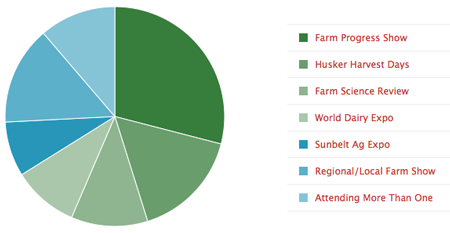
We’re nearing fall farm show time. So where are you going? Here’s the results from our latest ZimmPoll. We asked, “Which of these fall farm shows will you attend?” 29% of you said Farm Progress Show, 16% said Husker Harvest Days, 11% said Farm Science Review, 10% said World Dairy Expo, 8% said Sunbelt Ag Expo, 15% said Regional/Local Show and 11% said More than one. The ZimmComm team will be at a number of these shows starting with next week’s Farm Progress Show. There’s no doubt we’ll find some news on biofuels at these events and will bring it to you right here.

Our new ZimmPoll is now live. We’re asking the question, “What is your opinion on ag-related sponsorships of sporting events??” Your input and thoughts would be greatly appreciated. Thanks.

ZimmPoll is sponsored by Rhea+Kaiser, a full-service advertising/public relations agency.

ZimmPoll

Plug My Ride

Joanna Schroeder

Westport, Connecticut now has its first electric vehicle (EV) charging station. The charging station was installed as part of Connecticut Light & Power’s (CL&P) EV research project and is believed to be one of the first in the nation to offer drivers a pay-by-phone option.

“We’ve worked hard to make Connecticut an early market for EVs,” said Jeff Butler, CL&P’s president and chief operating officer. “We’re excited to see towns like Westport take advantage of the opportunity to become a leader in clean technology.”

The new charging station is located at Luciano Park Commuter Lot on Charles Street and already had its first customer the same day it was unveiled – a 2011 Chevy Volt from Karl Chevrolet in New Canaan. Westport First Selectman Gordon Joseoff downloaded a mobile phone application and then plugged the Volt into the charging station.

The Level II, 240-volt charging station in Westport can fully charge a Chevy Volt in four hours. Volts can also be charged using a regular 120-volt wall socket but it takes twice the time. According to CL&P, the electricity needed to fully recharge an EV battery costs about $3.00 on average, while a driver who “tops off” could do so for as little as 25 cents.

“Westport has always been a leader in promoting green and protecting the environment,” added Joseloff. “We are pleased to join CL&P in pioneering this latest effort to encourage Americans to make a lifestyle change to help preserve our planet.”

There are plans to have at least 30 EV charging stations by year end in Connecticut, western Massachusetts and New Hampshire and they will acquire data for parent company Northeast Utilities (NU) as part of the EV research project. Also part of the program is a new online tool – Plug My Ride – to connect consumers and others interested in electric transportation.

Electric Vehicles, Electricity, Energy

Largest U.S. Grocer Explores Solar

Joanna Schroeder

Kroger, the largest U.S. traditional grocer, is exploring solar energy and the first of its projects have been completed. Smith’s Food & Drug Stores, a division of Kroger, has completed the installation of photovoltaic (PV) solar panels on two of its locations in Albuquerque, New Mexico. Total combined output is estimated at 320,000 kWh. Each solar system is comprised of 442 panels.

“We have done a lot of work over the last several years to integrate sustainable practices into our everyday business operations,” said Rodney McMullen, president and chief operating officer of Kroger. “Today, we are proud to unveil Kroger’s first operational solar energy project. Smith’s has done a tremendous job bringing this to realization. Kroger will continue reducing energy consumption and testing technologies that support future use of alternative energy sources.”

The Smith’s stores were selected due to the sunny climate and economic incentives offered by energy provider PNM. Affordable Solar, based in Albuquerque, designed and installed the panels. Kroger is also developing photovoltaic systems in stores located in Wilsonville, Oregon (Fred Meyer) and Cincinnati, Ohio (Kroger).

Electricity, Energy, Solar

Elusieve Process Removes Fiber From Corn

Joanna Schroeder

A new way to remove fiber from corn has been discovered by a professor from Mississippi State University (MSU). He calls his process Elusieve and has filed for a patent. The process was invented by Dr. Radhakrishnan Srinivasan of the MSU Department of Agricultural and Biological Engineering with some help from University of Illinois professor Dr. Vijay Singh who believe the process will improve both ethanol production efficiency as well as dried distillers grains (DDGS).

“Corn has mainly starch, fiber and protein. We are removing the fiber, so the starch is increased in concentration. Therefore, you can produce more ethanol,” Srinivasan said in an interview with Mississippi Business Journal.

Srinivasan explains that pigs and chickens cannot digest fiber well. By removing the fiber from its feed, which consists primarily of DDGS, ground corn flour and soybean meal, the energy content of the feed is improved and reduces the need for expensive ingredients such as fat and enzymes. He believes the Elusieve process will be adopted by feed mills to separate fiber downstream of the bins where the feed is stored.

Today, there is one pilot plant using the Elusieve technology at MSU and its using a combination of sieving and air classification, called elutriation, to separate out the fiber. From there, the feed is sieved into four sizes and air is blown through the three biggest to carry away the fiber. Ultimately this process increases protein of feeds like DDGS and also increases starch content.

Other researchers are working on technologies to remove fiber from corn but Srinivasan said his is less expensive and less complicated. His has already received the patent for DDGS via Elusieve.

biofuels, corn, Distillers Grains, Ethanol, Research

E85 Station Opens in Corpus Christi, Texas

Joanna Schroeder

A new E85 station has opened at the Stripes Convenience Store in Corpus Christi, Texas and is now the only E85 station within 100 miles. The pump is located at its location on Weber Road, south of Saratoga Blvd. The company also offers E85 at its station in Lubbock, Texas. Only flexible fuel vehicles can fill up with E85.

“Stripes takes pride in leading the way by bringing a new alternative fuel option like E85 to our customers looking for a cleaner burning gas for their flex fuel vehicles,” said Steve DeSutter, President & CEO of Stripes LLC. “This is something new for us but with the number of flex fuel vehicles growing, and as cities like Corpus Christi push to find ways to improve air quality and make renewable resources a focus, Stripes will offer E85 fuel at more locations if we find that consumers demand that option.”

Stripes says according to E85refueling.com there are around 50 E85 stations in Texas and more than 2,600 across the U.S. They become the first retailer in the area to offer E85 as part of their commitment to supporting environmental initiatives and reducing air pollution in the community.

E85, Ethanol

Private Investments for Alt Energy At Four-Year Low

Joanna Schroeder

According to new research from Lux Research, investments in the alternative fuels sector have reached a four-year low of $930 million for alternative fuel start-ups in 2010. However, 2010 was also a record-breaking year for investments to companies with flexible technologies that can use a variety of feedstocks to produce a variety of products at $698 million. Lux says that if this trend continues, then start-ups with less flexible technologies will be forced out of the industry.

Hedging Bets with Flexibility in Alternative Fuels,” has shown that since 2004 more than $6.4 billion in investments have been made in the alternative energy industry but in recent years, investors are giving more to less. The winners follow one simple principle: flexibility in feedstock or end product. Lux Research analyzed 333 investments in 170 unique start‐ups since 2004, breaking down investments by technology, fuel, geography, and investment stage.

“The recent successful IPOs of Amyris, Solazyme, and Gevo all reflect the larger industry trend of investing in more flexible end‐product technologies,” said Andrew Soare, a Lux Analyst and lead author of the report. “A handful of fuels‐focused start‐ups continue to draw investors, including waste‐to‐fuels companies Enerkem and LanzaTech, and cellulosic ethanol companies Qteros and Mascoma. But flexibility is part of their DNA as well, in that they derive fuels from multiple feedstocks.”

Several key conclusions include:

• Synthetic biology’s inherent flexibility is a wise investment, but not the only one. Synthetic biology has attracted the most funding since 2004: $1.84 billion or 28.4% of the total. But investors shouldn’t ignore other flexible technologies.

• Investments will favor fewer companies in later stage funding. Most alternative fuel technologies today are past the point of initial seed funding, and are seeking capital to scale up manufacturing. Those closest to scale will continue to raise large Series C and Series D rounds, while less advanced companies will struggle to land moderate earlier rounds, resulting in more failed start‐ups over the next few years.

• Expect new corporate investors to enter the space. Expect forward‐looking corporations to bring additional industries into the fray, such as pulp and paper, food and beverage, and non‐obvious downstream brand owners such as UPS.

advanced biofuels, biochemicals, biofuels, feedstocks, Research