ACE Conference 2026

DIRECTV Expands Propane Fleet

Joanna Schroeder

DIRECTV is expanding its propane autogas fleet. The company currently operates 77 ROUSH CleanTech Ford E-250 propane autogas vans and will increase that number over the next year. After comparing alternative fuel options, DIRECTV said they chose propane autogas due to its low cost and accessibility of fuel; vehicle return on investment; domestic nature of the fuel source and vehicle supply chain; and accessibility to high occupancy vehicle lanes.

direcTV-van“The addition of more propane autogas fueled vehicles to the DIRECTV fleet strengthens our commitment to reducing the company’s overall gasoline usage,” said Brandon Morris, director of Fleet Services for DIRECTV. “We have learned a lot from analyzing our current propane fleet, and the benefits we are seeing from using propane as an alternative to gasoline include the lower cost of propane, ease of implementation, distribution network, and the high quality conversion kit produced by ROUSH CleanTech.”

Since its propane autogas vehicle deployment in November 2011, DIRECTV has reduced gasoline consumption by 75,000 gallons and saved nearly 50 percent on a cost per gallon basis compared to gasoline.

“For over a year and a half, DIRECTV’s service vans fueled by reliable, cost-competitive propane autogas have met the company’s goals — to cut back on high-priced gasoline with the use of a domestic, cleaner fuel solution,” added Todd Mouw, vice president of sales and marketing for ROUSH CleanTech. “With DIRECTV’s plan to increase the size of its propane autogas fleet, they’ll experience even greater cost-savings with this alternative fuel technology and further strengthen their position as a leader in alternative fuel initiatives.”

Propane

Worried About Government Collecting Private Data

Talia Goes

Before we get to our new Zimmpoll let’s look at the results of our latest one which asked the question, “How concerned are you about the government having your private data?” Our poll results read loud and clear this week. Over half of you are now more worried that the government sees private data.

Our poll results: Sixty-nine percent said More Worried, twenty-four percent said Not Concerned, four percent said Other and two percent said Less Worried. Many agriculturalists have converted to digital data systems in order to become more efficient. Knowing the government is actively collecting private data is causing concerns in all sectors of business and that includes farming.

Untitled

Our new ZimmPoll is now live and asks the question, “Do you listen to satellite radio?” Satellite radio has become more and more popular over the years. Not only is it included in many new vehicles but you can even access it over your smartphone. So do you subscribe? Has it changed your listening habits? Will this affect “regular” farm radio? Let us know.

ZimmPoll is sponsored by New Holland Agriculture.

ZimmPoll

Groups Boo Obama’s Climate Plan

Joanna Schroeder

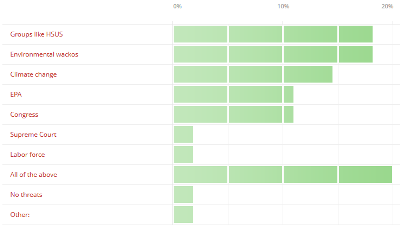
Not everyone is happy with President Obama’s new Climate Change Action Plan. The plan did many things including showed support for more renewable energy such as biofuels; tighter regulations on power plants, mandates to increase vehicle mileage; and increased subsidies for solar and wind projects on federal lands.

Those not in favor say the plan calls for unnecessary restrictions and is economically punishing and will actually stifle job creation – not create more jobs. Jay Lehr, Ph.D., science director with the Heartland Institute, said, “With clear evidence that the planet has not warmed in the pasbnoeryhcqaajvfjt 15 years while carbon dioxide has increased, we know reducing emissions of CO2 will have only one impact: to increase the cost of American energy. Obviously this is Mr. Obama’s intent, and while it will thrill his anti-capitalist environmental supporters, it will hopefully wake up the general public to the fact that he does not have their best interests at heart in creating more radical environmental regulations.”

Lehr’s colleague Craig D. Idso, Ph.D who is a senior fellow, environment and co-editor, Nongovernmental International Panel on Climate Change, adds, “In discussing the rationale for his climate change and energy plan, President Obama claims that carbon dioxide, or CO2, ‘causes climate change and threatens public health’ and that ‘cutting carbon pollution will help keep our air and water clean and protect our kids.’ Unfortunately, President Obama’s statements could not be further from the truth. Far from being a ‘pollutant,’ carbon dioxide is the elixir of life.”

Some groups say carrying out the climate plan will create a catastrophe including Emily Wismer, an analyst with the Independent Women’s Forum. Read More

Alternative energy, Climate Change, Environment, Renewable Energy

House Subcommittee Hearing on RFS Today

Cindy Zimmerman

The House Energy and Commerce Subcommittee on Energy and Power is holding a hearing today in Washington on “Overview of the Renewable Fuel Standard: Government Perspectives.” The hearing features testimony from the Energy Information Administration, U.S. Department of Agriculture and the Environmental Protection Agency.

dinneen-capitol
The hearing was scheduled to begin on 1:30 eastern time but has now been postponed until 2:30. It will be webcast live at http://energycommerce.house.gov and Renewable Fuels Association president and CEO Bob Dinneen will be live tweeting during the hearing with fact-checks, reaction to statements, and responses to questions put forth during the hearing. You can follow Bob at @EthanolBob.

Ethanol, Ethanol News, Government, RFA, RFS

College Teams to Race with SunPower

Joanna Schroeder

Nine university teams will race in the 2013 Formula Sun Grand Prix (FSGP) with solar vehicles powered by SunPower’s Maxeon solar cells. Various FSGP race events will be held from June 24 – 29, 2013 and are open and free to the public.

According to SunPower, the all-back contact solar cells collect and convert more sunlight into energy when compared to cells with contacts on the front. This all-back contact Iowa-State FSGP Teamallows SunPower cells to generate maximum solar power when applied to limited surface areas found on some rooftops, as well as on the hoods of FSGP racecars.

“SunPower’s solar technology continues to be the choice for innovative projects that blaze new trails for renewable energy solutions,” said SunPower CEO Tom Werner. “SunPower cells fueling the Formula Sun Grand Prix cars, and the Solar Impulse airplane that recently journeyed above Texas, utilize the same solar technology that power residential rooftops, commercial applications and power plant installations around the globe.”

Of 12 university teams that registered to compete in this year’s FSGP, nine chose to build and race their solar vehicles with high efficiency SunPower Maxeon solar cells including: Illinois State University; Iowa State University; Missouri University of Science and Technology; Northwestern University; Oregon State University; Principia College; University of Texas at Austin; University of Waterloo; and Western Michigan University.

The FSGP is an annual, three-day race where university teams from around the world challenge their solar vehicles to successfully handle curves, braking and acceleration on a grand prix-style course. This year’s event will be held in Austin, Texas at the Circuit of The Americas™ on an official Formula 1® racetrack for the first time in FSGP history. The University of Texas at Austin Solar Vehicles Team from the Cockrell School of Engineering will act as local university host.

SunPower is an official sponsor and employees will be onsite to assist with race-day logistics.


automotive, Solar

BioEnergy Bytes

Joanna Schroeder

  • BioEnergyBytesDFSolar Energy International is training a workforce and enabling them to increase universal access to electricity through renewable energy development in Central America. La Academia de Profesionales Solares de las Américas (APSA) will train 50 people representing countries, communities, and organizations throughout Central America and Mexico to design, install, and maintain solar PV systems and to successfully launch and administer businesses in this critically important industry.
  • Intermountain Wind and Solar is offering a guide covering the benefits of wind and solar power in Utah and the impact they have on wallets and the environment.
  • National Fleet Hybrids has partnered with Lightening Hybrids to sell, install and distribute Lightning’s hydraulic hybrid retrofit systems. The partnership brings together two companies focused on providing fuel-efficient technologies to fleets of shuttle buses and other medium-duty vehicles.
  • U.S. Energy Initiatives Corporation has received a patent assignment of a proprietary biofuel patent entitled GREEN RECYCLED DERIVED BIOFUEL (RDBF). This patented fuel was designed for automotive, aviation and stationary electrical power applications.
  • To mark the 5th Annual Global Wind Day, held on June 15 th, the Canadian Wind Energy Association (CanWEA) launched the second annual Power of Wind Blog Contest with bursary prizes for students entering post-secondary education. Students from across Canada can submit a 300 word blog on the subject of Building a clean energy future. Students should use their creativity and write about how they are or can become part of a renewable energy future.
Bioenergy Bytes

Closer Look at EPA Biodiesel Winner

John Davis

epa-logoRecently we told you about how students at Loyola University had won the EPA’s P3 Award (People, Prosperity and the Planet) for their greener way, through a wetland and a distillation process, to treat and reuse byproducts of biodiesel. Our friend Ron Kotrba at Biodiesel Magazine looked a little deeper into what their innovation actually was:

I reached out to Zach Waikman, the biodiesel lab manager at Loyola, who provided some clarity to the project behind the P3 Award…

Loyola undergraduate and graduate students and faculty mentors will design, test, and implement an innovative, cost-effective sustainable system for treating contaminated wash-waters resulting from our student-led Biodiesel Program. This project is original in its approach to treating wastewater on-site with environmentally benign living technologies. It will be the first known attempt to use living machine technology to solve the biodiesel wastewater problem. Our technologies will be transferable and scalable.

Expected results: The primary long-term results of our P3 project will be a) designing and building an environmentally and economically sustainable biological waste-water treatment system capable of cleaning, detoxifying, and recycling 100 percent of the waste-water produced in the LUC Biodiesel Lab and b) disseminating the design and complementary materials to other sustainable biodiesel producers throughout the U.S. and the world in order to prevent unnecessary environmental pollution and increase economic solvency.

Some other things we’re able to find out from this article is that the concept of the machine is in line with an anaerobic digester, although they’re not using that biological process in their plans. The researchers believe there will lots of possibilities with the program.

Biodiesel, Government, Research

Enogen Corn to Present ‘American Ethanol 200’

Joanna Schroeder

Syngenta and its Enogen brand will be the presenting sponsor for the NASCAR Camping World Truck Series at the Newton track on Saturday, July 13, 2013. The American Ethanol 200 presented by Enogen is a 200 lap, 175-mile event over Iowa Speedway’s 7/8 tri-oval featuring 36 NASCAR drivers racing with to win fueled by E15.

“We are thrilled to welcome Syngenta as the newest member of our family of promotional Presented by Enogen logopartners,” said Chuck Spicer, Iowa Speedway Vice President of Sales & Marketing. “We are especially proud that, given Enogen’s initial success in the ethanol production marketplace, Syngenta has chosen our ‘American Ethanol’ event to promote their unique brand of seed corn.”

Enogen corn features a corn output trait bio-engineered specifically for ethanol production. Syngenta says this technology helps drive dramatic process improvements in dry grind ethanol production and is delivered through a high-value grain system that has the potential to greatly benefit growers, local communities and the renewable fuels industry.

“Syngenta is excited about this opportunity to come together with key partners and show our support of American Ethanol,” said David Witherspoon, head of renewable fuels at Syngenta. “We understand the significant role ethanol plays in driving economic growth and creating value for our nation and in our rural communities. We are truly honored to be a part of this race and are committed to the long-term success of the ethanol industry.”

American Ethanol, corn, Ethanol

Genera: Feedstocks, Start Early & Think Big

John Davis

FEW13-genera-randleWhen it comes to biomass feedstocks for biofuels, you need to think ahead.

“Start early and think big,” was the advice Bob Randle, VP Sales and Marketing for Genera Energy gave attendees of the recent Fuel Ethanol Workshop (FEW) in St. Louis, Mo. “Because there’s a lot of moving parts in providing 250,000 to 700,000 tons of material annually, on a 24-7 basis, particularly if you’re dealing with a perennial crop since it takes two to three years to establish.”

Bob says Genera, a relatively new company out of Tennessee, focuses its efforts on the front end of the biofuels chain, developing and delivering energy crop and biomass feedstock solutions, starting with switchgrass and now branching into other stocks as well. They work with farmers to develop long-term supply contracts, to grow, harvest, store and finally deliver the crops to the plants that convert it into biofuels.

“We’re the middleman on the feedstock supply side,” Bob said, adding they partner with the seed companies specializing in energy crops. He also said they try to look to the long term.

“That’s been one of the big revelations in the industry in the last year or so, is that as these technologies developed, the companies didn’t think about where massive quantities of feedstock would come from.” His company finds the solutions that bridge that gap between what was a concept for a biofuel to what is needed to produce it at commercial scale. Plus, Bob said they are focused on U.S. operations.

Listen to more of Joanna’s interview with Bob here: Bob Randle, VP Sales and Marketing for Genera Energy

Visit the 2013 FEW Photo Album.

Audio, biomass, Ethanol, feedstocks, FEW, News

POET-DSM Cellulosic Ethanol Plant Ready in ’14

John Davis

The POET-DSM Advanced Biofuels’ first commercial cellulosic ethanol plant is on track to start in 2014. The announcement for the plant was made at the recent Fuel Ethanol Workshop (FEW) in St. Louis, Mo., where Wade Roby from POET took part in a panel discussion.

FEW13-poetdsm-hartigSteve Hartig, General Manager for POET-DSM, talked with Joanna and said Project LIBERTY, currently under construction and co-located with POET’s grain ethanol plant in Emmetsburg, Iowa, will turn bales of corn cobs, leaves, husks and some stalk into 20 million gallons of cellulosic ethanol each year, with plans to move that amount up to 25 million gallons.

“We’re in the middle of construction, so we have a lot of the concrete done, the large biomass building, a lot of the tanks for the fermentation are up and running, and basically we’re on schedule to start up end of first quarter, second quarter next year,” Steve said.

He said they’ve been working with the local farmers over the past five years on how to collect and bring in the corn stover biomass, bringing in 70,000 tons last year and expecting to bring in 120,000 tons this year and up to 250,000 tons next year. Steve points out that the biomass can be stored out in the weather for at least a year, and he defends against criticisms that they are taking valuable nutrients off the field.

“The fields with the high productivity, high-yield corn crops, you have about five tons of stover per acre that’s left on the field after the harvest. We’re taking about one ton of that,” and citing their work with Iowa State University, he said that taking some stover off the field is actually good for it. “If we can take a bit more we will, but we’ll do it slow, steady and in a conservative way, working closely with the farmers and local universities.”

Steve said they’re building this plant together with DSM, and that’s the model they’re carrying forward – taking the technology to other companies and partnering with existing facilities, especially corn ethanol plants, and he believes they could even take the technology internationally.

Finally, he concluded that they have learned a lot building this plant and look forward to their next project going up next year. And they’re sticking with cellulosic ethanol.

“Cellulosic ethanol is real. It’s been called the ‘fictional fuel,’ [but] big companies like ours are putting a lot of commitment to it.”

Listen to more of Joanna’s interview with Steve here: Steve Hartig, General Manager for POET-DSM

Audio, Cellulosic, Ethanol, feedstocks, FEW, News, POET