The California State Senate Committee on Transportation and Housing heard testimony Monday from the Renewable Fuels Association (RFA) criticizing the proposed Low Carbon Fuel Standard (LCFS).
RFA Vice President of Research Geoff Cooper testified on behalf of the ethanol industry that under the standard proposed by the state Air Resources Board (ARB) “biofuels are penalized for a highly uncertain and unproven market-mediated effect known as indirect land use change, while petroleum and other fuel types are assumed not to cause any indirect or market-mediated impacts.”
 RFA’s testimony reflects the views of 111 scientists, researchers, and academics from California and around the country who wrote Governor Schwarzenegger recently stating, “Leaving aside the issue of whether these [indirect] effects can be predicted with precision or accuracy, or whether such a penalty is appropriate for the LCFS, it is clear that indirect effects should not be enforced against only one fuel pathway.”
In addition, RFA is concerned that the proposed standard “has the potential to undermine the development of next generation biofuels, like cellulosic ethanol, because of the arbitrary nature in which the carbon accounting modeling is applied to biofuels and ethanol specifically.” Cooper testified that “artificially limiting the use of first generation biofuels may inadvertently “blow up the bridge” to future renewable fuels.”
Cooper suggested that the ARB change the proposal by improving the modeling used and including more current data for agricultural yields and the impact of distillers grains, the feed co-product of ethanol production, on reducing the need for additional crop acres. He also suggested that ARB initiate a comprehensive evaluation of the indirect impacts of other fuels under consideration, including gasoline, electricity, natural gas, and others to ensure an accurate performance-based regulation and organize a multi-disciplined group of disinterested economists, climate experts and other scientists to evaluate the accuracy of ARB’s work.


 Indiana Senate lawmakers today approved a bill that would allow schools to receive grants to install E85 dispensing units. House Bill 1193 was sponsored by State Senator Ron Alting (shown right).
 Ford plans to unveil a vehicle that is capable of running on gasoline, up to 85 percent ethanol fuel, as well as LPG (liquefied petroleum gas). The Mondeo will be displayed at the AMI Leipzig Motor Show in Germany starting March 28. The vehicle will be available in a four-door sedan, five-door liftback and in station wagon forms.
  The
The 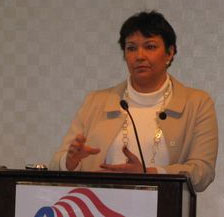 Just a few days before the waiver petition was filed, Administrator Jackson met with a group of 30 ethanol supporters who traveled to Washington DC for the “Biofuels Beltway March,” a grassroots ethanol advocacy fly-in organized by ACE.
  With the economy in mind, the
  Despite having some pretty wind-swept plains, Nebraska has lagged behind other states in wind energy production… including its closest neighbor to the east, Iowa, which boast the nation’s second largest amount of wind energy produced. But that could soon change.
 Mississippi-based Encore Energy has announced it is buying up biodiesel plants that are not producing at their capacity.
 South Dakota-based
  The proposed common carrier pipeline system would gather ethanol from production facilities in Iowa, South Dakota, Minnesota, Illinois, Indiana and Ohio to serve terminals in major Northeastern markets. The project, preliminarily estimated to cost in excess of $3.5 billion, would span approximately 1,700 miles and would take several years to complete.
  Asked about their discussions during a joint press conference, President Obama praised Brazil for its leadership in biofuels but acknowledged that “the issue of Brazilian ethanol coming into the United States has been a source of tension between the two countries” that is “not going to change overnight.”