

The opening of an E-85 pump on Friday at Oceania Naval Air Station in Virginia Beach, Virginia received enthusiastic response from the public and the media.
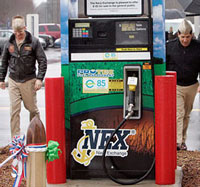 The Virginia-Pilot reported that, “A crowd of Navy officers, energy executives, a congressman and camera-toting media circled the first customer who pulled up to the shiny new pump, Petty Officer 1st Class Lacresha Fears.” The first tankful of E85 was pumped and paid for by NEXCOM (Navy Exchange Service Command) Commander Rear Adm. Robert Bianchi.
 Television station WAVY-TV was also on hand to cover the event Friday, as Bianchi participating in a ribbon cutting for the new pump with Renewable Fuels Association president Bob Dinneen, Congressman Glenn Nye of Virginia; Capt. Mark Rich, commanding officer of Naval Air Station (NAS) Oceana; and Protec Fuel CEO Todd Garner.
“Just as the U.S. Navy is vital to the security of this nation, so too is ethanol in helping this nation become more energy secure,” said Renewable Fuels Association President Bob Dinneen. “America’s ethanol industry is pleased to partner with the United States Navy to help reduce the demand for imported oil and increase our reliance on homegrown sources of renewable energy. Opening this facility sends a powerful signal that the U.S. Navy is committed to reducing oil dependence by leading by example.”
The pump at Oceana Exchange was made possible by a contract between NEXCOM and Protec Fuel.
 Soon, you might be able to drive from Canada to Mexico along the Pacific Coast… without ever burning a single drop of gasoline.
  In a bid to stay afloat in these tough economic times, Seattle-based Imperium Renewables has laid off more than half of its staff at its Grays Harbor biodiesel plant.
 It’s a lucky seven for National Wind, LLC, as the company has announced the formation of Little Rock Wind, LLC, its 7th Minnesota-based, community-owned wind energy company. The latest venture in Big Stone County will develop up to 150 megawatts of wind energy generation within the county.
 Rear Adm. Robert Bianchi, Commander, NEXCOM, and Captain Markham Rich, Commanding Officer, NAS Oceana hosted the ceremony with principal guests and speakers Congressman Glenn Nye, D-VA 2nd District and Bob Dinneen, President and CEO, Renewable Fuels Association.
 This latest edition of Domestic Fuel Cast communicates some important information for those who communicate the story of renewable energy.
 “This conference is designed to help communicators evolve the skills they are going to need to be successful in communicating why consumers should adopt their product.”
 According to the
  Southeast Missouri State University (SEMO), in Cape Girardeau, Missouri, will be saving money as well as doing its part to save the environment. Facilities management have devised a recycling and waste management plan and will also purchase flexible fuel vehicles (FFVs).
 This week I read the book,