

Numerous biofuels representatives testified at a day-long hearing Tuesday in Washington DC on the Environmental Protection Agency’s proposed rulemaking for the Renewable Fuels Standard.
 National Corn Growers Association (NCGA) testified that corn growers have serious concerns about assumptions in the proposed rule regarding indirect land use changes. Ethanol Committee Chairman Steve Ruh says EPA has failed to take into account modern agricultural practices and biotechnology that are increasing both corn yields and ethanol production.
“Over the past nine years, a time when ethanol production grew dramatically, for every bushel required for the increased ethanol market, 2.89 new bushels were grown on the same acres, thus requiring no additional acres be brought into production for the purpose of ethanol,” Ruh testified.
POET VP for science and technology Dr. Mark Stowers told EPA that the model for calculating indirect land use changes is “flawed and has no basis in law or science.”
Stowers urged EPA officials to visit a modern ethanol plant to “obtain real data about the industry, rather than relying on unproven models, hypotheses and assumptions.”
About 60 people testified at the hearing yesterday, split about evenly between those who supported the rule and those who wanted to see changes.
 While I’ve always admired U.S. Marines for their ability to go anywhere, anytime, under any conditions – and kick some serious butt!!! – you have to admire the way they are also looking out for the environment.
 The stock in a company that seemed to be wiped out by Hurricane Ike last year has taken a dramatic jump. While Texas-based renewable energy company Greenhunter Energy Inc won’t say anything about Tuesday’s 62 percent surge in price,
 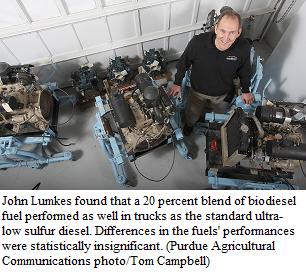 “In terms of performance, reliability and maintenance costs, it was basically a wash,” said John Lumkes, the assistant professor of agricultural and biological engineering who led the study. “The only differences are environmental and economic.”
 The
The  One of the issues with burning higher blends of biodiesel in newer diesel engines that use post-injection for controlling emissions is significant engine wear with methyl ester dilution in the engine oil crankcase.
 “Further developing the biofuels industry helps create jobs and stimulates rural economies, an important part of getting our economy back on track,”
  The 19th Annual Ethanol Producers and Consumers (EPAC) Conference, Fuel, Food and the Future, will be held at the the Best Western Grantree Inn, Bozeman, Montana June 29 and 30, 2009. This educational conference will allow attendees to network with and learn from nationally recognized authorities, and participate in discussions of the emerging technologies in first generation Biofuels, also Biofuel Co-product research and use and the Future Biofuel feedstocks and opportunities.
 Looking for a conference that encompasses all forms of renewable energy? Then