

Today the Environmental Protection Agency (EPA) and the Department of Energy (DOE) signed a joint final rule that establishes greenhouse gas emission standards and corporate fuel economy standards for light duty vehicles for model years 2012-2016. This National Fuel Efficiency Policy requires passenger cars and light trucks to get an overall average of 35.5 miles per gallon (mpg) by 2016 while cars are expected to average 39 mpg and trucks will be required to get 30 mpg. According to the current administration, this measure is expected to save 1.8 billion barrels of oil over the life of the program.
However, we could actually reduce oil imports and emissions even more under this program by using ethanol.

Ricardo’s EBDI engine technology
Let me explain. The easiest way to gain the improved fuel economy is through “engine downsizing,” in other words, using smaller engines. But the new smaller engine technologies will not mean less power, like in the past. According to Ethanol Boosting Systems, their technology enables gasoline engines to “reach their full potential” by utilizing performance enhancing properties of ethanol in conjunction with advances in direct injection (DI) and turbocharging.
Here is how their system works: The EBS approach uses controlled direct ethanol injection to add a very significant vaporization-enhanced On-Demand Octane BoostTM that essentially removes the knock limit on engine performance. The elimination of the knock constraint has been proven by systematic engine dynamometer tests. This allows a small gasoline engine to provide the same or higher torque as compared to a conventional engine of much larger size.Read More



 “Available evidence suggests that biofuels had a relatively small contribution to the 2008 spike in agricultural commodity prices,” the report noted. “Studies which have found a large biofuel impact across agricultural commodities have often considered too few variables, relied on statistical associations or made unrealistic or inconsistent assumptions.”



 According to the forecast, farmers intend to plant 88.8 million acres of corn in 2010, three percent more than both last year and 2008. Meanwhile, the
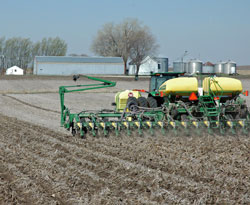 Early reaction to the prospective plantings report is that corn acreage will likely be higher than forecast. While the report estimates corn acreage will increase by 300,000 or more in Illinois, Kansas, Missouri and Ohio, a decrease of 200,000 acres is forecast for Iowa. However, corn growers in Iowa say they definitely expect to see their acres increase when it’s all said and done. Northeast Iowa farmer Tim Burrack, chairman of the