ACE Teams with Fuel Ethanol Workshop

Cindy Zimmerman

The American Coalition for Ethanol (ACE) has teamed up with BBI International to better serve the ethanol industry as part of the International Fuel Ethanol Workshop & Expo (FEW).

fuel ethanol workshopIn recent years, ACE paired its annual conference with a trade show. This year, to better serve ACE members, ACE will partner with BBI as a Supporting Organization for the FEW, allowing ethanol industry suppliers and plant operators to concentrate on one trade show, and giving ACE the opportunity to focus its efforts on continuing to provide a valuable conference event. ACE will continue to hold its annual conference separate from FEW.

american coalition ethanol“ACE is proud to partner with BBI and pleased to support one industry exposition at the FEW,” said Brian Jennings, Executive Vice President of ACE. “Both organizations have a longstanding history of offering first-class events to the ethanol industry, and we believe this partnership will continue to strengthen the industry as a whole.”

The International Fuel Ethanol Workshop & Expo will take place June 27-30, 2011 in Indianapolis, IN and the ACE Conference will be held August 22-24, 2011 in Des Moines, IA.

ACE, Ethanol, Ethanol News, FEW

Rural America Will Provide Energy Solutions

Joanna Schroeder

There are advanced biofuels on the horizon and one such fuel will be algae fuels produced from the waste streams of a first generation corn-ethanol plant. In the future, many believe that more co-located biofuel refineries are on the way and the model will be the Green Plains Renewable Energy (GPRE) / BioProcess Algae plants. BioProcess Algae is in the final stages to commercialization and last week dedicated its Grower Harvester bioreactors and announced plans for its algae farm. On hand for the event was USDA Ag Secretary Tom Vilsack, who gave the keynote speech during the event.

Vilsack stressed several key issues and one was the need to revitalize rural America and create innovative and creative jobs to bring our bright, young people back home. Today, 16 percent of our country’s population comes from rural areas like Shenandoah, Iowa, the home of the biofuels project, and 44 percent of our military comes from these areas.

“I am a great believer in American ingenuity,” began Vilsack. “I’m a great believer in the capacity of the American farmer and rancher to literally meet any challenge.”

Vilsack believes that projects such as BioProcess Algae will spread across the country and rural communities. “There’s phenomenal innovation and phenomenal growth opportunities to be able to do something for your country that needs to be done and that’s to wean ourselves off of our dependence on foreign oil,” continued Vilsack. “It’s an opportunity for us to create jobs in small towns. It’s an opportunity for American agriculture to continue to respond to the challenges it has met time after time in the country.”

Vilsack highlighted that rural America is the source for our food, most of our water and an ever increasing amount of our fuel. The algae component of the biofuels project uses carbon dioxide, waste heat and waste water from the corn ethanol plant, recycling nutrients and resources in a more efficient way. Both the corn ethanol process and soon the algae fuel process will provide food, feed and fiber.

There are four components that Vilsack believes are the secret for success in revitalizing the rural economy: significant investment dollars, innovation, networking, and a sense of place. Vilsack said these are the reasons why the USDA was supporting this project.

He concluded, “I want to congratulate the folks at BioProcess Algae and I want to congratulate the ethanol industry and the advanced biofuels industry for coming together in this operation because it’s a model for the rest of the country and it sends a strong unmistakable message the ethanol industry and the biofuels industry is here to stay and is going to play an important role in shaping not just opportunity for America but very specifically a wonderful opportunity, an unlimited opportunity for the bright young people who want to live, and work and raise their family in the greatest part of America.”

Click here to view the Flickr photo album from the BioProcess Algae/GPRE Grower Harvester event.

advanced biofuels, algae, biofuels, corn, Ethanol, Video

Military Will Buy Biofuels But Won’t Drive Market

John Davis

The U.S. military plans to up its share of biofuels, including biodiesel and ethanol, by nearly a billion gallons over the next few years.

But this article from Biofuels Digest says officials warn that won’t be enough to be the sole driver in the market:

Mark Iden of the Defense Logistics Agency confirmed that the US government proposed to purchase several hundred million gallons of drop-in advanced biofuels by 2016, citing an expected demand of 336 million gallons from the Navy and 587 million gallons from the Air Force.

But Iden, likened the government, although a large customer, to a large commercial airline in terms of purchasing power, and cautioned biofuels producers that the Department of Defense would be a large buyer but not in enough quantity to “singlehandedly drive a market.”

Meanwhile, Navy officials say they will be undertaking a “biorefinery development analysis” to gauge the Navy’s participation in green fuels development.

Biodiesel, biofuels, biojet fuel, Ethanol, Ethanol News, News

NBB: For Earth Day, Biodiesel Friendly Destinations

John Davis

As we sit on the eve of Earth Day (Friday, April 22, 2011), our friends at the National Biodiesel Board have pointed out several tourist destinations that are friendly to the environment by using the green fuel biodiesel:

“Green tourism is more popular than ever, and biodiesel’s ease-of-use and greenhouse gas reductions have made it a big part of that movement,” said Joe Jobe, National Biodiesel Board CEO.

Here are a few of the tourist destinations where you can find biodiesel running behind the scenes:

* Orlando, Fla.: This family vacation hotspot has many choices for biodiesel-supported tourism, from the Jaws Ride at Universal Studios to the LYNX city transit system, which uses 20 percent biodiesel (B20) in all of its diesel buses. The Orlando area is also home to the next National Biodiesel Conference & Expo, Feb. 5 – 8!

* Central Park: The New York City Parks & Recreation Department is leading a green revolution in the Big Apple. The agency maintains more than 29,000 acres in New York City, including such well-known venues as Central Park, Battery Park, Flushing Meadows, Coney Island and more. Since 2006, the Parks Department’s diesel fleet has run on B20. The Parks Department also uses B20 for 95 percent of heating oil sites.

Read More

Biodiesel, NBB

CARD Revisits History of Ethanol and Corn Prices

Cindy Zimmerman

A new report from the Iowa State University Center for Agricultural and Rural Development (CARD) revisits history to look at the impact of ethanol and ethanol subsidies on corn prices.

cardThe analysis by Bruce Babcock and Jacinto Fabiosa uses a computer model to “rewrite history” by re-creating what actually happened in agricultural markets then removing government incentives to produce and consume corn ethanol. To further isolate the effects of ethanol on commodity prices, they also ran a scenario where ethanol production was frozen at 2004 levels.

In summary, this is what they discovered:

First, the general pattern of corn prices that we saw in the historical period—increasing prices in in 2006 and 2007, a price spike in 2008, followed by a sharp price decline in 2009—would have occurred without ethanol subsidies or even if corn ethanol production had not expanded. Second, investor fervor for corn ethanol in 2005, 2006, and 2007 would have occurred even without subsidies because a combination of cheap corn, a phase-out of MTBE, and higher crude oil prices made ethanol profitable. Thus, ethanol production would have expanded quite rapidly even without subsidies.

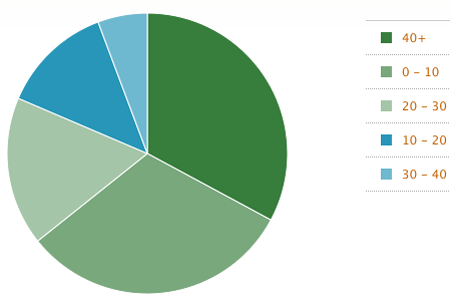
Using the 2004 corn price of $2.06 per bushel as a reference, actual corn prices increased by an average of $1.65 per bushel from 2006 to 2009. Only 14 cents (8%) of this increase was due to ethanol subsidies. Another 45 cents of the increase was due to market-based expansion of the corn ethanol industry. Together, expansion of corn ethanol from subsidies and market forces accounted for 32% of the average increase that we saw in corn prices from 2006 to 2009. All other market factors accounted for 68% of the corn price increase.

Renewable Fuels Association
Vice President of Research and Analysis Geoff Cooper provides some thoughts on the CARD analysis in a new E-xchange blog post.

corn, Ethanol, Ethanol News, RFA

Ethanol Production Drops as Gas Prices Increase

Cindy Zimmerman

eiaAs gasoline prices edge toward $4 a gallon, ethanol production is declining.

According to the latest report from the Energy Information Administration, ethanol production averaged 856,000 barrels per day last week, down almost five percent from the previous week to the lowest level in six months. Production has been steadily declining for the past four weeks due to a number of factors, including higher corn prices. Ethanol plants used about nine million less bushels of corn last week than the latest USDA forecast average.

The higher gasoline prices also have an impact on ethanol production, since nearly all gasoline sold in the country is blended with ethanol. As gas prices go up and people cut back on consumption, demand goes down, which in turn lowers demand for ethanol.

Ethanol, Ethanol News

May Deadline for Biomass Crop Assistance

Cindy Zimmerman

May 27 is the deadline for proposals to be submitted under USDA’s Biomass Crop Assistance Program (BCAP).

bcapThe program, which is administered by USDA’s Farm Service Agency (FSA) provides incentives to eligible farmers, ranchers and forest landowners for the establishment and production of biomass crops for heat, power, bio-based products and biofuels. FSA Acting Administrator Val Dolcini announced the deadline for submitting project area proposals. “The nation that harnesses the power of clean, renewable energy will be the nation that leads the 21st century. BCAP can help rural communities save money, create jobs and improve air quality while reducing the demand for fossil fuels,” said Dolcini. “I encourage all those interested in participating in this program to contact their Farm Service Agency (FSA) state office for details.”

BCAP project areas are specific geographic areas where producers grow eligible biomass crops. Producers then receive annual payments for growing those crops. To be considered, proposals must be submitted to the applicable state office by close of business, May 27, 2011. More information can be found on the FSA BCAP web page.

biomass, USDA

Twin Cities Clean City Coalition Top Gas Use Reducer

Joanna Schroeder

The U.S. Department of Energy has released a national ranking of Clean Cities programs that have had the most impact in the reduction of gasoline use. At the top of the list is the Saint-Paul-based Twin Cities Clean Cities Coalition. The group has been instrumental in a reduction of 135,175,133 cumulative gallons of gas displaced between 2005-2009. The release was actually part of a move by the DOE to help accelerate the deployment of electric vehicles (EVs). As part of the program, Energy Secretary Steven Chu announced the availability of $5 million in new funding for community-based efforts to deploy electric vehicle (EV) infrastructure and charging stations.

“The Department of Energy’s Clean Cities initiative is bringing together local governments and industry to demonstrate the benefits of advanced technology vehicles and help communities use less oil and gasoline to power their vehicles,” said Secretary Chu. “The initiatives announced today are just the latest steps in our broader efforts to reduce America’s dependence on oil, improve our energy security, and save families and businesses money.”

Much of Minnesota’s efforts to reduce gas use has focused on the use of higher blends of ethanol including E85. The state has more than 360 E85 pumps and was the first to pass a 5 percent biodiesel blend mandate. The cities of Minneapolis, Saint Paul and Brooklyn Park were early adopters of alternative fuel vehicles, as were Hennepin, Dakota and Ramsey counties. The state fleet includes 2,500 flex fuel vehicles that can use E85 or gasoline that used nearly 1 million gallons of E85 in 2010.

“We are very pleased to see the hard work of our many partner organizations reflected in our number one ranking,” said Lisa Thurstin, manager of outdoor air programs for the American Lung Association in Minnesota, which administers the Twin Cities Clean Cities Coalition. “The ranking was determined based on the amount of E85, biodiesel, natural gas, propane and other cleaner-burning alternative fuels reported by each Clean Cities coalition to the Department of Energy.”

The EV program was announced during a call with Chu, Transportation Secretary Ray LaHood, Colorado Governor John Hickenlooper, Tucson Mayor Bob Walkup, and St. Paul Mayor Christopher Coleman.

Biodiesel, biofuels, E85, Electric Vehicles, Ethanol, Natural Gas, Propane

BIO Releases Policy White Paper

Joanna Schroeder

The Advanced Biofuels Leadership Conference is underway in Washington, D.C. and more than 400 senior level executives are in attendance to learn more about the trends in the advanced biofuels industry. During the Conference, the Biotechnology Industry Organization (BIO) released a new policy white paper that determined the Renewable Fuels Standard (RFS2) provides both stable market support and a pricing system (through Renewable Identification Numbers or RINs) that are necessary to attract private investment in the advanced biofuels industry. The paper is also being published this month in the journal, Industrial Biotechnology.

“The Renewable Fuel Standard, as it has been implemented by the Environmental Protection Agency, can provide the long-term, stable, market-based government policy mechanism that advanced biofuel producers and investors have been looking for. It provides both and assured market and a significant degree of price certainty for cellulosic and advanced biofuels, which can significantly mitigate the capital risk associated with commercialization of new technologies,” said Brent Erickson, executive vice president of BIO’s Industrial & Environmental Section.

Erickson notes that the RFS is very effective for incentivizing biofuels innovation. He said that with this policy, companies have already made significant investments in research and development. He continued by highlighting the amount of good jobs and positive economic opportunities that the industry provides and then went on to stress that federal support must continue in order for the industry to realize commercial scale production levels. Today, many of these investments are seeing fruition in that several companies in the industry are beginning to make major commercialization announcements.

“Access to capital remains the biggest challenge for the industry, especially as high oil prices threaten to plunge the country into another recession. The RFS must work in coordination with other federal programs administered by the USDA and DOE to provide the industry, its investors and obligated parties needed stability and forward-looking guidance. This paper should reassure capital markets that advanced biofuels represent a sound opportunity. And coupled with the recent USDA loan guarantees and DOE grants the advanced biofuels sector should experience a surge in 2011 and beyond,” concluded Erickson.

You can view photos from the Advanced Biofuels Leadership Conference in my Flickr photo album.

advanced biofuels, BIO, biochemicals, biofuels, conferences

Iowa State Develops Biodiesel, Ethanol Plant Simulator

John Davis

Researchers at Iowa State University have developed a simulator that allows them to replicate all the functions of biodiesel and ethanol plants.

According to this article from the school, the I-BOS (the Interactive Biorefinery Operations Simulator) will help students in Iowa State’s biorenewable resources and technology program learn about biofuel production, as well as helping the biofuel industry train employees:

“This could be the major component of a curriculum for teaching biofuels operators how to run a plant,” [David Grewell, an associate professor of agricultural and biosystems engineering] said. “It’s like a flight simulator for pilots.”

And like a good flight simulator, the virtual control room is calibrated to match real-world performance. It’s based on differential calculations that describe the fundamental transport phenomena and incorporate the principles of mass and energy conservation. The simulations also take into account more than 20 specific production attributes including moisture, starch content, contaminants, temperature and particle size. All the attributes change as biomass is converted into biofuel. And they can be changed by instructors, giving students experience with a variety of production conditions.

The virtual control room is now written to simulate the operation of ethanol and biodiesel plants. It keeps track of energy consumption, production efficiency and fuel quality. It also features interactive video clips from real biofuel plants that give students a good look at the entire production process.

Grewell says the simulator will also help operators in case of an emergency at the plant.

Biodiesel, Ethanol, Ethanol News, News