

In a collaborative effort between University of Wisconsin-Madison, University of Massachusetts-Amherst and Gwangju Institute of Science and Technology, a continuous process for converting biomass and electricity into renewable liquid transportation fuels has been developed. The researchers used a proton-exchange-membrane fuel cell to convert the model biomass compound acetone into isopropanol. This chemical compound can be used in a myriad of pharmaceutical and industrial applications and can also be used as a gasoline additive.
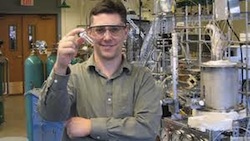 The project, led by George Huber, a UW-Madison professor of chemical and biological engineering, and other members of his research team, say the advance paves the way for researchers to convert biomass molecules such as glucose into hexanes, which are significant components of gasoline currently derived by refining crude oil.
“Essentially, we are making renewable liquid fuel that fits into the existing infrastructure,” said Huber, whose team published its results in the Sept. 7, 2012, issue of the journal ChemSusChem. Unlike other technologies that use large quantities of expensive hydrogen gas to convert biomass to biofuels, the team’s process is driven by electricity, which is inexpensive and readily available in rural areas. And, we’re storing the electrical energy as chemical energy.”
A fuel cell converts chemical energy into electrical energy, or vice versa. Reactions in a proton-exchange-membrane fuel cell, which consists of two “halves,” require only water, electricity and the biomass-derived molecule. The chemical reaction is facilitated by a positive electrode coupled with a catalyst. The other side-the cathode-consists of a negative electrode and a catalyst.
The next step involves reducing biomass molecules into fuel. Read More




 Since ethanol is powering cars across the country these days, it’s about time it had a place at the premier annual event dedicated specifically to automotive service and repair professionals, which is appropriately called CARS – the


 ZimmPoll is sponsored by