Solar Industry Responds to Solar Anti-Dumping Rulings

Joanna Schroeder

After a year, The U.S. Department of Commerce (DOC) has released its final findings regarding the Countervailing Duty and Anti-Dumping rules regarding the imports of billions of dollars of solar cells from China.

DOC ruled that there will be no change of scope with the exception that small consumer goods are now excluded. In addition, the effective rate on Suntech has gone up a few percentage points, down four percent for Yingli and Canadian Solar with Trina down 12 percentage points from the preliminary numbers. The DOC also recommended anti-subsidy duty percentages of 14.78 percent for imports made by Suntech, 15.97 percent Trina Solar and 15.24 percent for all other Chinese manufacturers. Lastly, critical circumstances are in effect save for Suntech’s anti-dumping tariffs.
Jigar Shah, the president of The Coalition for Affordable Solar Energy (CASE) responded by saying, “We are gratified that the scope of today’s decision is limited only to solar cells made in China and that the Department did not significantly increase the tariff from its preliminary decision in May. We are hopeful that continued innovations in technology, a competitive global marketplace, and demand-generated pressure for lower prices will take precedence moving forward. At the same time, we remain concerned about the growing global trade war, which will only hurt American solar industry jobs, growth and consumers.

He added that CASE believes global competition is good for American solar consumers and companies and that the tariffs will not stop the development of solar energy.

In its final decision, the DOC determined that crystalline silicon photovoltaic (“PV”) cells produced in China, whether or not assembled into modules, would be subject to antidumping and countervailing duties. Under the ruling, solar modules assembled in China from cells produced in third countries do not fall within the scope of the duties. Based on this, PV cells produced in China by JA Solar will be subject to an antidumping duty of 25.96 percent and countervailing duty of 15.24 percent.

Jonathan Pickering, president of JA Solar USA, commented, “We are pleased that the dispute is coming to a close and that the scope of the investigation was not expanded. JA Solar cooperated fully with the DOC during its investigation, and we continue to state our case to the International Trade Commission (ITC).” The ITC will make its final ruling on or before November 23, 2012.

Pickering added, “We remain focused on addressing our customers’ need for high-quality, high-performance products, and we’re determined to play an active role in the rapid growth of the U.S. market.”

Energy, International, Solar

Navy: Biofuel Technology is Here

Joanna Schroeder

According to an article on Military.com, biofuel technology has arrived. While several legislators fight to stop the military from pursuing the use of biofuels, Secretary Ray Mabus says the Navy will continue to develop biofuel technology for use in its ships and aircraft. During a luncheon on October 9th, Mabus said the technology is already here.

Research shows that between 2018 and 2024, biofuels will be a viable alternative fuel. What Mabus is focusing on is how to speed up that timeframe and make biofuel technology more competitive with current technologies.

The Navy is currently putting together a “Green Fleet” of ships that use alternative fuels. They are also developing a “Green Hornet” F-18 based on the same concept they are using for their ships.

Mabus says one of the more interesting technologies the Navy is pursing is to hone the chemistry for producing jet fuel while in “theater”. In other words, the ability to develop alternative jet fuel when a troop is deployed. The most promising pricess would catalytically convert carbon dioxide hydrogen gas directly to liquid hydrocarbon fuel used as JP-5, a process being developed and honed by the Naval Research Laboratory (NRL).

The article says that NRL has already successfully developed and demonstrated technologies for the recovery of carbon dioxide and the production of hydrogen gas from seawater using an electrochemical acidification cell. From there the hydrogen gas is converted to hydrocarbons that can be used to produce jet fuel.

Yet despite the promising technology, Mabus says the Navy doesn’t have a favorite technology and their goal is to simply keep develop alternatives.

advanced biofuels, aviation biofuels, Government

Ethanol Myth Busting at Automotive Event

Cindy Zimmerman

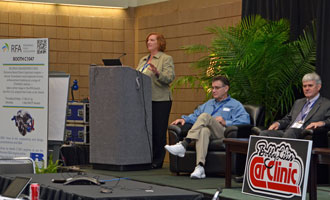
A panel consisting of an automotive technician, an automotive engineer and an ethanol industry representative had the opportunity to bust some myths about ethanol at the National Automotive Service Task Force meeting in New Orleans on Saturday.

Renewable Fuels Association Director of Regulatory Affairs Kelly Davis, Ricardo Chief Engineer for powertrain controls Dr. Matti Vint, and automotive talk show host/service center owner Bobby Likis each addressed one myth about ethanol related to the vehicle industry.

Vint busted the myth that ethanol ruins engine performance by detailing the benefits of the fuel’s higher octane rating, which is a measure of its anti-knock properties. “The higher octane, the higher the cylinder pressure you can operate without causing destructive damage to the engine,” he said. “So high octane is good for extracting the maximum performance of the engine and improving the efficiency.” He explained how designing engines like the Ricardo EBDI (Extreme Boost Direct Injection) engine will better utilize ethanol’s higher octane rating.

Likis busted the myth that ethanol poses repair and service problems. “In the 41 years I’ve been in the automotive service business, I’ve never had a single engine fail as a result of ethanol,” he said, noting that engines have been designed to run on E10 for the past 30 years.

Finally, Davis busted the myth that consumers don’t want choice at the pump. “A recent survey complete by American Viewpoint showed 61% were in favor of replacing imported fossil fuel dependency with renewable fuels like ethanol,” Davis said, pointing out that the approval of E15 allows more options for model year 2001 and newer vehicles.

Listen to the panel presentations here: Ethanol Myth Busters Panel

Watch Dr. Matti Vint’s presentation below:


CARS Event Photo Album

Audio, automotive, Ethanol, Ethanol News, RFA, Video

Gevo Awarded Two Patents

Joanna Schroeder

Gevo, a company focused on developing biobutanol technology,  has been awarded two patents. The first is US Patent No. 8,273,565, entitled “Methods of Increasing Dihydroxy Acid Dehydratase Activity to Improve Production of Fuels, Chemicals, and Amino Acids.” The patent covers suppression of a glutaredoxin protein called GRX3. In combination with other Gevo patented technologies, deletion of GRX3 significantly increases the production of isobutanol by yeast cells.

The second patent awarded was U.S. Patent No. 8,283,505, which protects Gevo’s Integrated Fermentation Technology (GIFT). The GIFT system permits the continuous removal of isobutanol as it is formed in the fermentation broth. This increases productivity of the genetically modified yeast cells because yeast does not thrive in high concentrations of isobutanol. The technology also increases final isobutanol concentrations extracted from the fermentation broth.

advanced biofuels, biobutanol

Bobby Likis Loves Ethanol

Cindy Zimmerman

Automotive talk show host and Pensacola service center owner Bobby Likis uses a tag line that plays on his last name – “Like us? You’ll love us!” And Likis doesn’t just like ethanol, he loves it and he lives it.

It is his passion for the domestic renewable fuel that led to his recent partnership with the Renewable Fuels Association (RFA), not the other way around. That passion was clearly on display this past week during Automotive Service & Repair Week in New Orleans, where Likis took his Car Clinic Network television and radio programming on the road. It was his idea to bring the facts about ethanol to automotive mechanics and technicians at the event and to spotlight new engine technology to optimize ethanol by Ricardo, Inc.

Likis offered a live feed of events at the Congress of Automotive Repair and Service trade show on Watch Bobby Live where he interviewed guests Thursday and Friday last week leading up to his regularly scheduled live program on Saturday from 10 am to noon Eastern. The program on October 13 featured RFA’s Kelly Davis as well as engineers from Ricardo.

I put together a little five minute highlight video of the show below and you can find more on the Watch Bobby Live page.


CARS Event Photo Album

automotive, Ethanol, Ethanol News, RFA, Video

Global Renewable Energy Investments Growing

Joanna Schroeder

Despite global struggles with the economy, investments in renewable energy technologies have continued to grow in 2011. New investments in renewable power and fuels (excluding large hydropower and solar hot water) reached $257 billion, and increase $37 billion from 2010. This according to research conducted by the WorldWatch Institute’s Climate and Energy program. In addition, during 2011, investments in renewable energy were $40 billion greater than in fossil fuel based technologies.

In 2011:

  • Total renewable energy investment in industrial countries accounted for 65 percent of global investment. This is an increase of 21 percent to $168 billion in total.
  • The 35 percent of global new investment that went to developing countries increased 10 percent to $89 billion. Of this total, China, India and Brazil accounted for $71 billion.
  • “Financial new investment” in renewable energy installations in industrial countries outpaced investments in developing world. In 2010 investments in this category in developing countries surpassed those in industrial countries.
  • Driven by a 50 percent reduction in price from 2010 to 2011, $147.4 billion was invested in solar compared with $83.8 for wind projects and $10.6 billion for biomass and waste-to-energy.
  • Biofuels attracted the fourth highest total investment with $6.8 billion, followed by $5.8 billion for small hydro and $2.9 billion for geothermal installations. Read More
biofuels, Energy, Geothermal, Hydro, Solar, Waste-to-Energy, Wind

First Time for Ethanol at CARS

Cindy Zimmerman

The annual Congress of Automotive Repair and Service (CARS) is part of Automotive Service and Repair Week (ASRW), which is an umbrella for several different related organizations to meet, network and learn about what’s new in the industry.

The whole event is coordinated through the Automotive Service Association (ASA) and president Ron Pyle says having the Renewable Fuels Association (RFA) as part of it this year was a great addition. “People understand the reality that we’re going to be dealing with alternative fuels and different technologies,” said Pyle. “Our organization really represents the top echelon of the shops in America today … they’ve very interested in this kind of content.”

Pyle said it was also the first time that Bobby Likis Car Clinic was at the event broadcasting live from the trade show. “Bobby is a long time Automotive Service Association member,” said Pyle. “He spent quite a bit of time with me earlier this year talking about the myths (about ethanol) that he’s going to bust while he’s here and on the show floor they’ve been doing that every day.”

Ricardo engineering rounded out the ethanol education team at the event showing new engine technology under development that can optimize the high octane properties of ethanol as the industry moves toward increased fuel efficiency. “The people that are ready for that revolution will absolutely have a competitive edge,” Pyle said.

Listen to my interview with Ron Pyle here: Automotive Service Association president Ron Pyle
CARS Event Photo Album

Audio, automotive, Ethanol, Ethanol News, RFA

Ricardo Talks Ethanol at CARS

Cindy Zimmerman

The Renewable Fuels Association (RFA) exhibit at the Congress of Automotive Repair and Service (CARS) in New Orleans this past week featured new engine technology developed by Ricardo, Inc. that has the ability to optimize the performance of ethanol in fuel.

Ricardo Chief Engineer for Innovations and Chemical Technology John Kasab was one of the company representatives who presented information at the exhibit and on the Bobby Likis Car Clinic Network broadcasts from the show. During his presentation at the booth, Kasab talked about Ricardo’s history in the automotive realm and how “everything old is new again” when it comes to alternative fuels. “Three key automotive inventors from about a century ago – Henry Ford with Ford Motor Company, Charles Kettering with General Motors and Harry Ricardo our founder – all anticipated depletion of petroleum reserves,” said Kasab. “Henry Ford was thinking about making (fuel) from crops that will help sustain rural economies.” Kettering was thinking about saving the auto industry from oil shortages and Ricardo’s interest was in energy security, especially since he was British, and Kasab noted that all of them also saw the potential of ethanol for anti-knock properties.

Kasab says federal and state regulations calling for dramatically increased fuel economy for vehicles, as well as the Renewable Fuel Standard requiring more alternative fuel use, means a great need for engines optimized to run on fuels other than gasoline in the future. “Over the next decade, we’re going to see a lot of new technology coming into internal combustion engines to significantly improve their efficiency,” he said. “The technologies that are going to facilitate this efficiency improvement will have a natural thirst for higher octane and we see increased ethanol content in the fuel as part of the pathway toward facilitating better engine performance.”

To that end, Ricardo developed the EBDI – Extreme Boost Direct Injection Engine – which we will learn more about from other members of the Ricardo team who attended the CARS event.

Listen to Kasab’s presentation here: Ricardo's John Kasab at CARS
See photos from the CARS event with Ricardo, RFA and Bobby Likis.

Audio, automotive, Car Makers, Ethanol, Ethanol News, RFA

Ethanol Industry Pumps $5B Into MN State Economy

Joanna Schroeder

According to a new report from the Minnesota Department of Agriculture (MDA), the state’s ethanol industry generated more than $5 billion in total economic activity in 2011. In addition, the ethanol industry supported more than 12,600 jobs. The state is 5th nationwide in ethanol production with 21 ethanol biorefineries.

According to the MDA report, ethanol added $912 million to the value of the state’s corn crop in 2011, a second record high. For every bushel of corn processed into ethanol, $2.07 was generated in additional revenue. The report also shows that for every dollar invested into the ethanol plants, more than eight dollars were generated for the Minnesota economy.

“While there have been ups and downs in the ethanol industry, the fact is it’s a huge advantage for us to keep more of the value of the corn we produce rather than ship it to another state or country as a raw commodity,” said Su Ye, the author of the report. “The ethanol industry is an important economic driver that adds value to every bushel of corn grown by the roughly 11,000 farmers who supply it to the plants.”

Last year, of the 1.2 billion bushels of corn harvested by Minnesota growers, 440 million bushels were put into production of ethanol and its co-products including distillers grains. Forty-two percent of the corn is exported and 39 percent is processed. In comparison, 12 percent of the total U.S. corn crop is exported and 50 percent is processed. Ye says the ethanol industry continues to have a critical role in bringing increased returns to the state’s largest agricultural crop.

Agribusiness, biofuels, corn, Ethanol

Platts Acquires Global Sugar & Biofuels Info Provider

Joanna Schroeder

Platts, a division of McGraw-Hill, is in the process of acquiring Kingsman, SA, a Switzerland-based provider of price information and analytics for the global sugar and biofuels markets. If all goes as planned, the acquisition will become official on November 1, 2012. Platts focuses on delivering news to the agricultural and energy sectors.

“Kingsman is widely recognized as the leading global brand for sugar market data and analytics,” said Larry Neal, president of Platts. “Our acquisition of Kingsman deepens Platts’ capabilities in biofuels and gives us a springboard for growth in the global agricultural markets.  It also reinforces our commitment to becoming a leader in market analytics as well as news and price information.”

Neal said the deal was a good fit for the company because it will allow the company to develop benchmarks that support market evolution and enhance price transparency. Kingsman has analysts, researchers and report writers in key markets including London Montreal, New Delhi and  Sao Paulo and the company offers a variety of subscription publications covering sugar, ethanol and biodiesel.

biofuels, International