Electric One-Seater Colibri Heading to Market

Joanna Schroeder

During the 83rd Geneva International Motor Show, Innovative Mobility Automobile GmbH (IMA) unveiled its new electric one-seater Colibri. The lightweight, street legal vehicle is scheduled to enter production by late 2014 and in the first year around 17,000 EVs are expected to be produced at a price point of 10,000 Euro, with an additional monthly battery lease.

colibri“Our vision was to construct an electric vehicle suitable for daily urban use, one which is safe and also fun. It was to be economic, ecologic, and easy to combine with other modes of transportation,” said Thomas delos Santos, CEO of IMA.  We succeeded in achieving this. And the market feedback shows: the Colibri strikes a nerve.”

Here are the specs: the Colibri measures of 2.75m length, 1.18m width and 1.30m height. A specially designed lifting mechanism eases entering and exiting, while pedals and steering wheel can be adjusted to suit drivers between 1.58m and 1.98m. The trunk offers enough volume for two crates. The lightweight frame is mounted on a magnesium-steel basis, reducing vehicle weight and energy consumption costs. The company anticipates the electric vehicle will pass all safety and crash tests.

Two CPM Twin engines provide 24 kW peak power. The car reaches a top speed of 120 km/h and accelerates from 0 to 100 km/h in 9.9 seconds. Electricity for a range of 110 km is provided by a high-performance lithium-iron-phosphate battery from the company Axxellon. Its distinct features are a long lifecycle and short charging times.

Electric Vehicles

Growth Energy Leadership Conference Kicks off

Joanna Schroeder

Today Growth Energy is kicking off its fourth annual Executive Leadership Conference in Las Vegas. The event is designed to bring Growth Energy members together to assess the stGrowth_Energy_logo (1)ate of the organization as well as the state of the ethanol industry. The conference will feature several roundtables with moderators and special guest speakers from NASCAR as well as the automobile, agriculture, and renewable energy industry.

“The Executive Leadership conference provides an excellent opportunity for our members to have a frank and open discussion regarding the state of the industry, the successes we have realized in the past year as well as the challenges moving forward,” said Tom Buis, CEO of Growth Energy. “As our organization continues to grow, so does the size and scope of the conference,” Buis continued. ‘This year promises to be the best yet with many in depth conversations about how our industry moves forward on a number of fronts.”

Buis said in particular, there have been a number of forums planned to discuss the global marketplace, E15 and the path forward, the importance of the Renewable Fuel Standard (RFS) and many of the myths surrounding it, as well as market conditions moving forward. Additionally, there will be a in-depth discussion of American Ethanol’s role in this year’s NASCAR season.

“We have always strived to put together a broad conference that addresses many of the specific issues our membership faces and this year will be no different. I am confident that this conference will help outline the strategic goals of our industry and how best to achieve them in these challenging times,” continued Buis.

“I look forward to this year’s conference and also celebrating the many successes our industry has achieved in the past year. Regardless of the challenges this industry has faced, the individuals gathered here are among the very best and exemplify true leadership in every sense of the way and I look forward to working with them the next few days to help identify the strategic goals and challenges we will face together in the biofuels industry.”

American Ethanol, E15, Ethanol, Growth Energy, NASCAR

Let’s Talk About Ethanol

Joanna Schroeder

classic-13-ace-ron-lambertyRon Lamberty is the Senior Vice President for American Coalition for Ethanol (ACE) but he focuses mainly on market development. Lamberty has run gas stations for nearly 30 years and still operates a few. In his role with ACE, he works directly with gas stations to answer any questions they have about ethanol and ethanol blending.

ACE, said Lamberty, during an interview at the 2013 Commodity Classic, is a grassroots organization that focuses on promoting the ethanol. Many of their members are state and federal corn groups, rural electric cooperatives, ethanol plants and more. Many corn growers are also individual members of ACE.

A big initiative that ACE has coming up is the Biofuels Beltway Fly-in that around the corner (March 13-14, 2013). Lamberty explained this is where their members, who aren’t necessarily ethanol producers, join other advocates in D.C. to explain to as many people the benefits of ethanol beyond that to just producers. Some of the growers who attended Commodity Classic will also be in Washington, D.C. next week sharing their personal stories about ethanol with members of the Congress, their staff and other key federal leaders.

In addition to the upcoming fly-in, Lamberty mentioned an outreach effort they share with the Renewable Fuels Association called Blend Your Own Ethanol. This program helps retailers who would like to sell ethanol blends, such as E15 and E85, learn everything they need to know to offer consumers more choices at the pump.

Listen to Jamie’s interview with Ron Lamberty who also takes about some other key 2013 ACE initiatives: Let's Talk About Ethanol

2013 Commodity Classic Photo Album

ACE, Audio, biofuels, Biofuels Beltway, Commodity Classic, Ethanol

Iowa Could Be Energy Independent Today

Joanna Schroeder

Did you know that if Iowa were a country, it would be the fourth largest producer of corn in the world behind the U.S., China, and Brazil? Iowa also produces more than the entire European Union – comprised of 27 countries. And Iowa has a tiny footprint in comparison to America, U.S. and Brazil. Talk about producing more on less land!

irfa-northeyGuess who told me this cool stuff. Iowa Ag Secretary Bill Northey who I had a chance to speak with during the Iowa Renewable Fuels Summit.

Iowa is also the largest producer of corn-ethanol in the world with 41 plants producing between 3.5 and 4 billion gallons of fuel per year. This is enough fuel for the state to be energy independent said Northey. Last year Iowa produced 3.7 billion gallons of ethanol, and of the 3 million Iowans, drivers used about 1.4 billion gallons of ethanol and gasoline in 2012. So Iowa uses less than half of what the state produces in ethanol alone. Northey said if Iowa didn’t have to blend its gasoline with ethanol, the state wouldn’t need a drop of gasoline imported from other states or other countries and Iowa would still be able to export nearly half of the ethanol it produced.

“We would be the only state that would be a net-exporter of liquid fuels that doesn’t pump a barrel of oil from the ground,” said Northey.

On the biodiesel side, Northey said the state also uses less gallons of diesel than the total production of biodiesel. Like ethanol, Iowa is the largest producer of biodiesel in the country.

In last January, Senator Harkin announced that he would be retiring. I asked Northey for his thoughts on what Harkin’s retirement means to the biofuels industry. “I hope Iowa elects someone just as strong and just as vocal in his or her support of the biofuels industry,” he said.

Well, Bill fits those requirements. Will he be putting his hat in the ring?

You’ll have to listen to my interview with Bill to find out. You’ll also get some other cool biofuel facts about Iowa: Iowa Could Be Energy Independent Today

View the IRFA Renewable Fuels Summit Photo Album.

Audio, Biodiesel, biofuels, corn, Ethanol, Iowa RFA

Strong Policies Will Boost Clean Jobs

Joanna Schroeder

According to a new report from Environmental Entrepreneurs (E2), there were more than 300 clean energy and clean transportation projects in 2012 that created 110,000 jobs. E2 notes that the report comes at a time that groups and lobbyists backed by the fossil fuel industry are currently trying to derail clean energy policies including the Renewable Fuel Standard and state Renewable Portfolio Standards.

E2 Fourth Quarter Job Report“It’s now crystal-clear that clean energy and clean transportation are helping our economy recover,” said Judith Albert, executive director of E2. “The projects and job announcements like we saw in 2012 can continue – as long as we don’t let smart energy policies get hijacked by special interests.”

Albert notes that state policies have done a lot to drive growth in the clean energy industry. “If lawmakers care about creating good, clean energy jobs in their neighborhoods, they should continue supporting those policies. If not, they can sit back and watch these good-paying jobs go elsewhere.”

In 2012, California, North Carolina and Florida led the nation. Illinois, Connecticut, Arizona, New York, Michigan, Texas and Oregon rounded out the Top 10. As a region, the Southeast led the country in manufacturing-related clean energy job announcements, with more than 13,700 jobs announced last year, accounting for about 80 percent of the nation’s total. Solar, advanced vehicles and wind energy were the leading clean energy manufacturing industries in the Southeast. Nationwide, clean transportation projects led the job growth last year, followed by clean power generation, manufacturing and energy efficiency projects.

In the fourth quarter of last year, nearly 16,000 clean energy and clean transportation jobs were announced, up from 10,800 in the third quarter, thanks in large part to a 7,000-job light rail announcement in Charlotte, N.C. Clean transportation jobs aside, several sectors saw sharp declines in the fourth quarter, due in large part to regulatory uncertainty in Congress and during the 2012 election.

“Smart policies and regulatory certainty– at both the federal and state levels – drive economic growth,” added Albert. “If 2012 taught us anything, it’s that if America wants to keep creating good, clean energy jobs, we need good, clean energy policies.”

Clean Energy, Environment

Unique Solar Parking System

Joanna Schroeder

WattLots has installed a unique solar parking system, Power Arbor, at Runnells Specialized Hospital in Berkeley Heights, New Jersey. According to the company, the system uses mono-crystalline silicon solar cells and unlike typical flat panel systems, the open-air design of the Power Arbor does not collect snow. This reduces structural costs while Runnels-Solarproviding up to 60 more days of annual power generation, making it a good solution for Northeast Corridor lots or regions with regular snowfall. The structures are manufactured and assembled in New Jersey.

“The product’s unique design answers a number of issues which plague conventional parking lot structures,” said WattLots’s CEO, William Kaufman. “The Power Arbor provides a uniquely styled parking lot canopy system that is specifically designed for the northeastern climate.”

The company says its Power Arbor system provides substantial quantities of clean, renewable electrical energy at the source of demand where it is needed and it automatically rotates and follows the sun, increasing energy generation by up to 40 percent when compared to typical fixed installations.

“The Power Arbor development is illustrative of the value provided to emerging entrepreneurs by Clean Energy Alliance (CEA) members, in this case the NJIT Enterprise Development Center,” said James F. Groelinger, Executive Director of CEA, of which WattLots is a member. “CEA members currently are mentoring hundreds of clean tech entrepreneurs and companies, many of which will become important contributors to our energy and environmental future while creating jobs in America.

Alternative energy, Electricity, Energy, Solar

Growers Asked to Join Grassroots Ethanol Efforts

Joanna Schroeder

classic-13-growthTara Chandra with Growth Energy spends much of her time working in the organization’s public policy sector. She helps with their social media efforts and other educational efforts as well as helps their member’s with their policy and communication efforts. Chandra was at the 2013 Commodity Classic that took place in Kissimmee, Florida talking to growers from across the country in an effort to build their grassroots membership.

One area Chandra said she received a lot of questions about how to get more E15 at the pump. She said growers and consumers alike need to continue to ask their retailer to offer E15. Once the retailer is on the hook, organizations like Growth Energy can help them navigate the process of selling E15. At their booth Growth Energy featured one of their Flex-Fuel pumps that allow retailers to sell E10, E15 or E85 among other mid-level ethanol blends.

Chandra said Growth Energy will be all over the country this year spreading the good word about ethanol and encourages growers to join them in their efforts.

Listen to Jamie’s interview with Tara Chandra: Growers Asked to Join Grassroots Ethanol Efforts

2013 Commodity Classic Photo Album

Audio, Commodity Classic, E15, Ethanol, Growth Energy

Duckweed for Biofuels?

Joanna Schroeder

Duckweed may be a viable material for biofuel production according to a new report in ACS’ journal Industrial and Engineering Chemistry Research. Duckweed is a fast growing floating plant that turns ponds and lakes green.

DuckweedChristodoulos A. Floudas, a professor at Princeton and Xin Xiao with Langfang Engineering and Technology Centre, Institute of Process Engineering, Chinese Academy of Sciences, along with several colleagues explain that duckweed, an aquatic plant that floats on or near the surface of still or slow-moving freshwater, is ideal as a raw material for biofuel production. It grows fast, thrives in wastewater that has no other use, does not impact the food supply and can be harvested more easily than algae and other aquatic plants. However, they say, few studies have been done on the use of duckweed as a raw material for biofuel production.

In the article, Floudas and Xiao describe four scenarios for duckweed refineries that use proven existing technology to produce gasoline, diesel and kerosene. Those technologies include conversion of biomass to a gas; conversion of the gas to methanol, or wood alcohol; and conversion of methanol to gasoline and other fuels. The results show that small-scale duckweed refineries could produce cost-competitive fuel when the price of oil reaches $100 per barrel. Oil would have to cost only about $72 per barrel for larger duckweed refiners to be cost-competitive.

The research was partially funded from grants from the National Science Foundation and the Chinese Academy of Sciences.

advanced biofuels, feedstocks, Research

Intentions for 2013 Corn

Talia Goes

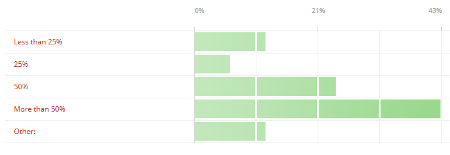
Our latest ZimmPoll asked the question, “What are your spring planting intentions for corn?”

Our poll results: Forty-four percent said More Than 50% and twenty-five percent said 50% Corn. Tying for 3rd, thirteen percent said less than 25% and Other. Six percent said 25% Corn. Even with the extreme drought conditions our poll shows that the majority of you are going to continue planting a lot of corn!

chart

Our new ZimmPoll is now live and asks the question, “Will the sequester monster impact you personally?” U.S. sequestration ordered by President Obama officially began Friday March 1st. Will sequestration impact you? Let us know.

ZimmPoll is sponsored by New Holland Agriculture.

New Holland, ZimmPoll

Algal Based Biofuel Retail Pilot Successful

Joanna Schroeder

Propel Fuels and Solazyme have announced the results of their pilot retail program and over the 30 days consumers were given a choice to purchase biofuels produced from algae, they chose the algal-based biofuel. In a survey of users, consumers said they prefer its environmental benefits compared to conventional fuels; would purchase more of it if it was widely available and would even pay a premium for it. The pilot program, which marked the first commercial availability of algal derived fuels, offered SoladieselBD in a B20 blend (20 percent biodiesel, 80 percent diesel) to consumers through Propel’s Clean Fuel Points in Redwood City, San Jose, Berkeley, and Oakland.

Algal-B20 at Propel Photo: Michael Macor, The ChronicleIn the consumer survey, 92 percent of participants noted that they would be more likely to purchase algae-derived fuel for its environmental benefits; 70 percent indicated that they would purchase the fuel more frequently if it were derived from algae; and nearly 40 percent of customers indicated they would pay a premium for algae-derived fuel. The survey responses were reflected at the pump. Sales results reflected a 35 percent volume increase at Propel stations offering the algae-derived fuel over area sites not participating in the pilot.

“Our fuels have already been successfully demonstrated in fleet vehicles, corporate buses, military applications and the first U.S. commercial flight on biofuel,” said Bob Ames, VP of Fuels, Solazyme. “The successful pilot program with Propel further exhibits strong consumer appetite for the superior performance and environmental properties of Soladiesel.” The algal-based biofuel, SoladieselBD meets or exceeds ASTM quality specifications and has shown performance enhancements including superior cold temperature operating performance and environmental benefits, according to Solazyme.

“Propel is committed to providing drivers true choice at the pump by bringing to market the world’s highest quality and most sustainable fuels,” added Matt Horton, CEO of Propel Fuels. “The results show strong preference for algae-based fuel, and we are thrilled to have partnered with Solazyme to enable our customers to be the first in the country to purchase this next generation biofuel.”

advanced biofuels, algae, Renewable Energy, Retailers