Lee Consulting: Alternative Energy Knowledge Center

Joanna Schroeder

Have a question about renewable energy? Then look no further than Lee Enterprises Consulting based in Sherwood, Arkansas and your go-to guy, Wayne Lee. Lee has been a consultant for nearly 30 years and about a decade ago, began expanding his expertise into biofuels as people began coming to him with questions. He said he began fairly small with the goal of becoming the one-stop shop for those in the renewable fuels industry. Today, his firm has a breadth of talent in biodiesel, ethanol, biomass, cellulosic, biobutanol, waste-to-energy, wind, solar, and more.

RWL1So what types of services do they offer? Lee says in it upwards of 100.

And what might be a common request or question for his team?

For example, Lee said they are often contacted to do project feasibility studies such as the feasibility to build a biodiesel plant, If the the outcome is a green light, the client will often ask his group to serve as the project manager. In this case, they would help find experts to design and optimize the plant, build the plant, install the plant and bring you up to speed and get you trained. Lee said if this is four different people, he has found that if there is a problem, the four different companies would play the blame game. But if it is one person coordinating all the partners, then he or she can get down to the problem quicker and have it resolved in a timely manner.

As the environment continues to take center stage, I asked Lee if when working with his clients, he kept sustainability in mind. He noted, “If you look at the renewable fuels industry and the alternative fuels industry as a whole, there is a lot of overlap, but really it’s an all of the above approach. I can see an ethanol plant with a biodiesel plant sitting adjacent to it and perhaps add solar panels on the roof and wind turbines on the outside. I think that the key is Mother Earth will give us a lot of free stuff if we’re willing to take it.”

Lee added, “I think that alternative fuels is here to stay. I don’t think that there is bad and a good. There is a what’s good right now. My hope is over the next few years the alternative fuels industry becomes a little more mainstream. Petroleum is here to stay but it’s getting harder to find and harder to get and that’s going to make its price go up. And I think we all have a duty to keep the Earth clean and the way it was meant to be.”

Listen to Wayne Lee’s full interview here: Lee Consulting Enterprises: Alternative Energy Knowledge Center

Alternative energy, Audio, Biodiesel, biofuels, Ethanol, Renewable Energy, Solar, Wind

DOE Announces $18M to Advance Drop-In Biofuels

Joanna Schroeder

The U.S. Department of Energy (DOE) has announced $18 million in investments for four pilot-scale biorefineries that will test renewable biofuels that will meet military specifications for jet fuel, shipboard diesel, cars and trucks. These projects build on the Obama Administration’s broader efforts to advance biofuels technologies to continue to bring down costs, improve performance and identify effective, non-food feedstocks and processing techniques.

Logos for DOE StoryThe projects selected for negotiation are: Frontline Bioenergy LLC (up to $4.2 million based in Ames, Iowa); Cobalt Technologies (up to $2.5 million based in Mountain View, California); Mercurius Biorefining, Inc. (up to $4.6 million based in Ferndale, Washington) and BioProcess Algae (up to $6.4 million based in Shenandoah, Iowa).

“Advanced biofuels are an important part of President Obama’s all-of-the-above strategy to reduce America’s dependence on foreign oil, improve our energy security and protect our air and water,” said Energy Secretary Steven Chu. “The innovative biorefinery projects announced today mark an important step toward producing fuels for our American military and the civil aviation industry from renewable resources found right here in the United States.”

Chu says domestic oil and gas production has increased each year the President has been in office. Simultaneously the administration is taking additional steps to reduce America’s reliance on foreign oil. As part of this effort, the Department is helping to speed the development of hydrocarbon-based biofuels that are more compatible with today’s infrastructure and engines, including heavy vehicles and other applications. According to the Energy Department’s Billion Ton Study, advanced biofuels have the potential to displace approximately one-third of the nation’s current transportation petroleum use.

The pilot-scale biorefinery projects selected today will use a variety of non-food biomass feedstocks, waste-based materials, and algae in innovative conversion processes to produce biofuels that meet military specifications for jet fuel and diesel. The projects will demonstrate technologies to cost-effectively convert biomass into advanced drop-in biofuels and assist these organizations to scale up the processes to commercial levels. Recipients are required to contribute a minimum of 50 percent matching funds for these projects.

advanced biofuels, algae, aviation biofuels, biomass, military

Indonesia, EU to Meet Over Biodiesel Subsidies

John Davis

eu-indonesiaflagsIndonesian and European Union (EU) officials will meet to discuss allegations by the EU that Indonesia is illegally subsidizing biodiesel exports to Europe. The Jakarta Post reports says the Indonesians are confident they’ll be cleared of any wrongdoing:

An investigation initiated by the European Commission in November said that Indonesia had illegally subsidized its biodiesel producers.

The EU has accused the Indonesian government of imposing low export taxes on biofuel exports, making local biofuel products cheaper than those produced in the EU.

It was also alleged that the government provided local producers a subsidy of between Rp 2,000 (21 US cents) and Rp 3,000 per liter for domestic biodiesel.

[Indonesian Trade Ministry trade safeguard committee director] Ernawati told reporters that there was a big hole in the EU’s argument, claiming that low export taxes for biodiesel were part of a government strategy to boost the downstream industry, which no way aided local biodiesel producers.

“We impose different tariffs on various products. We impose higher export tariffs for raw materials and lower tariffs for processed products. We want to boost downstream products,” Ernawati added.

The government subsidy, according to Ernawati, was actually only Rp 1,000 per liter and was given to boost domestic consumption of the eco-friendly fuel. She claimed that the subsidy did not affect the price of Indonesian biodiesel in the international market and that the subsidy had been given only when biodiesel prices were higher than that of regular diesel fuel.

The EU is also accusing Indonesia and Argentina of dumping biodiesel in the EU market by selling it at lower prices than available locally.

Biodiesel, International

BioProcess Algae Awarded $6.4M Grant

Joanna Schroeder

BioProcess Algae has been selected to receive a grant of up to $6.4 million from the U.S. Department of Energy (DOE), as part of an innovative pilot-scale biorefinery Bioprocess Algae's Growth Systemproject related to production of hydrocarbon fuels meeting military specification. The project will use renewable carbon dioxide, lignocellulosic sugars and waste heat through BioProcess Algae’s Grower Harvester(TM) technology platform, co-located with the Green Plains Renewable Energy’s ethanol plant in Shenandoah, Iowa.

“BioProcess Algae was the only algae platform chosen to be a part of this project by the DOE,” said Todd Becker, President and CEO of Green Plains. “This project will link our commercial scale platform for growing and harvesting algal biomass with technology partners for conversion into advanced biofuels. While this is a project for the development of drop-in biofuels, we continue to focus our technology for growing and harvesting algae for feed, food or fuel.”

The project will demonstrate technologies to cost-effectively convert biomass into advanced drop-in biofuels and the recipient is required to contribute a minimum of 50 percent matching funds for the project.

Tim Burns, President and CEO of BioProcess Algae added, “We believe our Grower Harvester platform will be vital in the development of this project with the DOE. For this project, we will integrate low-cost autotrophic algal production, accelerated lipid production, and lipid conversion in an effort to develop a cost-effective advanced biofuel for military needs. This development is consistent with our current plans to build the next phase of Grower Harvester reactors in Shenandoah.”

advanced biofuels, algae, Renewable Energy

Kinder Morgan to Blend Biodiesel in Las Vegas, Phoenix

John Davis

KinderMorgan-LogoEnergy company Kinder Morgan has announced it will soon start blending biodiesel at its Las Vegas and Phoenix terminals. This Reuters article says the company made the decision based, in part, on the upswing in Renewable Identification Numbers values:

The company is benefitting from a spike in the price of renewable credits, known as RINs. The move is “positive for us because we generate excess RINs at our transmix facilities,” said CEO Richard Kinder during a conference call.

He said Kinder Morgan generates 700,000 gal/month of excess RINs. “We are selling them on a monthly basis to a customer who wants to take all we have,” said Kinder, without specifying the types of RINs.

Biodiesel RINs have risen from 45 cents/RIN at the beginning of this year to current prices of about 80-90 cents/RIN.

Biodiesel, RINS

Enhanced Geothermal System Changing Energy Future

Joanna Schroeder

Ormat Technologies, the U.S. Department of Energy and GeothermEx have successfully produced 1.7 additional megawatts from an Enhanced Geothermal System (EGS) project inside an existing wellfield in the U.S. –the first EGS project to be connected to the electricity grid. Using subsurface technologies, research and development teams stimulated an existing sub-commercial injection well resulting in a 38 percent increase in power output from brine at Ormat’s Desert Peak 2 geothermal power plant in the Brady complex, Churchill County, Nevada.

Support for the project included $5.4 million in direct DOE funding, $2.6 in million investment from Ormat, and more than four years of collaborative work with Ormat Geothermal Project in Nevadapartners including Lawrence Berkeley National Laboratory, U.S. Geological Survey, Sandia National Laboratory, University of Utah EGI, Temple University and TerraTek.

Ormat explains that by expanding existing hydrothermal fractures deep within the Earth’s crust, EGS technology enhances the permeability of underperforming wells, making it possible to extract additional heat from a reservoir’s rocks and inject geothermal fluid at higher flow rates. Ormat’s air-cooled power plants don’t consume water in the conversion of energy into electricity; all the geothermal fluid is re-injected, to be produced again after heating in the reservoir.

“This research and development project was conducted under a stringent induced seismicity protocol developed by LBNL and the Department of Energy. We achieved an increased injection rate up to 1,600 gallons per minute without consuming or discharging water at the surface and using only existing geothermal brine returned to the original aquifer,” said Lucien Bronicki, founder and chief technology officer for Ormat. “Our objective in the Desert Peak EGS project was to demonstrate that this technology can have a significant impact on sub-commercial wells. This could enable us to use unproductive wells to generate more power and new revenue.”

“DOE’s Geothermal Technologies Office is changing geothermal development in the U.S.,” Bronicki added.

Electricity, Energy, Geothermal

Honeywell UOP Selected for Floating LNG Project

Joanna Schroeder

UOP LLC, a Honeywell company, has been selected by Malaysia‘s Petroliam Nasional Berhad (PETRONAS) to provide technology for acid gas removal on the world’s first Floating Liquefied Natural Gas (FLNG) project, known as PETRONAS Floating LNG 1or PFLNG 1. The PFLNG 1 facility, which is designed to extract natural gas from offshore wells and liquefy and store it for later transport, will use Honeywell’s UOP Amine Guard FS process to remove carbon dioxide and hydrogen sulfide from UOP-LLC-to-Provide-Acid-Gas-Removal-Technology-for-PETRONAS-PFLNG-1the liquefied natural gas (LNG) feed streams.

“We are pleased to continue to grow UOP’s long-standing relationship with PETRONAS and for the opportunity to work with the company on its historic first floating LNG project,” said Rebecca Liebert, vice president and general manager for Honeywell’s UOP Gas Processing and Hydrogen business unit. “UOP offers a full suite of leading-edge, agile gas processing technologies, enabling us to design solutions for customers monetizing their gas resources. Together with PETRONAS, we are excited to bring continued improvements to meet the world’s growing demand for cleaner-burning and versatile natural gas energy in this new frontier of gas conditioning and treating.”

Scheduled for start-up by the end of 2015, the FLNG unit will be moored approximately 112 miles off the coast of Sarawak, Malaysia, and is designed to produce 1.2 million tons per year of LNG.

FLNG facilities such as PFLNG1 represent a step change because they allow these operations to be carried out far from land and closer to offshore gas sources. UOP says they will play a significant role in efforts to unlock gas reserves, particularly in remote and stranded fields previously deemed uneconomical to develop.

Liquefied natural gas (LNG)

Ten Ways Renewable Fuels are Enviro

Joanna Schroeder

The Iowa Renewable Fuels Association (IRFA) has unveiled a list of 10 ways the renewable fuels industry is helping to improve the environment. According to IRFA, renewable fuels offer positive impacts on the environment compared to petroleum-based counterparts.

“Renewable fuels make our planet a better place to live with healthier air and water, and that’s exactly what Earth Day is all about,” said IRFA Executive Director Monte Shaw. “Smart energy policies like the Renewable Fuel Standard (RFS) encourage the production and use of cleaner, more environmentally friendly fuels like E15 and B20 that significantly reduce the environmental harm that is caused by petroleum-based fuels.”

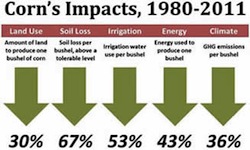
Corns impact source NCGAThe following Top 10 list highlights ways in which ethanol and biodiesel have benefited the environment over the past decade through improvements at the plant, on the farm, and out of the tailpipe.

1.  According to the U.S. Department of Agriculture (USDA), for every unit of fossil energy needed to produce biodiesel, 5.5 units of energy are gained, while ethanol generates 2.3 units of energy for every unit of fossil energy input. By comparison, gasoline and diesel fuel have negative energy balances.

2.  The adoption of regenerative thermal oxidizers (RTO) has significantly reduced volatile organic compound emissions from ethanol plants.

3.  On a per gallon basis, today’s ethanol plants require 28% less thermal energy and 32% less electricity than a decade ago, according to the University of Illinois at Chicago.

4.  According to the U.S. Environmental Protection Agency (EPA), biodiesel reduces greenhouse gases (GHG) by up to 86% compared to petroleum diesel, while Yale University found that ethanol reduces GHG by up to 59% compared to gasoline.

5.  Water used to produce a gallon of ethanol has dropped 40% over the last decade, while biodiesel production reduces wastewater by 79% and hazardous waste by 96% when compared to petroleum diesel.

6.  Increased income from ethanol demand for corn has allowed farmers to invest in precision farming equipment and stronger conservation and environmental protections.

7.  The environmental footprint of U.S. corn production has improved greatly since the advent of the ethanol industry, including significant reductions in soil loss, irrigation, energy use and the amount of land required to produce a bushel of corn.

8.  Ethanol and biodiesel are both biodegradable and non-toxic.

9.  Biodiesel and ethanol significantly reduce tailpipe carbon monoxide emissions, air toxics, fine particulate matter and smog pollution compared to petroleum diesel and gasoline, making our air healthier to breathe.

10. Since the beginning of the RFS, biodiesel use alone has reduced lifecycle greenhouse gas (GHG) emissions by nearly 74 billion pounds, the equivalent of removing 5.4 million vehicles from U.S. roads.

Biodiesel, biofuels, Environment, Ethanol, Iowa RFA

PowerPot Turns Heat and Water into Electricity

Joanna Schroeder

Although this story doesn’t fit the traditional mold of renewable energy, it does honor Earth Day. Power Practical, a student startup that sprang from research at the University of Utah (the U), is selling a portable cook pot, coined the PowerPot, that transforms heat and water into a power source. The technology uses thermoelectricity to gPowerpot2enerate power by capturing the electrons moving from the heated pot to the cooler water inside. The greater the temperature difference, the more electricity is generated.

The students behind the company have been surprised by its rapid growth and are struggling to keep up with growing interest and demand. David Toledo, co-inventor and founder said, “We knew we were on to something when we got requests from around the world and more than doubled our goal during our Kickstarter campaign. We just shipped all of those orders, and we are quickly getting our product into more stores.”

Paul Slusser is the other co-inventor and founder. Other members of the Power Practical team include Matt Ford, the CEO who graduated with a degree in finance from the U in 1990; Wafiq Ali, who is graduating this May with a business degree from the U; Caleb Light, a business graduate from University Valley University; and Kenyon Ellis, an international studies student at the U.

Powerpot3The company has already shipped more than 1,000 units after attracting $126,000 in funding from its debut on Kickstarter, a crowdfunding platform, and they recently raised an additional $750,000 in seed funding.

“David and Paul are examples of what makes engineering so exciting ­ by mixing creativity, science, math and design education, they came up with a product that improves the quality of life for people around the world,” said Richard Brown, dean of the College of Engineering at the U. “Being entrepreneurial comes naturally to many engineers. In fact, 41 percent of the spinoff companies from the U are from engineering.”

The PowerPot is geared toward camping enthusiasts but also for those in developing countries who need electricity, such as to charge a cell phone. The company has a growing variety of PowerPots that serve different needs. The basic model, the PowerPot V, weighs less than a pound and produces 5 volts, enough to charge a cellphone in 60 to 90 minutes. Larger models, like the PowerPot X, produce 10 volts and can charge larger devices, like a tablet computer.

Alternative energy, Electricity, Environment

Walmart: 100% Renewable Energy by 2020

Joanna Schroeder

Walmart President and CEO Mike Duke has announced the company’s next step on the path to achieving its goal of being supplied 100 percent by renewable energy. Unveiled at Walmart’s Global Sustainability Milestone Meeting, the company committed to achieving the following by Dec. 31, 2020: drive the production or procurement of 7 billion kWh of renewable energy globally every year, a 600 percent increase over 2010 levels; and reduce the kWh/sq. ft. energy intensity required to power Walmart’s buildings globally by 20 percent compared to 2010 levels.

“More than ever, we know that our goal to be supplied 100 percent by renewable energy is the right goal and that marrying up renewables with energy efficiency is walmart-solar-storesespecially powerful,” said Duke. “The math adds up pretty quickly – when we use less energy that’s less energy we have to buy, and that means less waste and more savings. These new commitments will make us a stronger business, and they’re great for our communities and the environment.”

Walmart’s six-fold increase in renewable energy projects is expected to be equal to eliminating the need for roughly two U.S. fossil fuel power plants. Based on external estimates of projected energy costs and other factors, the two new commitments are anticipated to generate more than $1 billion annually in energy savings once fully implemented. For the first time, the company is projecting this GHG decrease even with significant anticipated growth in stores and sales.

“When I look at the future, energy costs may grow as much as twice as fast as our anticipated store and club growth,” Duke said. “Finding cleaner and more affordable energy is important to our every day low cost business model and that makes it important to our customers’ pocketbooks. Our leadership in this area is something our customers can feel good about because the result is a cleaner environment. And savings we can pass on to them.”

In 2012 alone, Walmart added nearly 100 renewable energy projects, bringing the total number of projects in operation worldwide to nearly 300 today. According to the Solar Energy Industry Association, it has more solar power capacity and number of systems than any other company in America. Walmart has also been cited by the U.S. Environmental Protection Agency (EPA) as America’s leading user of onsite renewables, using more onsite renewable power than any other company in the U.S. In addition to onsite solar, the company will continue to develop projects in wind, fuel cells and other technologies. It will also procure offsite renewable energy from utility-scale projects, such as large wind projects, micro-hydro projects and geothermal.

energy efficiency, Geothermal, Renewable Energy, Solar, Wind