Oil Industry Blames RFS for Gas Prices

Cindy Zimmerman

With gas prices on the rise again, the Senate Energy Committee held a timely hearing today on domestic oil production and fuel prices, and representatives of the oil industry used it as an opportunity to blame the Renewable Fuel Standard (RFS) for volatile prices.

gas-prices-valeroValero Energy CEO Bill Klesse noted in his testimony that his company supports ethanol production and owns ten ethanol plants, but he blames the RFS system of buying biofuels credits, called Renewable Identification Numbers (RINS) for fuel price volatility. “The Renewable Fuel Standard is out of control. It is broken. RINS are going up as we speak,” he said. “The RFS must be fixed. This cost is just skyrocketing.”

Klesse and other witnesses also challenged the use of E-15 as a way of increasing the use of ethanol. “We are not supportive of E-15 for all the reasons that have been stated – car warranties, pumps, everything that goes with it,” he said. Klesse RFS Comments

gas-prices-stabenowCommittee member Debbie Stabenow (D-MI), who chairs the Senate Agriculture Committee, questioned the panel about support for blender pumps to allow higher blends of ethanol in the marketplace. Petroleum Marketers Association of America President Dan Gilligan claims other types of infrastructure are needed. “We spend a lot of time talking about making dispensers capable of E15, we’re concerned about all the stuff under the ground – storage tanks, piping, glues that were used – how will those perform with a higher level of ethanol?” he asked. “It’s a real tangled web of issues.”

Stabenow pointed out the need for competition in the marketplace. “I’m all for competition and I’m anxious to make sure that we have the opportunity for lots of different choices for fuel at the pump,” she concluded. Senator Stabenow Q&A

Audio, Energy, Ethanol, Ethanol News, Government, Oil, RFS

UFOP: Sustainability Ups Biodiesel Content Choices

John Davis

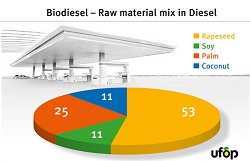
UFOPgraphic1A study from a group in Germany says sustainability certification systems have opened up market access for vegetable oils from countries outside the European Union. The study from the Union zur Förderung von Oel- und Proteinpflanzen e.V. (UFOP) surveyed 60 filling stations across Germany and found that rapeseed oil remains the most important raw material source for the production of the green fuel in that country, making up more than half (53 percent) of the feedstock for biodiesel there. Palm oil was next at 25 percent, with coconut and soybean oil each contributing 11 percent.

In the years 2010 and 2011, German agriculture benefitted from the fact that practically only certified rapeseed from domestic production was available after the immediate national implementation of the Renewable Energies Directive. The raw material mix now determined reveals that the certification systems approved by the EU Commission have now also been introduced in countries outside the EU such as Argentina, Brazil as well as Indonesia and Malaysia. In other words, the supply of sustainably certified raw materials for biofuel production has meanwhile become globalised, according to UFOP.

It is a stipulation of the international laws that market access may not be denied if the specified ground rules are complied with. Nevertheless, the UFOP has serious misgivings and believes that closer attention must be paid in respect to the quality of the national implementation and the certification introduced in the sense of fair competition, but also nature and environmental protection locally.

UFOP went on to urge the the EU Commission to maintain its strict rules for the certification of the origin of biodiesel feedstocks.

Biodiesel, International

Vital Signs: Volume 20 Released

Joanna Schroeder

The Worldwatch Institute has released Vital Signs: Volume 20, the latest compilation from the Vital Signs project. The report finds that in 2012, global oil consumption reached an all-time high and physical water scarcity affected nearly 1.2 billion people. The Vital Signs report provides insight on many of the most critical global concern and provides data and analysis on significant global trends such as fossil fuel subsidies, agricultural commodities and rapid urbanization in the developing world.

Worldwatch Institute Logo,jpg“Our recent economic systems and theories are programmed to squeeze ever more resources from a planet in distress,” said Michael Renner, Worldwatch senior researcher and director of the Vital Signs project. “A mixture of population growth, consumerism, greed and short-term thinking by policymakers and business people seems to be inexorably driving human civilization toward a showdown with the planet’s limits.”

Some of the trends are positive. For example, within the agriculture sector, efficient irrigation methods have increased more than sixfold over the last two decades. In addition, socially sustainable ways of doing business continue to emerge.

“There is no shortage of alternatives to change the destructive trajectory that humanity finds itself on,” continued Renner. “Renewables and efficient irrigation are two practical options among many others. But we need to get serious about these tasks instead of consigning them largely to the margins.”

biofuels, Climate Change, Environment, Renewable Energy

Tennessee State to Take Biodiesel Maker on Road

John Davis

Tennbiodieseltrailer1Researchers at Tennessee State University hit the road this week with a mobile demonstration lab to convince more farmers to brew their own biodiesel. This school news release says unit will also be on display at the university’s Small Farm Expo this Thursday, July 18th.

The eye-catching mobile lab is the showpiece of the University’s pioneering alternative fuels program. Funded with $250,000 from the USDA Capacity Building Grant program, the mobile lab takes biodiesel fuel education right to working farmers, and has all the equipment necessary for producing the alternate fuel.

“This region has a modest oil seed production rate by area farmers,” said Dr. Jason de Koff, assistant professor of agronomy and soil sciences in the College of Agriculture, Human and Natural Sciences. “We want to be able to show them something they might not have thought about. With as much oil seed production taking place in the state, we want to explain the production of biodiesel fuel from vegetable oil is a viable process that can replace traditional fuel used in existing diesel engines.”

According to de Koff, a typical farm uses around two to six gallons of diesel fuel per acre every year. Depending on the oilseed crop and yield, a farmer could devote one to 15 percent of farm acreage to producing oilseed crops strictly for biodiesel fuel production.

“It is possible they could become totally self-sufficient in diesel fuel use,” added de Koff. “As a clean-burning, renewable energy source, biodiesel fuel offers a number of built-in advantages that regular diesel fuels simply can’t match.”

The mobile demonstration unit has all that’s needed to produce biodiesel, including an oil seed press and biodiesel processor. Supporters hope to show how easy the process can be not only to farmers but to area lawmakers, 4H clubs and schools.

Biodiesel, Research, University

Gas Prices Predicted to Spike

Joanna Schroeder

Summer driving season is nearing its peak and as events continue to unfold in Egypt, gas prices are again expected to spike. To learn more about the reasons behind rising fuel prices, Fuels America hosted a media briefing with several energy experts to provide a panoramic view of the real drivers behind volatile gas prices.

Speakers discussed how renewable fuel drives gas prices down and provides the only CNBC Story on Rising Gas Prices July-15-2013market competition to oil; how oil markets are global in nature and are affected by both domestic and international forces; and common myths around the relationship between gas prices and Renewable Identification Numbers (RINs).

Energy experts included Geoff Cooper, VP of Research and Analysis, Renewable Fuels Association (RFA); Anne Korin, Co-director of the Institute for the Analysis of Global Security; Anna Rath, CEO, NexSteppe; and Bruce Vollan, Owner, Vollan Oil – a family-owned gas station in South Dakota that provides choice at the pump for customers by selling E15, E85, and other fuels.

Earlier in the day, the American Petroleum Institute (API) launched a new TV and print campaign to disparage biofuel use synonymously as gas prices took a sharp rise with the national average of 14 cents per gallon in one week. In response, Fuels America sent out a statement saying, “API’s new ad campaign is another example of how out of touch the oil industry is with real Americans. But using stock images of blue collar workers to demonize our domestic renewable fuel industry, not to mention the nation’s auto mechanics, is a bizarre new low.”

“Furthermore, API’s attempt to make E15 the nexus of the debate is a miscalculation. E15 is the most tested renewable fuel in history and to suggest otherwise ignores a wealth of facts,” the statement continued. “But, here’s some real fuel for thought: while Big Oil wants to maintain the status quo – and their insanely high profits – renewable fuel is providing consumers with choice and savings at the pump.”

Listen to the full media briefing here: Gas Prices Predicated to Spike

advanced biofuels, Audio, Biodiesel, biofuels, Ethanol, Oil, RFS, RINS

Ethanol Groups Comment on RFS Path Forward

Joanna Schroeder

Both the Renewable Fuels Association (RFA) and Growth Energy submitted comments to the Environmental Protection Agency (EPA) this week on pathways forward for the Renewable Fuel Standard (RFS). The comments highlight the importance of next generation biofuels and how increased market access will play a critical role in the ultimate success of the RFS.

RFA-logo-13Both organizations voiced support for the addition of cellulosic fiber from the corn kernel to the list of qualifying feedstocks, and the agency’s simplified approach to RIN generation for renewable fuels derived from cellulosic biomass.

“We applaud EPA for confirming that corn kernel fiber is ‘crop residue,’ and believe the Agency has proposed a sensible and straightforward approach to RIN generation for renewable fuels derived from cellulosic biomass feedstocks,” wrote RFA President and CEO Bob Dinneen. “Several technologies to convert corn kernel fiber into cellulosic ethanol have been developed in recent years, and a number of existing ethanol plants have already adopted these technologies or are poised to integrate them in the near future. The volumes of cellulosic ethanol produced from corn kernel fiber can meaningfully contribute to RFS2 cellulosic biofuel requirements in the near term.” The comments also included a scientific analysis from a noted animal nutritionist examining the potential impacts of reduced fiber DDGS on livestock and poultry markets.

RFA’s comments expressed support for most of the RFS2 technical amendments and new pathways proposed by EPA. However, Dinneen noted, the conditions for applying the alternative RVP (Reid Vapor Pressure) approach should be limited to whether blending an approved gasoline additive with E10 results in no net increase in RVP.

Growth_Energy_logo-1“The RFS has been the country’s most successful energy policy over the last forty years. Since the inception of the RFS, Growth Energy’s members and the ethanol industry have produced significant volumes of renewable fuel that have displaced 10 percent of U.S. transportation fuel, which has substantially helped reduce our dangerous dependence on foreign oil, improve our air quality, create thousands of jobs and revitalize rural communities nationwide,” noted Tom Buis, Growth Energy CEO in his comments. “The industry has successfully built the foundation of the RFS with the first generation of grain-based ethanol production, and our members are poised to do the same in the next generation with advanced biofuels and cellulosic ethanol.”

Growth Energy also supports additional pathways to meet the goals of the RFS including the new pathway for cellulosic biofuel from corn kernel fiber, as well as additional crop residues. “We believe that any renewable biomass meeting the 60 percent greenhouse gas threshold should be able to generate cellulosic RINs.” Comments also addressed the issue of foreign ethanol producers, advocating that those who produce biofuels, generate RINs and importers of renewable fuel should be subject to U.S. jurisdiction to prevent fraud, and that E15 fuel should be treated the same as E10 fuel with regards to RVP.

biofuels, Environment, Ethanol, Growth Energy, RFS

BioEnergy Bytes

Joanna Schroeder

  • BioEnergyBytesDFSolarCity has opened a new operations center in Stockton, California. The Stockton location is currently staffed with more than 70 full-time, locally-hired employees who provide sales, consultations, and installation services to homeowners and businesses in the San Joaquin region.
  • According to EIA data, ethanol production averaged 881,000 barrels per day (b/d) — or 37.00 million gallons daily ending the week of July 6, 2013. That is up 18,000 b/d from the week before. The four-week average for ethanol production stood at 875,000 b/d for an annualized rate of 13.41 billion gallons. Gasoline demand for the week averaged 390.6 million gallons daily, the highest since August 2012. Notably, net refiner/blender input of ethanol reached a record 896,000 b/d, proving that U.S. refiners and blenders have the capability to consume at least 13.74 billion gallons of ethanol annually.
  • Distributed Sun and Mosaic announced a joint project to allow individuals to invest in a 657 solar installation on a charter school in Colorado and earn an estimated 5.4% annually.
  • Several more businesses have signed the Climate Declaration, a petition that calls on U.S. policymakers to capture the American economic opportunity of addressing climate change.
  • Natural Power has collaborated with academia to develop a new framework to inform the impact assessment and consenting of Offshore Wind Farms in Scotland. Natural Power’s principal consultant Nancy McLean has been actively involved in a collaboration which has published a novel framework to enable impact assessments of underwater piling noise.  Within Natural Power Nancy specialises in consent management, working with her team to deliver Environmental Impact Assessments.
Bioenergy Bytes

Solar PV Breaks 10 GW Barrier

Joanna Schroeder

According to a new report by NPD Solarbuzz, solar photovoltaic (PV) installations in the U.S. have broken through the 10 gigawatt (GW) barrier. During the first half of 2013, more than 1.8 GW of new solar PV capacity was installed according to the North America PV Market Quarterly report.

130708_us_reaches_milestone_of_10_gigawatt_solar_photovoltaic_capacity“The U.S. has now joined an elite group of maturing solar PV markets that have accumulated more than 10 GW of installed capacity,” commented Christopher Sunsong, analyst at NPD Solarbuzz. “Only Germany, Italy, and China have more installed PV capacity than the US. The US is only the fourth country to reach the 10 GW milestone of installed PV capacity.”

Solar PV has been one of the fastest growing energy sources in the U.S. over the past six years, with a compound annual growth rate of over 50 percent since 2007. Cumulative solar PV installations are forecast to increase an additional 80 percent over the next 18 months, surpassing 17 GW by the end of 2014 says the report.

NPD SolarBuzz says the rapid uptake of solar PV in the U.S. is being driven by the dramatic solar system price declines observed since 2011. Average installed system prices have declined from around $6/watt two years ago to approximately $4.25/watt for residential installations and $3/watt for large utility-scale PV projects today.

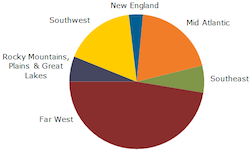
“U.S. solar PV market growth has been stimulated by an increased range of solar incentive programs at the state level,” added Sunsong. “While the Far West and Mid-Atlantic states dominate the 10 GW installed, the Southwest and Southeast regions have recently made strong contributions. Other regions however, such as the Great Plains and Great Lakes, remain largely undeveloped, creating further market upside going forward.”

The report also finds that solar PV installations in the U.S. have seen significant growth since the start of 2010; 83 percent of the 10 GW were completed within the past 14 quarters. Almost 1,400 solar PV installations in excess of 500 kW in 39 different states are providing 5.4 GW of capacity, and nearly 40 percent of that capacity is within California.

Electricity, Energy, Renewable Energy, Solar

API Launches New Campaign

Joanna Schroeder

American Petroleum Institute (API) has launched a new campaign featuring print and TV ads taking aim at E15 and the Renewable Fuel Standard (RFS). The ethanol industry responded and Bob Dinneen, President and CEO of the Renewable Fuels Association said that Big Oil’s latest campaign is nothing more than an oil slick of misleading scare tactics.

“What does it say about an industry so desperate to protect its monopoly that it distorts reality in a feeble effort to hoodwink consumers?” questioned Dinneen. “API is intentionally confusing a debate about E15 with the RFS, an important policy that is reducing our dependence on imported oil while saving consumers money at the pump. E15 is not mandated. E15 is a cost-saving, environment-protecting, oil addiction-breaking fuel API Campaignalternative. E15 is a choice and American consumers are in the driver’s seat. Give them an option and let them decide. That’s the way competitive markets work.”

Dinneen along with Tom Buis, CEO of Growth Energy both noted that E15 is the most tested fuel in American history, but the oil industry will not tell you that. Big Oil will also not tell you that 40 million miles have been driven on it, and there have been no reports of engine trouble.

“This is nothing more than a diversion from what is really on motorist’s minds. Notice how this ‘new campaign’ comes on the heels of a gas price increase of 3.2 cents last Friday, the largest one day spike in five months, and predictions from AAA of another expected increase of .10 to .15 cents in the coming days,” said Buis.

The Department of Energy (DOE) tested over 86 vehicles on a lifecycle test, resulting in over six million miles with no negative outcomes. Even the DOE has said that API’s studies are not based on unbiased science. After failing on the legal and regulatory fronts, Buis notes that Big Oil will do “whatever it takes to keep us addicted to the failed status quo, so they can continue to line their pockets at the expense of American consumers.”

Buis concluded, “Looks like API, once again, will do anything to drive attention away from record profits and skyrocketing gas prices by using junk science in an attempt to prevent a choice and savings at the pump for American consumers.”

biofuels, E15, Ethanol, Growth Energy, RFA, RFS

Surmountable “Blend Wall”

Joanna Schroeder

Screen Shot 2013-07-15 at 11.27.47 AMFuels America recently hosted a briefing on the Hill (Washington, D.C.) to give an update on the so-called “blend wall.” Energy experts and biofuel industry representatives discussed the need to provide consumer choice at the pump. Other topics discussed during the event included: benefits of renewable fuel; penetration  of new fuels like E15  and cellulosic ethanol into the marketplace; compliance flexibility; and Renewable Identification Numbers (RINs).

Panelists for the event included:

  • Tom Buis, CEO, Growth Energy
  • Dr. Andy Randolph, Engine Technical Director, Richard Childress Racing
  • Brent Erickson, Executive Vice President, Industrial and Environmental Section Biotechnology Industry Organization (BIO)
  • Bruce Vollan, Midway Service, Inc.
  • Bob Casper, President, POET Ethanol Products

Tom Buis kicked off the briefing and noted the timing of the event happened to coincide with a spike in oil prices – now higher than $100 per barrel for domestic oil. He said that the oil companies are touting all the oil – new oil finds, oil from shale (i.e. fracking) oil drilled from oceans, and arguing that the Renewable Fuel Standard (RFS)  is not needed. “Well I think this morning’s headlines is just another good example of yes we do. Yes, we need a competitive, alternative to fossil-based fuel.”

You can listen to the Hill briefing, “Surmountable Blend Wall” here: Surmountable Blend Wall

Audio, biofuels, blends, Ethanol