Darling Int’l Buying Canadian Rendering for Biodiesel

John Davis

darlingTexas-based rendering leader Darling International Inc. is buying all the assets of Canadian company Rothsay, a division of Maple Leaf Foods Inc. for approximately CAD $645 million in cash. This Darling news release says the deal includes machines to turn fats and proteins into biodiesel feedstocks, as well as an actual biodiesel operation itself.

Rothsay has a network of five rendering plants in Manitoba, Ontario and Nova Scotia and a biodiesel operation in Quebec, Canada. Rothsay employs approximately 550 people and generated approximately CAD $85.0 million of EBITDA over each of the past two fiscal years.

Randall C. Stuewe, Darling International’s Chairman and CEO said, “The combination of our two companies will create North America’s leading provider of independent rendering and recycling services. The opportunity to add Rothsay to our North American platform is an exceptional honor. Rothsay is Canada’s premier recycler of animal by-products and a leading biodiesel manufacturer. We look forward to joining forces with Rothsay’s management team and employees and to the opportunity this brings our shareholders for future growth.”

Earlier this summer, Darling opened a joint venture renewable diesel plant with energy giant Valero in Louisiana. That plant also uses animal fat to make the renewable diesel, as well as using waste cooking oil and corn oil.


Biodiesel

BioEnergy Bytes

Joanna Schroeder

  • BioEnergyBytesDFPOET-DSM Advanced Biofuels is now hiring full-time, quality team members to operate its 20 million-gallon-per-year cellulosic ethanol plant, which is set to open in early 2014. Project LIBERTY is a cellulosic biorefinery under construction today in Emmetsburg, Iowa that will use crop residue (corn cobs, leaves, husk, some stalk) to produce 20 million gallons of ethanol per year, later ramping up to 25 million gallons per year. The plant is currently filling a number of positions, including: environmental health and safety specialist, plant engineer, accountant, and plant technician.
  • Solar Power International 2013 is taking place in Chicago, Illinois from October 21-24, 2013 at the McCormick Place. New show programming and events for 2013 include multiple featured areas on the show floor for companies to showcase their technologies and foster new business ventures along with new educational sessions. Click here to learn more and to register.
  • IMPCO has announced the availability of its bi-fuel CNG fuel system for the 2014 Chevrolet Cruze 1.4L sedan. The company says this system eliminates “range anxiety” by including a trunk mounted Type 3 tank (8.4 gasoline gallon equivalent) that provides over 200 miles of additional range.
  • EnterSolar hasannounced the receipt of more than $6 million through multiple rounds of NYSERDA funding to facilitate the construction of 10 new large-scale commercial solar installations. The awards are being funded under the Competitive PV program as part of Governor Cuomo’s NY-Sun initiative. EnterSolar is currently working with a number of businesses and seeking others that may have interest in participating in round 3 of the Competitive PV Program.
Bioenergy Bytes

Farm Bureau: RFS Bendable, Just Don’t Break It

John Davis

afbf-logoFarm Bureau officials are making the case that the Renewable Fuels Standard has some flexibility… but just don’t break it. In this story on its newsline, American Farm Bureau energy economist Matt Erickson makes the case that the RFS is working, but Americans are using 10 billion fewer gallons of gasoline this year than in 2007 when the law was passed. That drop makes mandated amounts in the RFS unrealistic. But he believes the flexibility in the law still makes it beneficial.

“It’s reduced our dependence on foreign crude oil. Now we’re importing over 40 percent instead of 60 percent that we saw in 2007-2008. It also creates good paying jobs in rural America, creates environmental benefits to society. It’s a good energy policy and I’d rather have my energy source come from a farmer than a Middle East dictator.”

Erickson dismisses Big Oil’s claims that the law is causing economic harm, and he says it just needs a little tweaking.

“EPA does have the flexibility to adapt within a changing environment. The world is changing quite frankly. We had the recession. We have CAFE standards which are higher fuel efficiencies within our transportation system.”

Finally, Erickson makes the case that if we abandon the RFS, we would pull the plug on new cellulosic technology.

“Looking at cellulosic, we’re going to sources such as algae or corn residue containing the corn cob anything that’s left in the field that’s not the food.”

Biodiesel, Ethanol, Farm Bureau, RFS

Senator Michael Bennet Visits Gevo

Joanna Schroeder

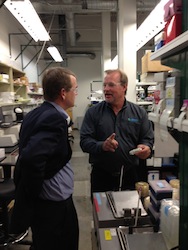
Senator Michael Bennet (D-CO) recently toured and met with Colorado-based Gevo to discuss renewable fuels and chemicals for Colorado and the U.S. economy. Senator Bennet met with Gevo executives including chief executive officer Patrick Gruber, Ph.D. to discuss energy policy and see first-hand the research and development Gevo has done on creating isobutanol to be converted to biochemicals and renewable fuels.

photoIsobutanol is a drop-in product that can be used in existing infrastructure. Gevo’s isobutanol has successfully cleared registration with the U.S. EPA as a fuel additive, is the first isobutanol to be listed in the EPA’s Fuel Registration Directory, making it approved for blending with gasoline. Last June Gevo worked with the United States Air Force (USAF) to provide fuel for the first successful “alcohol-to-jet” (ATJ) fuel test flight in an A-10 Thunderbolt II.

“We applaud Senator Bennet’s support for the renewable energy industry and appreciate his visit to our headquarters to learn about the technology that makes Gevo a leading renewable chemicals and advanced biofuels company,” said Gruber.

Senator Bennet remarked that he very much enjoyed his visit to Gevo and said, “Colorado has a strong reputation as a hub for innovation and firms like Gevo are leading the way. By developing innovative techniques for converting biomass to fuel, Gevo is a critical part of developing a balanced national energy portfolio.”

advanced biofuels, biobutanol, biochemicals

Happy 5th Anniversary Patriot Renewable Fuels

Joanna Schroeder

Patriot Renewable Fuels celebrated their five year anniversary today and dozens of community members, legislators, employees and those from the ethanol industry were on Community tour of Patriot Renewable Fuelshand for the celebration. With fierce attacks from ethanol detractors on the corn-based ethanol industry, the celebration was proof that the ethanol industry is standing firm.

Bob Dinneen, RFA president and CEO attended the celebration touting the five year milestone. “Today is truly a day of celebration for everyone involved in Patriot Renewable Fuels,” said Dinneen to the crowd gathered at the plant for the celebration. “It is often said that the first year of business is always the hardest. It is truly an accomplishment that you have long passed the first year and have reached the five year anniversary. There have been times of prosperity and times of drought, but as a company you have shown perseverance, dedication and hard work. Today is a day to celebrate and enjoy the fruits of your labor.”

Rock KatschnigPatriot Renewable Fuels is located in Annawan, Illinois and employs 55 full time employees at a plant that produces 110 million gallons of ethanol and 300,000 tons of DDGS per year. Over the past few weeks, plant partners have been congratulating the bioenergy plant on five years of success and wished them success for many more years.

“The last five years in business has been both challenging and uniquely rewarding. I have seen the company grow and thrive from an idea into reality,” said Patriot Renewable Fuels’ CEO and co-founder Gene Griffith. “I am proud of the positive impact we have had on our country, creating jobs, decreasing our dependence on foreign oil, and revitalizing our rural community. It is my hope that the next five years will be as rewarding as the last.”

biofuels, Ethanol, Ethanol News, RFA

Chevrolet Funds Plug-In EV Chargers

Joanna Schroeder

Two of the most popular State Parks in Southern California – Leo Carrillo State Beach and Malibu Creek State Park – now have free electric vehicle (EV) charging for plug-in electric vehicle owners. The EV charging stations were made possible through Chevrolet’s EcoAd advertising with CBS EcoMedia Inc. The two, 240 volt, chargers can accommodate up to four plug-in electric vehicles. The units were installed at the two parks by EcoMedia’s nonprofit partner, Adopt A Charger. Chevy’s funding will provide free charging and service and maintenance for the charging stations for three full years.

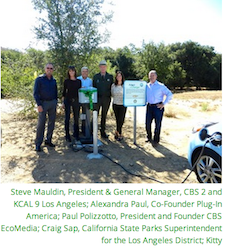
Screen Shot 2013-08-23 at 11.38.43 AMA ribbon-cutting celebration was held in front of the Malibu Creek State Park Administration Building. The ribbon-cutting celebration was hosted by Craig Sap, California State Parks Superintendent for the Los Angeles District; Chevrolet Group Manager, Western Region Communications, Dave Barthmuss; Kitty Adams, Executive Director, Adopt A Charger, Inc.; and CBS EcoMedia President and Founder, Paul Polizzotto. Special guests included Alexandra Paul, Co-Founder, Plug-In-America, a Chevy Volt owner; along with several other Chevy Volt and Chevy Spark EV drivers and other interested plug-in car enthusiasts.

Chevy brought out two Chevy Volts and a new Spark EV for test drives and several attendees had the opportunity to get behind the wheel of the battery-powered vehicles.

“Electric vehicles are catching on and we’re proud that the Chevy Volt is the number one selling plug-in vehicle in the country,” said Dave Barthmuss, Chevrolet’s Western Region Group Manager. “These new chargers will allow EV drivers to enjoy trips out to Southern California beaches without range anxiety. Installing EV charging stations at destination locations like Malibu Creek State Beach, where vehicles will sit for several hours, is a perfect example of the kind of infrastructure that will help grow the EV market.”

California State Parks recreational activities and outdoor experiences draw approximately 85 million visitors each year –an increasing number of who drive plug-in vehicles. Installation of EV charging stations is part of the “Cool Parks” initiative by California State Parks that responds to the pressing challenges of climate change and seeks to educate park visitors, and motivate the broader public to be part of the solution. By “adopting” these chargers, GM becomes a Proud Partner of the California State Parks.

Alternative Vehicles, Electric Vehicles

BioEnergy Bytes

Joanna Schroeder

  • BioEnergyBytesDFJinkoSolar Holding Co., Ltd has announced that it will supply 23MW of Solar PV modules to Swinerton Builders. The company will utilize JinkoSolar’s 300W 72 cells high-efficiency PV modules in its construction of the Westland Solar Farms, LLC ground-mounted solar plant in Fresno County, California. When completed, this utility scale solar farm will provide electricity to PG&E.
  • Pattern Energy Group LP has closed the financing and started construction of its Panhandle Wind project, a 218 MW wind power project located in the Texas Panhandle. The project will utilize Texas’ new Competitive Renewable Energy Zone transmission infrastructure, which connects to the state’s main power grid operator, Electric Reliability Council of Texas.
  • Globally renowned water conservationist Robert F. Kennedy Jr. and environmental author Bill McKibben will join regional leaders this fall for the Midwest’s first partially-solar-powered Concert for the Climate. Music will link together workshops, Kennedy’s keynote speech, and McKibben’s featured presentation at the confluence of the Kansas and Missouri rivers at Kaw Point Riverfront Park on Saturday, September 28, 2013. The event will last from 11 a.m. to 6 p.m.
  • The ZephIR 300 has been chosen by Babcock International Group to collect wind data on its pioneering floating lidar platform. The new platform allows the ZephIR 300 to collect data offshore without the need for post-processing or compensation, reducing the possibility of miscalculation or human error. The new technology will, once proven successful, significantly cut capital expenditure costs by removing the need for fixed meteorological masts. The platform provides the stability needed to collect accurate lidar data by utilising a low-motion buoy. Babcock’s marine expertise means the buoy has been shown to pitch and roll less than five degrees from vertical in waves of up to 4.25m Significant Wave Height (Hs).
Bioenergy Bytes

Interactive Map Shows Biofuel Friendly Policies

Joanna Schroeder

According to the Global Renewable Fuels Alliance (GRFA), 62 countries now have biofuels friendly policies in place that have driven global demand to over 1 million barrels per day. To help people around the world keep track of the changing political landscape, GRFA has launched an Interactive World Biofuels Map available on their new website.

“It is amazing to watch the growth of the biofuels industry from a global perspective,” said Bliss Baker, spokesperson for the GRFA. “Today, governments have embraced biofuels in every corner of the world, from Australia to Zimbabwe.”

GRFA Interactive Globla Biofuels MapOne of the latest countries to enact a biofuels mandate is India. Currently their mandate is set at 5 percent ethanol content and scheduled to increase to 10 percent as soon as production capacity is in place. India has ultimately set a goal of 20 percent for all biofuels content by 2017.

“Enacting biofuels friendly policies in developing countries and growing economies like India will be crucial for the continued growth of the global biofuels industry and reducing our reliance on crude imports,” said Baker. “The GRFA applauds the government of India for taking the steps to reduce its reliance on crude oil and setting a plan in place to become a global leader in biofuels use and production.”

Baker explains that the new Interactive World Biofuels Map clearly shows that biofuels production and policies are no longer limited to the United States and Brazil, but have spread to numerous countries that are struggling to reduce GHG emissions and reduce their reliance on crude imports.

“It is interesting to note that several African countries now have biofuels friendly policies in place. Countries like Nigeria, Ethiopia, Sudan and Mozambique all now have biofuels friendly policies in place to encourage the use and production of renewable fuels. In total, ten African countries have implemented biofuels friendly policies to reduce their crude oil reliance,” concluded Baker.

advanced biofuels, Biodiesel, biofuels, Ethanol, International

Wallace Goes Full Throttle for Ethanol

Joanna Schroeder

Bristol Motor Speedway will see a familiar face and a familiar brand Saturday for the Food City 250, as American Ethanol again joins forces with veteran driver Kenny Wallace. Wallace climbs back behind the wheel of the No. 29 RAB Racing American Ethanol Toyota Camry.

770“I’m so excited to be going to Bristol Motor Speedway, the ultimate short track, for grassroots racing just like I grew up on. The night race at Bristol is absolutely electrifying, and I’m really excited to be a part of it and looking forward to showing off our new American Ethanol paint scheme,” said Wallace. “It’s been almost a full year since I’ve raced an American Ethanol Camry, and I’m so happy to be debuting a brand new paint scheme for them on a very special day for me, my 50th birthday.”

Wallace, a veteran of the .533-mile oval, has not only won at “Thunder Valley”, but has finished in the top ten in half of his Nationwide Series starts (18 of 36). Additionally, Wallace has two top-ten finishes and two laps led in Sprint Cup Series competition at Bristol Motor Speedway.

“We (NASCAR drivers) have driven more than four million miles on American Ethanol. It’s been well accepted in the sport because it works. The transition was easy. We got more power and better performance,” said Wallace. “Unlike imported oil, ethanol is good for our economy and creates jobs in America both in ethanol plants and on family farms.”

This will mark the first NASCAR Nationwide Series race in 2013 that American Ethanol will be the primary sponsor on the No. 29 of Kenny Wallace, with RAB Racing. This will also be Wallace’s 897th NASCAR start.

“Away from the track Kenny is an outspoken advocate for American Ethanol and family farmers,” said Jon Holzfaster, a Paxton, Neb. farmer and chairman of the National Corn Growers Association’s NASCAR Advisory Committee. “He is a fan favorite and has played a big role in building fan support for ethanol within the sport. Today, NASCAR fans are 50 percent more likely than non-fans to support the use of ethanol in their own cars.”

American Ethanol, Ethanol, NASCAR, NCGA

Univ. of Tenn. Develops More Sensitive Biodiesel Sensor

John Davis

Embraer_170An issue that biodiesel runs into in the jet fuel field is the lack of tolerance for ASTM D1655, the jet fuel specification at just 5 parts per million (ppm) of allowable amount of fatty acid methyl ester (FAME) contamination. Biodiesel Magazine reports while that traditional analytical equipment, such as gas chromatography, Fourier transform infrared and high-performance liquid chromatography, cannot detect levels that low, scientists at the University of Tennessee have developed a more sensitive sensor:

[R]esearchers at the University of Tennessee have developed thin-film sensors with high sensitivity toward biodiesel contamination in jet fuel. Small strips of these sensors have been tested to detect the trace biodiesel contaminant in diesel at as low as 0.5 ppm in less than 30 minutes. The sensor also gives quick response to B20 in less than five minutes and may be used with the naked eyes. The sensors, developed by UT chemistry professor Ziling Xue, are intrinsically small, easy to use, inexpensive, and can be mass-produced for disposable applications. When combined with a portable reader, the sensors can be potentially used as a compact portable device for field applications. The university is seeking partners to commercialize the technology.

According to the article, another track in the biodiesel-jet fuel saga is getting a higher contamination tolerance allowed. Officials with the National Biodiesel Board make the case that allowing a higher level of biodiesel in the ASTM specifications for jet fuel than 5 ppm will make it much easier for pipelines to manage shipments of biodiesel blends in a manner that ensures jet fuel will always meet the specifications. In addition, the U.K.-based Energy Institute wants to test biodiesel at 400 ppm, four times the proposed allowable limit.

Biodiesel, biojet fuel, Research