Enter The Haunted Energy House

Joanna Schroeder

gI_86333_haunted-house_200The United States celebrated Halloween yesterday and to pay homage to the holiday, ClearlyEnergy created an energy haunted house that unmasks the energy gremlins lurking in your home. Here are some fun tips to banish the gremlins and ghosts from your home (well, at least until Halloween next year).

  • Afraid of the dark? Don’t be: 11 percent of the typical household energy budget goes to lighting, so just turning off the lights can reap ghostly good savings. Avoiding the ghoulish gloom, save by using more compact fluorescent bulbs (CFLs) instead of incandescent bulbs, or better yet: go straight to LEDs.
  • Familiar with energy saving angels battling comfort demons on the thermostat front? Programmable thermostats can cut the tug-of-war: make the savings when nobody’s home or when everybody’s asleep.
  • Letting old showers & toilets RIP (aka rest in peace) can save big bucks. Low-flow shower heads use less than half the gallons per minute of older regular models, and cut the electricity and gas use needed to heat all that water. Newer toilet models flush a whole lot less water down the …toilet!
  • Think being a tech geek unleashes the electricity demons? Think again! While home electronics are the fastest-GROWING part of the household electric bill, over two-thirds still goes to the big stuff: lights, heat & a/c. Turning off a mobile phone all night for a year (rather than leaving it plugged in) saves 50c, while washing clothes cold rather than hot for a year saves $80. So to save green and be green, not point fiddling with a tablet’s power settings (but beware of the XBox, TV and computer gremlins).
  • How does doing laundry make us energy devils? Washers which are not EnergyStar maniacally throw money away. A typical non-EnergyStar top-loading washer uses over ten thousand gallons of water per year (that’s over $100 in water costs) and another $100 to heat all that water and run the machine. An EnergyStar model (even the top loading kind, rather than the even more efficient front load variety) uses half as much water and a third less power.
  • Think the emissions from the witch’s cauldron look pretty icky? Any ancient fridge is also causing some serious human earth farts (greenhouse gas emissions). Refrigerators made in the 80s use about four times as much electricity and cost $200 more each year than modern ones, and even 90s models suck down twice as much power as those made in the past couple years.

Click here to experience the full interactive tour of the energy-haunted house.

Clean Energy, Education, energy efficiency

Ambassador Energy Expands Solar Training Program

Joanna Schroeder

Ambassador Traning Install Training SmallAmbassador Energy has expanded its solar training programs both for companies and individuals seeking to learn more about the solar industry. The company is offering both classroom and online courses including North American Board of Certified Energy Practitioners certified courses (NABCEP EL), in its Southern California Training Facility.

Director of Training, Catherine Kelso, facilitates the training program and is herself NABCEP certified in both PV Installation and PV Technical Sales. “Solar jobs are abundant,” she said, “but the good ones require a unique skill set. NABCEP is the gold standard in solar. I call NABCEP certifications ‘job insurance’.”

The next 32-hour course required to be completed before the participant is able to take the NABCEP EL test is scheduled for January 13-17, 2014 in the AE training center in Murrieta, California.

The 2014 Solar PV training calendar includes:

  • NABCEP Entry Level – Solar PV Design and Installation 32-hour course and NABCEP Entry Level exam
  • Prep courses for NABCEP PV Technical Sales and PV Installer
  • Advanced PV Design and Installation [qualifying for NABCEP continuing education credits]
  • AE’s proprietary New Agency Boot Camp
  • Solar for Electricians
  • Solar for Contractors

Click here for more information on the solar training courses.

Alternative energy, Education, Solar

Greenlots Selected to Manage EV Charging Network

Joanna Schroeder

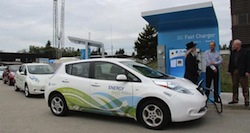
BC Hydro has selected Greenlots to manage a provincial network of DC Fast Chargers in Canada. The company will use its SKY network management solution and initial rollout Greenloots SKY network managementincludes 13 DC Fast Chargers supplied by ABB and Eaton. By utilizing Greenlots’ SKY platform, BC Hydro says it will be leveraging an open standards platform that ensures best-in-class services for site hosts such as access control and pricing, while enabling multiple payment options for EV drivers, all without requiring a subscription to utilize the charge station.

“The deployment of Canada’s first Fast Charger network is a key enabler for the adoption of electric vehicles in B.C. [British Columbia]. The installation of more charging locations with faster charging rates will allow greater freedom for EV owners and enable inter-urban travel. The network is also running on an open standards platform that ensures flexibility for future growth and for changes in technology,” said Kip Morison, chief technology officer with BC Hydro. “The deployment of this infrastructure brings British Columbia to the forefront of EV adoption in North America.”

The DC Fast Charger Project, announced in January 2013, was funded by the provincial government under the Clean Energy Vehicle Program to provide electric vehicle owners across British Columbia with an accessible network of charging options. To date, 13 B.C. communities have agreed to serve as site hosts and charging station operators for the DC Fast Chargers.

The Clean Energy Vehicle Program includes the Community Charging Infrastructure Fund, which supported 452 Level 2 charging station installations in public locations throughout B.C., the CEV for BC Point of Sale Incentive Program which has provided 659 vehicle incentives to date; upgrades to hydrogen fuelling infrastructure; the LiveSmart Residential Charging Station Rebate Program which has supported 190 residential charging stations; and 125 Level 2 charging station installations in Multi-Unit Residential Buildings by March 31, 2014.

BC-Hydro-DC-Fast-ChargerBased on Open Charge Point Protocol (OCPP), the open communications platform that has become an industry standard in Europe and is gaining significant traction in North America, SKY allows site hosts the flexibility to mix and match hardware and software vendors to suit their specific needs, while providing full access to programs and the ability to monitor charging station activity. The DC Fast Chargers running on SKY allow drivers to charge their cars, free from subscription-based issues, and offer payment options for credit cards via mobile apps, RFID cards, pay-by-phone or card swipe.

“British Columbia experiences the highest discrepancy between gasoline and electricity prices in North America, which provides a favorable environment for high EV adoption rates,” added Brett Hauser, President of Greenlots. “Having seen the inherent risks associated with deploying proprietary communication protocols in other countries, BC Hydro has selected SKY to manage the provincial charge station network because of the robust functionality and open standards architecture. BCH can provide best in class services to site hosts and EV drivers today, while ensuring that the provincial charger network will scale well into the future.”

Alternative Vehicles, Electric Vehicles

BioEnergy Bytes

Joanna Schroeder

  • BioEnergyBytesDFNRG Energy, Inc. and SunPower Corp. has announced the completion of the final phase of the California Valley Solar Ranch photovoltaic generating facility in San Luis Obispo County, California, bringing total electric generating capacity of the plant up to 250 megawatts (AC). CVSR is one of the world’s largest operating solar PV power plants and will sell its electricity to Pacific Gas & Electric under two long-term power purchase agreements.
  • Governor Tom Corbett and the Department of Environmental Protection today urged residents and small businesses to act now to take advantage of the remaining $1 million in rebates available through the agency’s Sunshine Solar Program, ending Dec. 31 or when funds are exhausted. The $1 million in remaining funds will be disbursed on a first-come, first-serve basis. Homeowners are eligible for rebates of up to $7,500 for solar electric projects; and small businesses of 100 or fewer employees are eligible to receive up to $52,500. Homeowners are eligible for rebates of up to $5,000 for solar hot water projects, while small businesses are eligible to receive up to $50,000.
  • Stellar Solar was selected by the First Unitarian Universalist Church of San Diego to design and install a 73kW solar system. Stellar Solar was selected after a very thorough vetting process by the church and was chosen based on a combination of experience, competitive pricing, and their low-pressure, educational approach.
  • Canadian Solar Inc. has announced that it has been awarded a module supply agreement to provide China Three Gorges New Energy Co., Ltd. with photovoltaic modules totaling 100MW for a solar power project located in Guazhou County, in the Gansu Province of China. Canadian Solar will supply its high efficiency 60 cell CS6P250P and CS6P-255P modules with power output of 250Wp and 255Wp for the project.
Bioenergy Bytes

SMUD Announces CSP Project

Joanna Schroeder

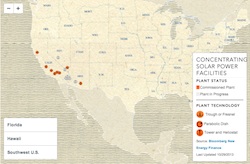
The Department of Energy (DOE) has announced a new concentrating solar power (CSP) project let by the Sacramento Municipal Utility District (SMUD). The project will integrate utility-scale CSP technology with SMUD’s 500-megawatt(MW) natural gas-fired Cosumnes Power Plant. The project is supported by a $10 million DOE investment, and the funds will be used to help design, build and test cost-competitive CSP-fossil fuel power generating systems in the United States.

Concentrating Solar Power Facilities in US“Responsible development of America’s solar energy resources is a critical part of our all-of-the-above energy strategy, and the Sacramento project furthers our commitment to building a cleaner, more sustainable energy future,” said Assistant Secretary for Energy Efficiency and Renewable Energy David Danielson. “Innovative systems that combine solar power with traditional energy sources will help cut carbon pollution across the U.S. power sector while improving the efficiency and performance of both resources.”

Concentrating solar power technology uses sunlight to produce steam, which is then used to generate electricity. Hybrid systems couple traditional fossil fuel-powered plants with CSP technology to improve the efficiency and performance of both systems and marry baseload power with new, cost-effective capacity. Today, between 11 and 21 gigawatts of CSP could be built and integrated into existing fossil fuel plants in the United States – enough to power to between 3 million and 6 million homes.

The SMUD project announced today will feed solar-produced steam directly into the plant’s turbines – generating at least 10 MW of new electric generation capacity. The project will include energy storage technology to improve system performance and meet peak and off-peak power needs.

Alternative energy, Electricity, Solar

Most Top Selling Cars Approved for E15

Cindy Zimmerman

jagIf you’re in the market for a 2014 F Type X152 Jaguar and want to use 15% ethanol blended fuel in it, you are in luck. It is one of the 70% of the Top 20 best-selling cars approved by automakers to use E15 in 2014 models, according to the Renewable Fuels Association.

Maybe you would prefer a Mercedes C Class Coupe, or a Range Rover L405. They are approved for E15 as well, as are all Ford, GM and Volkswagen 2014 models.

See the complete list of makes and models 2012, 2013, 2014 approved for E15 use at ChooseEthanol.com.

Car Makers, E15, Ethanol, Ethanol News

NC Biodiesel Maker to Host Collective Conference

John Davis

CollectiveBiodieselConf1A North Carolina biodiesel maker will host next year’s conference for biodiesel producers from home brewers to grease collectors to multi-million gallon producers. Biodiesel Magazine reports the 2014 Collective Biodiesel Conference, Aug. 14-17, will be at Piedmont Biofuels in Pittsboro, N.C.

“We are delighted to have been chosen as the 2014 host site,” said Lyle Estill, Piedmont founder and president. “For grassroots biodiesel, winning the bid for this conference is like winning a bid for the Olympics.”

“I’ve always been a fan of the Collective Biodiesel Conference,” said Andy McMahan, Central Carolina Community College biofuels program coordinator, who has attended past conferences in Colorado and Washington, D.C., and who will be co-chairing the 2014 conference. With its Natural Chef Program, green roof, wastewater recycling and building performance systems, not to mention its biofuels production facility and laboratory classrooms capable of providing hands-on biodiesel analytics, Central Carolina Community College is an ideal co-host for next year’s CBC.

“We look forward to working with Piedmont as they gear up to host the 2014 conference and are excited to be bringing the conference to the East Coast,” said Graydon Blair of the CBC board and owner of Utah Biodiesel Supply.

This year’s conference was held in Breckinridge, Colo., hosted by Summit Greasecycling, and Calif.-based Promethean Biofuels hosted the event in 2012.

Biodiesel

Brazil Looks to Up Biodiesel Blend

John Davis

brazilBiodiesel blends in Brazil could soon rise above the 5 percent mix to 7 or even as much as 10 percent. This story from Bloomberg says the South American country wants to move more of its biodiesel glut.

“We’ve already sent to the Presidency a proposal to increase the mixture of biodiesel with diesel,” Energy Minister Edison Lobao told reporters today in Brasilia. “There’s still been no decision taken.”

The world’s second-biggest biodiesel industry is operating at 50 percent of capacity, Jeronimo Goergen, president of a parliamentary lobby group for the renewable fuel, said today in a telephone interview.

Goergen said the blend rate may rise to 7 percent and then expand again to 10 percent in 2020. Lobao didn’t give a figure for the proposed increase.

Five years ago, Brazil instituted a 2 percent mandate, moving to 5 percent in 2010, three years ahead of schedule when capacity grew rapidly.

Biodiesel, International

Farm Bill Conferees Urge Energy Funding

Cindy Zimmerman

The Senate version of the farm bill includes $800 million in mandatory funding for energy programs while the House version contains zero – one of the relatively minor differences in the two bills that could get resolved quickly in conference.

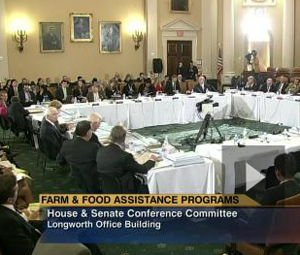
fb-confSeveral senators spoke in support of providing mandatory funding for the energy title during the first meeting of the House Senate Conference Committee on Wednesday. “This title helps our country be more energy independent,” said Sen. Debbie Stabenow (D-MI). “This is a win-win-win for rural communities and America’s future.”

Sen. Amy Kobuchar (D-MN) said she strongly supports funding for the energy provisions “including expanding home-grown renewable energy” noting that biofuels now account for ten percent of the nation’s fuel supply.

Rep. Tim Walz (D-MN) urged his colleagues on the House side to support the senate version for the sake of jobs at home. “We spend over a billion dollars a day importing oil from countries that hate us – they’ll hate us for free,” he said. “Get some mandatory funding for this. It will come back to us economically, it will come back to us in jobs, and it will come back to us in national security.”

The Senate energy title includes increased funding for the Rural Energy for America Program (REAP), Biorefinery Assistance, Biomass Crop Assistance Program (BCAP) and Biomass Research and Development.

biofuels, Energy, Ethanol, Ethanol News, Government

American Ethanol Storms Into the Lone Star State

Joanna Schroeder

American Ethanol is racing in the Lone Star State this week and team spokesman Austin Dillion is closing in on a championship. Ethanol supporters and NASCAR fans will be heading to Texas to cheer on their driver and interact with fans about ethanol.

NASCAR driver Austin Dillion Photo NASCARDillon is known for his signature cowboy hat, but he wouldn’t mind trading in his hat for a new one at Texas Motor Speedway on Saturday. Because what else would they give you as a trophy in Texas except a cowboy hat and a boot trophy? Dillon, who has never finished outside the Top 10 at Texas Motor Speedway in NASCAR Nationwide Series competition, currently leads the series standings by eight points over Sam Hornish Jr. As in other races, he will display the American Ethanol logo on the side of his car.

Corn farmers from Texas, Minnesota and North Dakota will also be on hand to distribute American Ethanol green starter flags throughout the campgrounds; more than 2,500 flags will be distributed over the course of the weekend. This weekend marks the largest activation for the American Ethanol brand in 2013, and the final one for the season.

A fan exhibit is also planned on the midway. The centerpiece for the exhibit will be a mobile biofuels education unit that will allow fans to learn more about how ethanol is made to provide consumer fuel and Sunoco Green E15 for NASCAR. This weekend the American Ethanol exhibit will be adding a new educational piece, a graphic that shows all of the toxic and in some cases carcinogenic, substances in modern gasoline. The visual carries a clear message that consumers need to know; “Some Fuels are Greener Than Others.”

The NASCAR Nationwide Series O’Reilly Auto Parts Challenge at Texas Motor Speedway starts at 3:30 p.m. EDT Saturday, November 2 and will be aired on ESPN2. The NASCAR Sprint Cup Series AAA Texas 500 at Texas Motor Speedway starts at 3 p.m. EDT Sunday, November 3 and will be aired on ESPN.

American Ethanol, biofuels, Ethanol, Growth Energy, NCGA