RFA E-15 Ad

Stop Protecting Big Oil’s Bottom Line

Joanna Schroeder

A new TV advertising campaign is being launched in Washington, D.C. this Sunday by Americans United for Change calling for the Environmental Protection Agency (EPA) to stop supporting Big Oil’s bottom line. The EPA is currently reviewing comments of their 2014 proposed rule for the Renewable Fuel Standard (RFS). The goal of the TV ad is to underscore the consequences for rural jobs and all American consumers if they ultimately give Big Oil what they want: crippling their cheaper, cleaner renewable fuels competition.

‘Bottom Line’ follows two previous Americans United TV ads in support of the RFS, “Simple Choice” and ‘Why Mess With Success?”, and its digital ad campaign ‘Big Oil Is the Real Winner’, fighting back against the oil industry’s lies.

“Big Oil needs another giveaway from Washington like our coastal environment and economies need another BP deep-water spill,” said Caren Benjamin, executive director of Americans United for Change. “The industry already enjoys absurd loopholes that allowed the biggest companies among them to pay no taxes or even negative taxes in recent years. And while the ethanol industry voluntarily gave up their tax credit at the end of 2011, Big Oil runs attack ads against lawmakers who dare to suggest they don’t need $4 billion a year in taxpayer subsidies at a time when they’re posting $100 billion in profit. And how does Big Oil pay back the taxpayers for all their generosity? By shaking them down at the pump and polluting their ground water.”

Benjamin noted that Big oil gets whatever they ask for from Washington and said they are now asking the EPA to help put out of business their 70 cent cheaper and cleaner renewable fuels competition. “It’s time to draw the line not just because gutting the RFS is another giveaway to Big Oil, but because it’d be a huge takeaway from our rural economies, our national security, environment, and innovation towards cleaner renewable fuels of tomorrow.”

With a call to action to stop messing with the RFS Benjamin concludes that it doesn’t make sense to “mess with the success of the RFS.”

biofuels, EPA, Ethanol, Oil, RFS, Video

Iowa RFA’s Shaw Has Ag Support for Congress

Cindy Zimmerman

shaw-congressIowa Renewable Fuels Association Executive Director Monte Shaw is one of several Republican candidates vying to replace the retiring Tom Latham as Iowa’s representative in the Third Congressional District, but he may have more grassroots agricultural support than most of them.

Shaw has just announced the formation of his Iowa Agriculture Team, which includes key ag leaders from across the district. “It takes more than just great land and good weather to make Iowa the leading agricultural state – it takes great leaders,” Shaw said. “As a farm boy, I’ve still got the dirt under my fingernails and with the help of these experts I will be up to speed on the challenges facing Iowa’s farmers. I also appreciate their willingness to take our message out to the countryside and the city. Folks connected to and interested in agriculture will play key roles on our path to victory in June and November.”

Among the members of his team are Grant Kimberley of Ankeny, a 6th generation corn and soybean farmer who was just named executive director of the Iowa Biodiesel Board, and Julius Schaaf of Randolph, chairman of the United States Grain Council and a 4th generation farmer.

Shaw officially launched his campaign for Iowa’s 3rd Congressional District last month. He intends to remain in his position with Iowa RFA during the campaign with the full support of the organization’s board of ethanol producers.

Watch his campaign announcement below.

Biodiesel, Ethanol, Ethanol News, Government, Iowa RFA, Video

Virginia Biodiesel Plant Gets Permit Extended

John Davis

tidewaterbiodiesel1A Virginia biodiesel plant that says it needs a little more time to line up the finances to complete its construction has gotten help from a local city council. This story in the Virginian-Pilot says the Tidewater Biodiesel LLC plant in Deep Creek got a six-month extension on the original permission.

The council initially granted permission for the project in 2011, and the plant was to be completed in 2012. But the company said it had to put its plans on hold because of the economic climate and other complications.

A conditional-use permit allowing the project to go forward was set to expire in May.

In a letter to the city, the company said it has taken longer than expected to line up financing and acquire a 5-acre parcel on Steel Street but is close to finalizing those arrangements. It asked for a six-month extension.

By a unanimous vote, the council extended the permit by a year.

When completed, the refinery will produce 10 million gallons of biodiesel per year from waste vegetable oil.

Biodiesel

Expiring Biodiesel Tax Credit Pushed Up Profit

John Davis

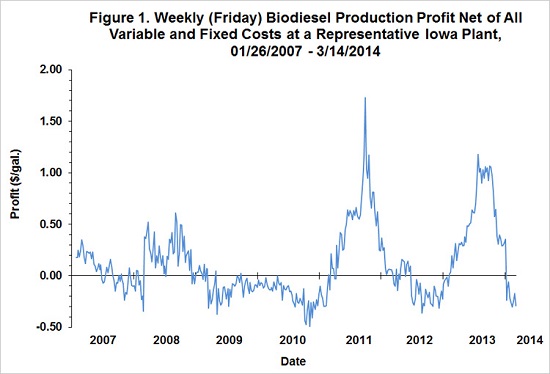
The race to take advantage of the expiring federal biodiesel tax credit helped push up profits for the green fuel. Last week, we told you about the University of Illinois analysis on the profitability of ethanol. Well, the analysts from the school are back, and this time they’ve looked into the factors over the past few years that have helped push up biodiesel profits, and fear of losing the credit seems to help that market.

biodieselprofit1
Figure 1 presents the (pre-tax) estimates of biodiesel profits based on the prices and model assumptions… When returns are in the black the average is $0.35 per gallon compared to -$0.16 per gallon when returns are in the red. The two largest spikes in profitability can be traced to the effects of biofuels policies. The first major spike in 2011 was directly attributable to the race by diesel blenders to take advantage of the blender tax credit that was set to expire at the end of 2011. The second major spike in 2013 was also directly attributable to the race by diesel blenders to take advantage of the blender tax credit that was set to expire at the end of 2013 (the credit has yet to be reinstated for 2014). In addition, obligated parties under the RFS needed to incentivize expanded biodiesel production in order to meet the increased biodiesel mandate for 2013 and build up the stock of biodiesel RINs that could be used to fill the “renewable gap” in future years.

The analysts also show that 2013’s profit margin was a whopping 64.3 percent, the highest of the seven years examined, and 2011’s profit was also an impressive 54.4 percent. Overall for the period of 2007-2013, investors in biodiesel operations saw a 14.7 percent profit, more than twice ethanol’s 5.8 percent return on investment during the same period.

Biodiesel

Ethanol Industry Takes LCFS Fight to High Court

Cindy Zimmerman

The nation’s ethanol industry has decided to take its fight against the California Low Carbon Fuel Standard (LCFS) to United States Supreme Court.

rfagrowthThe Renewable Fuels Association (RFA) and Growth Energy today filed a joint petition with the U.S. Supreme Court for “certiorari to make a final determination relating to the constitutionally flawed LCFS.” The action follows a decision by the Ninth U.S. Circuit Court of Appeals in January to deny rehearing en banc in the litigation regarding the California law.

A joint release from the two ethanol groups stated, “California, through adoption of the LCFS, has violated the most basic, structural features of interstate federalism. LCFS not only discriminates against out-of-state commerce, but it seeks to regulate conduct in other States in direct contravention of our constitutional structure and at the direct expense of Midwestern farmers and ethanol producers.”

The January decision by a divided panel of the the Ninth Circuit Court reversed a previous District Court finding that the California LCFS violates the Commerce Clause of the U.S. Constitution and is therefore unconstitutional. The ethanol groups note that California officials admit the LCFS seeks to regulate greenhouse gas emissions occurring in other states “by rewarding and punishing industrial and agricultural activity taking place outside California” and in doing so systematically favors California, which they contend is unconstitutional.

Ethanol, Ethanol News, Growth Energy, RFA

Most Say Open Ag Data Alliance is Good Idea

Jamie Johansen

New Holland ZimmPollOur latest ZimmPoll asked the question, “What do you think of the Open Ag Data Alliance?”

Over half of those who participated in this week’s poll thought the Open Ag Data Alliance (OADA) was a great idea. Even though many are for this new software project, there are many who are questioning it’s benefits and believe it is confusing. If the learning curve was easy, would more be for it?

Our poll results:

  • Great idea – 54%
  • Terrible idea – 16%
  • No idea what it is – 22%
  • Other – 8%

Our new ZimmPoll is now live and asks the question, “How will you celebrate Ag Day?”

National Ag Day is Tuesday, March 25. The agriculture community will be taking part in festivities across the country to celebrate the abundance provided by agriculture. Chuck and Cindy will be in Washington D.C. Chuck is covering the National Ag Day Activities and Cindy the American Coalition for Ethanol Biofuels Beltway March. Whether big or small, we can all do something to recognize the contributions of farmers and ranchers to our nation. What will you do?

ZimmPoll

Research Looks Into Water-Free Biodiesel Brewing

John Davis

waste-vegetable-oil-for-biodieselEfforts to make biodiesel production even more sustainable might get a boost from research into a water-free method of making the green fuel. This story from Biofuels Journal says researchers at the University of Porto in Portugal are looking at a way to eliminate the water normally used water to remove impurities to meet stringent quality standards.

Instead of water, researchers used catalysts to pre-treat and target impurities such as calcium ‘soaps’ in the biodiesel.

The impurities were then removed by absorption into resins or passing through ceramic membranes.

The researchers were able to produce good quality biodiesel from both virgin vegetable oil and, importantly, waste oils used for frying.

The new process could provide significant economic and environmental benefits compared to other more energy intensive water-based production methods.

The researchers believe that finding more water-free or less-water-consuming methods of making biofuels becomes more and more important as more of the world turns to the alternative fuels.

Biodiesel, International, Research

Biodiesel Bites Back… with a Gator CHOMP!

John Davis

gator-fuel-webWe’ve told you before about how researchers found a way to turn alligator fat into biodiesel. But this article in Biodiesel Magazine says new findings show a method using a supercritical methanol to make the scaly-sourced biodiesel even more efficiently.

Researchers reported on a novel method this week at the 247th National Meeting of the American Chemical Society, to produce biodiesel from crude animal fats, including waste fat from alligators, using supercritical methanol in a flow reactor. “Conversion of animal fat to biodiesel has been around for some time, but the traditional biodiesel process generates significant quantities of solid waste,” said Thomas Junk with the University of Louisiana at Lafayette. “Our new method creates hardly any such residues.” In an earlier study, Junk used alligator fat and a batch reactor, but for his new research, a flow reactor and supercritical methanol were used. “We set up a flow reactor, and the reaction converting alligator fat to biodiesel happened within a few minutes,” said Junk. “That’s important for commercial manufacturing, where you want to produce as much fuel as quickly as possible.”

The biggest advantage to using the supercritical method is that it doesn’t require a catalyst, which creates residue. In addition, the fat doesn’t have to be extracted and can be used in its raw form. That means while gator fat could be a viable feedstock, the researchers also see a bigger application for even more plentiful animals fats, such as chicken and beef, that might otherwise be dumped into a landfill.

Biodiesel, Research

An Energy Enthusiast Version of March Madness

Joanna Schroeder

March Madness is upon us. For those not living in the United States, it’s the two weeks where college men and women’s basketball teams battle it out on the court until the last team is standing and crowned champion. Now that the NCAA teams have been announced and the brackets determined, people are filling out their official tournament forms with hopes of also being the last one standing (this assures bragging rights for one year).

This year, the Americans United for Change has released its own version of March Madness: the 1st Annual Environment Protection Agency (EPA) Renewable Fuel Standard Elimination Tournament. Jeremy Funk, communications director, notes that there is only one possible upset in this tournament and its a long shot and that is the renewable energy industry coming out the victor. He says “everyone knows the fix is in at this tournament if the EPA ejects the RFS and guarantees victory for 1st seed team Big Oil over the 16th seed team, The American Consumers”.

tumblr_n2n687cBjP1ts83mmo1_1280The EPA is currently reviewing more than 100,000 comments submitted in response to its 2014 proposed Renewable Fuel Standard (RFS) – an energy policy designed to reduce the use of imported oil while also reducing greenhouse gas emissions.

“Big Oil has been working the refs in Washington for decades, complaining they need billions of dollars in taxpayer subsidies, even when they’ve got $100 billion in profits on the scoreboard,” added Funk. “Now the oil industry has a full court press on Washington to once again rewrite the rules in their favor by ejecting the cleaner, cheaper renewable fuels competition from the game. Without a strong Renewable Fuel Standard promoting healthy competition, Big Oil would be free to give consumers the Bobby Knight treatment at the pump.”

He says he is confident that when the EPA’s referees review this call, they’ll see the RFS has been an incredible Cinderella Story for rural communities when it comes to creating jobs, income and opportunity.

Funk concluded, “They’ll see the RFS has meant our troops have has been playing stronger D by reducing our dependence on oil from unstable regions overseas. They’d see the RFS has been a slam dunk for innovations in cleaner burning, next generation renewable fuels to combat climate change. We’re confident in the end, the EPA will reverse this terrible call and make Big Oil play fair for a change.”

biofuels, Government, Legislation, Oil, RFS

Lockheed Martin Advances Tidal Energy

Joanna Schroeder

Lockheed Martin has signed a contract with global tidal energy company Atlantis Resources Ltd to optimize the design of Atlantis’ new 1.5 megawatt tidal turbine. The AR1500 is designed to facilitate operation in highly energetic tidal locations, and will be one of the largest single rotor turbines ever developed and will have active rotor pitch and full nacelle yaw rotation.

According to Lockheed Martin, the increased capability and integrated, advanced functionality will help bring commercial tidal energy to reality, and will initially support the MeyGen project in Scotland’s Pentland Firth and deployment in Canada’s Bay of Fundy. Once completed, the MeyGen LOCKHEED MARTIN AR1000project – the world’s largest tidal stream project under development and in development to contributed to the country’s 100 renewable energy goal– is expected to deliver up to 398 megawatts of power, enough energy to power 200,000 homes.

“By 2040, world energy demand is expected to dramatically increase,” said Tim Fuhr, director of ocean energy for Lockheed Martin’s Mission Systems and Training business. “Lockheed Martin’s technology, development and expertise in ocean systems and global system integration skills will enable the AR1500 to use powerful tides to produce safe, clean renewable energy for homes and businesses around the world.”

Tidal turbines work like an underwater wind turbine. The tides’ ebb and flow force the blades to spin, which rotate the turbine and activate a generator that produces electricity. Tidal energy’s greatest advantage over other alternative energy sources, such as wind power and solar energy, is that it is almost entirely independent of the weather. The movement of the tides can be accurately forecast several years out.

“With us acquiring the MeyGen project, and receiving full consents to begin construction of the project’s first phase, it has been an amazing 12 months of growth for Atlantis,” said Tim Cornelius, chief executive officer of Atlantis Resources Ltd. “Our AR1500 development program with Lockheed Martin will ultimately deliver the rapidly growing tidal energy industry the most advanced, robust and powerful tidal turbine system available on the market.”

Last year, Lockheed Martin and Atlantis entered into an exclusive teaming partnership to develop technology, components and projects in the tidal power sector on a global basis.

Renewable Energy, water, Wind