Aruba to Get Methes Energies Biodiesel Maker

John Davis

denami600A biodiesel producer on the tropical island of Aruba is going to the Great White North to get its biodiesel maker. Ontario-based Methes Energies International Ltd. is building a Denami 600 for Antilla Energy VBA (formally known as BioFuel Aruba) to brew biodiesel from local waste cooking oil.

Nicholas Ng, President of Methes Energies, said, “We’re very excited about this project as it fits well with our business model. I believe that this is the first of many more manufacturing orders we will receive this year. We have been working with several clients that are, just like Antilla, at a point where they now need to order their Denami. It is a sometime a long process but at the end it is very rewarding for our clients and our company.”

Gregory Fung-A-Fat, Managing Director of Antilla Energy VBA, added, “Our due diligence exercise took a bit longer than we first anticipated, but we are finally there and ready to go. We now look forward to receiving delivery of our first Denami with commissioning happening in the fourth quarter of this year. The plan is to grow our facility to about 6 million gallons per year so we are setting up in a way that will make it easy and cost effective to add 4 more Denami’s 600’s as the market conditions allow. We’re glad to be doing our part to help Aruba reach its Green Aruba 2020 targets.”

Antilla Energy VBA is focused on on producing biodiesel from non-food crop biodiesel feedstocks.
Biodiesel, International

EPA “Add-Up” for RFS & Biodiesel Tax Credit

John Davis

The government’s proposed change in how to figure biodiesel and ethanol use for purposes of the Renewable Fuel Standard (RFS) could end up being a boost for the green fuels. This analysis from the University of Illinois looks at how the EPA’s method of “adding-up” the market potential for E10 and E85 ethanol, biodiesel and other non-ethanol fuels changes how we should look at the RFS and Biodiesel Blenders Tax Credit.

In its proposed rule for the 2014 RFS, EPA announced a plan to waive a portion of the RFS from 2014 on, a notable break from previous proposals.

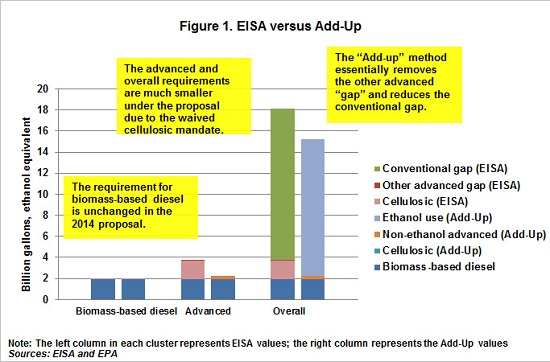
The EPA proposal maintains the hierarchy, but replaces the set targets of the Energy Independence and Security Act (EISA) with annual estimates of how much renewable fuel use is ‘expected’ (Figure 1). The Add-Up method sets the biomass-based diesel requirement at the higher of a base level of 1.28 billion gallons or expected use… Higher RIN prices would appear to lead to additional E85 consumption would then potentially lead to greater future mandates.
addup1
A blender’s tax credit, such as the $1.00 per gallon credit given to biodiesel blenders which expired at the end of 2013, gives an incentive to blenders to use more biofuel. Under the EPA’s previous method, the credit may simply make the mandate less costly to achieve… If the RFS was then easy to exceed or if obligated parties wanted extra RINs to carry into the next year, biodiesel use might rise but perhaps not very much. If extra biomass-based diesel was used beyond its own requirement, then it might displace ethanol used for advanced or overall requirements.

The analysis concludes that using the Add-Up method, the RFS renewable fuel requirements will respond to market conditions and other policies, not remain at set EISA targets.

Biodiesel, EPA, Ethanol, Government

It’s Fish Eating Time of Year

Jamie Johansen

New Holland ZimmPollOur latest ZimmPoll asked the question, “What’s your favorite fish?”

Looks like grilled is a favorite by a landslide. Personally, I agree. I didn’t learn to like fish until later in life and still don’t cook it often, but love when someone makes it for me. It is interesting to see all the fast-food chains adding a fish sandwich to their menu this time of year. Maybe we should have added fish sticks to the list.

Our poll results:

  • Pan Fried – 11%
  • Deep Fried – 19%
  • Poached – 3%
  • Baked – 9%
  • Grilled – 35%
  • Smoked – 9%
  • Soup – 0%
  • Don’t eat fish – 11%
  • Other – 3%

Our new ZimmPoll is now live and asks the question, “What do you think of the Open Ag Data Alliance?”

The Open Ag Data Alliance (OADA), an open standards software project to ensure farmers have full data access, security and privacy, has officially been launched with the goal of enabling farmers to have flexibility and control over data-driven decisions on their farm. What do you think about it? Do you think there is a need for this – or do you even understand it at all? Let us know!

ZimmPoll

Google Hopes for Good Results from Wind Project

John Davis

makaniSearch engine giant Google is hoping the expansion of a California wind energy operation by one of its companies will give good results. This story from KCBS in San Francisco says Google-owned Makani Power is expanding its presence at, or maybe more accurately, ABOVE the formal naval base in Alameda.

When Google bought Makani Power in 2013, the seven year-old start up was leasing 17, 000 square feet at Alameda Point. The new lease calls for 127,000 square feet—with an option to take over the adjacent hangars and buildings as they become available.

“It’s exciting to the city of Alameda on number of different levels,” Alameda Mayor Marie Gilmore told KCBS. “One, we get to keep a tenant and who is seriously on the cutting edge of technology, and with Google’s investment. Who wouldn’t want to have a high profile tenant like Google?”

Makani Power is trying to build off-shore wind farms using tethered-winged devices that capture wind energy at high altitudes or above deep waters. Check out the video on that project:
)

Video, Wind

Gas Station Offers Ethanol, Biodiesel and Your Mail

John Davis

protecfuel1The folks in Raleigh, N.C. can now pick up their mail when the stop in to fill up on ethanol or biodiesel. The New Bern E85/B20 Crown Station, the first station in that city to offer both E85 and B20, held a grand opening for the new Village Post Office housed within its store.

“We’re pleased to have New Bern Station as a Chamber member,” said Chamber member, Richard Urquhart. “We welcome them as our newest Village Post Office to the Raleigh area and wish them much success going forward.”

“The USPS plans to use our E85 in its area flex-fuel vehicles. We hope that alternative fuel will become the future norm for commuters and state and local government agencies to help support domestic fuel initiatives and meet certain environmental targets,” said Girish Amin, owner, New Bern Crown Station. The USPS, in a 2011 Sustainability Report, demonstrates its commitment to targets; see “What we are doing” USPS environmental initiatives report.

Protec Fuel supplies the E85 for the station. Officials hope that one day they’ll be able to provide EPA-approved retrofits that can convert vehicles to use the high blends of ethanol.

Biodiesel, Ethanol

Solar Leads U.S. in Clean Energy Jobs in 2013

John Davis

Solar power generation operations led the U.S. in the number of clean energy jobs announced in 2013. The nonpartisan business group Environmental Entrepreneurs (E2) says solar was the top sector of the 78,600 clean energy and clean transportation jobs last year with 21,600 jobs announced.

Solar Farm in Las Vegas Photo- Joanna Schroeder“Our report makes it clear. When we invest in clean energy and clean transportation, we put people to work in every corner of the country. Whether it’s a new wind farm in Iowa, an energy efficiency retrofit in Massachusetts, or a utility-scale solar array in Nevada, these projects require American ingenuity and labor. The sector is helping stimulate our economy,” said E2 Executive Director Judith Albert.

“As a business owner, I see a strong need for long-term policies that can stimulate private investment in clean energy and energy efficiency. Businesses in this sector create jobs, save consumers money, and help our environment.

“But ongoing regulatory uncertainty takes a serious toll. Elected officials shouldn’t be holding back economic growth – they should be encouraging it,” said Geoff Chapin, CEO of Next Step Living, a Boston-based energy efficiency company.

California topped the overall list of jobs announced that also includes building efficiency and public transportation. A strong fourth quarter helped Texas finish second in the report.

Solar

Bulk of Advanced Biofuel Payments Go to Biodiesel

John Davis

USDA Rural Development LogoThe biggest portion of money recently paid out for the U.S. Department of Agriculture’s Advanced Biofuel Payment Program went to biodiesel operations, indicating that green fuel is the leading advanced biofuel in the U.S. Biodiesel Magazine reports that about $40 million of the $60 million paid out went to biodiesel production. USDA officials say the entire $60 million announced last week shows the the Obama Administration’s commitment to support an “all-of-the-above” energy strategy.

“The Bioenergy Program for Advanced Biofuels is building the foundation for a clean energy economy and protecting our environment while making America less dependent on foreign and fossil fuels and increasing rural economic growth,” said Paco Valentin, USDA Rural Development State Director.

Through this program and others at USDA, the department is working to support the research, investment and infrastructure necessary to build a robust and lasting biofuels industry that creates jobs and broadens the range of feedstocks used to produce renewable fuel. More than 300 producers in 47 states have received $279 million in payments since the program’s inception. It has supported the production of more than 4 billion gallons of advanced biofuel and the equivalent of more than 40 billion kilowatt hours of electric energy.

The funding was first established with the 2008 Farm Bill and reauthorized in the recently signed 2014 Farm Bill.

Biodiesel, Government, USDA

Editorial from Father of Ethanol

Cindy Zimmerman

merle-andersonThe man who is known as the “Father of Ethanol” in the United States is still busy advocating for the industry at the well-seasoned age of 93.

Merle Anderson, one of the founding members of the American Coalition for Ethanol (ACE), just recently penned an excellent editorial for the Grand Forks Herald about his favorite subject and his observations are just as sharp as ever when it comes to the fuel he has been promoting for decades. Here’s some excerpts his letter entitled “Government ‘myths’ limit ethanol’s full use” that he wrote with input from his friend and fellow ethanol advocate Orrie Swayze from Watertown, S.D.:

First, we must remember that Henry Ford favored E30 for his Model T. After that, what could go wrong, did go wrong as government teamed with oil, and — in a joint effort to keep ethanol out of gasoline markets — created misleading myths that E30 was illegal and would ruin engines…

Merle debunks several of those myths, including that higher ethanol blends void car warranties and that gas station pumps are unable to handle higher blends such as E30. “I really chuckle at that one, because standard gas station pumps were the only pumps available when E85 was introduced nearly 20 years ago, and they still are safely pumping E85.”

Merle concludes – My dream is every American and all of agriculture — including our sugar beet industry — would have access to an ethanol market that is not limited by EPA and big oil’s nonsense or the ethanol blend wall that has been in place since the first Model T was built.

Read Merle Anderson’s entire editorial here
.

ACE, Ethanol, Ethanol News, Opinion

Biodiesel Board Pleased with CARB Findings

Cindy Zimmerman

nbb-advancedThe National Biodiesel Board (NBB) is pleased with the preliminary Indirect Land Use Change (iLUC) values presented by the California Air Resources Board (CARB) at a workshop on Tuesday.

“We applaud the Air Resources Board for recognizing the need to reduce carbon from transportation and fossil fuels to mitigate climate change,” said Don Scott, National Biodiesel Board Director of Sustainability, who was present at the workshop. “Since America’s Advanced Biofuel, biodiesel, is among the most effective tools for carbon reduction this represents a major step forward. We are hopeful the agency will continue on this path to use the best science to quantify the benefits of biodiesel.”

According to NBB, the proposal “recognizes biodiesel’s sustainability and environmental benefits, takes a notable step in the right direction, and will open new avenues for biodiesel use in the state.”

During the workshop, Scott made several comments and observations about the preliminary findings presented by CARB. “I think CARB is on the right track with improving these models to quantify those economic impacts that ripple through the world and impact food production,” he said at one point in the meeting. “The biodiesel industry was not thrilled initially about the idea of indirect land use change because our goals have always been to do what we can domestically without impacting food, either in prices or availability.” But, he says the iLUC models actually show that is true when it comes to biodiesel. Don Scott, NBB comments during CARB Workshop

Audio, Biodiesel, Indirect Land Use, Low Carbon Fuel Standard, NBB

Vestas Becomes World Wind Leader, Adds US Jobs

John Davis

vestasmachosprings1Danish wind turbine builder and installer Vestas has become the world’s leader in wind energy installation, while adding jobs right here in the U.S. The company says it installed 13.2 percent of all wind energy in 2013, nearly a third more than its closest competitor. And this record-setting year for Vestas prompted the company to hire about 400 workers at its Colorado factories, with another 450 expected to be hired this year.

Vestas installed turbines in 31 countries last year. According to Vestas’ own figures, our largest market for installations in 2013 was Germany, followed by China, Canada, and Brazil. Vestas’ largest market for sales in 2013 was the United States, followed by Germany, Canada, and Sweden.

CEO Anders Runevad says, “Vestas has been through a tough two-year turnaround process to return to profitability. That we simultaneously achieved our financial goals in 2013 and solidified our market leadership is a testament to the strength of the company.”

One of the best years for wind-turbine orders for Vestas has led to significant hiring at its four Colorado factories. The company’s blade factory in Windsor, blade and nacelle factories in Brighton and tower factory in Pueblo expect to add more than 850 production workers this year after Vestas secured orders in 2013 for nearly 900 turbines.

“We are going to be extremely busy making blades, nacelles and towers this year through at least 2015,” said Chris Brown, President of Vestas’ sales and service division in the United States and Canada.

Vestas’ V110-2.0 MW and V100-2.0 MW turbines are made in Colorado and shipped out all over the world.

Wind