Global Wind Power Capacity to Double by 2020

Joanna Schroeder

Despite a slowing down of global wind energy power installations in 2013, a new report has found that global cumulative wind power capacity will more than double from 319.6 gigawatts (GW) at the end of 2013 to 678.5 GW bu 2020. The report, “Wind Power, Update 2014 – Global Market Size, Average Price, Competitive Landscape, and Key Country Analysis to 2020,” was released by GlobalData.

Offshore wind farm in chinaThe report finds that China, the largest single wind power market responsible for 45 percent of total global annual capacity additions in 2013, is expected to have a cumulative wind capacity of 239.7 GW by 2020. China overtook the U.S. as the leading market for installations in 2010, when it added a massive 18.9 GW of wind capacity.

Harshavardhan Reddy Nagatham, GlobalData’s Analyst covering Alternative Energy, said: “China doubled its cumulative wind capacity every year from 2006 to 2009 and has continued to grow significantly since then. Supportive government policies, such as an attractive concessional program and the availability of low-cost financing from banks, have been fundamental to China’s success. While China will continue to be the largest global wind power market through to 2020, growth for the forecast period will be slow due to a large installation base.”

The report also finds that the U.S. will remain the second largest global wind power market in terms of cumulative installed capacity, increasing from 68.9 GW in 2014 to 104.1 GW in 2020. This will largely be driven by renewable energy targets in several states, such as Alaska’s aim to reach 50% renewable power generation and Texas’ mandate to achieve 10 GW of renewable capacity, both by 2025. An additional driver would include the reinstatement of the Production Tax Credit that expired on December 31, 2013.

Nagatham concluded, “The slump in 2013 was largely a product of a decrease in installations in the US and Spain. While there are likely to be further slight falls in annual capacity additions in 2015 and 2016, overall industry growth will not be affected as global annual capacity additions are expected to exceed 60 GW by 2020.”

Renewable Energy, Research, Wind

BioEnergy Bytes

Joanna Schroeder

  • BioEnergyBytesDFMosaic has launched a new line of home solar loan products and services for residential installers. Among them, the company has built a fast and easy-to-use online portal to manage customer experience, a 20 year Hassle-Free Service Guarantee, and new loan products. Mosaic’s online portal is fully automated, taking as little as 2 minutes to navigate from start to finish. The tool allows installers to control and ease their customer’s experience. Mosaic’s 20 year Hassle-Free Service Guarantee provides an extra level of customer assistance for the solar system’s maintenance and performance in addition to the comprehensive warranty and maintenance packages often offered by their installers.
  • The 4th Québec Wind Industry Gala, organized by the TechnoCentre éolien in Gaspé (Québec, Canada) on June 10,2014 the Business of the Year award to Boralex Inc. The company was originally nominated in the Developer and Operator of wind farm category and Étienne Champagne as Personality of the Year category, however, the company was awarded the top honor instead. Boralex has seen wind power success in Québec, more specifically in Côte-de-Beaupré and Témiscouata regions, and with the company’s real concern to build sustainable long-term relationships with their host communities was a factor in honoring them with the Business of the Year award.
  • Sunnova Energy Corporation, a provider of solar service to homeowners across the United States, announced it has secured $145 million in financing to accelerate customer acquisition and market growth.
  • Southern Research Institute, based in Birmingham, Alabama, has announced the completion of a facility to study solar photovoltaic (PV) systems. The facility, the Southeastern Solar Research Center (SSRC), will house numerous research efforts beginning with an Electric Power Research Institute (EPRI) project focused on solar PV system orientation, tracking and aging. The Southeastern Solar Research Center includes multiple configurations of photovoltaic solar panel arrays, microinverters and an advanced energy-monitoring system, including trackers that follow the sun throughout the day, as well as southwest-facing solar PV systems to evaluate the utilization of afternoon sun, when electricity use is generally higher. The SSRC will be located on the campus of Southern Research Institute in Birmingham, Ala. The center is looking for participants to evaluate technologies in this climatic region.
Bioenergy Bytes

New USDA Report Validates Sustainability of Biomass

Joanna Schroeder

Experts from Iowa State University and the United States Department of Agriculture (UDSA) have dtermined that after five years of soil nutrient data gathered at POET-DSM’s Project Liberty site are consistent with more than 500 site-years of additional soil research. The research team has concluded that the results show that biomass harvesting, which is now being done in the Emmetsburg, Iowa area, is consistent with proper farm management.

POET-DSM Project Liberty May 2014“Successful deployment of cellulosic bioenergy production operations such as the POET-DSM ‘Project Liberty’ program near Emmetsburg, Iowa can strengthen rural economies, help ensure energy security, and reduce greenhouse gas emissions without contributing to soil degradation – another global challenge,” said Dr. Douglas Karlen with USDA-ARS.

POET-DSM is currently finishing construction on its 25 million gallon-per-year cellulosic ethanol plant located in Emmetsburg, Iowa. That plant will use crop residue – corn cobs, leaves, husk and some stalk – to produce renewable fuel. Since 2008, POET-DSM has commissioned soil research from Karlen and Dr. Stuart Birrell (Iowa State University BioSystems and Agricultural Engineering Department) to determine changes in soil quality under different biomass harvest scenarios. That data has now been aggregated with 500+ years of additional soil data from four separate sites.

Karlen said fields that would be good candidates for biomass harvesting have qualities including

  • Slopes of less than 3%
  • Consistent grain yield histories of 175 bu/acre
  • Good nutrient management plans with soil test records

At a 1 ton per acre harvest rate, which POET-DSM advocates, Nitrogen and Phosphorus applications should not need to change, but Potassium should be monitored. Karlen also said that by monitoring natural variability within a particular field, “even more stover may be harvested from some areas in a sustainable manner.” These recommendations are in line with previous recommendations from Karlen and Birrell for the Emmetsburg area.

“We’ve been working with farmers for almost eight years now to ensure that biomass harvesting is done right,” said POET Biomass Director Adam Wirt. “We’ve developed an EZ Bale harvest system that maximizes our cob content and minimizes stalk removal. It’s a quick, clean and effective method for farmers to get more revenue from their fields while managing what is often excess crop residue.”

advanced biofuels, biomass, Cellulosic, corn, POET

FIFA World Cup to Feature Biofuels & Solar

Joanna Schroeder

FIFA World Cup BrasilThe FIFA World Cup 2014 is underway in Brazil and this year’s event features several renewable energy and sustainable measures never before seen during the event.

Sugar Cane Industry Association (UNICA) is supplying the governing body of the football fleet (known as soccer to those living in the U.S.) with ethanol. Flex-fuel cars from Hyundai, Model HB20 Edition FIFA World Cup, are running the streets and roads of Brazil powered with fuel from cane sugar.

The adoption of ethanol is one of the measures to avoid, reduce and offset emissions of carbon dioxide (CO2) released dioxide in the atmosphere, the ‘Football for the Planet,’ according to FIFA’s official environmental program that aims to reduce the negative impact of their activities on the environment. In Brazil, FIFA and the Local Organising Committee (LOC) of the 2014 World Cup are putting in place projects that address key areas such as waste, water, energy, transport, logistics and climate change.

Kids play football on the beach as Brazil prepare for the World Cup on June 11, 2014 in Maceio, Brazil. (Photo by Alex Livesey - FIFA/FIFA via Getty Images)

Kids play football on the beach as Brazil prepare for the World Cup on June 11, 2014 in Maceio, Brazil. (Photo by Alex Livesey – FIFA/FIFA via Getty Images)

For the consultant Emissions and Technology of Sugar Cane Industry Association (UNICA), Alfred Szwarc, the initiative of the FIFA program is extremely appropriate as sugarcane ethanol compared with gasoline. He cites sugar-based ethanol reduces 90 percent of greenhouse gases that cause climate change when compared to straight gasoline. Reducing global warming is one of focuses of the “Football for the Planet” FIFA campaign.

In addition to biofuels, Yingli Green Energy has provided dozens of solar panels to various operations involved with FIFA and this year the company plans to offset all carbon emissions arising from its promotional activities in Brazil to make the FIFA World Cup Brazil the greenest in history. The company’s efforts included all solar powered stadiums, commercial displays, customer hospitality, media activities, and employee travel and accommodation. To achieve carbon neutrality, Yingli has:

  • Supplied over 5,000 Yingli solar panels and nearly 30 off-grid solar energy systems to help power matches at multiple FIFA World Cup stadiums;
  • Partnered with ClimatePartner, an independent, certified environmental agency, to accurately calculate and verify emissions data for the duration of Yingli’s sponsorship activation in Brazil;
  • Committed to investing in carbon emission reduction certificates that are generated by a local Brazilian project, and that are certified by the Bureau Veritas Certification Holding SAS.

“By becoming history’s first carbon neutral sponsor of the FIFA World Cup, Yingli is honoring its commitment to our environment and to our planet,” noted Mr. Liansheng Miao, Chairman and Chief Executive Officer of Yingli Green Energy. “As a company whose products and mission are deeply intertwined with sustainability issues, we are dedicated to reducing the ecological impact of all aspects of our business operations, including our highly visible and pervasive marketing activities.”

advanced biofuels, Carbon, Climate Change, Education, Environment, Ethanol, global warming, International, Renewable Energy, Solar, UNICA

FEW Panel Looks Back and to Future of Ethanol

John Davis

Lucy Norton IRFAAttendees of this week’s 30th Annual Fuel Ethanol Workshop (FEW) heard a discussion of 30 years of past and the next five years ahead for ethanol.

“I think one of the opportunities we missed 30 years ago was developing a national brand for ethanol,” says Lucy Norton with the Iowa Renewable Fuels Association (IRFA). “We let the industry that didn’t like the fact we were taking away 10 percent of their market name it, label it, sell it the way they wanted to,” missing out on a huge opportunity to create an image for ethanol of a high-performance, low-cost fuel.

But, she’s not just about looking back. Lucy credits their new efforts to market and brand ethanol to the high-performance vehicles of NASCAR as a way to correct that image. Fans are able to see ethanol’s performance in their favorite racers’ vehicles and realize they too can have ethanol in their tanks. She says as they build that demand for the green fuel, they also need to make sure the infrastructure is in place so consumers are able to access ethanol.

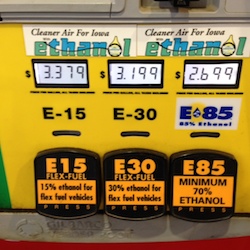
Moving forward, Lucy says they are looking to higher blends of ethanol, such as E15, as the way to increase the amount of ethanol sold and used in this country.

“We need a way to sell unhindered higher blends of ethanol and convince marketers and petroleum refiners that there is market for low-vapor pressure gasoline in the Midwest and other parts of the country. If they would just ship it here, we would find them the customers.”

You can listen to Leah’s interview with Lucy here:Interview with Lucy Norton, Iowa RFA

Check out the 2014 Fuel Ethanol Workshop photo album.

Audio, biofuels, Ethanol, FEW, Iowa RFA

Patriot Renewable Fuels is an Innovation Leader

Joanna Schroeder

Last week Patriot Renewable Fuels announced the news that the biofuels plant is making plans, and hopes to add, ICM’s Fiber Separation Technology as well as their Generation 1.5 cellulosic technology to their biorefinery facility located Annawan, Illinois. Patriot is one of the first ethanol plants in the country to adopt both technologies together. During 2014 FEW this week Gene Patriot Renewable Fuels Gene GriffithGriffith, co-founder and president of Patriot updated DomesticFuel on the project. It should be noted that this is just one of several major value-added projects Patriot has announced in less than a year making them one of, if not the most innovative ethanol plant/biorefinery in the U.S.

Griffith said they are pretty excited about the projects and after spending several months doing due-diligence on ICM’s technologies as well as other technologies, they felt that this was the right time to begin the project.

“If we get it implemented, we’ll be one of the earlier, maybe one of the earliest independent ethanol producers to this form of cellulosic ethanol, and we’re really excited about it,” said Griffith.

Griffith said being at FEW is a great networking opportunity because the the people Patriot works with are entrenched and have a lost of useful information and they are able to learn information they wouldn’t be able to generate on their own.

Last December, Patriot added another ICM platform, Select Milling Technology, and the Fiber Separation Technology builds upon this platform. “The Select Milling Technology is a separate mill that further processes the starch in the corn kernel as its ground before it goes into the fermentation process, explained Griffith. “The platforms we’re adding will be the Fiber Separation Technology which separates the fiber from the starch. Essentially, by removing the fiber from the starch, it improves our ethanol production efficiency so we get more ethanol from the corn,” explained Griffith.

Then he noted that they are able to take the fiber and do two-three things with it. One, they could add it back to the distiller’s grain (DDGs) and sell it has a high fiber form of distillers grain protein. Two, they could keep the fiber separate and sell a higher protein feed for a premium that is better for monogastric animals (such as pigs). The third option, which is what Patriot would like to do, is to ferment the fiber for additional ethanol.

Corn delivery to Patriot Renewable FuelsPresently Patriot is producing around 130 million gallons of ethanol per year and Griffith thinks they can produce another 10-12 percent ethanol production from the same kernel of corn. Griffith hopes that they can have all their permits by the end of the year and implement the two new technologies by 2015.

Griffith said many producers are doing similar things with different company’s technologies but they spent a lot of time with him learning about the technologies they implemented. He also said other producers will be watching their progress to help them decide if and when the technologies might be a good addition to their plants.

Learn more Patriot’s ethanol innovations by listening to Gene Griffith: Interview with Patriot's Gene Griffith

Check out the 2014 Fuel Ethanol Workshop photo album.

advanced biofuels, Audio, biofuels, Cellulosic, corn, Distillers Grains, Ethanol, Ethanol News, FEW, Patriot Renewable Fuels

Ennovor’s Biodiesel Earns Sustainability Certification

John Davis

ennovor-group-logoA European biodiesel maker has earned an important sustainability certification. This company news release says Ennovor Group is the first in the United Kingdom to garner the Roundtable on Sustainable Biomaterials (RSB) sustainability certification for their used cooking oil methyl ester (UCOME) biodiesel. The certification is based on 12 key principles, providing a holistic approach towards sustainability assurance, covering social, environmental, economic and operational aspects in its analysis.

“As an international certification system, RSB is appropriate for any feedstock in any country thus works very well along the entire supply chain,” says David Frohnsdorff, CEO of Ennovor. “The RSB certification will enable Ennovor to demonstrate strict compliance with EU and international sustainability standards”.

“Ennovor’s commitment to feedstock traceability fits very well with the robust RSB approach to waste verification. We are very pleased that Ennovor has chosen RSB to demonstrate the sustainability and greenhouse gas savings of their biodiesel and that RSB-certified waste-based biodiesel will be now be available in the UK,” said Rolf Hogan, RSB’s Executive Secretary.

Ennovor is one of Europe’s largest sustainable biodiesel producers, using an online “digital chain of custody” record for every consignment of biofuel it trades.

Biodiesel, International

Tom Buis Discusses Ethanol Challenges at FEW

Joanna Schroeder

The 30th Annual Fuel Ethanol Workshop (FEW) kicked off this week with an annual ethanol industry update from Growth Energy’s CEO Tom Buis. Leah Guffey was able to catch up with Buis after his presentation and asked him what some of the biggest challenges facing the ethanol industry are right now.

growth energy Tom Buis 2014 FEW“The most immediate challenge confronting us is what the EPA and the administration is going to with the 2014 renewable fuel volume obligations (RVOs),” answered Buis. This is in essence what the industry calls the 2014 Renewable Fuel Standard.

The rule, noted Buis, should have been finalized by January 1, 2014. He said the Environmental Protection Agency (EPA) is late and the proposed rule is a very controversial rule. “The proposed rule really missed the mark in our opinion,” said Buis. “We don’t think they based it upon the facts. We’ve spent the last six months trying to convince them they got it wrong and they’ve got to move it forward not backwards.”

When asked when he thought the final rule would come out Buis answered, “Pick your rumor.” He said there were over 300,000 comments about the proposed rule and he believes EPA is working as fast as they can.

While there are many steps that have to be taken before the rule can be finalized, Buis said, “Hopefully they get it right. I’ll take it late if it’s right as opposed to early and wrong.”

Learn more about some of the challenges facing the ethanol industry in Leah’s interview with Tom Buis:Interview with Growth Energy CEO Tom Buis

Check out the 2014 Fuel Ethanol Workshop photo album.

Audio, biofuels, Ethanol, FEW, Growth Energy

Argonne Scientists Blast EWG Corn Ethanol GHG Report

Joanna Schroeder

A recent Environmental Work Group corn ethanol greenhouse gas report has caused lifecycle analysis experts and economist from Argonne National Laboratory and three universities to lash out and what they call “erroneous conclusions”.

The experts isEWG report Ethanols broken promisesued a scathing 13-page response to EWG’s May report titled “Ethanol’s Broken Promise.” EWG “confused parameters” and “misunderstood” previous modeling results, according to experts from Argonne, North Carolina State University, Purdue University and University of Illinois-Chicago. “…based on an analysis of the methodology EWG used and a comparison of their results to those in the literature, from models, and from other data sets, EWG appears to have overestimated the amount of land converted for corn farming between 2008 and 2012. Second, EWG used emission factors that appear too high.”

More specifically, the experts found the following problems—among many others—with EWG’s report:

  • “EWG confused parameters in GREET with those in an economic model, the Global Trade Analysis Project (GTAP).”
  • “EWG misunderstood EPA’s GHG emissions for years 2012 and 2017.”
  • “In their report, EWG picked the EPA 2012 GHG emissions for corn ethanol and applied them to the EPA-proposed reduced volume for corn ethanol in 2014 to make the erroneous conclusion that the proposal resulted in 3 million tonnes of CO2 reduction in 2014.”
  • “…the emission factors they applied are high compared to those in other reports and studies that take into account important variations in initial and final land states.”
  • The satellite data set used by EWG is “…explicitly not designed to be used for pixel-by-pixel or localized analyses.”
  • The land use change data used by EWG is “…based on data that is decades old, reflecting wetland conversion over a much longer time horizon.”
  • The report “…overestimated wetland conversion, especially for the conversion of wetlands to corn farms.” Wetlands and grasslands conversion estimates are “…too high when compared with estimates in other studies and data sources.”

The authors also point out that EWG is stuck in the past when it comes to lifecycle analysis. They write, “Since 2009, when EPA conducted corn ethanol LUC GHG modeling…, significant efforts have been made to improve economic models and soil carbon models to better estimate biofuel LUC GHG emissions. EPA and other federal agencies should consider updating RFS LUC modeling so that up-to-date LUC results can be used for biofuel policy making.”

biofuels, corn, Environment, Ethanol, Ethanol News, global warming, Indirect Land Use

Sierra Club Launches Wind Energy Jobs Ad Campaign

Joanna Schroeder

With uncertainty around the major federal wind incentive, the Sierra Club has launched a national ad campaign urging Congress to reauthorize the critical incentive for domestic wind energy investments. The campaign focuses on Members of Congress with wind manufacturing jobs in their districts and states that are at risk of the Wind Production Tax Credit is not renewed.

The first wave of ads targets 20 House members who have been silent as the Wind Production Tax Credit has expired, and involves a television advertisement targeting Congressman Tim Walberg (MI-07) as well as geo-targeted online ad buys in 20 other districts. These members represent districts and states with a growing wind industry who have not taken a position in support of extending the federal Production Tax Credit for Renewable Energy. In most cases, they have taken no position at all.

The Wind Production Tax Credit expired at the end of last year, in part, said the Sierra Club, because of new opposition from groups backed by the billionaire Koch Brothers and other dirty fuels interests who’ve also fought to preserve the $4 billion in annual tax breaks for the oil and gas industry.

“The Wind Production Tax credit is arguably one of the best bets we’ve made on clean, domestic energy,” said Dave Hamilton, Director of Clean Energy for Sierra Club’s Beyond Coal campaign. “It encourages huge investments, creates good American jobs, helps our country become more energy independent, and cuts air and water pollution. But many in Congress are failing to act, leaving thousands of American workers and communities across the country blowing in the wind.”

The wind industry employs more than 80,000 American workers and produces enough clean energy to power 15 million homes. It saves more than 30 billion gallons of fresh water each year compared with other energy sources. According to the American Wind Energy Association, if growth remains steady, the industry will produce 20 percent of America’s electricity by 2030.Read More

Electricity, Legislation, Renewable Energy, Video, Wind