ACE Conference 2026

US Ethanol Exports Drop Again

John Davis

Ethanol exports dropped again during May to hit their lowest level of 2015. The Renewable Fuels Association (RFA) reports exports dropped 14 percent from April to 64.6 million gallons (mg), with the largest cutbacks in Tunisia, India, the Netherlands and the Philippines. Year-to-date exports of 377.1 mg implied an annualized total of 905 mg for 2015, which would surpass all years but 2011.

ethanolimportsexports1
The United States reduced its exports of undenatured ethanol for fuel use by 34%, dropping from 42.8 mg in April to 28.4 mg in May. Top customer Brazil once again cut U.S. ethanol imports (13.8 mg, or 49%), while the Philippines (4.0 mg), Mexico (3.8 mg) and Nigeria (3.4 mg) received significant volumes. May exports of denatured ethanol fuel increased 13% to 33.5 mg, surpassing shipments of undenatured product for the first time since October 2014. Canada (17.2 mg), Oman (12.6 mg) and Peru (3.5 mg) accounted for virtually all of the volume exported. The United States exported 545,652 gallons of undenatured ethanol for non-fuel, non-beverage use and 2.2mg of denatured ethanol for non-fuel, non-beverage use in May, in line with recent norms.

Ethanol imports were dramatically lower in May, with the U.S. taking delivery of 3.2 mg of denatured product from the Netherlands and 33 gallons from Germany. Total year-to-date imports of 16.4 mg are less than a third of imports at this time last year.

Meanwhile, May exports of U.S. distillers dried grains with solubles (DDGS)—the animal feed co-product manufactured by dry mill ethanol plants—surged 23 percent over April levels and marked the second biggest monthly jump on record. May shipments were 1,171,916 metric tons (mt), topping the 1.1 million mt mark for only the third time. Monthly exports to China were at an historic high of 864,777 mt in May, nearly three-quarters of total U.S. DDGS exports.

Distillers Grains, Ethanol, Ethanol News

Ethanol Group Becomes ‘Renew Kansas’

John Davis

renewkansasA group representing ethanol producers in Kansas has changed its name. The Kansas Association of Ethanol Processors (KAEP) has changed its name to Renew Kansas to better reflect an evolution of the association’s mission to promote ethanol as a renewable fuel that is good for the Kansas consumer, environment and economy.

The transition comes after months of strategic planning and analysis by the KAEP Board of Directors and staff. The Greteman Group, an advertising agency in the Wichita area, directed the rebranding efforts with a new logo, website and industry messaging.

“Changing our name to Renew Kansas better reflects our focus in promotion and education of ethanol fuels as good for consumers and the state,” said Tom Willis, CEO of Conestoga Energy Partners in Liberal and Chairman of the KAEP Board of Directors. “We look forward to expanding our reach with our new identity and growing our organization to help meet future energy needs.”

Chek out the Renew Kansas website, www.renewkansas.com.

Ag group, Ethanol, Ethanol News

Biofuel Perennial Crops Could Use Less Water

Joanna Schroeder

A new research report from the Great Lakes Bioenergy Research Center (GLBRC) finds that perennial crops grown on marginal land for biofuel use could use comparable water to that of corn. The report looked at how these crops could affect the balance of water between rainfall inputs, evaporation losses, and movement of soil water to the groundwater. The report cites that in humid climates such as the U.S. Midwest, evaporation returns more than half of the annual precipitation to the atmosphere, with the remainder available to recharge groundwater and maintain stream flow and lake levels.

The study, led by GLBRC scientist and Michigan State University professor of ecosystem ecology Stephen Hamilton, is a multi-year effort to compare the water use of conventional corn crops to the perennial cropping systems of switchgrass, miscanthus, native grasses, restored prairies, and hybrid poplar trees, feedstocks currently under review for use as biofuel crops.

Michigan State University; (R) Stephen Hamilton, professor of ecosystem ecology at Michigan State University and GLBRC researcher. Photo by John W. Poole, NPR.

Michigan State University; (R) Stephen Hamilton, professor of ecosystem ecology at Michigan State University and GLBRC researcher. Photo by John W. Poole, NPR.

“When we established the different cropping systems in 2008,” said Hamilton, “we installed soil-water sensors at various depths through the root zone. We’ve been continuously monitoring the soil water content ever since.”

To measure the rate of evapotranspiration occurring within each cropping system, soil-water sensors are used. Evapotranspiration refers to the sum total of water lost while the plant is growing, either from evaporation through the plant stem itself (a process called “transpiration”), or from water evaporated off of the plant’s leaves or the ground. By measuring the amount of precipitation that has fallen against actual soil water content, Hamilton said it’s possible to quantify the water lost to evapotranspiration while each crop is growing.

In a finding that contrasts sharply with earlier modeling studies that found particularly high perennial water use in areas with high water tables, the report finds that the perennial system’s evapotranspiration did not differ greatly from corn. Hamilton’s study, however, took place in Michigan’s temperate humid climate and on the kind of well-drained soil characteristic of marginal farming land.

Hamilton and his team also measured the water use efficiency (WUE) of each crop, calculating which plants grew the most biomass with the least amount of evapotranspiration. Miscanthus had the highest WUE, then corn, followed by poplar, native grasses, and prairie.

advanced biofuels, Renewable Energy, Research, water

Wave Energy Prize Entrants Move Forward

Joanna Schroeder

The U.S. Department of Energy’s (DOE) wave energy competition is moving toward the next phase with 92 teams. The Wave Energy Prize is a design-build-test competition encouraging the development of better innovations for wave energy conversion (WEC) devices that will double energy capture. When this is achieved, costs will be reduced making wave energy more competitive with established energy technologies.

The 91 American teams and one team from Denmark official will now begin working to double the energy captured from ocean waves and win a prize purse totaling more than $2 million.

“We’re extremely pleased with both the quantity of teams and the diversity of participants reflecting broad expertise from so many established companies in the ocean energy space, universities, anWave Energy Prize logod newcomers to the industry,” said Julie Zona, Wave Energy Prize administrator. “The composition of the participating teams truly demonstrates one of the benefits of a prize challenge, which is to encourage the inclusion of new perspectives. We’re very hopeful that the diverse backgrounds of these teams will help lead to the Prize’s goal of achieving game-changing performance enhancements to wave energy technologies.”

Team names and background information on the official registered teams can be found on the Wave Energy Prize website.

Clean Energy, ocean energy, water

Letter to Congress: No Changes to RFS

Joanna Schroeder

Screen Shot 2015-07-07 at 9.36.35 AMA broad group of companies supporting the renewable fuels industry sent a letter urging members of Congress to reject proposals that ‘amend, repeal, defund or otherwise modify or interfere with the Renewable Fuel Standard‘(RFS). This included the amendment from Rep. Barry Loudermilk that would defund the RFS.

The letter compares renewable fuel favorably to gasoline on environmental measures and argues that renewable fuel breaks the oil monopoly on gasoline. The letter also cites that in 2013, 33 percent of the petroleum consumed in the United States came from foreign sources, the lowest level since 1985.

Read the letter. Read More

Biodiesel, biofuels, Ethanol, RFS

BioEnergy Bytes

Joanna Schroeder

  • BioEnergyBytesDF1ChargePoint Home electric vehicle (EV) charger will be available to order on Amazon later this summer. The price of the networked station ranges from $499 to $749. ChargePoint Home’s price varies based on power level, installation type and cord length. The station is available as a 32 amp station that can deliver a maximum of 25 miles of Range Per Hour (RPH), or a 16 amp station that can deliver a maximum of 12 RPH with a range of cord lengths. The station can be installed either indoors or outdoors.
  • Princeton Power Systems, a global designer and manufacturer of technology products and embedded software for energy storage, microgrid operations, and electric vehicle charging, has announced that their Brooklyn Army Terminal project is a finalist for the 2015 Intersolar Project of the Year Award.
  • Continental Energy Corporation, an emerging international energy developer, has announced that it has entered into a strategic alliance agreement with Indonesia based Bluline Group, a family owned group of companies that specialize in private equity investments in Food-Energy-Water related businesses and infrastructure projects throughout the Indonesian Archipelago. Under the Alliance, the Continental will act as the vehicle to implement Bluline’s “E for Energy” segment.
  • TerraForm Power, Inc. and SunEdison, Inc. have announced that TerraForm Power has signed a definitive agreement to acquire net ownership of 930 MW of wind power plants from Invenergy Wind LLC, the largest independent wind owner in the United States.
Bioenergy Bytes

Nebraska Ethanol Board to Talk Ag Careers

John Davis

NEethanolboardThe ethanol industry holds lots of job opportunities in agriculture-related businesses. That’s why the Nebraska Ethanol Board staff will be at the Nebraska Agriculture Youth Institute Career Fair this Thursday, July 9, at 3:30 p.m.

The Nebraska Agriculture Youth Institute (NAYI) is a weeklong experience – July 6-10 – for high school juniors and seniors from across Nebraska to learn about career opportunities within agriculture. This conference features speakers, workshops, agricultural education, networking with peers and industry leaders, professional development and leadership experience.

“NAYI is an opportunity for high school students to get a taste of the variety of opportunities in agriculture,” said Trent Mastny, Nebraska Agriculture Youth Council head counselor. “Youth from across the state can make connections and share their passion for agriculture and feeding the world.”

A recent impact study by University of Nebraska-Lincoln economists reveals Nebraska’s ethanol production growth was tenfold in the past two decades, which means high-quality jobs in the state. Nebraska’s 24 ethanol plants staff 1,300 full-time employees earning $71 million in annual wages and benefits.

“The ethanol industry has opportunities in agriculture fields, as well as careers in science, technology, engineering and math (STEM), which are in high demand,” said Todd Sneller, Nebraska Ethanol Board administrator. “Ethanol plants provide jobs for educated youth in rural communities.”

Ethanol, Ethanol News

U.S. Energy Efficiency Increasing

Joanna Schroeder

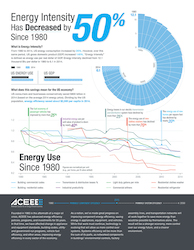
Energy efficiency is improving in America. A new report find the country’s energy intensity, the measurement of energy used per dollar of gross domestic product, is down from 12.1 thousand Btus per dollar in 1980 to 6.1 thousand Btus per dollar in 2014. The report, Energy Efficiency in the United States: 35 Years and Counting, was released by the American Council for an Energy-Efficient Economy (ACEEE).

ACEEE energy reduction report infographicThe report found that nearly 60 percent of the improvement in energy intensity was due to energy efficiency and about 40 percent to major structural changes in the economy. The bottom line according to ACEEE:  Just the energy efficiency portion saved U.S. consumers and businesses about $800 billion in 2014, roughly $2,500 per capita. Even though U.S. energy use edged up by 26 percent from 1980 to 2014, the U.S. gross domestic product (GDP) increased by 149 percent.

The report concludes that “while much progress has been made, there are large and cost effective energy efficiency opportunities that, by 2050, can collectively reduce energy use by 40-60 percent relative to current forecasts.”

Report co-author and ACEEE Executive Director Steven Nadel said: “Energy efficiency has made great strides in the past 35 years, and we have learned many important lessons on how markets and policies can work together to advance it. Looking forward, we find opportunities to reduce 2050 energy use by half relative to a business-as-usual reference case. In order to harvest these large efficiency opportunities, we need to take our efforts to a higher level. The challenges are many, but so are the benefits in terms of lower energy bills, a stronger economy, improved energy security, and a cleaner environment. The past has shown us what efficiency can do and it can guide us to even greater success in the future.”

In addition to highlighting the areas that have achieved most significant energy reduction, the report also recommends tactics to be taken to further improve energy efficiency.

Clean Energy, energy efficiency

Clean Jobs Continue to Rise

Joanna Schroeder

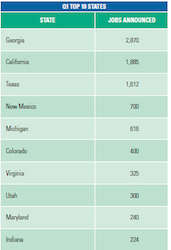
A new report finds that more than 9,800 clean energy and clean transportation jobs were announced in the U.S. in the first three months of 2015. This is nearly double the number of jobs announced during the same timeframe in 2014. The report was released by Environmental Entrepreneurs (E2).

E2 Q1 2015 top clean job statesThe top three states for the quarter were: Georgia (2,870 jobs), California (1,885) and Texas (1,612). New Mexico, Michigan, Colorado, Virginia, Utah, Maryland and Indiana rounded out the top 10. Georgia’s No. 1 ranking was its first since E2 began its clean energy job-tracking analysis in 2011. The vast majority of its jobs came in the solar sector.

“Nearly 10,000 new job announcements in one quarter shows just how fast clean energy is growing in America,” said Bob Keefe, executive director of E2. “But building an economy increasingly fueled by clean, renewable energy like wind and solar doesn’t happen in just one quarter. Smart policies like the federal Clean Power Plan – which will reduce carbon pollution from existing power plants and increase clean energy – will help keep the job growth going.” Final Clean Power Plan standards will be announced later this summer.

Nationally, solar was the top sector in Q1, with more than 6,600 jobs announced from nearly 20 projects in solar generation and solar manufacturing. The report attributed declining materials costs as a primary reason for the solar industry’s strong showing. In the wind energy sector, more than 1,400 jobs stemming from 11 projects were announced, while the biomass, energy storage, advanced vehicle and lighting efficiency sectors announced hundreds of jobs each.

Clean Energy, Solar, Wind

BioEnergy Bytes

Joanna Schroeder

  • BioEnergyBytesDF1An upcoming episode of “In America” will cover the topic of water power and dams. The episode will be hosted by famous actor and voice-over specialist, James Earl Jones. The purpose of this episode is to inform viewers about how we obtain electricity from water. It’ll also cover the history of hydro-electric power and the future of associated endeavors.
  • IKEA has announced it officially has ‘flipped-the-switch’ on a fuel cell system installed at its retail location in Emeryville, CA. Slightly larger than the physical size of a commercial back-up generator, the 300-kW system will operate on biogas and produce approximately 2,497,651 kWh of electricity annually for the store. Combined with the solar energy system installed atop the store in 2011, these fuel cells will help generate more than a majority of the store’s energy onsite.
  • RGS Energy has completed the previously announced $5 million offering of units consisting of its Class A common stock and Series F common stock warrant at a price of $3.65 per unit.
  • The League of Conservation Voters (LCV) has launched a digital ad campaign thanking Rep. Cheri Bustos for her vote against Rep. Whitfield’s H.R. 2042, gutting the EPA’s Clean Power Plan. The $20,000 digital ad campaign aims to hold Members of Congress, including Rep. Bustos, accountable for their votes last week on Rep. Whitfield’s bill.
Bioenergy Bytes