 The latest crop production forecast out Friday from the U.S. Department of Agriculture slightly lowered the production estimate of the 2008 corn crop from 12.288 billion to 12.072 billion bushels, which would still be the second highest on record.
“We were expecting to see the numbers decrease a little, but we remain optimistic about this year’s crop,” said National Corn Growers Association President Ron Litterer of Greene, Iowa. “After such a bumper crop in 2007, we were faced with a number of challenges as the 2008 season began. Our nation’s corn growers have done a terrific job dealing with colder spring temperatures and Midwest flooding, and we salute them for their hard work.”
 Renewable Fuels Association (RFA) President Bob Dinneen agrees that farmers are delivering an excellent crop despite unprecedented challenges. “All indications continue to point toward a remarkable harvest this fall and further evidence of American farmers’ capacity to continue feeding the world and helping to fuel this nation,” Dinneen said.
In the new World Supply and Demand forecast, feed and residual use for corn was lowered by 100 million bushels compared to the August report, to 5.1 billion bushels. Ending stocks were also be lowered, by 115 million bushels, to 1.018 billion bushels. However, the estimate for ethanol use of corn is unchanged at 4.1 billion bushels.
RFA believes that USDA may be overstating gross demand for corn for 2008/2009. According to RFA, Based on USDA’s calculations, American ethanol biorefineries will produce approximately 11.3 billion gallons of ethanol between September 1, 2008 and August 31, 2009 (the corn crop marketing year). Given current ethanol market dynamics and the requirements of the Renewable Fuels Standard (which calls for 10.5 billion gallons of starch-based “conventional” ethanol use in calendar year 2009), it is unlikely that ethanol production will reach the levels estimated by USDA in that time frame.
RFA also points out that the USDA estimate of gross usage of corn for ethanol does not take into account the fact that one third of every bushel processed returns to the feed market in the form of distillers grains.


 Wal-Mart Foundation recently donated $369,000 to the Arkansas Biosciences Institute at Arkansas State University to help fund biomass to ethanol research.
 Ethanol-powered planes flew in formation in the blue Hoosier sky Thursday to mark the opening of Indiana’s newest ethanol plant in North Manchester.
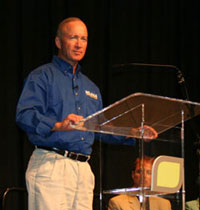 “With its third Indiana facility, POET is quickly becoming a household name in our small towns,” said Indiana Governor Mitch Daniels. “This new North Manchester facility means more good jobs and an important market for our Hoosier farmers.”
  The group of 250
  The president of the Austrian Chamber of Forestry and Agriculture Gerhard Wlodkowski commented on the issue during his welcome address to the journalists. He noted that consumers in Austria are complaining about the increase in food prices, but they “don’t consider that in the year 1970 in Austria everybody spent 33 percent of their income for food and today they spend only 13 percent of their income.”
  “We have clearly seen a positive impact since the biodiesel tax incentive was enacted as part of the American Jobs Creation Act of 2004,” Feraci stated. “Not only has there been an increase in jobs, biodiesel has proven to be a viable energy alternative which is environmentally friendly. Continuing this incentive will take the nation one large step closer to energy independence,” Feraci continued.
 Earlier this week at the new, green NBB building grand opening ceremony in Jefferson City, Mo., Missouri Congressman Kenny Hulshof made the case why the biodiesel industries needs the incentives. He explained that it’s the only way to level the playing field with the petroleum industry that has been the benefactor of tax breaks for decades… even as it enjoyed record profits.
 A handful of students at Washington State University are trying to take their energy future into their own hands. While the WSU Biodiesel Club only got about 10 members at their first meeting this week, organizers hope that the student-run operation soon will be producing 200 gallons of the green fuel a day.
 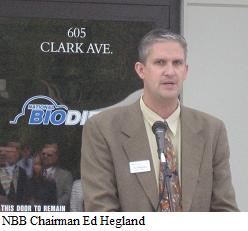 During this week’s ribbon-cutting ceremony at the new National Biodiesel Board building in Jefferson City, those in attendance included local and state officials and nine members of the Board from around the country.
 Oklahoma might be famously known for its “winds that come sweepin’ down the plains,” and one of the leading universities in the state is going to put that to work.
 “It is our patriotic duty as Americans to help our country achieve energy independence,” Boren said at a news conference at OU. “We should become a national role model for the environment.”