

 What do you think of when you hear that there’s a sled running on biodiesel? Probably not thinking tractor pull sled are you? Unless you’re a tractor pull fan. Well those big machines that the tractors and trucks pull are also diesel powered and in Jefferson City, MO there’s a company that manufactures them and runs them on biodiesel.
The company is Bungart Motor Sports and I learned about if from Donnie Bungart. Thanks to Tom Steever, Brownfield Network, for the picture.
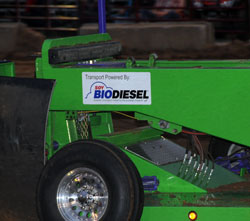 Donnie says they do over 160 shows a year around the country. At the Midwest Extreme Truck and Tractor Pull in Jefferson City he says they had two sleds in operation. He says they run B20 in them and have been for over 3 years very successfully. Donnie says they’ve had a lot of luck locating the fuel when they need it, especially at major truck stops.
So if you’re not a tractor pulling enthusiast you might ask, “What’s a sled?” Donnie says it’s a weight transfer machine. It starts out not weighing much but as the tractor pulls it more and more weight is transferred which ultimately stops the tractor. At least we hope! Thanks again to the United Soybean Board for inviting me out to the tractor pull.
You can listen to my interview with Donnie below:
 This edition of “The Ethanol Report” features comments from the
  Thanks to an invite from the
  One of the things I love about America is “freedom of the press” and the ability for people to disseminate “conspiracy theories”. Conspiracies are driving amuck in the quest for the ‘winning’ technology to replace gas guzzlers. The best way forward, according to author
  The U.S. Department of Energy has handed out $1.6 million to the Alternative Fuel Trade Alliance… a group made up of the Renewable Fuels Association, the National Biodiesel Foundation, the Propane Education & Research Council, the Clean Vehicle Education Foundation and ASG Renaissance… to boost efforts for a targeted educational plan aimed at Clean Cities Coordinators and related stakeholders.
 Bob Dinneen, President and CEO of the Renewable Fuels Association, commented, “This DOE grant will supplement our individual and joint efforts to work with and train coordinators, stakeholders, and others at the national and regional level to enhance their knowledge and expertise on the latest developments and applications for alternative fuels and advanced vehicle technologies which include ethanol, biodiesel, propane, and natural gas fuels as well as hybrid/electric technologies and idle reduction strategies to improve fuel economy.”
 Joe Jobe, CEO of the National Biodiesel Board, said “This program unites the mainstream alternative fuel organizations in working collaboratively towards a common goal: educating America on all aspects of alternative fuels, and increasing their use. This will benefit our air quality, our energy independence and our economy.”
 Watermelons… that tasty summertime treat… could be the next feedstock for the green fuel ethanol.
 The online resource is designed to help consumers learn more about the benefits of ethanol for America’s environment, economy and national security and includes answers to many frequently asked questions about the ethanol industry.
 The
The  St. Louis was the destination this week as more than 100 researchers and industry leaders from 10 states came together for the “Algae-to-Energy in the South” regional summit aimed at looking at algae’s potential as a renewable energy resource, particularly making it into biodiesel.
 The National Biodiesel Board has been proactive to support research and development to learn more about algae’s potential as well as honing algae extraction techniques. NBB’s feedstock program, with funding from the U.S. Department of Transportation, is working with Dr. Sayre to further develop a non-destructive oil extraction process, sometimes referred to as “milking the algae,” that is capable of continuously removing oil from living algal cultures. The program is considering what strains perform best and how the process may benefit production efficiency by removal of contaminants.
 Dr. Sayre explained that oil based fuels, such as biodiesel, have many benefits. They boast twice the energy density of alcohol; oil producing plants have reduced impact on the environment; and algae based biodiesel can be produced on land not suitable for other uses and result in higher oil per acre than currently available.
 Federal officials have handed out $4.2 million in grants for projects that will reduce the fuel for forest fires, while creating a green fuel source.