Second Biodiesel Boat to Shuttle Pearl Harbor Visitors

John Davis

USSArizonaLast April, I told you about how visitors to one of the most sacred places in U.S. history, Pearl Harbor, Hawaii, were now being shuttled out to the USS Arizona Memorial by a boat that runs on biodiesel.

This U.S. Navy press release
says a second biodiesel boat, USS Arizona Ferry Boat #39-2, “Samuel G. Fuqua,” is now taking people to that hallowed place:

090825-N-3666S-080The new boats will eventually replace the existing 20-year-old U.S. Navy-operated tour boats that shuttle visitors to and from the USS Arizona Memorial as part of the National Park Service’s (NPS) World War II Valor in the Pacific National Monument tours.

The design of the environmentally friendly boats will reduce the carbon footprint of the ferry service, contributing to the Navy’s efforts toward affordable and clean naval power. The clean fuel technology components include twin diesel engines that fully comply with EPA emissions standards, and a complex fuel system optimized for biodiesel fuel and designed to further reduce emissions. The diesel oxidation system is engineered to chemically convert hydrocarbons and carbon monoxide into water and carbon dioxide. The new boats use locally produced, 100 percent renewable biodiesel.

While most U.S. Navy boats have hull registration numbers only and no names, the five new Arizona ferry boats are unique because they are named after five Medal of Honor recipients of the Pearl Harbor attack. The boats are numbered 39-1 through 39-5 to reflect Battleship Arizona’s hull designation, BB-39. The remaining boats, #39-3 Cassin Young and #39-4 Donald K. Ross, will arrive in the next several months, with the fifth and final boat, #39-5 Jackson C. Pharris, to be delivered in the summer of 2010.

This latest ferry boat is named in honor of Samuel Glenn Fuqua. Nearly 60 years ago on that “day that would live in infamy,” Lt. Commander Fuqua showed tremendous courage trying to save as many lives as possible on the ill-fated USS Arizona. Despite being knocked unconscious by a bomb that slammed into the Arizona, Fuqua was able to recover to direct the fighting of fire and rescue of wounded and injured personnel. Being the senior surviving officer, Fuqua realized the ship could not be saved, ordered the ship abandoned, and remained on the quarterdeck to save the ship’s remaining crewmen. I think the biodiesel industry should be proud to have such a high-profile transport named after a true American hero burning its green fuel.

Biodiesel

Ford’s B20 Biodiesel-compatible Engine Cheered by NBB

John Davis

NBB-logoThe news that Ford has developed a new diesel engine… code-named Scorpion… to put in its 2011 F-Series Super Duty diesel pickups will be fully compatible with a 20 percent biodiesel blend (B20) (see my post from yesterday) is being welcomed by the National Biodiesel Board:

“This is the first of what we expect to be many formal announcements of B20 approval in new clean diesel technology,” said Steve Howell, technical director for the National Biodiesel Board. “With the formal approval and acceptance of B20 in the 2011 Super Duty, Ford now has a clean and green engine of tomorrow that will also reduce NOx emissions by more than 80 percent. NBB already has inquiries from biodiesel fans wanting to purchase a new B20 pickup!”

The NBB and the National Renewable Energy Laboratory have spent more than $10 million testing B20 and understanding how it works in the new diesel engines and after-treatment technology during the last five years. That’s in addition to research and development efforts by the individual Original Equipment Manufacturers like Ford. The new F-Series engines were torture-tested internally by Ford to more than 250,000 miles to test their durability cycles with multiple biodiesel blends, according to the company.

“It’s rewarding to see the efforts by NBB and NREL start to pay off,” said Howell, noting that most of the NBB funding for the testing was provided by U.S. soybean farmers through the soybean checkoff program. “The engine makers asked for an ASTM B20 blended standard, in addition to the pure biodiesel standard, and we worked hard to get it passed.”

NBB goes on to point out that Ford has nearly half of the on-road diesel truck market in this country, so there could be some big implications with this news. Can’t wait to see the reactions when these engines start arriving in new trucks in the first half of next year!

Biodiesel, Car Makers, NBB

The U.S. Needs to Transition to Hydrous Ethanol

Joanna Schroeder

Our nation needs to transition to hydrous ethanol as the primary renewable transportation fuel, writes Brian J. Donovan with Renergie, Inc. Many of you may be thinking that this is no different than what many people are proposing – the move to ethanol- but Donovan is proposing the use of hydrous ethanol versus anhydrous ethanol. Simply put, anhydrous ethanol has a purity of at least 99 percent and meets the standard specification for ethanol used as a motor fuel. Hydrous (or wet) ethanol can be produced by simple distillation (think in your backyard) without the dehydration step (which then produces anhydrous ethanol) and is between 93-96 percent ethanol and 7-4 percent water.

gassy.jpegIn February, 2009, the U.S. EPA granted Renergie a first-of-its-kind waiver for the purpose of testing hydrous E10, E20, E30 & E85 ethanol blends in non-flex-fuel vehicles and flex-fuel vehicles in the State of Louisiana. Under this test program, Renergie will use variable blending pumps, not splash blending, to precisely dispense hydrous ethanol blends of E10, E20, E30, and E85 to test vehicles for the purpose of testing for blend optimization with respect to fuel economy, engine emissions, and vehicle drivability.

Initial tests conducted in Europe have confirmed that hydrous ethanol can be blended effectively with gasoline without phase separation or other problems. But why is this important you ask? According to Donovan, hydrous ethanol may be better suited for mid-level blends used in FFVs and non-FFVs.

He writes that due to emissions and durability testing requirements, ethanol producers are having difficulty with assessing the economic and environmental impacts of midlevel anhydrous ethanol blends on current auto engines in order to increase blending rates and the RFS. In contrast to higher percentage anhydrous ethanol blends, HE15 and higher blends can be utilized in legacy vehicles (existing auto engines) as well as FFVs. Once parallel testing has been conducted for midlevel and E85/HE85 anhydrous and hydrous ethanol blends, further fuel efficiency and emissions testing may not be necessary.

Should that be the case, then this is good news for both consumers and the ethanol industry – consumers get more choice at the pump and the ethanol industry has a larger home for its product.

blends, Ethanol, News

Growth Energy Press Conference at Farm Progress Show

Chuck Zimmerman

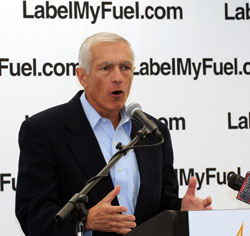
General Wesley ClarkGen. Wesley Clark, Growth Energy, made an announcement this morning at the Farm Progress Show. The organization is calling for country of origin labeling for fuel. I would call that COOL for fuel! Hey, we do it with food, why not fuel?

General Wesley Clark, Co-Chairman of Growth Energy, today called on the United States Congress and the White House to take action to dramatically enhance the market transparency of the nation’s fuel supply by requiring a national standard of country of origin labeling (COOL) for fuel.

The Label My Fuel initiative would create a COOL standard similar to requirements already in place for common consumer items, including apples, beef, cars and coffee. The goal is to help create consumer awareness of the costs and national security implications of the nation’s addiction to foreign oil.

Clark also unveiled Growth Energy’s labelmyfuel.com, which showcases the costs of American dependence on foreign oil, and serves to rally grassroots support for Congressional action on COOL for fuel legislation.

You can find photos from the press conference in our Farm Progress Show photo album and you can listen to the press conference below:

Audio, Farm Progress Show, Growth Energy

Florida Vetrans Denounce Big Oil Front Group

Joanna Schroeder

Big Oil is out astroturfing once again, this time under the guise of the group “Energy Citizens,” a front group set up by their Washington lobbying arm, the American Petroleum Institute. The goal of this effort is to stage rallies across the country in an attempt to kill the clean energy and climate plan now being considered by Congress.

temp-splashIt’s not only the biofuels industry that has had enough. Operation Free, a coalition of leading Veterans and national security organizations is fighting back and has denounced the claims of Energy Citizens and its ‘Oil Dependence Tour’ and cites that the groups efforts threaten our national security. Spokespersons for Operation Free note that they strongly support immediate Congressional action on clean energy and a climate plan that breaks the country’s addiction to oil, tackles global warming and enhances national security.

During a press conference held by the Florida Veterans, participants noted that you, “don’t often see veterans coming together to talk about national security,” as well as said that, “for us, there’s not a huge jump between energy and national security”.

Jason Whitaker, a 10 year Army veteran with multiple deployments, has seen first hand the devastation caused by climate change. He said, “There are few challenges facing America that are more urgent than climate change. Denial is no longer an acceptance response. The stakes are too high and the consequences are too serious.”

biofuels, Energy, Environment, global warming, News

Ford Offers Rival to GM Biodiesel-ready Engine

John Davis

ForddieselenginePreviously, I told you about how General Motors was soon to debut a new heavy-duty, diesel engine designed to burn B20 biodiesel (see my post from Aug. 11, 2009). Well it looks like Ford is going to give GM a run for its money in the green, heavy-hauling pickup engine race.

This story from green.autoblog.com says Ford’s V8 diesel… code-named Scorpion… designed for the company’s Super Duty pickups will come out in 2011 to rival GM’s so-called LML Duramax engine:

Officially the Scorpion retains the Power Stroke badge, but that and eight cylinders in a V-configuration are all that are carried over. The Scorpion engine picks up a variety of technologies that have been appearing on other recent engines both gas and diesel fueled, as well as adding a few new tricks, particularly the turbocharger. The biggest change for the architecture is the move to an inside-out layout. Since the early days of the V-engine configuration, most examples have had the intake system mounted in the valley between the banks with the exhaust on the outside. Like BMW’s new turbocharged gas V8 and GM’s currently-on-the-shelf Duramax 4500, the Scorpion switches this around.

A turbocharger uses the engine’s exhaust gases to spin up a turbine which in turn drives a compressor that pushes more air into the engine thus making more power. The beauty of the system is that it consumes very little energy under light load conditions and allows smaller engine displacements for improved efficiency most of the time. When extra power is needed, the turbo helps expand the engine’s operating range on-demand…

Like the 2010 version of GM’s 6.6-liter Duramax, the 6.7-liter Power Stroke will be fully compatible with B20 biodiesel blends, addressing one of the issues some current Power Stroke operators have had. Because the current engine injects some fuel into the exhaust stream for particulate filter regeneration, the use of B20 has caused damage to some engines. This will no longer be true for the new engine.

I’m no motorhead, so I won’t even try to determine which motor is better. But it’s nice to see the big automakers are competing to see who can make the biggest and baddest, green engine possible.

More information on Ford’s engine is available here.

Biodiesel, Car Makers

How to Shift to a Bio-Based Economy

Joanna Schroeder

Interested in getting a little insight into how the country will shift from a petroleum-based economy to a bio-based economy? Then look no further than DomesticFuel, or to be more exact, Dyadic International CEO, Mark Emalfarb. Emalfarb was interviewed during the Sixth Annual World Congress on Industrial Biotechnology and Bioprocessing which took place in Canada this past July.

The interview was conducted as part of the Biotechnology Industry Organization’s (BIO) I am Biotech campaign. Emalfarb was asked several questions including the importance of biotechnology and biofuels, how biotechnology is helping to heal, fuel and feed the world, how do you demonstrate biotech is the way of the future, and more.

You can watch the first part of  Mark Emalfarb’s interview here and the second part by clicking here.

Biotech, Video

Missouri Facility Gets First Biomass Assistance Payment

John Davis

bcapA Missouri plant that turns agricultural waste products into fuel pellets is the first to receive a payment from the USDA’s Farm Service Agency’s new Biomass Crop Assistance Program (BCAP).


This USDA press release says the Show Me Energy Cooperative of Missouri conversion facility will get the funds aimed at paying producers for biomass materials for collection, harvest, storage and transportation:

“As the Obama Administration continues laying the foundation for a stronger, revitalized economy, biomass has great potential to create new, green jobs for American workers,” said Vilsack. “Biomass also has important environmental benefits to produce cleaner energy and reduce greenhouse gases.”

“Show Me Energy completed an agreement soon after our July 29th announcement and had biomass producers waiting,” said FSA Administrator Jonathan Coppess. “Agriculture Secretary Vilsack had a chance to see first hand the company’s successful operation during a recent visit to Missouri. He was impressed and excited about the opportunities that BCAP presents for agriculture, the
environment and the nation.”

According to Show Me Energy Cooperative CEO Kurt Herman, “Our plant produces fuel pellets from agricultural waste products, but could expand to produce cellulosic liquid fuels.”

The pellets, made from switchgrass, straw, corn stover, sawdust, woodchips and other biomass materials from more than 500 producers, will be used to heat homes and livestock facilities. It’s being tested at a power plant to see if it could supplement coal for electrical production.

FSA is urging other biomass conversion facility operators are encourage to sign agreements to get the same funds themeselves. MOre information is available at www.fsa.usda.gov.

biomass, USDA

Waste Management Investment in Terrabon Technology

Cindy Zimmerman

TerrabonWaste Management, Inc. has become the latest company to invest in waste-to-fuel conversion technology developed by Terrabon. Waste Management, the leading provider of comprehensive waste management and environmental services in North America, joins Valero Energy Corporation, the largest refiner in North America, which also invested in Terrabon in April 2009 and recently increased its investment in Terrabon.

TerrabonThis investment from Waste Management and Valero will be used by Terrabon to advance the scalability of their technology. Waste Management will also assist Terrabon in securing organic waste streams, which Terrabon will use to produce high-octane gasoline using its MixAlco™ technology. MixAlco is an acid fermentation process that converts biomass into organic salts.

Energy, technology

Construction to Start on Southern California Ethanol Hub

Cindy Zimmerman

A Houston-based company is starting work on a new ethanol transport hub in southern California.

usdgU.S. Development Group (USDG) will begin construction on the West Colton Rail Terminal, a new ethanol hub located in the Inland Empire area of southern California.

Construction of the facility will occur in two phases. The first phase, located in Rialto, Calif., will consist of a manifold transfer system that will begin receiving and offloading ethanol railcars in the fall of 2009. The second phase includes full unit train capability and ethanol storage. It will be located on an adjacent site in Colton, Calif., and is scheduled for completion in mid 2010. The Phase 1 facility will have the capacity to handle the current Colton area demand for ethanol plus that required to meet the 2010 mandated increase to a 10% blend.

“Demand for ethanol in southern California continues to grow in order to meet the requirements of the State’s biofuels mandates,” said Larry Padfield, vice president of U.S. Development Group. “Our new facility will help meet this growing need for ethanol by greatly enhancing the distribution capability of ethanol in the region.”

Ethanol, Ethanol News