 The Biotechnology Industry Organization (BIO) has joined the chorus of renewable fuel advocates who are calling on the EPA to give biodiesel and ethanol a fair shake in the proposed Renewable Fuels Standard (RFS2).
BIO’s remarks come as a growing number of green fuels backers say the EPA has to acknowledge the full extent of the uncertainty in its estimation of biofuels’ lifecycle greenhouse gas emissions and ensure that biofuel technologies are not preemptively disqualified from the RFS2:
Brent Erickson, executive vice president of BIO’s Industrial & Environmental Section, stated, “EPA’s proposed methodology yields highly uncertain estimates of biofuels affect on international land use change, due in part to starting assumptions about future crops productivity and land constraint, causality, and the role of other countries’ land use policies. EPA must acknowledge the limitations of the current state of the science of estimating international land use change and not preemptively disqualify biofuels from the program unless they are clearly demonstrated to exceed the greenhouse gas emission thresholds set in the law. Because of the high degree of uncertainty in the model and the embryonic state of the emerging science, EPA should expressly disclaim any intent to establish precedent in this rulemaking for how international land use change may be measured under a different regulatory program.
“Technology innovation is occurring at a rapid rate across the biofuels industry, even as petroleum exploration pursues more environmentally questionable sources of oil. EPA has already recognized the contributions biotechnology makes to a “best case scenario” for future conventional biofuel production. The agency should also recognize the contributions biotechnology can make in continuing to increase crop yields, decrease fertilizer inputs, increase drought tolerance and lower the overall carbon footprint of biofuel feedstocks.
Erickson goes on to say that the EPA is being too inflexible in its categorizing of biofuel production technologies and suggests the agency adopts an approach that allows biodiesel and ethanol producers to estimate their plants’ carbon footprints based on specific data plugged into a flexible, technology neutral analysis tool that can account for future improvement and innovation.
The comments come on the heels of the National Biodiesel Board’s and Renewable Fuels Association’s official comments on RFS2, which they have just submitted to the EPA.

 “Veyance Technologies is pleased to be in a position to make the submission to UL for its review and consideration,” stated Paula Russell, Veyance Technologies. “We have invested significant resources in development of a curb-pump hose and are confident it will meet the robust U.L. standards. We appreciate the financial support being provided by Growth Energy that is allowing us to submit the hose without further delay. The UL certification testing process is expensive and Growth Energy’s financial support has been critical in allowing us to move forward with the effort.”
 A
A  An E85 promotion will be held at the Holiday Kranz Super Stop at 1185 Main Street South in Sauke Center, Minnesota on Tuesday September 29. The alternative fuel will sell for 85 cents off per gallon from 4 p.m. to 7 p.m.
 Event Supporters include the Stearns County Corn Growers, Kranz Super Stop (Holiday),
  As I
As I  The Department of Energy (DOE) awarded
 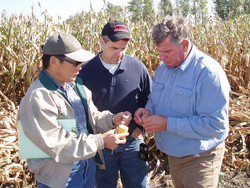 According to Cary Sifferath, USGC Senior Director in China, drought conditions in China this year have led to high corn prices. “Those high prices have led to some opportunities for US feed grains products, specifically distillers dried grains (DDGS) products from the US ethanol industry,” Cary said. “We had roughly 8,000 metric tons of DDGS that was exported from the US into China and right now for 2009 we can easily predict 250,000 to 300,000 tons of distillers dried grains being imported by China’s feed and livestock industry, especially in the southern and coastal areas of China where DDGS has become a very competitive feed ingredient.”