Obama to Slash Gov’t GHGs by 28%

Joanna Schroeder

For those of you who still have President Obama’s State of the Union speech in your mind, then you may remember his call for the government to slash greenhouse gas emissions (GHG). He has followed through. Less than a week after the pronouncement, Obama has issued an Executive Order 13514 on Federal Sustainability for the federal government to slash GHG emissions 28 percent by 2020.

According to the White House, the federal government, which includes all of our armed forces, is the largest energy user in the U.S. The 28% reduction would decrease annual electricity use by 1.5% saving between $8 – $11 billion in energy costs through 2020. Just in 2008, the federal government racked up a $24.5 billion energy bill.

“As the largest energy consumer in the United States, we have a responsibility to American citizens to reduce our energy use and become more efficient,” said Obama as quoted in an article in Recharge. “Our goal is to lower costs, reduce pollution, and shift Federal energy expenses away from oil and towards local, clean energy.”

This goal will require the government to shift to clean energy sources such as solar, wind and geothermal, which will support job growth and technology development in the clean tech sector – another major goal of the administration. This move also signals Obama’s commitment to passing a comprehensive climate change package, which is currently stalled in the Senate.

In the meantime, departments will be required to develop sustainability plans that will include current GHG emission estimates and to ensure follow-through, achievement reports will be published online for the public to view and submit reponses.


Energy, Environment, Geothermal, global warming, politics, Solar, Wind

Verenium and BP Extend Agreement

Cindy Zimmerman

Verenium and BP are extending their joint development contract for another month as they continue more long term negotiations in the partnership to develop and commercialize cellulosic ethanol.

VereniumBPThe two companies have extended the initial 18-month joint development program established in August 2008, which was scheduled today until March 1, 2010.
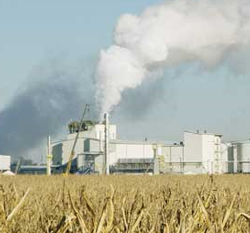
BP and Verenium will continue their ongoing joint development work to accelerate the development and commercialization of cellulosic ethanol, while the two parties continue to negotiate the terms of a multi-year extension of their collaboration program. Verenium will receive an additional $2.5 million from BP to co-fund various scientific and technical initiatives for the month of February.

Cellulosic, Ethanol, Ethanol News

Another Record Month for Ethanol Production

Cindy Zimmerman

November set yet another record for ethanol production in the United States.

According to the latest figures from the Energy Information Administration (EIA), U.S. ethanol production hit a record high in November 2009 of 761,000 barrels per day (b/d). That is a 93,000 barrel increase from the previous year.

Ethanol demand, as calculated by the Renewable Fuels Association, also reached an all time high at 781,000 b/d in November, up from 683,000 b/d a year ago. Ethanol demand is averaging 702,000 b/d through November.

EIA also reports fuel ethanol imports of 12 million gallons in September.

Ethanol, Ethanol News, RFA

Railroad to Run Hydrogen Locomotive in California

John Davis

A railroad will run one of its locomotives on hydrogen.

This article in the Orange County (CA) Register says the Burlington Northern Santa Fe will use the first locomotive powered by hydrogen-fuel cells:

Trains powered by hydrogen instead of diesel fuel could help solve two problems, officials said – provide an alternative to increasingly scarce fuel supplies and prevent millions of tons of carbon from being released into the environment.

The hydrogen-fuel train is a switch locomotive that moves train cars short distances and from track to track. It will initially operate in Los Angeles. The company plans to continue developing the technology, with the hope of eventually pulling entire freight trains through the region.

California Governor Arnold Schwarzenegger calls it “the beginning steps of the technology.”

Hydrogen

E. coli to Help Brew Biodiesel

John Davis

A group of federal researchers has figured out how to better extract biodiesel from biomass using a microbe that most of us try to avoid in our food.

The U.S. Department of Energy’s Joint BioEnergy Institute (JBEI) has announced that researchers have engineered a strain of E. coli bacteria that can extract an advanced biodiesel directly from biomass:

“The fact that our microbes can produce a diesel fuel directly from biomass with no additional chemical modifications is exciting and important,” says Jay Keasling, the Chief Executive Officer for JBEI, and a leading scientific authority on synthetic biology. “Given that the costs of recovering biodiesel are nowhere near the costs required to distill ethanol, we believe our results can significantly contribute to the ultimate goal of producing scalable and cost effective advanced biofuels and renewable chemicals.”

E. coli is a well-studied microorganism whose natural ability to synthesize fatty acids and exceptional amenability to genetic manipulation make it an ideal target for biofuels research. The combination of E. coli with new biochemical reactions realized through synthetic biology, enabled Keasling, [Eric Steen, a member of the team from JBEI’s Fuels Synthesis Division] and their colleagues to produce structurally tailored fatty esters (biodiesel), alcohols and waxes directly from simple sugars.

“Biosynthesis of microbial fatty acids produces fatty acids bound to a carrier protein, the accumulation of which inhibits the making of additional fatty acids,” Steen says. “Normally E. coli doesn’t waste energy making excess fat, but by cleaving fatty acids from their carrier proteins, we’re able to unlock the natural regulation and make an abundance of fatty acids that can be converted into a number of valuable products. Further, we engineered our E. coli to no longer eat fatty acids or use them for energy.”

The researchers point out that using E. coli to convert biomass into biodiesel will eliminate a food source from the fuel chain.

Biodiesel, biomass, Government

Grassley Looks for Biodiesel Credit Renewal in Feb.

John Davis

One of the biggest advocates for renewal of the $1-a-gallon federal biodiesel blender’s tax incentive looks for renewal of the credit sometime next month.

Agriculture.com reports that Iowa Senator Chuck Grassley has been working with the Chairman of the Senate Finance Committee, Max Baucus to get it restored very soon:

“It would be my hope that we would have this to the president by the week we take off for town meeting recesses — president’s holiday,” he told Agriculture.com on Tuesday.

Late last year the House of Representatives passed a bill extending several tax credits, including the $1-a-gallon biodiesel credit that helps make the soybean-based fuel competitive with diesel. But the Senate, unable to reach an agreement on the federal estate tax, failed to renew the biodiesel tax credit which expired at the end of 2009.

Grassley, of Iowa, is the top ranking Republican on the Finance Committee and seems to have a good working relationship with Baucus, a conservative Democrat from Montana.

Later, Grassley’s press aide, Beth Levine, said in an e-mail message that “Senator Grassley had a long discussion with Senator Baucus about tax extenders, and in particular about the necessity of extending the biodiesel tax credit.

Fellow Iowan Senator Tom Harkin, a Democrat, blames the delay on the Republicans. However, most Washington observers agree that the Senate was too busy debating the unpopular health care bill to get to the biodiesel tax credit. Harkin thinks it could get done by the end of February, but he’s not sure.

Biodiesel, Government, Legislation

DF Cast: Ethanol, Biodiesel Industries Optimistic on 2010

John Davis

The new year brings in new hope, and it’s no different for the ethanol and biodiesel industries in this country.

You couldn’t blame the folks who make biofuels in the U.S. if they just wanted to forget about 2009 … especially when you consider the fights over food versus fuel, delays of regulatory implementations that would have helped both ethanol and biodiesel, indirect land use issues, and to cap it off, the loss of the $1-a-gallon federal biodiesel blender’s tax incentive.

Renewable Fuels Association LogoBut, as I said, a new year brings new hope, and the people who represent ethanol and biodiesel in this country, are hopeful they’ll see a new Renewable Fuels Standard (RFS-2) soon, and the green fuels industries will bounce back.

In this edition of the Domestic Fuel Cast, listen in on my conversations with Tom Buis, the CEO of Growth Energy, a group representing America’s ethanol producers; the Renewable Fuels Association’s Matt Hartwig; and Joe Jobe, Chief Executive Officer of the National Biodiesel Board, as they discuss how they believe each of their respective industries moves forward in 2010.

[audio:http://www.zimmcomm.biz/domesticfuel/DFCast-1-29-10.mp3]
Audio, Biodiesel, biofuels, Domestic Fuel Cast, Ethanol, Ethanol News, News

Growth Energy Embraces Obama’s Job Focus

Joanna Schroeder

In general it appears that the biofuels industry is embracing President Obama’s focus on job creation in the clean tech sector. Today, Growth Energy not only applauded Obama’s plan for job creation, but also welcomed the words of Energy Secretary Stephen Chu. Today, Chu spoke about the importance of American energy independence during an appearance at the Washington DC Auto Show. Last week, Growth Energy announced a partnership with Ricardo to help improve fuel economy when using higher level blends of ethanol.

“Ethanol is an advanced technology fuel that has the potential to create hundreds of thousands of U.S. jobs, which as we heard in last night’s State of the Union address is a top priority of this Administration. And Secretary Chu’s speech today highlighted the importance of investing in renewable energy sources – like ethanol as a transportation fuel – as a means of both creating American jobs and strengthening America’s energy and national security,” said Tom Buis, CEO of Growth Energy.

Last year, Growth Energy filed a “Green Jobs Waiver” (or a waiver to increase the minium blend of ethanol from 10 percent to up to 15 percent) with the Environmental Protection Agency (EPA). While the EPA has deferred on making any regulations on E15, research is continuing and the industry could see some good news by early summer. In a letter to Growth Energy, the EPA noted that if the testing proved favorable, they were “prepared to approved the E15 Green Jobs Waiver by mid-year.” A national study by the Windmill Group, out of North Dakota, estimated that moving to E15 would create 136,000 jobs in the United States.

Ethanol, Growth Energy

Blendstar to Add Biofuel Terminal In Louisiana

Blendstar, LLC has announced the launch of a biofuel transload terminal to distribute ethanol and biodiesel in Bossier City, Louisiana, a suburb of Shreveport. The facility is expected to open late this month with capacity to serve the local market as well as future growth related to increased demand as a result of higher blends of biofuels in the U.S. fuel supply.

According to the Blendstar press release, fuel distributors in Northern Louisiana, Southern Arkansas and Eastern Texas will be able to obtain high-quality ethanol and biodiesel at the terminal, located on 4800 Viking Drive, Bossier City, LA. The Bossier City facility will be a common stock terminal with direct rail access via the Kansas City Southern Railroad and will offer rail to truck offload services, as well as customized services dependent on customer needs.

“We are committed to providing the most cost-effective access to biofuels to our customers so they in turn meet the demands of their customers,” said Matt Griswold, president of Blendstar, LLC. “With Bossier City and other strategic terminal locations across the Southern U.S., Blendstar is able to extend our ethanol and biodiesel offerings to improve blending efficiencies in numerous markets.”

With the addition of the Bossier City terminal, Blendstar will soon operate nine biofuel terminals in seven states. The Bossier City terminal will be open 24 hours, 7 days a week.

Biodiesel, biofuels, E85, Ethanol, Ethanol News

Students’ Biodiesel Processor to Help Haiti

John Davis

MotherMcAuleyA school in Chicago is finishing up a $3,000, solar-powered biodiesel processor that will be sent to Haiti.

This story from Chicago Public Radio says a team of 10 girls from the private, Catholic, all-girls Mother McAuley High School have put the processor together in hopes of sending it to the small town of Pichon, Haiti to provide the town with a way to make biodiesel using only solar power and to give the village’s school electricity for the first time:

Dr. Roz Iasillo says the processor was built to provide electricity for an elementary school and will produce nearly 48 gallons of biodiesel fuel.

IASILLO: With any development in developing countries it’s the small scale projects that are the most successful. So we see this as, you know, providing them the opportunity to run a small scale, micro lending type of process, where they can kind of jump start their economy.

The processor was to be shipped this April, but the massive earthquake has put that on hold.

Biodiesel