ACE Conference 2026

ZeaChem Successful in Cellulosic Fermentation Tests

Joanna Schroeder

ZeaChem released the results of its recent fermentation results of acetic acid, used in the conversion of biomass to biofuels. According to the company, the results demonstrated successful process scaling to a level that is 10,000 time greater than the standard scale used in lab tests. Fermentation units were scaled from 0.5 liter to 5,000 liters. Acetogens, which are naturally occurring, are highly robust and unlike yeast, produce no carbon dioxide during the fermentation process.
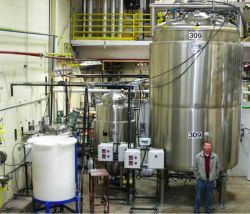
A ZeaChem Inc. engineer stands in front of a 5,000 liter fermentation tank at Hazen Research, Inc

The company has been collaborating with Golden Colorado-based Hazen Research on the tests. Hazen constructed and hosted the initial front-end process unit and provided the infrastructure and operational support. The initial test exceeded ZeaChem’s time goals for achieving the concentration level, greater than 50 grams of acetic acid per liter in less than 100 hours, as well as exceeded commercial acceptable acetic concentration levels.

“ZeaChem has met and exceeded its concentration and rate fermentation targets,” said Jim Imbler, president and chief executive officer of ZeaChem. “We now have sufficient evidence, based on mixed sugars, to indicate that our results are scalable to industrial production levels. Our process, using naturally-occurring acetogen bacteria and existing processes, exceeds the commercially viable threshold for fermentation. ZeaChem is meeting its milestones and continuing to move forward in deploying cellulosic biorefinery technology.”

Acetic acid is the first step in the hybrid biochemical and thermochemical process for creating cellulosic ethanol and bio-based chemicals, and the company’s next step is to concentrate and purify the ZeaChem produced acetic acid into a salable product, using an energy efficient, non-distillation based process. The company plans on building a 250,000 gallon per year facility in Boardman, Oregon and anticipates that the facility will be in production by the end of 2010.

Cellulosic, Company Announcement, Ethanol

Retech 2010 Kicks Off in DC

Joanna Schroeder

Retech 2010, the Renewable Energy Technology Conference and Exhibition, kicks off in Washington, DC tomorrow. The conference is co-produced by the American Council On Renewable Energy (ACORE) and TradeFair Group. Nearly 300 exhibitors from all sectors of renewable energy are expected to participate.

In addition to the exhibition, there is a Business Conference that will feature more than 250 speakers sharing their insights and knowledge about alternative energy. There are several parallel tracks that will be held during the three days with concentrations on core areas including geothermal, wind, solar, hydro, biomass, biofuels, and waste energy. Additional hot topics encompass the  challenges and opportunities in the green electricity and green building sectors along with industry leaders discussing the innovative, comprehensive and entrepreneurial strategies that will be needed to ensure the sustained growth of the renewable energy industry.

Poet CEO Jeff Broin will discuss ethanol’s impacts during the opening plenary session on Wednesday along with Carol Browner, Assistant to the President for Energy and Climate Change as well as other leaders in the energy and the environmental arena. In addition, Doug Berven, Poet’s Director of Corporate Affairs, will also be speaking and is part of the panel discussion “Research and Development: Conventional Biofuels” to be held on Friday.

Click here to learn more about Retech 2010.

conferences, Energy

Evogene Researching Castor Bean for Biofuels

Joanna Schroeder

There is no shortage of potential feedstocks for biofuels and yesterday, Evogene Ltd based in Rehovot, Israel announced that it will be conducting field trials in Texas and Brazil of its proprietary castor bean lines. The trials will be conducted in conjunction with Texas AgriLife Research in Texas, which is part of the Texas A&M System, and South Cone Agriculture in Brazil. This is the first round of trials outside of Isreal and the castor beans have been designed for higher yield and growth on semi-arid land making it a candidate for second generation biofuel production.

According to Evogene, the purpose of the field trials in Texas and Brazil is to evaluate the lines when grown in the two main target locations for future commercial growth, and further develop them to local conditions. The semi-arid land potentially available for castor commercial growth in these areas is estimated at over 10 million hectares and the climate conditions are suitable for this purpose.

In a company statement, Ofer Haviv, Evogene’s President and CEO said, “During the past few years, in addition to our well-established and rapidly growing agbio trait activities, our biofuel activity has grown with the castor project being a key component. Both the U.S.A. and Brazil have strong potential in terms of land availability, commitment to biofuels and ability to develop large scale agriculture industries. We look forward to working with the professional teams at Texas AgriLife Research and South Cone Agriculture to test our castor lines and further develop them towards commercialization.”

Evogene selected castor beans in part due to the growing demand of biodiesel in Brazil and America, although the biodiesel industry in the U.S is currently undergoing some challenges with the expiration of its tax credit. The biodiesel industry is working furiously to get this, other other safe guards that will continue to move the industry forward, into place.

“There is an immediate need for a sustainable, widely available and cost efficient second-generation plant feedstock for biofuels. We believe that the castor bean varieties Evogene is developing can provide a solution for the industry,” concluded Haviv.

Biodiesel, biofuels, International, News

Biofueling Iowa’s Economy

Cindy Zimmerman

Renewable fuels are the backbone of Iowa’s economy, according to a report released last week by the Iowa Renewable Fuels Association (IRFA).

According to the report, “Contribution of the Biofuels Industry to the Economy of Iowa,” ethanol and biodiesel producers are part of a manufacturing sector that adds substantial value to agricultural commodities produced in Iowa and makes a significant contribution to the state’s economy.

* Accounts for nearly $11.5 billion, or about 8 percent, to Iowa GDP
* Generates $2.3 billion of household income for Iowa households
* Supports more than 70,000 jobs through the entire Iowa economy
* Boosts state tax revenue by $532 million.

“That is an awesome success story,” said IRFA Executive Director Monte Shaw in his address at the 4th Annual Iowa Renewable Summit. “At the same time, we must not rest on our laurels. Iowa and the nation must move quickly to realize the full promise renewable fuels represent.”

Shaw says that means approving ethanol blends up to 15 percent nationwide and for Iowa, urging the Iowa legislature to enact an E10 Fuel Quality Standard so that all gasoline in the state would contain at least 10 percent ethanol. “Why shouldn’t Iowa say that E0 poses too high a cost to our economy and our energy independence? Shouldn’t Iowa lead the way to make E10 the standard fuel with E15 available for those who choose it?” Shaw questioned.

Shaw also called on Congress to restore the federal blenders tax credit for biodiesel and for EPA to implement the federal RFS2 biodiesel usage requirement. “If we can couple those two federal actions with a B5 fuel quality standard here in Iowa, it will go a long way toward restarting Iowa’s 15 biodiesel plants,” he said.

Biodiesel, biofuels, Ethanol, Ethanol News

Tennessee Cellulosic Ethanol Demo Plant Opens

Cindy Zimmerman

Leaders from DuPont Danisco Cellulosic Ethanol (DDCE), University of Tennessee and Genera Energy gathered on Friday in Vonore, Tennessee to cut the ribbon on a new cellulosic ethanol demonstration facility. The 74,000-square-foot plant has now started producing ethanol from agricultural residue and bioenergy crops, including corncobs and switchgrass.

During the grand opening celebration, Kelly Tiller, CEO of Genera Energy and director of external operations for the UT Office of Bioenergy Programs, said, “The University of Tennessee Biofuels Initiative is the only fully integrated program that is working with farmers and agricultural industry to reliably supply the necessary feedstock so biorefineries can produce plentiful, affordable, renewable and sustainable fuels.” She said plans are for Tennessee farmers to place an additional 4,000 acres of switchgrass into production this spring, bringing the total production in the state to nearly 7,000 acres of the dedicated energy crop.

The state-of-the-art facility in Vonore has capacity to produce 250,000 gallons of ethanol annually, though its focus is on optimizing technologies for large-scale production.

Cellulosic, Ethanol, Ethanol News

US Gas Consumption Down, Biofuels Replacing Oil

John Davis

Three years ago, petroleum-based gasoline consumption was the highest the U.S. had ever seen. But thanks in part to biofuels, including biodiesel and ethanol, the amount of gas we use has actually gone down since the peak of 2007.

This article in the Kansas City Star says that while the recession and the increased popularity of smaller, more fuel efficient vehicles has helped cut petroleum use, alternative fuels have done their part and will cover any expected increases in fuel use. And by 2035, American motorists are expected to use less gasoline than they do now:

“We’re on a slow but inexorable path away from petroleum. This is a big deal,” said James Williams, an analyst with WTRG Economics, an oil and gas consultancy.

That decline is reverberating through the oil industry. Refineries now use only 78.5 percent of their capacity, the lowest level since the federal government began routinely collecting the information in 1990. Valero Energy, which once bought refineries enthusiastically, now snaps up ethanol plants instead…

Federal tax incentives for ethanol, though widely criticized, have helped increase production from less than 1 billion gallons in 1992 to 10.5 billion last year. That reduces by 5 percent the amount of gas the country needs.

The article goes on to say that the Energy Information Administration believes that in the next 25 years, petroleum will still account for 88 percent of the fuel for cars and light trucks with the rest coming from mostly ethanol, followed by electricity, natural gas, hydrogen and propane. And some experts believe that alternative fuels could grow even faster if the right infrastructure is put in place.

Biodiesel, biofuels, Ethanol, Ethanol News, News

Book Review – Break Through

Joanna Schroeder

How many people agree with the statement, “We should not leave the solution to our environmental issues to environmentalists.” Two proponents of this idea are Ted Nordhaus and Michael Shellenbeger with the Break Through Institute and author of a book by the same name, “Break Through: Why We Can’t Leave Solving the Planet to Environmentalists.”

They write, “In the end, it is the global ecological crisis themselves that have triggered the death of environmentalism. For us to make sense of them, the category of “the environment” – along with the ancient story of humankind’s fall from nature – is no longer useful. The challenge of climate change is so massive, so global, and so complex that it can be overcome only if we look beyond the issue categories of the past and embrace a grand new vision for the future.”

They continue by arguing that before a new vision can be realized we must first ask, “What kind of beings are we? and What can we become?” And this is what they set out to answer; however, along the journey, I lost interest and barely held out long enough to discover the answer to these questions.

Right now, many people who read the book are thinking (or will write me) you didn’t get it. No, I got it. In fact, the answers are philosophical, engaging, well thought out, and have extreme merit. But the truth is, I like to be entertained when I read, even if it’s a nonfiction or business book, and this book felt like I was back in philosophy class in college (and for me that was one and done). Yet the philosophical arguments they lay out adeptly get us thinking into a new thought paradigm. We should no longer think about how the world can work together to solve global warming in the traditional sense of’ ‘environmentalism,’ but we must realize that true results will come when we understand that the solution to the problem lies in the intersection between ecological concern and global prosperity.

book reviews, Environment

Dow Showcasing Biodiesel Solutions at NBB Conference

John Davis

Just another reason for you to attend this year’s National Biodiesel Conference & Expo!

Dow Water & Process Solutions, a branch of Dow Chemical Company, will present its portfolio of solutions it picked up in its acquisition of Rohm and Haas to include biodiesel capabilities during next week’s conference in Grapevine, Texas. Stop by booth #1005 to talk to experts from Dow Water & Process Solutions, who will provide in-depth analysis and best practices around the following world-class and cost-effective biodiesel solutions:

§ DOW AMBERLYST™ BD20 solid catalyst FFA esterification technology offers biodiesel producers the flexibility to produce biodiesel from inexpensive low-quality feedstocks without sacrificing the purity needed in the end product.

§ DOW AMBERSEP™ BD19WET feedstock purification technology, a pretreatment step specially designed to be used together with DOW AMBERLYST™ BD20 catalyst technology, extends life time and improves the operability of the downstream process.

§ DOW AMBERLITE BD10DRY™ technology, a simple and cost-effective solution for biodiesel purification designed to maximize process yield.

§ DOW AMBERSEP BD19DRY™ adsorbent resin was developed exclusively to remove monoglycerides, sterol glucosides and soaps from the final biodiesel stream in one simplified process, eliminating poor cold temperature performance of biodiesel including failure to pass cold soak filtration testing.

More information is available here.

Biodiesel, Biodiesel Conference, NBB

Shell to Partner with Cosan to Produce Ethanol

Joanna Schroeder

Another major oil company has entered the Brazilian ethanol market – Shell. According to Brazilian newspaper Valor Econômico, Shell and Cosan S.A., Brazil’s largest producer of ethanol, signed a Memorandum of Understanding. Moving forward, the two companies hope to create several new joint ventures to the tune of $12 billion that will produce sugar-based ethanol as well as electricity and focus on retail distribution.

According to Green Car Congress, Cosan is the third largest sugar producer in the world, fifth largest ethanol producer in the world and the largest ethanol exporter in the world. Cosan owns and operates 23 ethanol plants.

In an article in the Financial Times, Mark Williams, Shell’s Director of downstream operations said, “Cosan represents the best entry to sustainable biofuels in the market – the best entry of scale…we will take the lowest-carbon, least-impact form of ethanol and leverage that into a worldwide opportunity.”

There are currently trade barriers in the form of a 54 cent tariff on Brazilian ethanol entering the U.S. marketplace, and another current barrier to “worldwide exports” was created when the country reduced is mandatory ethanol blend to 20 percent, down from 25 percent. The temporary mandate was put in place in response to a smaller sugarcane harvest than expected due to excessive rain.

This action, in conjunction with the public call for “Brazilian ethanol” from many politicians and citizens alike spurred Growth Energy‘s CEO Tom Buis to respond, “This is the perfect illustration of why it makes no sense to become dependent on any foreign source of energy – whether it’s Middle East oil or Brazilian sugarcane ethanol. Between high sugar prices and a sugarcane crop shortage, Brazil can’t meet its own ethanol needs – let alone the ethanol needs of the United States.”

“Yet time and time again we hear from critics of American ethanol that Brazilian ethanol is the solution…We can produce more than enough ethanol in this country using domestic feedstock, and we should. It makes no sense to replace our dependence on foreign oil with a dependence on foreign ethanol, especially if it forces job losses and would drive up prices if Brazil has another sugarcane crop shortage,” concluded Buis.

Ethanol, Growth Energy, International

MO Alt Fuel Tax Credit Now Defined

Missouri’s alternative fuel infrastructure tax credit is now defined easily in a website sponsored by the Department of Natural Resources (DNR). Retailers can take advantage of this credit in the taxable years between Jan. 1, 2009 and Jan. 1, 2012.

The Missouri tax credit is allowable on top of the income tax credit offered by the Federal Government in the amount of 50 percent up to $50,000 of the total cost of the project. Qualifying retailers can receive a state tax credit of 20 percent up to $20,000 of the total cost of the project. According to the website, DNR states that the cumulative amount of tax credits which may be filed for by eligible applicants claiming all credits authorized will not exceed the following amounts:

In taxable year 2009 – $3 million.
In taxable year 2010 – $2 million.
In taxable year 2011 – $1 million.

Desiring applicants must supply an application to MO DNR where they will review and certify eligibility. The application can be found by clicking here. A complete description of the MO alternative fuel tax credit rules can be found by going to: http://dnr.mo.gov/pubs/pub2382.pdf.

Biodiesel, E85, Equipment, Ethanol, Ethanol News, News