Biodiesel-Powered Ford Truck to Get More Powerful

John Davis

After announcing its 2011 Ford F-Series Super Duty truck will be compatible with B20 (see my post from Feb. 26, 2010), it looks like the auto maker now wants it to be the most powerful in its class.

This post from PickupTrucks.com says Ford is about ready to power-up its all-new 6.7-liter Power Stroke V-8 diesel engine to best GM’s 6.6-liter Duramax V-8 diesel in terms of power:

In February, Ford announced the 6.7-liter Power Stroke V-8 for its 2011 Ford F-Series Super Duty will pound out 390 horsepower and 735 pounds-feet of torque; earlier this month, GM announced that its 6.6-liter Duramax V-8 diesel for the 2011 Chevrolet Silverado and GMC Sierra HD pickups will make 397 hp and 765 pounds-feet of torque.

According to our sources, Ford isn’t about to settle for second place.

The 6.7-liter PSD is a clean-sheet design with lots of headroom for higher power settings, while the 6.6-liter Duramax is based on a legacy architecture that’s right at the limit of its performance envelope.

Bragging rights in the heavy-duty segment are critical because almost every truck is used for towing and hauling on a regular basis. More power can mean greater confidence in moving big loads.

The article goes on to say that Ford’s 6.7-liter V-8 could jump to 400 hp and over 775 pounds-feet of torque. The best news is that those who bought the lower-rated Ford could still get the jump in power through a reflash of the software in the engine control unit.

Biodiesel, Car Makers

Biodiesel Incentive to Wait At Least Until Mid-April

John Davis

Although it has a broad base of support across the country (unlike a certain health care measure that 60+ percent of Americans don’t favor), renewal of the federal $1-a-gallon biodiesel tax incentive seems that it will have to wait at least a month at the earliest before Congress will get to it.

This article from Reuters says with Congressional recesses coming up, the measure is unlikely to see any action until at least the middle of next month:

While the House and Senate have passed bills to renew the credit for 2010, they must agree on a common text to send to the president. “Neither the House or Senate has signaled any particulars on how they will do that,” said Michael Frohlich of the National Biodiesel Board, a trade group.

The tax credit is one provision in a $149 billion bill focused on job creation and extension of tax incentives.

A resolution is unlikely before mid-April, said two biofuels officials. Congress soon will recess until April 13, they noted, and a final vote on the credit could be delayed until late April or later, depending on the pace of House-Senate negotiations.

So, instead of moving quickly on a bill that is projected to save 23,000 jobs that have been or are being lost by the biodiesel industry because of the loss of the credit, we have lawmakers in D.C. staying up late on a Sunday night to pass a bill (healthcare) that has only about one-third of the country’s support. Maybe they should have nick-named the measure the “Biodiesel Health Bill.”

Biodiesel, Government, Legislation

NY Senator Supports Biodiesel Not Ethanol

Cindy Zimmerman

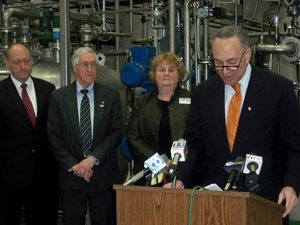
U.S. Senator Chuck Schumer (NY-D) visited New York’s only commercial biodiesel producer last month to assure them of his support for the federal tax incentive for biodiesel.

“The dollar tax incentive assures us that we are competitive with regular diesel fuel right now. The federal government subsidizes the petroleum industry as well, so if we lose our incentive, we lose our competitive advantage over the regular fuel,” said Schumer during a stop at Northern Biodiesel on February 19.

However, while Sen. Schumer supports biodiesel, he opposes corn ethanol. Informa Economics reports that Schumer sent a letter to a constituent outlining his concerns, saying that “corn ethanol provides no environmental, economic, or security benefit over petroleum, and it raises serious ethical concerns about our obligations towards our neighbors.” At the same time, Schumer does support the development of cellulosic ethanol, saying production does “have the potential to protect the environment and reduce America’s dependence on foreign oil, without putting strains on American agriculture or other countries’ food supplies.”

Schumer’s letter prompted officials with Western New York Energy (WNYE) to write him a letter and set the record on corn ethanol straight.

“Rather than pointing out the inconsistency in your ethanol and biodiesel positions, we wanted to take this opportunity to provide you with more current information about America’s ethanol industry in the hopes that you will revisit your position,” wrote plant owners John and Michael Sawyer. They are planning to contact the senator’s office to set up a tour of their 55 million gallon per year plant located in Medina, NY which was the first ethanol plant built in the northeast United States and is a member of the Renewable Fuels Association.

Biodiesel, Ethanol, Ethanol News, Government, RFA

Kinder Morgan Inks NJ Biodiesel Terminal Deal

John Davis

Kinder Morgan, one of the nation’s pioneers in biofuels by pipeline development, has signed a 30-year deal with Carteret, New Jersey to turn 14 acres of brownfields into a biodiesel storage and processing facility.

This article from NJToday.net says the project will have connections to some regional pipelines:

Adjacent to Kinder Morgan’s existing facilities, the project will make use of property formerly used for truck maintenance, calling for additional blending and storage units, and allowing for 1,035,000 million gallons of biodiesel storage and processing. Ultimately the project will provide new connections to SUN, Colonial, and Buckeye regional pipelines.

Kinder Morgan’s proposal was first presented to the borough in 2008, and received initial Planning Board approval on Jan. 27.

The agreement will offer many benefits to both the town and Kinder Morgan, according to [Carteret Mayor Dan] Reiman…

“The numbers are certainly impressive but the foremost benefit will be to our homeowners and workforce,” Reiman stated. “We’ve put a strong emphasis on unionized labor in this agreement as with all of our capital improvement projects, and are pleased to announce that 100% of the non-specialized construction labor involved with this project will come from New Jersey unions. This is in addition to the 250 private-sector jobs that will be created upon the facility’s completion.”

Got to love that. Clean up a brownfield, provide green energy AND jobs to an economy that really needs a boost right now. That’s what you call a REAL stimulus package.

Biodiesel

NBB: Biodiesel Supports World Water Day

John Davis

Today is World Water Day, and the National Biodiesel Board is tapping into the environmental day of recognition to illustrate just how water-thrifty the renewable fuel really is.

In an NBB piece, the group’s sustainability folks point out that fresh water is helped along by biodiesel’s green nature:

By switching to renewable fuels, like biodiesel, we help ensure future access to energy and future access to clean, fresh water. For every unit of energy put into producing biodiesel, 4.5 units of renewable solar energy are stored in the usable form of liquid fuel. Biodiesel is the best way to store energy from the sun in a dense, liquid fuel for transportation uses, but it can also be used as a renewable fuel for stationary uses such as the Thames Water Desalination Plant in London. This plant will use biodiesel from recycled fat and oil from London restaurants and households to provide water for one million people.

We must also protect our water resources by minimizing pollution. Biodiesel production reduces wastewater by 78 percent and reduces hazardous waste production by 96 percent compared to producing petroleum diesel. These numbers are based on the entire lifecycle of the fuel. The conversion of fats and oil to biodiesel uses very little water, and can be done consuming no water at all, if necessary. The year 2008 was a record year for biodiesel production in the US. Even during that record production, the entire US industry used less water than a handful of golf courses use to water their lawn. In the context of our societal uses of water and the benefit it brings, biodiesel production represents a very meager use of water.

And since it is nontoxic and biodegradable, biodiesel isn’t the threat to the environment that petroleum is. Seriously, when was the last time you saw a picture of a duck or an otter struggling through a biodiesel slick in some previously pristine bay?

Biodiesel, NBB

Acres for Biodiesel, Ethanol Feedstocks to be Big

John Davis

If the biodiesel makers ever get the $1-a-gallon federal tax credit back, the industry could have plenty of feedstock for the green fuel come fall.

This Bloomberg article posted in the Wichita (KS) Eagle
says U.S. farmers are expected to plant their largest soybean crop this year:

Soybean plantings will rise 2.1 percent to 79.111 million acres from a record 77.451 million last year, Allendale said today in its 21st annual survey of farmers. Production will total 3.338 billion bushels, down from 3.359 billion last year, the biggest crop ever, based on a projected national yield of 42.7 bushels an acre.

With a little luck, those biodiesel brewers will be able to take advantage of the big crop (despite it being a bit lower than last year) with lower commodity prices.

Another biofuel that could end up benefiting from farmers’ efforts would be ethanol. Bloomberg is expecting that green fuel’s main feedstock, corn, to have the second-biggest area planted since World War II and a projected record yield of 13.243 billion bushels.

Biodiesel, Ethanol, Ethanol News, News, Soybeans

Wind Power Faces New, Tough Opponent in US Military

John Davis

Wind energy has faced some opposition, mostly against people who are afraid their oceanfront views will be obscured by windmills seven miles offshore, but now it has a pretty tough opponent in the U.S. military.

This article from BiofuelsWatch.com says the military is raising concerns about wind farms disrupting military radar arrays:

The primary military concern about wind farm development stems from the fact that in order to maintain adequate efficiency wind farms must operate at least 80 to 100 feed in the air, with the higher the placement the more efficient the turbines can operate due to the “cleaner” wind streams. RADAR detection, however, generally begins at roughly 50 feet, thus any wind turbines present would potentially block any RADAR signals by bouncing back signal waves with their blades and create an effective “dead zone” on the opposite side of the turbine from the RADAR emitter.

Experts say the issue could, at best, delay some projects or, at worst, cancel individual wind turbines … and even bring about a whole new set of regulations.

Wind

Green Energy Benefits from Recession

John Davis

While parts of the renewable energy sector have had some tough times lately … biodiesel with the loss of the federal tax credit, ethanol with the food vs. fuel fight, the economic downturn and the tightening of the credit markets … it seems green energy has actually benefitted from the recession. Well, at least in the area of new ideas.

The Financial Times has details:

Not only did the funding model for much of the US renewable energy industry put the sector within a whisker of being dragged down in Wall Street’s wake, but the general economic climate also threatened to put numerous projects on hold.

But clean tech patents – admittedly only a rough indicator of industry sentiment – suggests a more confident picture. US patent filings for clean energy rose to their highest-ever level in the last three months of 2009, according to a report from consultancy Cleantech Group and intellectual property lawyers Heslin Rothenberg Farley & Mesiti:

U.S. patents for clean-energy technologies in 2009 were at an all time high with 200 more patents than 2008 at 1125.

… patents in fuel cells and hybrid/electric vehicles were each up over twenty percent over 2008 with solar patents up sixty percent and biomass/biofuel energy patents up two hundred sixty percent. Fuel Cells, wind, and biomass/biofuel energy patents were also at all time highs in 2009. In contrast, hydroelectric and tidal patents decreased in 2009 while geothermal patents were up only one patent over the year prior.

The article goes on to point out that while Silicon Valley is usually known for its venture capitalists going green, the real growth in renewable energy is being fueled by what’s happening in Detroit, with fuel cells dominating the conversation … four times the number of patents as closest competition wind and solar … and Honda, GM and Toyota are speaking the loudest.

Car Makers, Solar, Wind

Biggest Biodiesel Plant in Canada to Start Construction

John Davis

When it’s finished, it will produce nearly twice as much biodiesel as the entire country of Canada produces now and will supply our friends to the north with one-fourth of their increasing national demand by 2012.

The Edmonton Journal reports that the Bio-Street plant in Vegreville will begin construction later this year … just in time for Canada’s 2 percent biodiesel mandate to kick in in two years:

“With these federal standards, that means there will be a demand for one billion litres. And some provinces are going further, with B.C. requiring five per cent biodiesel by 2012,” vice-president Angela Reid told the Resource Industry Suppliers Association on Thursday.

“Our plant will produce 225 million litres, and will also produce canola meal, glycerine and potassium fertilizer.”

Currently, Canada produces less than 150 million litres of biodiesel each year, with the rest coming from U.S. suppliers, which largely use soybeans rather than canola.

BioStreet has 34 hectares of land, and after 18 months of waiting expects provincial and federal regulatory approvals within weeks.

Groundbreaking for the plant will begin sometime after this summer.

Biodiesel

New Ethanol Blender Pump Introduced

Cindy Zimmerman

Now that Underwriters Laboratory has approved the use of certain pump dispenser models for mid-level ethanol, the door is open for manufacturers to begin marketing them more aggressively.

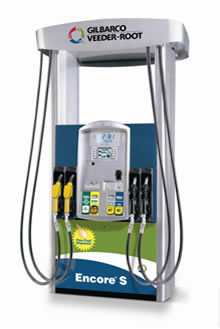
This week, Gilbarco Veeder-Root announced the release of a new dispenser in the Encore® S fuel dispenser product line that offers four fuel products at the same fueling position – regular unleaded, premium unleaded, a mid-level ethanol blend and E85.

Underwriters Laboratories (UL) and the National Conference on Weights and Measures have approved 19 other Gilbarco Encore S and Encore 300 flexible fuel dispenser models for use with Ethanol blends up to E25, giving retailers maximum choice and flexibility.

“Retailers are requesting products that provide flexibility in the fuel choices they can offer their customers. Increasing consumer demand for ethanol based fuels, combined with incentive programs to encourage the development of an infrastructure to deliver these fuels, are helping to create demand for a range of products,“ said Chad Johnson, product manager at Gilbarco Veeder-Root and a board member for Growth Energy. “The Encore series flexible fuel dispensers help retailers meet demand for higher Ethanol fuel blends and offer the opportunity to capture blender tax incentives as well.”

Find out more here.

blends, Ethanol, Growth Energy