 Just like a year ago, proponents of biodiesel and ethanol must be wondering if their green fuels were part of President Barack Obama’s “clean energy” comments in this year’s State of the Union address. Meanwhile, solar, nuclear and electric vehicle advocates have to be feeling pretty good about themselves as they received specific shout-outs during the hour-long speech.
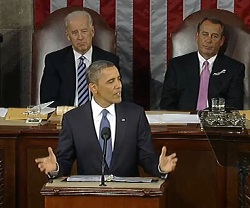
Appearing before a joint session of Congress (and what seemed like a much more collegial environment), Obama outlined in very broad, non-specific terms, such as “clean energy,” “renewable energy,” and “biofuels,” his vision for the future of alternative energy:
We’ll invest in biomedical research, information technology, and especially clean energy technology – an investment that will strengthen our security, protect our planet, and create countless new jobs for our people.
Already, we are seeing the promise of renewable energy. Robert and Gary Allen are brothers who run a small Michigan roofing company. After September 11th, they volunteered their best roofers to help repair the Pentagon. But half of their factory went unused, and the recession hit them hard.
Today, with the help of a government loan, that empty space is being used to manufacture solar shingles that are being sold all across the country. In Robert’s words, “We reinvented ourselves.”
That’s what Americans have done for over two hundred years: reinvented ourselves. And to spur on more success stories like the Allen Brothers, we’ve begun to reinvent our energy policy. We’re not just handing out money. We’re issuing a challenge. We’re telling America’s scientists and engineers that if they assemble teams of the best minds in their fields, and focus on the hardest problems in clean energy, we’ll fund the Apollo Projects of our time.
At the California Institute of Technology, they’re developing a way to turn sunlight and water into fuel for our cars. At Oak Ridge National Laboratory, they’re using supercomputers to get a lot more power out of our nuclear facilities. With more research and incentives, we can break our dependence on oil with biofuels, and become the first country to have 1 million electric vehicles on the road by 2015.
The President also set a new energy goal: getting 80 percent of this nation’s electricity from clean energy sources by the year 2035, and he proposes using wind, solar, nuclear, coal and natural gas … all renewable energy sources … to get to that number. He says we can pay for this by cutting the billions of taxpayer dollars now going to the big oil companies.


 At the
 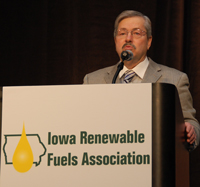 Proof of the industry’s importance to the state was the appearance of Iowa Governor Terry Branstad at the summit. It was not the first time that Branstad attended the conference. “I’ve been here in the audience in the past,” said Branstad. “This is the fifth and I’ve been to two or three of them.”

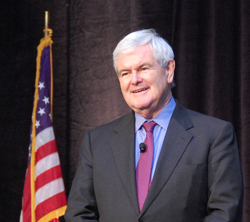 If it were up to the Iowa renewable fuels industry, Newt Gingrich would probably be elected the next president of the United States.