ACE Conference 2026

KiOR Lands DOE Loan Guarantee Promise

Joanna Schroeder

KiOR, Inc. has a $1 billion biofuels project in the works that will convert wood biomass into drop-in biofuels such as gasoline and diesel fuel. Today the company announced that it has received a term sheet for a DOE loan guarantee to help financially support the project. KiOR’s project under the DOE loan guarantee program will consist of four biorefineries that when complete, will contribute approximately 250 million gallons of cellulosic biofuel to the Renewable Fuel Standard (RFS2), which allows up to 16 billion gallons of the total 36 billion to be cellulosic biofuels by 2022. The first two plants are expected to be in Mississippi, with additional sites planned in Georgia and Texas.

“We are pleased to work with the DOE on reaching this milestone and are excited about the scale and impact of the project,” said Fred Cannon, President and CEO of KiOR, based in Pasadena, Texas. “The project’s first facility, planned in Newton, Mississippi, is expected to be the largest cellulosic biofuels facility in the United States. Additionally, the project will have a significant impact on rural communities through the creation of direct, indirect and induced jobs, with over 14,000 jobs created during construction and over 4,000 jobs created during operations.”

Cannon continued, “The project also expects to reduce greenhouse gas lifecycle emissions by over 70% as compared to fossil-derived gasoline and diesel fuels. While the term sheet is an important step in the process, we recognize that more work lies ahead to finalize the loan guarantee and there is no assurance it will be issued until the loan is closed.”

Khosla Ventures is a current investor in the project and in a recent article noted that “paper mill compatible woodchips” per ton prices will decline quickly in the U.S. as the “ecosystem and cultivation of alternative ‘fuels grade biomass’ (which does not need to meet paper mill feedstock quality metrics) develops within five years.”

Mississippi Gov. Haley Barbour is excited to have KiOR in the state for many reasons, one being that the paper mill industry has seen a significant decline in jobs over the past few years and the biofuels plants will bring jobs back to the region.

“Last year Mississippi realized the tremendous potential of the KiOR technology and made a decision to bring it to our state,” said Gov. Barbour. “We’re excited the U.S. Department of Energy has come to the same conclusion to support this one-billion-plus dollar project to speed up the construction of two additional KiOR facilities here.”

biofuels, biomass, Cellulosic, Ethanol

Online Biodiesel Equipment Auction Set to Begin Feb. 7

Joanna Schroeder

Maas Companies of Rochester, Minn. is coordinating an online auction of the sale of Sustainable Energy’s brand new 600 tons/day Hexane Extraction Equipment. The timed, online auction will take place on Monday, February 7, 2011 and end on Friday, February 18, 2011 at 5:00 p.m. EST. Maas specializes in the selling of ethanol and biodiesel plants and related equipment. This equipment was manufactured by Crown Iron Works for a biodiesel plant expansion, however, the equipment was never installed and is now ready and waiting to be loaded up and sent to its new home.

Buyers who are interested in participating in this online only auction, will need to submit bids via Proxibid and supply the seller with a $50,000 deposit. Final and in full payment is due no later than February 22, 2011. At that time, the equipment will be loaded and transported to the new owner.

Tyler Maas, Sales & Marketing Director said, “The on-line timed auction offers this equipment to a new buyer at a significant savings over new construction. During tighter economic times, a savings on equipment can enhance a plant’s bottom line.”

A complete package detailing the bidding process is available by contacting the auction company directly at 507-285-1444. Information can also be found at the company’s website, www.maascompanies.com.

Biodiesel, biofuels

Loan Supports Separation-of-Oil-from-Algae Process

John Davis

A $1.5 million loan will help an algae company buy the equipment to build its system of separating the water from the green microbes. And that could be key in the algae-to-biodiesel process.

Biodiesel Magazine reports that Algaeventure Systems Inc. has picked up the money from the Ohio development department’s R&D investment loan fund to support the purchase of machinery and equipment to manufacture its algae dewatering systems, a $2.5 million project expected to create 200 new jobs:

According to David Coho, Algaeventure’s vice president of business development, his company has developed a solid-liquid separation technology that enables energy-efficient algae culture dewatering. “The challenge with microalgae is, how do you separate it?” he said. “It’s kind of like taking a glass of water and adding food coloring to it, and then trying to get the food coloring back out. That’s the challenge, because microalgae can be so incredibly small.”

Traditionally, the method used to dewater algae focuses on the use of centrifuge processes, Coho said. These high-energy centrifuge systems spin the entire water mass to try advancing and speeding up sedimentation. “That is extremely expensive,” he said. For example, Coho said studies have shown that taking a 10-micron-sized microalgae species at a concentration of 3 grams per liter of water can use up to $3,400 in energy to dewater it to 10 percent solids.

“Industry experts have said that you need to be less than $50 a ton in dewatering for algae to be viable,” he said. “We’ve developed a technology called micro-solid liquid separation. What we are able to do, without adding vacuum pressure, head pressure, or high energy spinning the water mass, is dewater that same species of algae in the that same concentration up to 20 percent solids with an energy cost of about $1.92. So, we are really shattering the barriers that have been found with dewatering technologies.”

Algaeventure officials say their technology works by leveraging the natural properties of water, not by using high vacuum or head pressure.

algae, Biodiesel, Government

Sunoco Green E15 Ready to Race

Joanna Schroeder

The 53rd running of the Daytona 500 is around the corner, February 20, to be exact, and when this event takes place, it will mark the beginning of a new era – the era of NASCAR running on Sunoco Green E15. This 2011 season, all three national NASCAR series will be running on this American made, American produced fuel and as this famous race nears, NASCAR took the opportunity to welcome the new fuel and National Corn Growers Association (NCGA) to the family.

“NASCAR is very proud to welcome as partners the hard-working family farmers all over the United States who grow the corn that will be used in our new Sunoco Green E15 fuel,” said Brian France, Chairman and CEO of NASCAR. “We are happy our sport can play a part in creating jobs and fostering energy independence by using a renewable fuel grown and produced in America.”

Last year NASCAR announced that it would be switching to Sunoco Green E15, a 15 percent ethanol blend made with corn grown in America. Shortly thereafter, the league announced its partnership with the American ethanol industry that includes Growth Energy and the NCGA.

During a press call this morning, I asked how much E15 would be used in all three series. Jim O’Connell, Chief Sales Officer for NASCAR said that since this was the first year to use the fuel, he was unsure of the total number of gallons that would be used. However, he stressed that he was “absolutely sure it would be American grown, American produced ethanol.”

Darrin Ihnen, NCGA’s Chairman and a corn farmer from Hurley, South Dakota, also said during the call that they are excited about this opportunity to educate motorists and NASCAR fans at race tracks around the country about the great work American corn growers are doing in feeding and fueling the world. He said that ethanol will be extremely visible as it races around the track and in addition they will support their on-track campaign with high-profile TV ads as well as a strong grassroots campaign that will include American farmers on the track answering consumer questions about the fuel. NCGA will work closely with Growth Energy on their educational and promotional activities.

“The goal is to bring ethanol’s positive messages from job creation to cleaner air to consumers. When people hear a message like ‘American Ethanol: Trusted By NASCAR,’ that carries a lot of weight and adds to ethanol’s credibility and reputation,” concluded Ihnen.

Listen to NCGA’s NASCAR Partnership Press Conference here: NCGA Partners With NASCAR

American Ethanol, Audio, corn, Education, Ethanol, NASCAR, NCGA

Biodiesel Board Chair Sees Advance in Biodiesel

John Davis

The National Biodiesel Conference & Expo is just a few days away, set to begin on Sunday and run through Wednesday, Feb. 9, 2011, and the theme for the event in Phoenix, Arizona is “Advance” – reflecting the fact that biodiesel is classified as an advanced biofuel by EPA under the Renewable Fuels Standard (RFS2). So it’s only fitting that the National Biodiesel Board’s chairman provides us with a preview of what will be talked about during the conference.

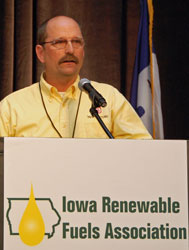
Gary Haer, who also serves as vice president of sales and marketing for REG (Renewable Energy Group), the nation’s largest biodiesel producer, talked about the future of the green fuel at last week’s Iowa Renewable Fuels Summit. During a panel session entitled “Advanced Biofuels Panel – A Turning Point for Renewable Energy,” Haer said that after a very challenging 2010, where the industry held its breath nearly all year while waiting for Congress to finally renew the federal $1-a-gallon tax incentive, biodiesel is ready to move forward as the nation’s first advanced biofuel.

“By EPA definition, an advanced biofuel must reduce greenhouse gas emissions by at least 50 percent. That gives us those environmental benefits, but it’s also good to note that biodiesel and advanced biofuels promote energy security … and they also contribute economic benefits for agriculture and rural America.”

Haer points out that biodiesel does not compete with food supplies and is more efficient than ever in the amount of energy used to produce each unit of energy. “Biodiesel continues to improve its energy balance. Today, it generates four units of energy for every unit consumed in the manufacturing and processing for finished product.”

Haer says the industry has plenty of capacity to meet the RFS2 requirements, as well as having enough feedstocks to produce the biodiesel to meet the increasing requirements. And he says there’s no new technology that has to be developed to meet that requirement. “With biodiesel, that next generation [of renewable fuels] is here today. The capacity, the industry is there. We’re ready to go, and we’re ready to utilize additional feedstock sources as they become commercially developed and commercially available.”

Haer admits there are some challenges out there, but the potential is so great. And he says since the stakes in the economy are so high, they must succeed.

“We’re providing jobs, and we’re providing green collar jobs for Americans. And we work hard to keep U.S. dollars in the U.S. economy.”

You can listen to Haer’s full remarks here: Gary Haer, NBB Chairman , as well as following along with his powerpoint presentation at this link.

Audio, Biodiesel, Biodiesel Conference, NBB

Energy Secretary Chu Tours Sharp Solar Facility

Joanna Schroeder

Energy Secretary Steven Chu toured Sharp Electronics Corporation’s solar manufacturing facility in Memphis, Tennessee last week. According to an article on the Energy.gov blog following his visit, the plant has produced more than 2 million solar panels since 2002. Also, due to the positive response for more solar power from both the public and private American sectors, Sharp has increased its staff from 300 to 480 employees over the last year.

In addition, with the aid of federal incentives, the company has grown its production capacity at its Memphis plant from 60 megawatts a year to 140 megawatts of solar paneling, enough to power more than 140,000 average sized U.S. homes.

“We are honored to welcome Secretary Chu to Sharp’s solar panel manufacturing plant in Tennessee,” said Kozo Takahashi, Chairman and Chief Executive Officer of Sharp Electronics Corporation prior to his arrival. “Sharp has seen strong growth in demand for solar electricity and in turn we have steadily increased output and job creation, making our factory a perfect venue to amplify President Obama’s top renewable energy priorities for the country.”

While at Sharp’s facility, Secretary Chu toured Sharp’s solar panel manufacturing operation and discussed President Obama’s energy initiatives as laid out in his State of the Union Address on January 25. During his address, the President called for 80 percent of America’s electricity to come from clean energy sources by 2035.

Electricity, Solar

NEC Student Scholarship Winners Announced

Joanna Schroeder

The scholarship students who will attend the 16th Annual National Ethanol Conference: Building Bridges to a More Sustainable Future, have been selected by the Renewable Fuels Association (RFS) and the Renewable Fuels Foundation (RFF). The six students will receive free conference registration, allowing them the opportunity to meet and connect with renewable fuels industry professional leaders, policymakers and experts. The conference takes place in Phoenix, Arizona February 20-22, 2011.

The NEC scholarship recipients are: Ethan Kenney, a junior undergraduate at the University of Nebraska-Lincoln; Derek Latil a recent graduate who is working part time for IllinoisVentures; Anuradha Mukherjee, who is pursuing her PhD in the Department of Chemical Engineering at Oklahoma State University; Kai Nortey, a graduate student of Integrated Marketing Communications and PR at Golden Gate University in San Francisco, Julia O’Rourke, a 2nd year MS/PhD student in mechanical engineering and MPaff student in public affairs at the University of Texas at Austin; and Andy Pringnitz, a junior undergraduate student at Iowa State University, where he is studying Agricultural Business, Economics, and International Agriculture.

“Attending the NEC is a stepping stone for these students in their path of pursuing a career in biofuels and renewable energy,” said Mike Jerke, RFF Chairman and General Manager of Chippewa Valley Ethanol Company. “This is the perfect occasion to network with U.S. ethanol experts and explore the opportunities this industry has to offer.”

According to RFA, this year’s conference will focus on the future of an industry that can and will be the bridge from a national petroleum-fueled economy to one that is anchored in renewable fuels, sustainably produced from all biomass including grains and cellulose.

Ethanol, Ethanol News

No-Till Farming Shows Up Strong In ZimmPoll

Chuck Zimmerman

In our latest ZimmPoll we asked our farming readers about tillage practices with the question, “Which tillage practice do you employ on most of your farming operation.” It looks like No-Till is the winner with 24%, followed by Conventional at 21%, Other at 9% and Strip-Till at 6%.

ZimmPoll 8

Our next ZimmPoll is now live and asks the question, “Will commodity prices be higher or lower a year from now??” Let us know and thank you for participating.

ZimmPoll is sponsored by Rhea+Kaiser, a full-service advertising/public relations agency.

ZimmPoll

Hawaiian Utility Seeks Biodiesel for Power Station

John Davis

A utility from the Aloha State is looking for a company to provide biodiesel for one of its new power plants.

The Honolulu Star-Advertiser says Hawaiian Electric Co. needs the green fuel for its 110-megawatt generating station in Campbell Industrial Park:

The request for proposals state’s HECO’s preference for locally-produced biodiesel, but if it isn’t available in sufficient quantities the utility said it would accept biodiesel produced on the Mainland or a mix of the two.

The contract is for three to seven million gallons of biodiesel a year over a three-year period. The contract will replace a two-year deal with an Iowa-based supplier of biodiesel made from waste animal fat. That contract that expires in July 2012.

HECO says the Campbell plant is the largest commercial power plant in the world powered exclusively by biodiesel. This announcement comes on the heels of last month’s announcement that ‘Āina Koa Pono, Hawaiian for “for the good of the land,” landed a contract to provide sustainable biofuels for HECO.

Biodiesel

Biomass Bales Being Delivered to Project Liberty

Joanna Schroeder

Last fall farmers in and near Emmetsburg, Iowa were harvesting biomass. Currently, they are in the process of delivering these biomass bales to POET’s 22-acre storage site situated next to Project LIBERTY, the future 25 million gallon per year cellulosic ethanol plant.

Area farmers have harvested nearly 56,000 tons of corn cobs, leaves, husks and some stalk but had to wait to deliver the material while the USDA worked out the details of their Biomass Crop Assistance Program (BCAP). The program provides matching funds of up to $45 per ton to each grower for a maximum of two years. The goal of the program is to help farmers offset the start-up costs for developing the cellulosic feedstock market for biofuels and renewable energy.

“While we shared the farmers’ frustration with delays to BCAP, we are happy to see that the program is being implemented and farmers are now delivering biomass to POET,” Project LIBERTY Director Jim Sturdevant said. “I know they are eager to deliver their bales, just as we are eager to validate our receiving and handling procedures at the new biomass stackyard.

Sturdevant continued, “BCAP is important to helping these first farmers get the new biomass market off the ground. BCAP’s inclusion in the next Farm Bill is an important part of continuing to develop this market.”

So last week, the farmers began completing the application process and shortly thereafter, began to deliver the biomass. Biomass bales this year will be used primarily to test procedures for delivery, receiving, quality assurance, storage, and handling at the stackyard. When operational, Project LIBERTY will use about 300,000 tons of biomass annually to produce ethanol.

Cellulosic, Ethanol, POET