ACE Conference 2026

DOE Awards $2.85M to GeoTek Energy

Joanna Schroeder

The Department of Energy is funding several geothermal projects in the United States including a project by GeoTek Energy to design its Gravity Head Energy System (GHES). The company received $450,000 with the potential for an additional $2.4 million to validate the design and for further development of the technology.

Geothermal energy uses heat from the earth to produce steam or hot water. This “energy” is then used to drive a turbine to generate electricity. Unlike some renewable energy sources, geothermal power is produced all the time making it easier for a utility to predict output and manage load requirements.

The GHES uses the force of gravity to eliminate pumps and motors typically needed in binary geothermal energy production. Once validated, the technology allows geothermal providers to sell as much as 35 percent more electricity over the current technology on the market. This will not only increase energy output, but profits as well.

“GeoTek was one of only eight projects nationwide recently approved for a total of $11 million funding by the Geothermal Technologies Program to advance geothermal power technology,” said Kenneth Fryrear, GeoTek’s chief operating officer. The company plans to supplement the government funds with private capital.

Electricity, Energy, Geothermal

Building Better Fuels Ad Debuts

Joanna Schroeder

Following a visit to the Beltway to conduct its member meeting and meet with politicians, the Advanced BioFuels Association (ABFA) has launched its first online advertisement to promote the successful uses of advanced biofuels. The ad is a first in a series. Michael McAdams, ABFA president said, “As Washington confronts our nation’s energy and economic challenges, we must demonstrate that advanced biofuels are real and successfully being put to the test today, all across the country. Advanced biofuels are today’s reality, not scientific hyperbole.”

The first ad is called, “Building Better Fuels Today and Tomorrow,” and opens with the statement, “There are those who speculate America’s day has passed…”

“This is an important opportunity for us to provide real world examples of advanced biofuels delivering ready to use fuels for cars on the road today as well as commercial airliners and our national defense structure,” McAdams added. “No waiting for the day when costly changes are made on car assembly lines or gas stations.”

advanced biofuels, Education, Video

LS9 & HCL Cleantech Awarded $9M from DOE

Joanna Schroeder

The Department of Energy has awarded $9 million dollars to LS9 and its partner HCL Cleantech to improve and demonstrate an integrated process to convert biomass feedstocks into fermentable sugars and then into diesel and other biofuel and biochemical products. As part of the DOE grant, the two companies are combining their proprietary technologies to produce drop-in advanced biofuels and other valuable bio-based chemicals mainly from wood waste and other agriculture waste.

“We are very pleased with this award and look forward to working with our grant partner, HCL Cleantech, to deliver a successful integrated project,” said Ed Dineen, LS9 President and CEO. “Demonstrating compatibility and integration of LS9’s broad technology platform with next generation biomass based sugar technologies is a key strategic objective for the Company.”

advanced biofuels, biochemicals

DFCast: Biofuels Take Flight

Joanna Schroeder

In the past few months, biofuels have taken to the skies with a multitude of successful flights conducted by both the military and the commercial airline industry. This news has been even more welcome with the achievements taking place during the aftermath of the Rand report predicting that aviation biofuels would not play a role in the next few decades. But where biofuels really took flight was during the Paris airshow, which kicked off with the transatlantic flight from North America to Paris using a 50/50 biofuel blend derived from camelina.

Ag Secretary Tom Vilsack attended the Paris Air Show and told the audience that “extraordinary progress has been made in the last 12 months.” He continued by saying, “I think we’re nearing a tipping point” in terms of building momentum toward use of biofuel on commercial flights. I think [biofuel powering airline flights is] not long-term. In the short term you’ll see the benefits.”

To further spur the development of biojet fuels, the European Commission launched the Biofuels Flightpath, a roadmap to achieve the goal of using 2 million tonnes of aviation biofuels per year by 2020. Prior to this announcement, back in the U.S., Sustainable Aviation Fuels Northwest released a comprehensive report to speed up the commercialization and use of aviation biofuels in the Northwest. In addition, ASTM officially approved renewable jet fuel standards.

The region has been a leader in the U.S. in the movement to more sustainable airport practices as well as in the movement to adopt renewable fuels. Lawrence J. Krauter, CEO of the Spokane International Airport, one of dozens of entities participating in the Sustainable Aviation Fuels Northwest initiative, noted, “The course is clear that aviation biofuels are key to the future of sustainable air travel. We can no longer base our future on imported petroleum, especially if the United States wants to remain an aviation leader. The SAFN study proves domestic biofuels are feasible and offers an economic opportunity for us to remain competitive as an industry and move toward a sustainable, domestic fuel supply.”

Learn more about the flight of biofuels here: Domestic Fuel Cast

You can also subscribe to the DomesticFuel Cast here.

Audio, biofuels, biojet fuel, Domestic Fuel Cast

REG Files for IPO

Joanna Schroeder

The largest biodiesel company in the U.S., Renewable Energy Group, has filed its registration statement for an initial public offering. The number of shares to be offered and the price range for the offering have not yet been determined. UBS Securities LLC and Piper Jaffray & Co will be acting as joint book-running managers for the IPO. In addition, Stifel, Nicolaus & Company, Incorporated and Canaccord Genuity, Inc. will be acting as co-managers.

Although not yet effective, a registration statement relating to these securities has been filed with the Securities and Exchange Commission. Prior to the time the registration statement becomes effective, these securities may not be sold, nor may offers to buy be accepted. REG says the offering is only being made by means of a prospectus.

A copy of the prospectus relating to these securities may be obtained, when available, from: UBS Securities LLC, Attention: Prospectus Department, 299 Park Ave, New York, NY 10171, (888) 827-7275 or by contacting Piper Jaffray & Co., Attention: Prospectus Department, 800, Nicollet Mall, Suite 800, Minneapolis, Minnesota 55402, (800) 747-3924 or via email at prospectus@pjc.com.

Biodiesel, biofuels

Kenya to Construct Largest Geothermal Plant in Africa

Joanna Schroeder

In my latest book review, Energy, Convenient Solutions, author Howard Johnson predicts that geothermal energy will play the biggest role in our energy future. Maybe because I’m now paying more attention to geothermal energy, it seems that some pretty significant geothermal projects have been announced recently. For example, Kenya has unveiled its plans to build the largest geothermal power plant in Africa. The plant, once operational, would have the capacity to generate 2,000 megawatts (MW) per year.

The $3.4 billion Borgia-Silali geothermal project is under development by the Geothermal Development Company (GDC) who plans on building out the project in four phases. GDC believes this project is critical in helping to resolve Kenya’s “critical recurring energy crisis.” The first phase of the project will involve the construction of a plant that will generate 800 MW by 2017. Phase II, with a capacity of 400 MW, is expected to be completed by 2019, while Phase III and Phase IV, each with a capacity of 400 MW, are expected to be completed by 2021 and 2023 respectively.

GDC is a state-owned company and is currently finalizing investors for this portion of the project and are already taking bids for Phase 1, that entails the construction of eight 100 MW power plants in the Bogoria-Silali area.

This is not the only area Kenya is targeting for geothermal power. GDC is also building a 400 MW geothermal plant in the Menengai caldera field and the geothermal power plant in Olkaria is generating 280 MW per year. The country’s current energy demand peaks today around 1,200 MW and is projected to grow by 10 percent to at least 17,000 MW over the next 20 years. The country hopes to generate at least 5,000 MW of energy by 2030 through geothermal power although GDC has identified 14 high potential sites along the Rift Valley that could generate between 7,000 – 10,000 MW.

Electricity, Energy, Geothermal

Louisiana Moves Forward On Sugar-to-Ethanol Plant

Joanna Schroeder

Louisiana is one step closer to being the first state in the U.S. to boast a sugar-to-ethanol plant. The Louisiana Public Facilities Authority Board of Trustees has approved bonds worth up to $70 million to help build the plant in Lacassine. The plant is a project of Louisiana Green Fuels (LGF) and is 80 percent owned by Andino Energy and 20 percent owned by Lake Charles-area sugarcane farmers. The refinery will be built by a manufacturer based in India where the plant would be pre-built and shipped to Lake Charles in late summer and be in place before the next year’s cane harvest begins this October.

“Because of increasing oil prices and concerns over the environment, interest in the alternative fuel industry is growing,” said Thomas A. Antoon, chairman of the LPFA Board, in a press statement. “This new sugar-to-ethanol plant will move our state into the forefront of the growing alternative fuel production industry and should have a favorable economic impact on southwestern Louisiana.”

The sugar-to-ethanol plant will be sited near the Lake Charles Cane-Lacassine Syrup Mill that has been in operation since 2006. The ethanol plant will use syrup produced at this plant along with can molasses sourced from other sugar mills in the state to produce the fuel. LGF anticipates the ethanol will be sold to the city of Houston as well as the state, that both have ethanol mandates in place.

The bond approval is considered a preliminary approval for additional bonds and LGF says these bonds lend credibility to the company’s effort to court private investors. To date, Andino Energy along with a cooperative of Lake Charles farmers have spent nearly $40 million to buy land and secure contracts for sugarcane and sweet sorghum farmers. According to Alex Santacoloma, co-owner of Andino Energy, this is the reason the bonds are needed to help build the ethanol plant.

biofuels, Ethanol, feedstocks

Grain Production Not Keeping Up With Demand

Joanna Schroeder

According to Purdue University agricultural economist Chris Hurt, grain crops are being “gobbled up” faster than farmers can grow them. This could lead to trouble down the road if production doesn’t catch up. Hurt says there have been two major demands surges on commodities in the past five years. One is the rising use of corn for ethanol production being driven by biofuel mandates and high oil prices. The second is increased soybean purchases by China being driven by the country’s growing income and food demand.

“These greater levels of usage have placed a strain on the agricultural production system, resulting in low inventories that leave little room for any production shortfalls,” Hurt said. “Producers certainly have responded to try to meet those demands, but what we’ve seen is that demand has really outpaced the ability of the world to supply.”

Hurt said wheat stocks are in better shape than corn and soybeans that are near “bare minimums” in the U.S. In the past, he said there was enough for 46-60 days or more but anticipates that this won’t be the case after this fall’s harvest.

“With corn, it looks like we could be down to about a 24-day supply at the end of this marketing year,” said Hurt. “That, of course, means any further threats to the 2011 crop yields would send markets into deeper shortages and higher prices.”Read More

Agribusiness, biofuels, corn, Ethanol News, Soybeans

Scouting for Biofuels Crops in Indian Creek Watershed

Cindy Zimmerman

The Department of Energy’s Argonne National Laboratory is looking for the best biofuels crops to grow in the northeast Illinois Indian Creek Watershed.

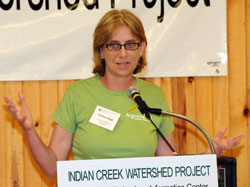
CTIC TourDuring a recent field tour of the watershed sponsored by the Conservation Technology Information Center, Argonne agronomist Cristina Negri said they are looking at alternative crops that can efficiently use nitrogen to grow on marginal land in the area. According to Negri, the purpose of the Biomass Production and Nitrogen Recovery project is to “find a way to bring biofuels into the big conservation equation.”

Negri participated in the CTIC tour to learn more about the production practices being used by farmers in the watershed and also gave a presentation on the Argonne project: Cristina Negri Presentation

CTIC Indian Creek Watershed Project Field Tour Photos

Audio, biofuels, feedstocks, Government, Research

Texas Looks to Algae As Next Cash Crop

Joanna Schroeder

According to Texas AgriLife Research scientists in Corpus Christi, microalgae may be the next cash crop. There are an estimated 200,000 to 800,000 species of microscopic freshwater and marine microalgae, yet only 35,000 species have been described. Researchers around the globe are trying to discover the best algae species for producing biofuels.

“It’s a huge, untapped source of fuel, food, feed, pharmaceuticals and even pollution-busters,” said Dr. Carlos Fernandez, a crop physiologist at the Texas AgriLife Research and Extension Center at Corpus Christi. He is studying the physiological responses of microalgae to the environment.

Fernandez said researchers are only beginning to scratch the surface of discovering algae’s secrets. Yet he believes farmers will one day soon be growing microalgae on marginal land that won’t compete with fertile farmland or for fresh water. One of the secret’s that needs to be unlocked is how to most effectively grow algae. Therefore, Fernandez constructed a microalgae physiology laboratory to study how algae is affected by temperature, salinity, nutrients, light levels, and carbon dioxide.

“We have four bioreactors in which we grow microalgae to determine the basic physiological responses that affect its growth,” explained Fernandez. “We will then integrate these responses into a simulator model, a tool we can use in the management of larger, outdoor systems.”

The study is also looking to find algae that can produce large amounts of lipids or fats, that are converted to biofuels such as biodiesel or biojet fuel. In addition, the research team, that includes members from Texas AgriLife Mariculture labs in Flour Bluff, are looking at a residue that remains after the lipids are extracted as a source of animal feed. Finally, they will also evaluate algae as a source of fertilizer for soil.

Fermandez said Corpus Christi is the perfect place to conduct the research for several reasons including access to seawater to grow the microalgae, large acres of marginal land and lower evaporation rates than in arid areas so water requirements are reduced. In addition, he noted that local power plants and oil refineries are good CO2 sources and there is a good network of higher education institutions in the region.

algae, biofuels, Research