Geothermal Plant Inaugurated in Costa Rica

Joanna Schroeder

A second geothermal plant designed and manufactured by Ormat Technologies has been inaugurated in Las Pailas, Costa Rica. Ormat was contracted by Banco Centroamericano de Integracion Economica “BCIE”, to supply all the power equipment, supervise the installation and conduct the testing and start-up of the 42 MW power plant. The plant will actually be operated by the Costa Rican National Electricity and Telecommunications Company.

Several country leaders attended the event including the president of Costa Ricka, H.E. Laura Chinchilla Miranda. Also on hand was the former Minister of Energy, Teofilo de la Torre who was recently nominated as the Executive President of ICE, the country’s national power utility. Dr. Nick Rischbieth, president of BCIE, along with other members of the government and distinguished dignitaries rounded out the attendees.

“We are very pleased to continue our collaboration with ICE which started with the 18 MW Miravalles Unit 5 in 2004. The Las Pailas plant demonstrates the trust that ICE and BCIE have in Ormat and its Binary Technology,” said Ormat’s Chairman, Lucien Y. Bronicki.

Electricity, Energy, Geothermal

You Have Or Want An iPad or Other Tablet

Chuck Zimmerman

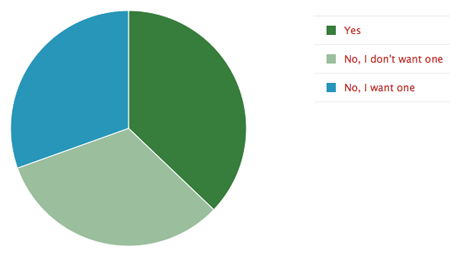
I’m very surprised at some of the response to our latest ZimmPoll. Although 37% responding say they have an iPad or other tablet, 33% said they don’t and don’t want one! And we had 30% who said they don’t have one but do want one. However, when you consider that no one had one less than two years ago you might consider the percentage who have or want one to be huge! I know I’m a geek and can’t have enough gadgets but not everyone is an agnerd.

Our new ZimmPoll is now live. We’re asking the question, “What do you think the biggest safety issue is at a biorefinery?” Your input and thoughts would be greatly appreciated. Thanks.

ZimmPoll is sponsored by Rhea+Kaiser, a full-service advertising/public relations agency.

ZimmPoll

U.S. Auto Club Endorses Ethanol

Joanna Schroeder

The U.S. Auto Club (USAC) made a surprise announcement at the Lucas Oil Raceway last week when they announced they are switching to “Ignite High Performance Ethanol,” an ethanol racing blend distributed by National Biofuels Distribution (NBD). USAC President & CEO Kevin Miller said during his presentation that his organization is “excited to take this direction toward environmentally-friendly fuel usage.”

Ignite High Performance Ethanol has proven during tests to have a 40 percent reduction in consumption, which translates to savings for our participants, while not compromising performance,” continued Miller. “It’s great to have an alternative which not only serves the environment but also the budgets of our competitors and offers a safer racing atmosphere.”

Several years ago NBD began offering ethanol racing blends in response to increased demand for the fuel. It’s been used on IndyCar Series’ tracks, American Le Mans Series’ courses, drag strips and more and as it demonstrated success word spread and popularity grew. In 2010, Ignite High Performance Ethanol became the title sponsor of the ARCA West Champion Stock Car Series with distribution in 42 states.

“We’re very excited to be partnering with USAC on this fuel produced by Indiana farmers,” said Jay Berry, NBD co-founder and vice president.  “I’m confident that their drivers will like the added power, increased mileage and safety. And we’re looking forward to showing the performance side of ethanol as a high-performance fuel, rather than just as an additive.”

The ethanol racing fuel is available in three blends – E98 and 108 and 114 octane.

Berry added, “Surprisingly, many people either still don’t know much about ethanol or have misconceptions about it. With USAC tracks spread all over the country, this will really give us a ‘grassroots’ opportunity to educate people what ethanol can do from a purely performance standpoint, which is a story that really needs to be told.”

biofuels, Ethanol, Racing

Amyris Partners with Kuraray

Joanna Schroeder

Amyris is now partnering with Kuraray Co. to develop innovative polymers from Biofene, a renewable hydrocarbon building block that is produced from their technology. As part of the partnership, Kuraray will use Biofene to replace petroleum-derived feedstock such as butadiene and isoprene in the production of certain polymers. Upon the success of the product, the two companies will then enter into a supply agreement for Kuraray’s exclusive use of Biofene in these polymer products.

“We are very excited to partner with Amyris, a leading renewable products company, to develop innovative polymer products with Biofene,” said Yasuhiro Yamamoto, director and senior executive officer of Kuraray. “We are confident the new Biofene polymer products will become important additions to our product portfolio and be an integral part of our growth strategy.”

Amyris CEO John Melo added, “We are committed to bringing innovative, high-performing and sustainable products to the polymers market. Partnering with an industry leader like Kuraray allows us to expand the use of Biofene to produce high-performance polymers as well as strengthen our timely and successful route to market.”

biochemicals, Company Announcement

Raleigh N.C. Police Department Converts to AutoGas

Joanna Schroeder

The Raleigh, North Carolina police department held a press conference yesterday to announce the successful conversion of 10 police vehicles to be fueled with propane autogas. The conversion took place with the help of Alliance AutoGas. The company outfitted the police department’s Ford Crown Victoria cruisers with dual fuel systems and also installed an on-site autogas fueling station at the Raleigh District stationhouse to give officers easy access to the fuel.

On hand for the event were Steven Whaley of Blossman Gas (an Alliance AutoGas co-founding partner) and he said the conversions are expected to save between 30,000-36,000 gallons of gasoline per year while also saving an estimated $30,000 in fuel costs. The police department will also experience reduced maintenance costs and vehicle downtime due to, said Whaley, the high octane rating of the autogas.

Also on hand for the event were Raleigh Police Chief Harry Dolan, representatives from the Triangle Clean Cities Coalition and the City of Raleigh’s Office of Sustainability. The North Carolina State Solar Center hosted the event.

Propane

Illinois Biomass Working Group Formed

Joanna Schroeder

The state of Illinois has formed the Illinois Biomass Working Group (IBWG) to study near-term uses for biomass in Illinois. The team is comprised of academics, government, industry and the private sector. Ted Funk, an Extension specialist in the Department of Agricultural and Biological Engineering at the University of Illinois is one of the founding members and saw the need for the group because “everyone is talking about liquid biofuels.”

“Can we grow biomass on the farm and put it in your car tank? Yes, we know it’s possible, and we’re getting closer to that day, but we’re still sometime away from it,” said Funk. “My fear is that we’ll have a bio-refinery system built, based on what we’re learning about turning cellulosic materials into liquid product, but we won’t know how to get huge quantities of biomass to those refineries.

Funk said he felt there was a need to pull people together to discuss opportunities, what markets are available today that could accept large quantities of biomass and how to put together supply chains.

To answer those questions, Funk and others, including Hans Blaschek and Natalie Bosecker from the Center for Advanced BioEnergy Research at Illinois, and Fred Iutzi from the Illinois Institute for Rural Affairs at Western Illinois University, organized a conference to analyze three markets they felt were currently open to the use of biomass for heat and power. One market is pellets to replace liquid propane, a second market is biomass to replace some of the coal used in industrial boilers and the third market is gasification.

“The IBWG has been an excellent way to get the right people in the room and start talking about possibilities,” added Funk. “We feel that the main function of the IBWG is to identify supply chains and put things together,” he concluded, “so that when the bio-refinery system is here, the supply chains will be here as well.”

biomass, Electricity, Research

Wind & Transmission Leadership Summit Announced

Joanna Schroeder

While wind energy is growing exponentially, renewable energy in the U.S. makes up less than 4 percent of total energy use. To increase energy created from wind power, several issues need to be address including transmission infrastructure and advanced energy storage. These very opportunities will be discussed and more during the first Wind & Transmission Leadership summit in Big Sky Montana from September 25-28, 2011.

The C-level summit will focus on seeking solutions to energy policy and wind development and will bring together leaders from the wind, energy storage and transmission industries as well as people from state and federal governments, finance and investment firms, academia, associations, environmental groups, and nongovernmental organizations (NGOs).

“This conference is well positioned to bring together the leaders in industry and government that are working to solve our greatest challenges to establishing a renewable energy standard for the U.S. and to address the continued risk to our economy and environment,” said Randy Stratton, Conference Co-Chairman. “We can solve these challenges with the private sector working with the government to fund research and development in wind, energy storage, transmission technology and electric vehicles. We must move forward now before we fall further behind the rest of the world.”

Several break-out sessions will occur during the three-day summit and focus on a key segments of the market. Sessions include: community wind development, transmission solutions, state and federal policies and incentives, opening electricity markets in the West, siting issues, large wind technology, public lands and transmission infrastructure, wildlife concerns, national and regional energy programs, eminent domain, smart grid advancements, finance/investment and risk/liability issues.

Tom Kaiserski, Director of Energy Promotions for the State of Montana added, “This summit is designed to bring together the players with the vision and resources capable of building a 21st century clean and renewable power and transmission system that will result in thousands of new jobs, billions of investment, millions in new tax revenues that will help secure our energy future.”

Click here to learn more about the conference and for online registration.

conferences, Electricity, Energy, Wind

RFA Offers Free 15% Ethanol Pump Labels

Cindy Zimmerman

The Renewable Fuels Association is offering EPA-approved labels to gasoline marketers free of charge.

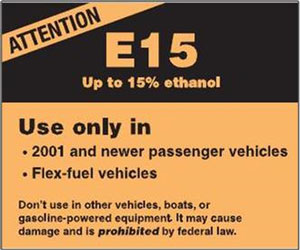
The labels comply with the language and design rules finalized by EPA in June to implement the use of E15 for cars, pickups, and SUVs made in model year 2001 and newer. The labels will be required on every pump offering E15 once EPA has certified E15 for commercial sale as required by Section 211(b) of the Clean Air Act.

“Making sure consumers are aware of the availability and proper use of E15 ethanol blends is a critical component of expanding the market for ethanol,” said RFA Director of Market Development Robert White. “Proper use of these labels will ensure gas stations and other fuel retailers choosing to offer E15 are complying with EPA labeling guidelines. These labels are yet another element of the RFA’s commitment to expanding the marketplace for ethanol-blended fuels by expanding ethanol fueling infrastructure and informing drivers of the benefits of ethanol use.”

The labels were approved for use by EPA today and will be available to ship in 14 business days. The RFA will be reaching out to National Association of Convenience Stores (NACS), the Society of Independent Gasoline Marketers (SIGMA), the Petroleum Marketers Association of America (PMAA), the Petroleum Equipment Institute (PEI), and other fuel retailing organizations to make sure gas pumps offering E15 blends are properly labeled.

Ethanol, Ethanol News, RFA

Ethanol Compromise Not in Debt Deal

Cindy Zimmerman

The deal to raise the U.S. debt ceiling and make spending cuts agreed upon by President Obama and congressional leaders includes no mention of the compromise to reform ethanol policy worked out last month in the Senate and ethanol industry leaders are disappointed.

“As this deal calls for a commission and a future budget framework, the possibility still exists for a more comprehensive dialogue about energy tax policy, including how to assure the continued evolution of the ethanol industry to new feedstocks and technologies, how to assure needed investments in vehicles and infrastructure to accommodate higher ethanol blends, and how to end the billions in subsidies and tax preferences still enjoyed by very mature and profitable petroleum fuels,” said Renewable Fuels Association president and CEO Bob Dinneen in a statement. “With the debt ceiling crisis looking as though it has been averted for now, we hope Congress and the Administration are now prepared to address the nation’s worsening energy crisis, as oil and gasoline prices continue to rise and the nation’s investment in home grown renewable fuels languishes.”

Brian Jennings, Executive Vice President of the American Coalition for Ethanol, calls it a missed opportunity. “By disregarding reform of the ethanol tax credit as part of this deal, consumers and the American biofuels industry have been shortchanged. It remains frustrating that some elected officials are continuing to protect billions in subsidies for the oil industry, while dismissing efforts to improve consumer choice at the pump.”

House of Representatives passed the compromise bill today by a vote of 269-161. The Senate is expected to pass the bill Tuesday and President Obama has said he will sign it.

ACE, Ethanol, Ethanol News, Government, RFA

New Catalyst For Biomass Production

Joanna Schroeder

A new catalyst for biomass production has been developed by researchers from the Department of Energy’s Pacific Northwest National Laboratory (PNNL) and Washington State University (WSU). These catalysts could turn ethanol into other products by converting it into a chemical called isobutene. This feat can be accomplished in one step, and the process can use water-diluted ethanol rather than purifying it first, saving time and money. The results of the research were published in the July 21, 2011 issue of the Journal of the American Chemical Society.

“Isobutene is a versatile chemical that could expand the applications for sustainably produced bio-ethanol,” said chemical engineer Yong Wang, who leads research at both PNNL in Richland, Washington and at WSU in Pullman.

The catalyst plays an important role to unlocking renewables to replace fossil fuel in products. For example, the catalytic converter in a car speeds up chemical reactions that break down polluting gases, cleaning up a vehicle’s exhaust. In the process of trying to improve on current catalysts, the team was actually trying to make hydrogen but discovered a significant amount of isobutene, which is better.

Isobutene can be used to make rubber or in cleaning products. In addition, it can be easily converted into jet fuel or octane boosting additives.

The researchers said no one had ever seen a catalyst create isobutene from ethanol in a one-step chemical reaction before, and realized such a catalyst could be important in reducing the cost of biofuels and renewable chemicals. When using a 1:10 ratio of zinc and zirconium, the mixed oxide catalyst could turn more than 83 percent of the ethanol into isobutene.

The research is just beginning and future study will look into optimization to further improve the yield and catalyst life. Wang and his colleagues are also curious to know if they can combine the isobutene catalyst with others to produce different chemicals in one-pot reactions.

biochemicals, biofuels, biojet fuel, Ethanol, Research