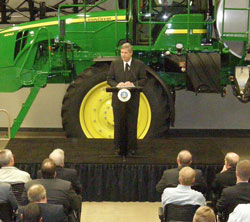
Last week I attended the 2011 IFAJ Congress in Canada. This is the International Federation of Agricultural Journalists. One of our stops was the Hensall District Co-operative. We were welcomed by CEO, Earl Wagner, who gave us an overview of the various business units of the co-operative.
HDC is a diversified farmer-owned Ontario Agricultural Co-operative. Established in 1937, HDC is the largest independent agricultural co-operative in Ontario with 4000 members who elect 10 Board of Directors. HDC employs 300 staff members with annual sales of 328 million.
One of our group asked him if HDC had gotten into the ethanol production business and he said that they have not. However, they did sell some land a few years ago to GreenField Ethanol who intended to build a plant but to date hasn’t done so. HDC does sell corn and Earl says that the demand for corn for ethanol production has been a good thing. As you can see from the pumps at the home base location, they sell ethanol blended gasoline. You can listen to my interview with Earl here: Interview with Earl Wagner
Registration Open for 2012 National Ethanol Conference
Registration is now open for the Renewable Fuels Association 17th Annual National Ethanol Conference – Accelerating Industry Innovation. The conference will be held February 22-24 in Orlando, Florida at the Gaylord Palms Resort and Convention Center.
The program will highlight how the industry has and continues to evolve to meet the demands of a rapidly changing marketplace. With federal policy changing, the global, market-driven environment in which the industry must compete comes with new market challenges. Industry leaders and experts will address how we are meeting these new demands by accelerating innovation in technology, marketing, logistics and feedstocks for the production of advanced ethanol.
More information can be found on the conference website – NationalEthanolConference.com.
Urbee Car Unveiled At Winnipeg Art Gallery
What might the future of transportation look like if fossil fuels cease to exist? If mechanical engineer Jim Kor, along with 11 other engineers and designers, is correct it will look like the Urbee Car. This visionary vehicle is an electric-ethanol hybrid that has been under development since 1996 and was finally unveiled at the Winnipeg Art Gallery over the weekend.
This two-passenger, aerodynamic car is ultra-lightweight and requires only one-eighth the energy of a small, conventional car. It features a single-cylinder, eight-horsepower engine. And the body is manufactured with a three-dimensional printer, yet it’s set to last up to three decades. What else is different about this car? It has no trunk.
Kor, president of Kor EcoLogic, believes one day all cars will be shaped like his. “True progress means using less horsepower,” said Kor in the Winnipeg Free Press.
Less power indeed. His car only has eight horsepower whereas even the smallest cars on the market have at least 68 horsepower. Today, Kor and his team are testing the Urbee to ensure that it is safe to drive on the road.
Several hurdles remain before the car can go “mainstream”. The company must raise at least $1 million to build a second prototype and from there they will build the first 12 working cars- one for each member of the team. Kor anticipates when the car comes to market, it will have a price tag between $30,000 – $50,00. He anticipates the price will go down when the car reaches mass production. In addition, the price will also go down because three-dimensional printing is faster and cheaper than moulds.
While it may take quite some time before this car hits the road, the concept of the electric-ethanol hybrid should take off faster.
Solar Takes Over St. Louis
Solar energy has taken over St. Louis. The St. Louis Housing Authority recently completed five solar energy projects that included powering its administrative building along with four affordable housing complexes. The 617 KW combined solar projects were designed, installed and engineered by Real Goods Solar and the energy produced is expected to reduce the complexes’ electricity use by more than 75 percent and reduce electricity use in the admin building by around 15 percent.
“Solar power isn’t just for large corporations or those with large incomes,” said Michael Steinbaum, Vice President and Chief Operating Officer at Sunwheel Energy Partners who developed the project. “It provides an opportunity for just about anyone to reduce costs and have a positive impact on the environment.”
The total combined systems are comprised of 405 SunPower and 2, 216 Sharp solar panels. The projects were funded through the federal Housing and Urban Development Green Communities stimulus funds along with energy and redevelopment tax credits and all parts of the solar system were manufactured in America. The system includes both roof-mounted and carport canopy solar arrays and are estimated to generate nearly 777,000 hours of energy each year. This is enough electricity to power 81 homes per year.
Tyson Grul, Director of Commercial Solar for Real Goods, added, “The coordination required to install systems on more than 90 buildings – in a wide variety of weather conditions – was no small feat. However, the result is the largest solar initiative in the state so far, and we believe it will open doors for many future projects – putting Missouri on the path to being a national renewable energy leader.”
Kingman I Wind & Solar Farm Begins Operations
The Kingman I wind and solar project located in Kingman, Arizona and owned by Western Wind Energy has begun operations. According to the company, the 10.5 MW combined wind/solar energy farm is the first purpose-built wind and solar project in North America. In other words, the combined wind and solar energy facility was designed and built for the power purchase agreement with Unisource Electric Services.
The project consists of five Gamesa G-90 2 MW wind turbine generators with 500 kW of solar panels located on a single axis tracking system. The farm went online on August 30, 2011 and began revenue service on September 16.
“This is a ground breaking, game changing development in the renewable energy industry where two completely separate types of technology and renewable fuel sources are integrated at the very beginning as a combined facility,” said Jeff Ciachurski, CEO of Western Wind Energy. “Integration of multiple renewable fuel sources allows for the maximization of existing transmission infrastructure by having a greater range of time of day availability. Western Wind Energy is excited to be the first owner/operator of this real-time, solution oriented facility.”
How to Engage Your Employees in Safety
To have a profitable business you need to operate safely while producing a high quality product. You can produce a high quality product but if your employees are getting hurt while you’re doing this, you’re not going to be in business long. So it’s important that you engage your employees into your safety program from top to bottom. And that’s the topic of Part 3 of the Biorefinery Safety Series.
To learn how to get people involved, I reached out to Joe Korpi with the Renewable Energy Group (REG), the largest biodiesel company in the country. Korpi said that many safety programs are struggling to answer that question.
“One of the things we’ve discovered is that too often the safety program focuses on the what. What happened in the past? What shouldn’t have happened in the past? How did we make mistakes in the past? One of the things we’ve decided to do here at the Renewable Energy Group, and it seems to work very well in all of the different industries that are trying it, instead of focusing on the what, focus on the why,” explained Korpi. “Train the employees on why they need to do the things they need to do, and, focusing on what specific actions, or behaviors the employees need to be able to demonstrate so they can do our safety programs correctly.”
There are several levels of “accidents” at a biorefinery. The first is the near misses or unsafe acts. These don’t actually result in an “accident”. The next level is where someone is hurt a little bit, say a burn. Then you have your recordables and then your reportables where you have to call OHSA within eight hours. Korpi said the best practice is to focus on those unsafe acts or near misses. In this situation, you identify something that could have happened but didn’t and focus on ensuring an accident doesn’t occur in the future.
Listen to my interview with Joe Korpi here: Biorefinery Safety Series Part 3: How to Engage Your Employees in SafetyRead More
REG Albert Lea Biodiesel Plant Officially Opens
The Renewable Energy Group (REG) celebrated the official opening of the REG Albert Lea biodiesel plant in Minnesota on Monday, with representatives of the state and local community and agriculture industry.
REG President and COO Dan Oh says they were involved in the construction and operations of the plant when it originally was built and opened by SoyMor. “We have worked together since 2003,” said Oh. The plant unfortunately got caught up in the economic issues that hit the renewable fuels industry back in 2008 and had to shut down, but REG felt it was a significant plant that needed to get back in operation, so they worked to make it happen for the local economy. “Think of a gallon of biodiesel in roughly every bushel of soybeans, this is a 30 million gallon biodiesel facility, so that really adds value back to a bean bushel,” Oh said.
Listen to or download interview with Dan Oh here. REG President Dan Oh
Representatives of the Minnesota soybean industry were on hand today for the grand opening, including Jim Willers, who is a farmer from Beaver Creek and a director on the United Soybean Board, as well as a member of the Minnesota Soybean Research and Promotion Council. After touring the plant, Willers said he was impressed with the shape it is in after being shut down for three years. “I found out that it was in excellent condition when they closed it down and the start up was way better than they thought,” he said. “It’s a state of the art facility and in six months they’re going to be a BQ-9000 plant.”
Listen to or download interview with Jim Willers here. Minnesota soybean farmer Jim Willers
Watch the ribbon cutting below and see photos in the REG Albert Lea biodiesel plant photo album
Ohio Ethanol Plant Celebrates Grand Opening
Guardian Lima, LLC of Ohio is officially back in full operation, producing 54 million gallons of ethanol a year, as well as 165,000 tons of dried distillers grains and jobs for the local economy.
Guardian Lima employs 33 full time Ohioans in positions from chemists to engineers to accountants and administrative support staff. Prior to the opening, there were 120 jobs involved with retrofitting and construction of the plant. The facility, formally Greater Ohio Ethanol, originally began operations in 2008 but went idle shortly thereafter due to adverse market conditions. Guardian Lima acquired majority stake in the ethanol production facility in November 2010.
“We are proud to bring this facility back into operation, creating jobs and providing a boost to the Lima economy,” said Don Gales, CEO of Guardian Lima, LLC. “Domestic ethanol production is a key component of the nation’s energy strategy and one that begins in hundreds of small towns and cities just like Lima.”
Renewable Fuels Association president and CEO Bob Dinneen congratulated the company for bringing the plant back into operation. “America’s ethanol industry continues to demonstrate an unparalleled ability to create jobs, particularly in small cities and rural communities all across the country,” said Dinneen.
Minnesota Biodiesel Plant Will Celebrate Re-Opening
The Renewable Energy Group (REG) will be celebrating the grand re-opening Monday of a Minnesota biodiesel plant that was shut down for three years.
REG acquired the former SoyMor production facility earlier this year, which is now known as REG Albert Lea, LLC. The company will be celebrating the grand re-opening of the plant with members of the Minnesota Soybean Research and Promotion Council, as well as state and local dignitaries, on Monday morning.
“With nationwide demand for biodiesel growing steadily through implementation of the Renewable Fuels Standard (RFS2) and Minnesota’s continued biodiesel consumption leadership, we expect to quickly ramp up production at REG Albert Lea, LLC,” said REG’s CEO Jeff Stroburg when the purchase of the plant was finalized. “With a foundation in agriculture and expertise in domestically-produced, renewable energy, REG is proud to bring green-collar jobs to this rural economy while supporting ag producers in Minnesota and across the Midwest.”
Minnesota is a leader in the biodiesel industry, being the first state to require that all diesel fuel contain a two percent blend in 2005, and has since increased to a five percent blend. “Increasing the amount of biodiesel in our fuel allows us to take advantage of a renewable fuel made right here in Minnesota,” said Ed Hegland, former National Biodiesel Board Chairman and Minnesota farmer. “I’m proud to live in a state that is leading energy innovations and taking part in valuable solutions like biodiesel.”
REG was already the largest biodiesel producer in the United States and the acquisition of REG Albert Lea brings the REG owned/operated total to more than 210 million gallons per year. REG was the general contractor and manager for the 30 mmgy refined vegetable oil feedstock biodiesel plant which originally began production in April 2005. Distribution of biodiesel at the facility started late last month. REG filed for filed an initial public offering in July.
Tapioca Pearls Can Dry Ethanol
Purdue University researchers have found proof in the pudding of a new way to dry ethanol.
The current industry practice for absorbing the water that is part of the ethanol production process after fermentation is to use corn grits. But the Purdue study found that the shape and structure of tapioca pearls make them more ideal for the job, not to mention that they are environmentally friendly and energy-efficient. Tests using tapioca collected about 34 percent more water than corn. “While corn grits are solid, irregularly shaped particles, tapioca pearls contain a gelatin starch core upon which dry starch granules are aggregated, significantly increasing surface area,” according to the researchers.
The researchers believe that U.S. ethanol plants would benefit from using tapioca pearls for drying, but the discovery may be more important for facilities in South America and Africa where the plant used to create tapioca – cassava – is grown.