

The U.S. Supreme Court will not hear a case brought by petroleum interests against the Environmental Protection Agency over the expanded Renewable Fuels Standard (RFS2).
The petition made by the National Petrochemical Refiners Association (NPRA) and the American Petroleum Institute (API) was rejected by the District Court of Appeals in December 2010. The petition filed in March 2010 claims that the RFS2 “violated the statutory requirements setting separate biomass-based diesel volume requirements for 2009 and 2010, that it was inappropriately retroactive without proper lead time and compliance provisions.”
 National Biodiesel Board vice president of federal affairs Anne Steckel says they are happy with the court decision.
“The RFS program is working just as Congress intended. It’s creating jobs across the country. It’s breaking our addiction to oil. It’s helping clean our air, and it’s reducing greenhouse gases,” said Steckel. “This year alone, the biodiesel industry is on pace to produce at least 800 million gallons of advanced biofuel while supporting more than 31,000 jobs. We’re pleased to see the Supreme Court put an end to this litigation as we continue building a strong U.S. biodiesel industry.”
Ethanol industry group Growth Energy was also pleased with the decision which mainly impacts biodiesel producers as they had intervened in the court case to defend the mandated volumes and make sure that the volumetric levels were retroactive as of Jan 2010. “The intent of Congress was clear when it passed the Energy Independence and Security Act – domestically-produced biofuels do strengthen our national defense and help support our economy. We welcome the Supreme Court’s decision as the right decision,” said Tom Buis, CEO of Growth Energy.
 The association which represents European ethanol producers is requesting that the European Commission take action “against unfair imports of fuel ethanol from the United States.”
 “In the past six months to a year, there’s been a strong connection between the stock markets and the energy markets,” Cooney said. “When things look bad in Europe, then our stock market tends to fall off and when the stock market falls off the energy markets tend to fall off.” He says world events in the currency and stock markets and whether the economy is strengthening or weakening have more impact on energy markets than public policy decisions, like the blenders tax credit for ethanol and the Renewable Fuels Standard.
  The initiative created a beef cattle advisory committee to work with University of Nebraska researchers to identify research projects that would benefit cattle producers and the
  The House Committee on Science, Space and Technology’s Subcommittee on Energy and Environment is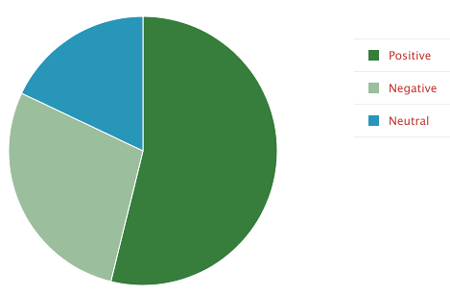


 The project will use INEOS Bio’s feedstock-flexible BioEnergy technology, which combines gasification and fermentation technologies, to turn different types of waste materials, including municipal solid waste, into advanced biofuels and renewable power. When completed, the BioEnergy Center will be the first commercial facility in the world to use this advanced technology with the capacity to manufacture eight million gallons of cellulosic ethanol and provide power for 1400 homes in the area.
 The
The  The Iowa Secretary of Agriculture Bill Northey is