

American Ethanol will be in the spotlight at the Martinsville Speedway NASCAR Sprint Cup Series race this weekend in Virginia.
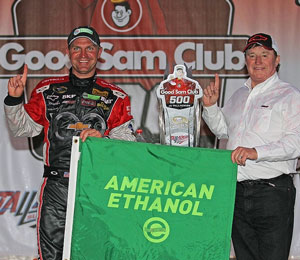
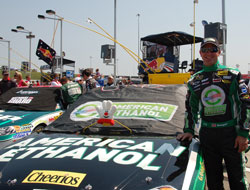 The No. 33 Richard Childress Racing Chevrolet race car will feature a special-edition American Ethanol paint scheme at the race and will be driven by American Ethanol spokesman and recent Talladega race winner Clint Bowyer. In addition, the American Ethanol brand will be featured on-track and accompanied with a broadcast in-car camera on Sunday.
“This branded race car design raises American Ethanol’s profile in a powerful way, especially coming off Clint Bowyer’s win last week in Talladega,” said Tom Buis, CEO of Growth Energy. American Ethanol is a partnership between NASCAR, Growth Energy, and the National Corn Growers Association.
National Corn Growers Association NASCAR Advisory Committee Chair Martin Barbre says they are excited about the high profile ethanol will have in the upcoming race. “Of course, we again congratulate our spokesman on his major victory last week. Now, tens of millions of fans across the country will be keyed into Clint as he again shows the incredible performance of E15 as it fuels him back into victory lane again.”
All NASCAR series races this year have been powered by 15% ethanol. “The transition to E15 has been seamless and overwhelmingly positive for myself and my team, and I am honored to have American Ethanol on the No. 33 Chevrolet this weekend,” said Bowyer. “I support American farmers as they strive to develop energy independence for our country and I look forward to representing American Ethanol both on and off the track this weekend at Martinsville.”
The Martinsville Speedway Sprint Cup Series race will be on ESPN beginning at 1:30 Eastern at Martinsville (Virginia) Speedway.
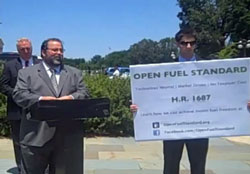
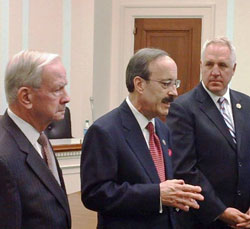 The two congressmen, pictured here with former National Security Advisor Robert McFarlane, outlined their Open Fuel Standard Act (HR 1687) which would set a deadline of 2017 for automakers to stop making cars that run on only gasoline. After than point, all American made cars must be either flex fuel (capable of burning gasoline, ethanol or methanol or any combination of these), or powered by natural gas, hydrogen, biodiesel, plug-in electric, or fuel cell.
 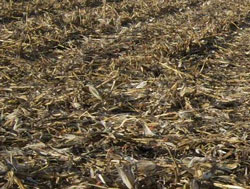 A research team discovered that when corn stover is processed to make ethanol, three distinct parts of it – the rind, pith and leaves – break down in different ways.
 ZeaChem has raised $19 million in Series C financing, led by Birchmere Ventures, and partner Sean D.S. Sebastian has joined the ZeaChem board of directors. “As an industry leader in the advanced biofuels and bio-based chemicals industries, ZeaChem’s proven capability to produce economical and sustainable petroleum alternatives is an innovation we are pleased to add to our portfolio,” said Sebastian.

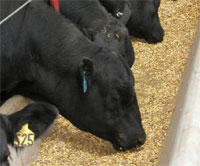 According to the report by USDA’s Economic Research Service (ERS), “We found that, on average, for the past 5 crop years (2006/07-2010/11), 1 mt of distillers’ grains substitutes for about 1.22 mt of corn and soybean meal combined in the United States.”
 The monthly Moderated Transaction System (EMTS) data from EPA is used to track requirements under the expanded Renewable Fuel Standard (RFS2) program for use of renewable fuels and Renewable Identification Number (RIN) transactions.
 “Americans need a choice at the pump and the Open Fuel Standard would allow them to pick an ethanol blend that meets their needs,” said