ACE Conference 2026

Amyris Ships First Product

Joanna Schroeder

240617Amyris has shipped it first commercial product from its plant in Brazil. The facility was the company’s first purpose-built industrial fermentation facility and produces Biofene, the company’s brand of renewable farnesene, to be used in a range of specialty chemical and fuel applications.

“This initial shipment marks the successful completion of our start-up activities. We have operated multiple tanks without contamination or surprises through several production runs during the first month of operation,” said John Melo, President and CEO of Amyris.

“We are now focused on ramping up Biofene production and delivering product to our customers, from renewable diesel for bus fleets in Brazil to squalane emollient globally and soon a range of specialty chemical applications,” Melo concluded.

Amyris’s Biofene plant in Brotas, in the state of São Paulo, Brazil, sources its sugarcane feedstock locally from the Paraíso mill. Prior to the start-up of this facility, Amyris relied solely on contract manufacturing for commercial production.

advanced biofuels, biochemicals, Brazil

Biofuel Industry Responds to RIN Integrity Proposal

Joanna Schroeder

biodiesel_and_ethanol_fuel_pumps_at_retail_fuel_station_e85__e10_ethanol_b5_b20_biodiesel_mind_J53-1369484The Environmental Protection Agency (EPA) released its proposed rules for the 2013 Renewable Fuels Standard yesterday. A portion of the proposal focused on dealing with Renewable Identification Number (RIN) fraud. Last year, several individuals were indicted for committing fraud by selling fake biodiesel RINS. The proposal is open for comment until March 19, 2013 and the industry is just now beginning to review and digest what it entails.

“While we are still reviewing the details, this proposal appears to be another positive step toward ensuring that RIN fraud is a thing of the past,” said Anne Steckel, National Biodiesel Board’s vice president of federal affairs. “We want to thank the EPA for working aggressively to address this issue and for proposing constructive solutions that will restore confidence in RIN markets.”

Steckel continued, “This problem was caused by a handful of wrongdoers who took advantage of a good policy for advancing America’s energy security. Two of those people are now facing significant prison time, and that enforcement along with these tightened regulations will go a long way toward preventing anything like this from happening again.”

The organization intends to continue working cooperatively with the EPA and our partners in the petroleum sector in bringing this issue to closure.

While the fraud cases were around biodiesel RINS, the EPA proposed rules addresses fraud across all renewable fuel sectors of the RFS. This includes ethanol RINS and cellulosic RINS. Tom Buis, CEO of Growth Energy said, “We are pleased to see that EPA is moving forward with a voluntary program to address the concerns raised about the integrity of RINS in the RFS program. We look forward to reviewing the proposal and will work with EPA to ensure that the program is successful.”

advanced biofuels, Cellulosic, Growth Energy, NBB, RFS

Bioenergy Bytes

Joanna Schroeder

  • BioEnergyBytesDFNovozymes has acquired Iogen Bio-Products, industrial enzyme business of Ottawa-based Iogen Corporation for CAD 67.5 million and potential earn-out payments of up to CAD 12.5 million.
  • IKEA has “plugged-in” the solar energy system installed at its South Florida store in the City of Sunrise, which will be the largest solar installation in South Florida and, when combined with IKEA projects already completed atop stores in Orlando and Tampa, will make IKEA the state’s largest non-utility solar owner.
  • SunPower Corp. has announced a new program with U.S. Bancorp, the SunPower Lease program, to expand financing options available to homeowners interested in high-efficiency SunPower solar power systems. Two to three thousand homes are expected to benefit from the new program.
  • Suntech Power Holdings Co., Ltd. has completed a 3.5 megawatt ground mounted solar PV system in the Kingdom of Saudi Arabia. The system is owned by Saudi Aramco and was  installed on the grounds of the King Abdullah Petroleum Studies and Research Center.
  • GlobalData has released the new report, “Offshore Wind Power – Global Market Size, Average Installation Price, Regulations, Market Share and Key Country Analysis to 2020.”
  • Solar 2013 has announced its line-up for speakers including Bill McKibben, author and founder of 350.org and Kevin Knobloch, president of the Union of Concerned Scientists. Click here for the full agenda.
Bioenergy Bytes

DF Cast: Wind Energy Tax Credit Welcomed in Iowa

John Davis

Probably no one in the country was more pleased to see the renewal of the wind energy production tax credit than the folks in Iowa, a place that has become a real leader nationwide in wind energy. During the recent Iowa Wind Energy Day, officials and advocates for wind energy expressed their appreciation for the extension… and the hope that it could become more permanent to give more stability to the green industry.

In this edition of the Domestic Fuel Cast, we hear from Iowa Gov. Terry Branstad, President of the Board for the Iowa Wind Energy Association Kathy Law and Executive Director of Iowa Wind Energy Association Harold Prior as they talk about what wind power has meant to their state and what potential it holds for the entire country… especially the rural areas.

You can listen to the Domestic Fuel Cast here: Domestic Fuel Cast - Wind Energy PTC Passes

You can also subscribe to the DomesticFuel Cast here.

And check out Joanna’s 2013 Iowa Wind Energy Day Photo Album.

Audio, Domestic Fuel Cast, Government, Wind

Biodiesel Industry Supportive of 2013 RFS Proposal

Joanna Schroeder

NBB-logo1The biodiesel industry is indicating is support today for the proposed rules from the EPA establishing this year’s advanced biofuels requirements under the Renewable Fuel Standard (RFs). In response, Anne Steckel, vice president of federal affairs for the National Biodiesel Board (NBB), thanked the EPA and the Obama administration for standing strong behind the advanced biofuels standards. She indicated that the U.S. biodiesel industry is ready to meet these requirements, which means reduced greenhouse gas emissions, a better economy and more domestic fuel choices for consumers.

“With plants across the country and more than a billion gallons of production last year, the U.S. biodiesel industry is already the leading producer of Advanced Biofuels in the country, accounting for more than 80 percent of required production to date,” Steckel continued. “The industry is adding new feedstocks and building capacity every year, and this policy will only help us continue that growth.”

For 2013, the EPA’s proposal calls for an overall advanced biofuel requirement of 2.75 billion gallons. Within that total, explained Steckel, the biomass-based diesel requirement – which has already been finalized and was not a part of today’s announcement – is 1.28 billion gallons. Refiners have the option of using biodiesel or other EPA-designated advanced biofuels to help fill the remaining overall advanced biofuel pool, and many experts are predicting that biodiesel will play an increasing role in doing so this year.

advanced biofuels, Biodiesel, NBB, RFS

EPA Releases Proposed Rule for 2013 RFS Obligations

Joanna Schroeder

The Environmental Protection Agency (EPA) has released it proposed rules today for the 2013 Renewable Fuel Standard (RFS) volumetric requirements. Public comment is open until March 19, 2013. The proposal waives the cellulosic biofuel requirement from one billion gallons to 14 million gallons, but retains overall advanced and renewable fuel requirements.

rfa-logo-09The ethanol industry responded today with statements and Bob Dinneen, the president and CEO of the Renewable Fuels Association said, “The 2013 RFS requirements will be the catalyst that finally compels oil companies to get serious about breaching the so-called blend wall. This year’s RFS requirements will necessitate the use of more E15, E85 and other higher-level blends. Injecting larger volumes of biofuels into the U.S. fuel supply and spurring a more rapid transition to domestically produced renewables is exactly what the RFS was intended to do. The program is working as envisioned by Congress.”

ace logoBrian Jennings, Executive Vice President of the American Coalition for Ethanol (ACE) noted that his organization is concerned, as our other ethanol organizations, about the way the advanced biofuel pool serves as a magnet for imports of Brazilian ethanol. “We appreciate EPA providing us the opportunity to elaborate on this concern and look forward to continuing the dialogue on how to ensure Brazilian imports don’t displace domestic ethanol. The RFS is a catalyst for technology innovation and we believe 2013 will deliver key breakthroughs for U.S. grain sorghum based advanced biofuel and cellulosic biofuel. We look forward to providing additional comments during the 45 day comment period,” said Jennings.

Growth_Energy_logo-1Growth Energy CEO Tom Buis said there are a number of issues that should be considered, which could have serious impacts on the U.S. production of biofuels. “The RFS has been a resounding success, helping create jobs in America that cannot be outsourced, revitalizing rural economies across the country in addition to reducing our dependence on foreign oil and providing consumers with a choice and savings at the pump,” he added.

aeclogoOne of the elements of the proposal waives the cellulosic biofuel requirement from one billion gallons to 14 million gallons. Brooke Coleman, executive director of the Advanced Ethanol Council said that the EPA’s is getting to right number on cellulosic biofuels and noted that the industry is just breaking through at commercial scale. ” U.S. EPA worked hard to ensure that the cellulosic biofuels volume standard for 2013 would be tied directly to the commercial production of cellulosic biofuels expected to come online this year. While weaning the United States off of its addiction to foreign oil is not easy, the volume standards proposed today will continue to provide advanced biofuel investors and innovators with a predictable and durable path forward in that effort.”

In conclusion, the industry representatives said they look forward to working together to finalize the targets.


ACE, advanced biofuels, AEC, Cellulosic, Ethanol, Growth Energy, Renewable Energy, RFA

General Wesley Clark Rallies The Troops

Chuck Zimmerman

General Wesley Clark Growth Energy AG CONNECT ExpoAt today’s U.S. Custom Harvesters luncheon, sponsored by New Holland, retired General Wesley Clark, co-chairman of Growth Energy, took the stage. The organization is holding their 30th annual convention which is co-located with the 2013 AG CONNECT Expo in Kansas City, MO.

Gen. Clark says his passion was the military and now his passion is national energy security and the move away from dependence on foreign oil. I have recorded his remarks for you to listen to or share below.

You can listen to or download General Clark’s remarks here: General Wesley Clark Remarks

I am attending this week’s show and sharing stories on AgWired.com and PrecisionPays.com.

2013 AG CONNECT Expo Photo Album

Audio, biofuels, Ethanol, Growth Energy

U.S. Ethanol Prices & Production Lower Than 2011

Joanna Schroeder

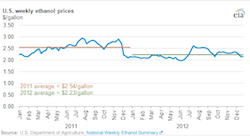
According to a 2012 Brief released by the U.S. Energy Information Administration (EIA), U.S. ethanol prices and production are lower compared to 2011. Spot prices for U.S. fuel ethanol were lower throughout most of 2012 compared to 2011. Prices were relatively stable during the first half of 2012, but they rose at mid-year as severe drought and high temperatures reduced corn yields, resulting in higher prices for corn that is used to produce the majority of all U.S. ethanol.

Screen Shot 2013-01-31 at 12.53.22 PMHigher ethanol prices during the second half of 2012 were mainly the result of higher corn prices, which rose 35 percent from mid-June through August due to concerns that the corn crop would be affected by the worst drought in the Midwest since the 1950s, coupled with triple-digit temperatures. During the hot and dry summer of 2012, the U.S. Department of Agriculture reported that 88 percent of the U.S. corn crop was within a drought area.

The 2012-13 U.S. corn crop is expected to be the smallest in six years at nearly 10.8 billion bushels, according to USDA’s January 2013 crop forecast, 13 percent smaller than the 2011-12 crop. USDA indicates that about 4.5 billion bushels, or 42 percent of the harvest, will go to make ethanol. That level is down from just over 5 billion bushels used to make ethanol during the previous crop year.

The brief finds that the combination of lower corn supplies, higher corn prices for ethanol producers, and weaker gasoline demand contributed to U.S. ethanol output falling from an average 900,000 barrels per day (bbl/day) during the first half of 2012 to an average of 815,000 bbl/day during in latter half, about 90,000 bbl/day less than in the second half of 2011.

Ethanol, Renewable Energy

DOE Announces New SunShot Projects

Joanna Schroeder

The Department of Energy (DOE) has awarded seven data-driven projects focused on reducing costs and accelerating solar energy deployment as part of the SunShot Initiative. DOE said the goal of the projects will result in viable methods for dramatically transforming the operations of solar researchers, manufacturers, developers, installers and policymakers, and speed the commercialization and deployment of affordable clean energy.

Print“Through powerful analytical tools developed by our nation’s top universities and national labs, we can gain unparalleled insight into solar deployment that will help lower the cost of solar power and create new businesses and jobs,” said Energy Secretary Steven Chu. “Projects like these will help accelerate technological and financing innovations – making it easier for American families and businesses to access clean, affordable energy.”

The Energy Department will invest about $9 million across the seven projects. These efforts will help scientists, project developers, installers and communities work together to discover previously unexplored ways to improve solar cell efficiency, reduce costs and streamline installation processes.

As part of the investment, DOE will provide $7 million to research teams led by Sandia National Laboratories, the National Renewable Energy Laboratory, Yale University and the University of Texas – Austin, and $2 million across three projects led by the University of North Carolina – Charlotte, Massachusetts Institute of Technology and SRI International.

Find the full list of projects here.

Alternative energy, Clean Energy, Solar

USDA Undersecretary Optimistic About Biofuels

Cindy Zimmerman

iarfa-13-dallasUSDA Undersecretary for Rural Development Dallas Tonsager is optimistic about the future of biofuels.

“When faced with an economic challenge, rural Americans came up with an economic solution and developed a biofuels industry,” Tonsager said in an interview after speaking to the Iowa Renewable Fuels Summit. “My belief is, as time goes along and we’re faced with challenging circumstances again, people will come up with solutions again.”

Tonsager sees success coming in the cellulosic biofuels world which should begin to demonstrate its economic viability as well. “We’ve got a lot of challenges in ethanol,” he said. “But the industry is stepping up and fighting and I think that is an extremely positive sign.”

Listen to an interview with Tonsanger here: USDA Undersecretary Dallas Tonsager


IRFA Renewable Fuels Summit Photo Album

Audio, Ethanol, Ethanol News, Iowa RFA, USDA